Super Bowl Victory? Maybe for Detroit and Michigan art!

Detail: Wayne County Building--Detroit MI

Detail: Wayne County Building–Detroit MI, photo by pinehurst19475.

Yesterday was a busy day for Michigan in Pictures as a lot of folks came by to learn more about the works of art featured in the Chrysler/Eminem “Imported from Detroit” Super Bowl ad. The Joe Louis Memorial, a shiny clean Spirit of Detroit, the murals of Diego Riviera (which Slate found ironic) and the stunning Fox Theatre have all been touched on here, but there was another sculpture,

At first I thought it was a second work by Marshall Fredericks, sculptor of the Spirit of Detroit and many more iconic works scattered about Michigan. I couldn’t find it under his name, so I widened the net and found Victory, the very first photo that the informative pinehurst19475 ever uploaded to Flickr. The photo was taken in June 2000, and he or she wrote (with my links):

This sculpture is a the base of the tower of the Wayne County Building (formerly the Wayne County Courthouse}, built from 1897-1903 and restored in the late 1980s. This quadriga, entitled “Progress,” is one of two at the building (the other is “Victory”). The sculptor was John Massey Rhind. The Wayne County Building is considered a fine example of Beaux Arts Classicism. To see the quadriga (four-horse chariot) and figures of this sculpture in all their glory, go to the large size version of this photo.

Learn a whole lot about Detroit in Anthony Lockhart’s slideshow.

An old couple at the Thoreson Farm

Untitled, photo by jenny murray.

The Thoreson Farm page at the Sleeping Bear Dunes National Lakeshore says that the

John Thoreson and Ingeborg Sakariasdatte emigrated from Norway in 1877. Although they crossed the Atlantic on the same boat, family lore has it that they never really met on the boat. Ingeborg resided with the higher-priced ticket-holders, while John remained below deck with the lower-fare travelers. They first settled in Suttons Bay, and arrived in Port Oneida in 1880. The family initially rented the Kelderhouse/Baker farm until 1883, when they moved to Minnesota for one year. After returning to Port Oneida, they rented the old Burfiend house. Around 1900, along with their sons Ole and Fred, they built their farm on 160 acres of land purchased from the Andersons…

The Thoresons operated a general farm with livestock, small grains, and hay. With 75 trees, they were the first Port Oneida farm to raise cherries for market. They also owned sheep, pigs, chickens, and a few dairy cattle.

You can see some more photos of the farm (including a volunteer working on these buildings) at Preserve Historic Sleeping Bear.

Check this out bigger and in Jenny’s Holga slideshow.

Giant Ski Bunny & Snowpocalypse How?

Boyne Falls MI RARE 1950s Ice Sculpture at Boyne Mountain Snow and Ice Sculptures were a popular attraction at Ski Resorts in the 50s and 60s Bob Miles Photo Card S24328 Unsent

Boyne Falls MI RARE 1950s Ice Sculpture at Boyne Mountain Snow and Ice Sculptures were a popular attraction at Ski Resorts in the 50s and 60s Bob Miles Photo Card S24328 Unsent, photo by UpNorth Memories – Donald (Don) Harrison.

In In Snowpocalypse Now Redux: When the weatherati cry wolf, what do we believe next time? Jeff Wattrick says that while we don’t want forecasts as understated as the “Snow, potentially heavy at times” that preceded the monstrous blizzard of ’78:

At some point we may actually get one of death storms with historic barometric pressure readings and the like. The forecasters may even predict it – that’ll happen when every dusting of wintery precipitation is a potential holofrost – but no one will care.

In essence, too much coverage can be as bad as not enough.

It’s like waking up every morning and predicting your own death. Eventually, you’ll be right. So what?

The wall-to-wall coverage – complete with live blogs, non-stop primetime school closure scrolls, and reports about panicked supermarket shoppers – doesn’t inform. It is absurdist theater that ignites in some a delusion that middle class life in 21st century Michigan can be a harrowing fight for survival.

…from such terrifying hazards as:

Thundersnow Is Go!: From beyond any known galaxy and bringing with it the laws and ideals of its home planet of Fontara…Thundersnow! As best as anyone can tell, it’s like a regular thunderstorm but with snow instead of rain because it’s winter. Like Murrow covering the London Blitz, the WXYZ liveblog bravely reported thundersnow rumbled through Southfield at 3:15 this morning.

As a resident and business owner in a resort destination I have railed about sensationalism in weather forecasts in the past. Definitely click through for the choice Simpson’s clip Jeff found!

Check this out bigger than a blizzard and in Don’s slideshow.

Happy Birthday Michigan!

Fireworks over the Capitol

Fireworks over the Capitol, photo by City Saunter.

January 26, 2011 is Michigan’s 174th Birthday. You can learn about Michigan’s rough & rocky road to Statehood on Absolute Michigan.

Check this out bigger in Ariniko’s Lansing slideshow and here’s hoping you find something about Michigan to celebrate today!!

PS: Also check out her City Saunter project to walk every street in Lansing!

Greater Buffalo or “When I grow up I want to be an aircraft carrier”

Greater Buffalo

Greater Buffalo, photo by joeldinda.

Joel’s Borucki’s Lakers set features photos some great old photos along with history of the vessels. He uploaded one the other day of the steamer Greater Buffalo heading toward Lake Erie on the Detroit River that was taken in August 4, 1939. On another photo of the Greater Buffalo he writes that this photo is easily the most interesting ship in the Borucki picture collection and says:

Greater Buffalo, shown here passing under the Ambassador Bridge, was launched at Lorain on October 27, 1923, for the Detroit and Cleveland Navigation Company, and made her first trip on May 13, 1925. She could carry 300 crew members and 1,200 passengers between Buffalo and Detroit on an overnight basis. Her sister ship Greater Detroit alternated on the run with her. These two Frank Kirby-designed ships were the last, largest, and (perhaps) fastest sidewheel passenger ships built on the lakes; when they were launched their construction costs were reported as $3.5 million apiece.

Greater Buffalo was requisitioned by the Navy in 1942, converted to an aircraft carrier and renamed USS Sable; she and USS Wolverine (the former Seeandbee–another Kirby design, and the other “fastest” claimant) worked as training ships out of Great Lakes Naval Station near Chicago. She was retired after the war and broken up in 1948.

There’s a couple more photos of the Greater Buffalo/U.S.S. Sable in the UD Mercy Marine Historical Collection.

Check it out big as a battleship and in Joel’s Borucki’s Lakers slideshow.

C is for Camp Cusino Civilian Conservation Corps … and COLD!

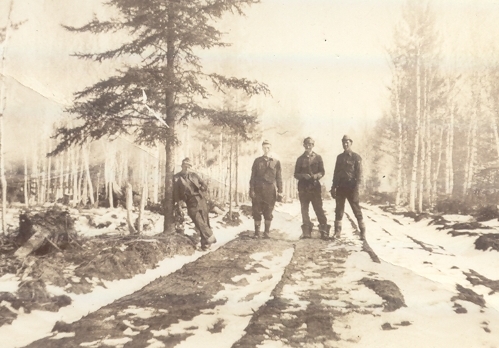
Road building by CCC men of Camp Cusino, photo courtesy Archives of Michigan

Read the story behind this photo and see a video of 94 year old Ernest Hubacker’s story of his time with the Civilian Conservation Corps at Seeking Michigan: Cold Conservation Corps. Check out a lot more features and Michigan history at seekingmichigan.org!

Martin Luther King and the Great March to Freedom in Detroit

Martin Luther King Jr, Walk to Freedom Detroit Michigan, 1963

I have a dream this afternoon that my four little children, that my four little children will not come up in the same young days that I came up within, but they will be judged on the basis of the content of their character, not the color of their skin.

I have a dream this afternoon that one day right here in Detroit, Negroes will be able to buy a house or rent a house anywhere that their money will carry them and they will be able to get a job.

~Martin Luther King, June 23, 1963 Detroit, Michigan

The quotation above comes not from Dr. Martin Luther King’s famous speech, but rather from the massive March to Freedom that happened 2 months earlier in Detroit. You can read the full text at mlkonline.com or it that’s overloaded still, view the cached version. A few years ago on Absolute Michigan, we featured an article on the Walk to Freedom:

On June 23, 1963, an estimated 125,000 people marched down Detroit’s Woodward Avenue carrying placards and singing “We Shall Overcome.” National and state leaders who marched along with Reverend King included United Auto Workers president Walter Reuther, former Michigan governor John B. Swainson, and Detroit mayor Jerome Cavanagh.

The march ended at Cobo Hall where the Reverend King was cheered by thousands of marchers when he emphasized that segregation needed to end. A veteran of the struggle to end racial segregation, King believed that it was the duty of African Americans to take part in demonstrations like the Walk to Freedom, which he called, “one of the most wonderful things that has happened in America.”

There’s a few pictures of the march at the Detroit News including this shot of the crowd on Woodward Ave from above (sorry – no direct link scroll down and look for it).

North American International Auto Show: Yesterday and Today

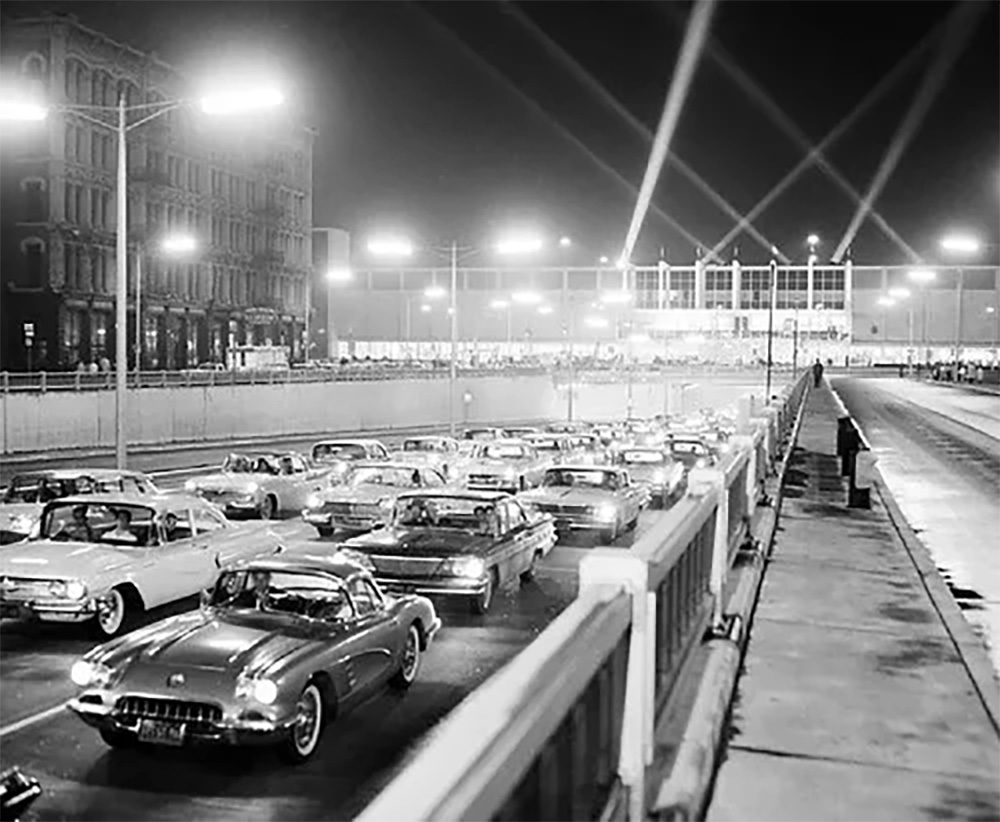
Traffic at the 1960 Auto Show by Hugo90

 Traffic at the 1960 Auto Show by Hugo90

“You know what? We’re going to prove one thing. That this is the Motor City, the motor capital of the world. And we’re going to bring it back, in the esteem of the world, to where it should be.”
~Ken Meade, International Auto Show, 1989

It’s time again for the North American International Auto Show aka the Detroit Auto Show. The world’s premier celebration of cars and car culture has lost some of its luster but is still an amazing event.

The NAIAS runs from January 15-25 at the Cobo Center in Detroit and you can get all the details including photos and video at 2011 Detroit Auto Show on Absolute Michigan. An article we link to from the Detroit News is the source of the quotation above and says that 1960 was the first year at Cobo Hall.

Check this out bigger and in Hugo’s THE OTHER CAR PICTURES slideshow.

Support Michigan in Pictures with Patreon

Point Betsie Lighthouse, in ice and HDR

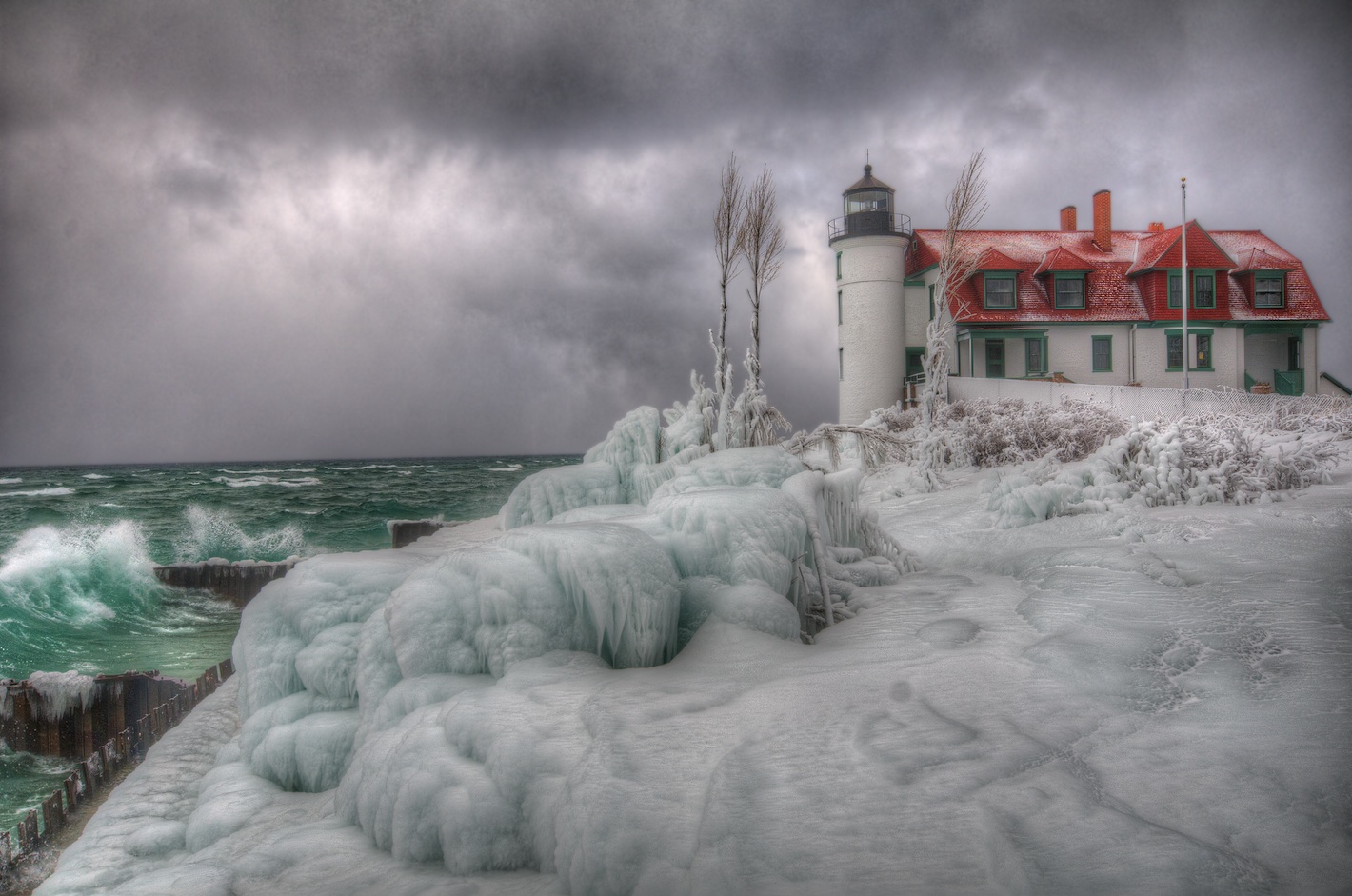
Point Betsie Lighthouse Winter

Point Betsie Lighthouse, photo by lomeranger.

The Point Betsie Light Station entry at Terry Pepper’s Seeing the Light says that although the lighthouse on the southern tip of South Manitou Island was in 1840, it wasn’t until 1853 that the decision was made to construct a lighthouse to mark the passage’s eastern side and to let ships know when to turn south.

The plan for the Point Betsey Light called for a cylindrical single-walled tower constructed of Cream City brick, standing 37 feet in height from the foundation to the top of the ventilator ball. Five concentric brick rings encircling the tower beneath the lantern, each successively larger in diameter than the lower ring, formed a support for the gallery on which an decagonal cast iron lantern was installed. The lantern was outfitted with a white Fourth Order Fresnel lens equipped with bulls eyes, which was rotated around the lamp by a clockwork drive at a precisely monitored speed to impart the station’s characteristic fixed white light with a flash every 90 seconds. By virtue of the tower’s location on the dune, the lens was located at a focal plane of 52 feet above lake level with a range of visibility of ten miles. The small two story dwelling, also of Cream City brick was located on an excavated cellar immediately inshore of the tower, to which it was connected by a short covered passageway. This passageway was outfitted with a cast iron door at the tower end in order to stop the spread of any possible fire between the two structures.

The exact date on which the Point Betsey Light was exhibited has been lost to history. While Lighthouse Board annual reports and Light Lists report the station as being completed in 1858, it was not until February 1, 1859 that David Flury, the first keeper to be assigned to the station, appears in District payroll. Thus, it may well be that while construction was completed in 1858, the Light was not activated until the opening of the 1859 navigation season.

Read on to learn much more about this gorgeous lighthouse including the steps they had to take to unsure that the pounding surf you see here didn’t destroy the light.

Check it out bigger in Jason’s Ice slideshow. And don’t miss this shot Jason took of Point Betsie’s neighbor, the Frankfort Pier Light being BLASTED by the big storm of October 2010!

Friends of Point Betsie note that the light is one of the most photographed lighthouses in the US. See the evidence in the Point Betsie slideshow from the Absolute Michigan pool!

Woodward Avenue: Mile by Mile | Exposure.Detroit January Show

A Hundred Views of Woodward

A Hundred Views of Woodward, photo by Terri Light Photo – Detroit.

The January Exposure Detroit Show is a group project titled Woodward Avenue: Mile by Mile. The show explores the architecture, people and energy on Woodward Avenue from its start at Michigan Avenue to where it ends in Pontiac through the lenses of a number of photographers in the Exposure.Detroit group on Flickr. The show will be on January 15, 2011 at the Bean and Leaf Cafe in Royal Oak.

All photos in the show are black & white, and you can see many of them at the edwoodwardproject tag on Flickr. Of course, the way to see them all is to check out the show from January 15 – February 3!

Michigan in Pictures has a great view from Detroit’s Golden Age Looking up Woodward Avenue, takes you cruisin’ Woodward in 1951 and many more photos from Woodward Avenue to explore. You might also enjoy the Woodward Avenue, Detroit’s grand old ‘Main Street’ from the Detroit News’ Michigan History section and M-1 Woodward Avenue at Wikipedia.

Check this photo out bigger and in Terri’s massive Belle Isle and Detroit slideshow. More of her work at terrilightphoto.com.