Farewell to the Silver Fox: Detroit Tiger great Jim Northrup

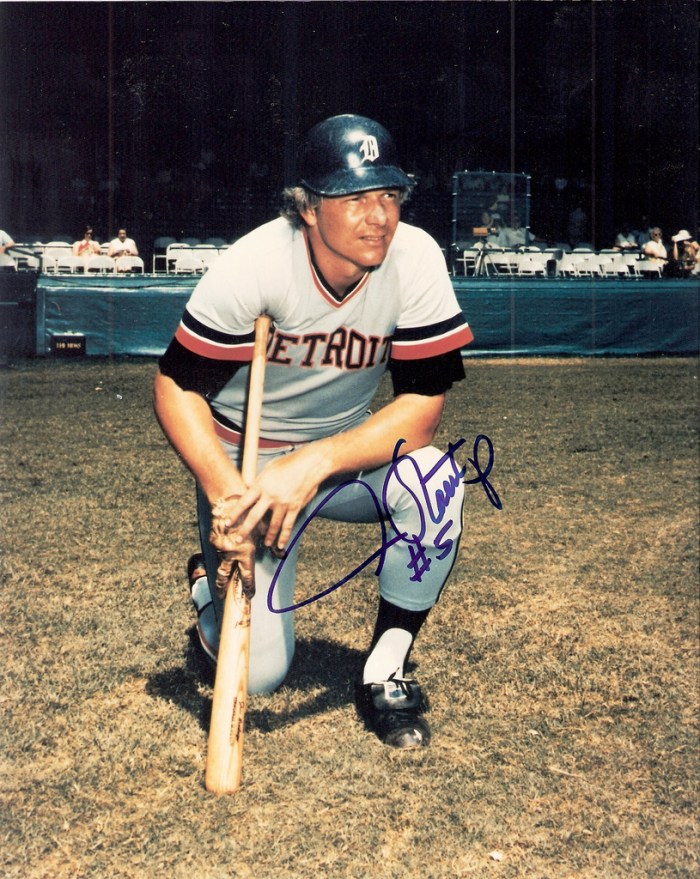
Jim Northrup , photo by mvsportsmemorabilia.

“One thing you could depend on, Northrup was going to put the bat on the ball in some kind of way. And 1968, that was his year. He was tough all year. He let you know that he was there.”
~Gates Brown

Wikipedia says that Jim Northrup was born in Breckenridge, Michigan in 1939. Samara over at Roar of the Tigers marked his passing today, as did the Detroit Tigers who say:

Northrup played parts of 12 seasons in the Majors, mostly with the Tigers. He made his big league debut in 1964.

…Northrup’s most memorable years were with Detroit, especially in 1968. He hit .264 with 21 home runs and 90 RBIs that season and shined in Game 7 of the World Series. With two outs in the seventh inning, Northrup tripled off St. Louis Cardinals ace Bob Gibson to bring in Norm Cash and Willie Horton.

Dick Tracewski, a reserve infielder on that club who also went on to coach with the Tigers, told the Free Press that Northrup’s famous triple was “the biggest hit that’s ever been gotten for the Detroit Tigers. He won the World Series for us.”

Get his stats at BaseballReference.com. You’ll probably enjoy these columns by David Mayo and Mike Mowry as well as this 3 part video interview with Jim Northrup by From Glory Days.

Check it out bigger and see a few more in their slideshow.

Boulderdash: Charlevoix’s Earl Young Houses

Boulderdash

Boulderdash, photo by hausfrau23.

A few month’s ago on Absolute Michigan we featured the quirky & amazing Earl Young and his Charlevoix cottages. One of the articles we linked to from the Freep in 1973 said:

Stone houses seem to sprout as naturally as dandelions from the soil of this pleasant Lake Michigan resort community.

And they do because of an already legendary 84-year-old man named Earl A. Young, who built them all.

For more than half a century Young has combed lonesome fields and dusty quarries searching for the odds and ends of nature. He blends stones and timber with an architect’s skill and a geologist’s respect for his raw material, and so far he has fitted more than 40 local landscapes with his art.

“l have a very strong feeling for stone,” Young explained recently as he sat in his wood-paneled office on the lower level of one of his most flamboyant creations, the Weathervane Inn, a local restaurant.

“Stones have their own personalities. People say I’m crazy when I say so, but they really do. Why I found a stone that weighed 160 tons. It was formed 350 million years ago at the bottom of a warm sea and was carried here 10,000 years ago by glaciers.”

Click through for lots more and links to great resources for seeing some of these architectural oddities including the Earl Young Collection at the Charlevoix Library and Park Avenue Prowl, which has a walking guide.

Check this out big as a boulder and in hausfrau23’s Up North Vacation – September 2010 slideshow.

Gray’s Reef Lighthouse

Gray's Reef Lighthouse

Gray’s Reef Lighthouse, photo by AdamMI88.

Terry Pepper’s Seeing the Light is the best resource for Great Lakes Lighthouses. The Grays Reef Light page begins:

Grays Reef Passage serves as the primary route between the Straits and the ports on the southern shores of Lake Michigan. Bounded on the east by Vienna Shoal and East Shoal, Grays Reef itself forms the western boundary of the passage, and consists of an extensive area of shallow water over a rocky bottom stretching over eight miles in length. With some portions of its rocky bottom almost protruding above the water’s surface, the reef has long represented a significant threat to any vessel master unfamiliar with the intricacies of the passage.

He goes on to explain tells how lightships kept the reef safe from 1891 until a crib light was finally approved in the 1930s. Click through for some photos of the lightships and a detailed account of what goes into building a crib light in 26 feet of water. The Archives of Michigan has a cool pencil drawing of Gray’s Reef as well!

Adam says that White Shoal Light is also visible (barely) in the distance (left). Check this out on black and in his Northern Michigan slideshow (which includes some other northern Michigan lighthouses!).

Check out more Michigan lighthouses on Michigan in Pictures.

Fresnel lens at the Museum Ship Valley Camp

Untitled

Untitled, photo by Jim Bedell.

The Michigan Lighthouse Conservancy’s page on Fresnel lenses begins:

The Fresnel lens is the 1822 invention of French physicist Augustine Fresnel who invented a lens that would make his name commonplace along the seacoasts of Europe and North America. Most lenses were handmade and shipped unassembled from France. Others were made in England. Early lens designs resembled a giant glass beehive, with a light at the center. The lens could be as tall as twelve feet high with concentric rings of glass prisms above and below a center drum section to bend the light into a narrow beam. Later designs incorporated a bull’s eye design into the center of the lens shaped like a magnifying glass, so the concentrated beam was even more powerful. Tests showed that while an open flame lost nearly 97% of its light, and a flame with reflectors behind it still lost 83% of its light, the Fresnel lens was able to capture all but 17% of its light. Because of its amazing efficiency, a Fresnel lens could easily throw its light 20 or more miles to the horizon.

Definitely read on to learn how flash panels or bull’s eyes were used to distinguish one light from the next and to view the different orders of Fresnel lenses that were used on the Great Lakes and also see Wikipedia’s Fresnel lens entry.

Jim snapped this aboard the Museum Ship Valley Camp in Sault Ste. Marie. You can take a photo tour right here.

Check his photo out bigger and take an awesome tour of the Valley Camp in his slideshow.

If you’re out and about this weekend, take some time to stop in at a Michigan museum!

Atop Jackson’s Golden Towers

Art Deco Tower with Antennas

Art Deco Tower with Antennas, photo by benft.

Jackson County says:

The 17-story Tower Building was built in 1929 for the new Union and Peoples National Bank. The Tower Building was at that time referred to as the “Golden Towers.”

…In 1975 it was sold to the County for a nominal sum by the Raymond Kolowich family and became the County Tower Building. The County Commissioners’ Chamber is located on the 2nd floor up the marble flight of stairs. Italian leaded stained glass windows surround the chamber which was originally the main banking area.

At the top there is a “Falcon Cam” that is trained on the nest of a peregrine falcons! Click through to watch the chicks grow up!

Check this photo out bigger and in Ben’s cool architecture slideshow.

More architecture and more from Jackson on Michigan in Pictures!

Catching a wave to the Petoskey Stone Festival

petoskey stone in surf

petoskey stone in surf, photo by northernlightphotograph.

The 6th annual Antrim County Petoskey Stone Festival takes place on May 28, 2011 in Barnes Park in Eastport. The Petoskey Stone is of course Michigan’s state stone.

Almost a century after the founding of Petoskey, on June 28, 1965, Governor George Romney signed a bill that made the Petoskey Stone Michigan’s official State Stone. It was fitting that Miss Ella Jane Petoskey, the only living grand-child of Chief Petosegay, was present at the formal signing. The legislation is very general. The bill simply states that the Petoskey Stone is the State Stone. The designation of Hexagonariapercarinata was made by Dr. Edwin C. Stumm in 1969. Dr. Stumm made this distinction based on his extensive knowledge of fossils.

This specific fossil coral is found only in the rock strata known as the Alpena Limestone. The Alpena Limestone is part of the Traverse Group of Devonian age. The Alpena Limestone is a mixture of limestones and shales. The outcrops of these rocks are restricted to the Little Traverse Bay area near Petoskey.

Check this out bigger and in Tim’s slideshow. See more of Tim’s photos on Michigan in Pictures.

You can read the story behind the Petoskey name on Michigan in Pictures (and learn about the little known holiday “Throw in a Petoskey Stone Day”).

Durand Union Station & Durand Railroad Days

Durand Train Station, HDR

Durand Train Station, HDR, photo by friday1970.

This weekend (May 13-15) is Durand Railroad Days. This annual event is in its 36th year and was established in 1975 to pay tribute
to the rail industry that helped develop the nation and was responsible
for the settlement of Durand late in the 1870s. The Michigan Railroad History Museum at Durand Union Station says:

The village of Durand was built up around the railroads in the late 1870’s. Durand Union Station was designed by Spier and Rohms and originally built in 1903. Eighteen months thereafter it was almost completely destroyed by fire and was rebuilt in 1905.

This was a very busy station as the Grand Trunk Western and Ann Arbor Railroads crossed at grade there. During the early 1900’s when the railroad industry was at its peak, 42 passenger trains, 22 mail trains, and 78 freight trains passed through Durand daily. Durand Union Station handled approximately 3,000 passengers per day, making it a prospering hub of the industry.

Read about the event & museum using the links above and definitely put the museum on your list of places to visit!

Check Tim’s photo out bigger. He writes that he was inspired by an old black & white photo from nearly the same spot.

You can see a similar photo right here and learn a lot more about Michigan’s railroading heritage from the Michigan Internet Railroad History Museum. There’s also a cool wallpaper sized photo of the station in the Absolute Michigan pool and (of course) you can learn a lot more about Michigan Trains & Railroads on Michigan in Pictures!

I Can’t Believe He Said That

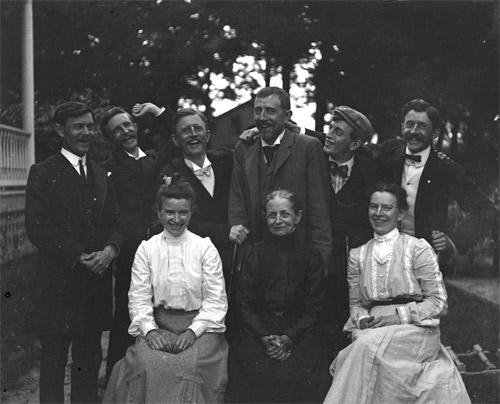
Can’t Believe He Said That, photo from the Dusty Diary

Over on the Dusty Diary, Laura writes that she would pay good money to know what the remark was is this unknown portrait.

At first I thought this was a wedding portrait. Now I think this is a family. All the guys, with the possible exception of the guy on the left, share a facial resemblance. There is a familial informality in the manner in which two of the men are grasping the chair backs. I’m guessing the person who made the remark in question is the tall guy in the center. Also suspecting that remark in question was a bit naughty. Woman on left is married… to whom? One of these gentlemen?

Also, older woman’s face is probably the single most beautiful thing I’ve seen this past week.

Click through to see the photo bigger and some details shots of their faces and definitely tune into the Dusty Diary for regular gems that Laura finds in the Yspilanti archives!

May is Blossom Time in Michigan!

Traverse MI 1950s East Grand Travese Bay Cherry Blossoms Photo by Phil Balyeat Avery Card 58253 S1155661 National Cherry Festival Postmark 1961

Traverse MI 1950s East Grand Travese Bay Cherry Blossoms Photo by Phil Balyeat Avery Card 58253 S1155661 National Cherry Festival Postmark 1961, photo by UpNorth Memories – Donald (Don) Harrison.

The annual National Cherry Festival got its start around 1910, as cherry growers in the Grand Traverse area began to hold informal “blessing of the blossoms” ceremonies each year at blossom time in May. Businesses jumped on the bandwagon (cherry truck?) in 1925 for the formalized “Blessing of the Blossoms Festival” which was such a big deal that in 1930 they expanded to 3 days and in 1930 President Herbert Hoover attended the opening. The next year the Cherry Festival was declared a national affair and in 1933 they moved it to summer.

Although it’s now a summertime affair (July 2-9, 2011), the wineries on the Old Mission Peninsula hold an annual Blossom Days celebration (May 14 & 15 this year). My informal read of the cherry blossoms here says that tart cherry blossoms will be in full swing with sweets kicking off.

Apparently in 1906 there was some sort of spiritual attraction of orchards, because to the south in Benton Harbor, the Reverend W. J. Cady of the First Congregational Church in Benton Harbor was the first to urge his parishioners to drive through the orchards and view the fruit blossoms. Cady termed them “symbols of life renewed” and his sermon is credited with the birth of the Blossomtime Festival. Now the Blossomtime Festival in St. Joseph/Benton Harbor is shared between the oldest and largest multi-community festival in the state of Michigan. Join them this Saturday (May 7) for the Grand Floral Parade and more!

Check this photo out big as a cherry orchard, in Don’s slideshow and see another cool old orchard photo right here.

Arbor Day, Michigan and Exposure.Detroit!

visually grounded

Untitled, photo by caterpillars and visually grounded photo by mlephotos

Today (April 29) is Arbor Day, a nationwide celebration that encourages people to take the simple action of planting trees. According to the Arbor Day history page, Arbor Day was founded in 1872 by Julius Sterling Morton. Morton grew up in Detroit and graduated from the University of Michigan. He actually grew up in Monroe, and you can read his story from Hometown History Tours (a very cool site btw!).

look who's showing at the woodbridge!!

A whole ton of Arbor Day can be found at the Michigan Arbor Day Alliance (Facebook).

I was faced with a bind this morning when I became aware of the fact that two of my favorite photographers, Laura Dyszynski aka caterpillars and Meghan East (mlephotos), were the subject of the latest Exposure.Detroit opening tomorrow night (April 30) from 7-10 PM at the Woodbridge Pub in Detroit! Click for all the details!

Thankfully, both women had photos of trees to choose from!

Check Laura’s out bigger and in her slideshow.

You can see Meghan’s photo on black and in her you like {top 30 favorites} slideshow, but the best way to see both of their work is to go to their show!