Michigan’s State Tree: White Pine (Pinus strobus)

Michigan Wite Pine by Sven

13/52 by Sven

This week is Arbor Week, a week dedicated to celebrating and planting trees. One tree for Michiganders to celebrate is the eastern White Pine (Pinus strobus), which was adopted as our official State Tree by Act 7 on March 4, 1955. Here’s an edited summary of what I’ve learned about white pines.

The eastern white pine, is also known as “soft pine.” It was called the Tree of Peace by the Iroquois and in Ojibway, Zhingwaak. Mature white pines can easily live 200+ years of age, with some Michigan trees that have approached 500 years in age. The eastern white pine has the distinction of being the tallest tree in eastern North America, and pre-colonial stands were reported over 200′ in height.

It was said that when settlers arrived, a squirrel could travel in the forest canopy from one side of the state to the other. With this amazing resource, Michigan led the nation in lumber production in the 1880s and 1890s, and by the early 1900s, over 100 million of Michigan pine trees worth more than all the gold mined in California had been felled in the Lower Peninsula. Most of that value was in white pine, an when the forest was depleted, timber companies moved to the UP.

Small white pines are popular as Christmas trees due to their ability to hold needles, while large white pines were prized as ship masts and known as mast pines by the British navy. These trees were marked with a broad arrow by agents of the crown, a very controversial action that was one of the factors leading to the Revolutionary War. The original masts on the USS Constitution (aka Old Ironsides) were single trees before they realized that laminated trees were better about to withstand cannon fire.

More about the White Pine in Michigan

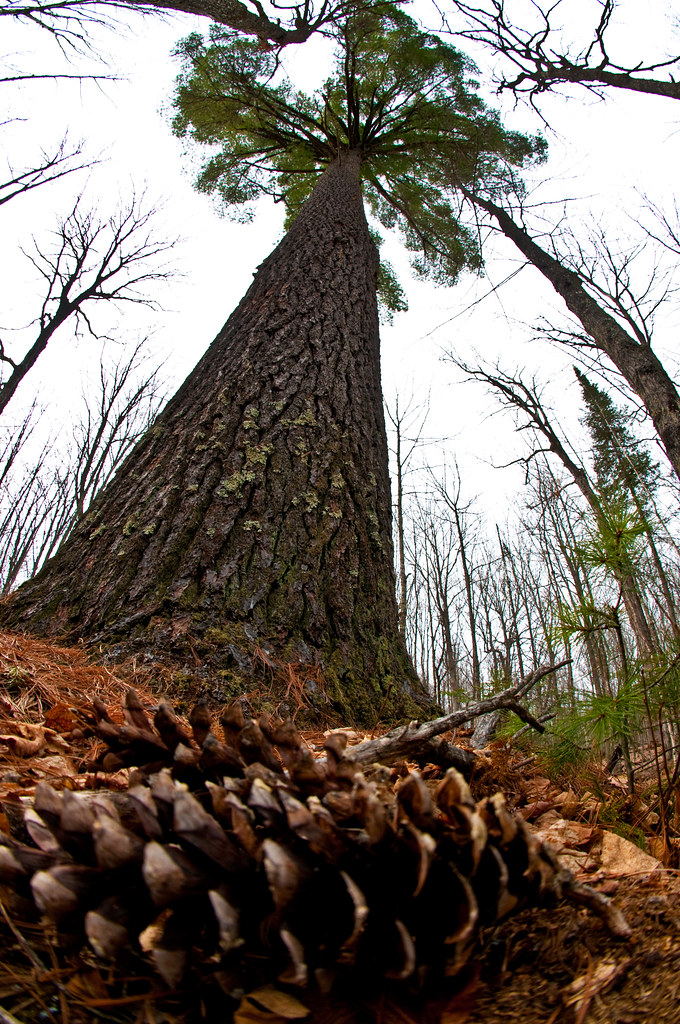
Scott writes that this mighty 200+ year old White Pine was spared the lumberjack’s axe, but he’s glad to have this remnant of the forest that once covered Upper Michigan standing sentinel in the forest surrounding his cabin. Check it out bigger and in his Fisheye slideshow. More of Scott’s work on his Facebook.

More of Michigan’s tallest things and more Michigan state symbols on Michigan in Pictures.

Support Michigan in Pictures with Patreon

At the Corner: 100 Years at Tiger Stadium

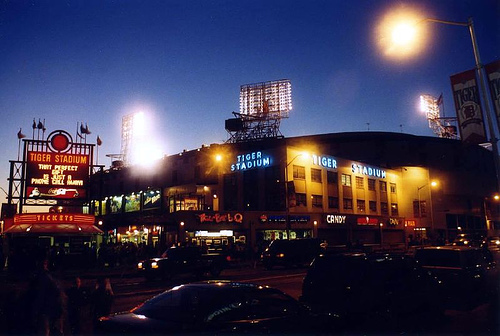
at the corner

at the corner, photo by 1ManWithACamera

“It was the most famous address in Michigan. Not the number, but everyone knows the location. The corner of Michigan and Trumbull was a connection for everyone all over Michigan to the city of Detroit”
~Charley Marcuse, former hot dog vendor at Tiger Stadium

The above is a quotation from a heartbreaking feature on the 100th anniversary of Tiger Stadium that we are linking to today from 100 years at Tiger Stadium on Absolute Michigan. It’s chock full of great links, photos and a video narrated by Jeff Daniels and featuring Tiger greats Al Kaline, George Kell and Ernie Harwell.

The feature was especially heartbreaking for me as I was as guilty as most of the rest of the media that let this historic milestone pass unmarked. Don’t get me wrong – I think Comerica Park is a fantastic place to play baseball and a fitting home for the Tigers. To me, the shame lies in the manner in which one of the finest ballparks in all of baseball was cast aside by a city that seemed more interested in squeezing one last dime from the stadium at Michigan & Trumbull than celebrating and honoring her rich legacy.

Check this out bigger and in Larry’s great Detroit Tigers and their ballparks slideshow.

Much more on Tiger Stadium and the Detroit Tigers at Michigan in Pictures.

April 20, 1909: The World’s First Mile of Concrete Highway

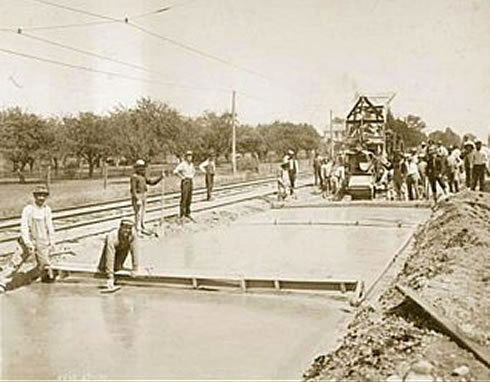
Paving Woodward Avenue in 1909, photo courtesy Woodward Avenue Action Association

On April 20, 1909,construction of the world’s first mile of concrete highway was begun in Detroit. The History of the World’s First Mile of Concrete Highway from the Wayne County Road Commission begins.

The year was 1909, and it was a big year in Detroit. Ty Cobb led the Detroit Tigers to a League Pennant at Bennett Park, Henry Ford introduced the Model T and J.L. Hudson was scouting out a location at Woodward and Farmer for his department store’s new location.

Also that year, the Wayne County Road Commission introduced the world to a new kind of road: Concrete. The only place it could be found that year was Woodward Avenue between Six and Seven Mile Roads in Greenfield Township, which is now northwest Detroit.

Roads up to that point – if they were paved at all – had been built with brick, cobblestone, or a material called macadam, which was not much more than stones sprayed with a tar to form some kind of wear resistant surface. Unfortunately, brick and cobblestone were uneven and labor intensive, while macadam didn’t last long.

Read on for more about this Michigan first, from the creation of Michigan’s first road commission in Wayne County in 1906 (Henry Ford was a charter member) to the details of this and other transportation innovations from the Motor City. They also have the facts about that first mile including the cost ($13,492.83) and daily pay of workers.

See more photos from the Woodward Avenue Action Association and read a whole lot more about the history of Woodward Avenue.

More cars on Michigan in Pictures.

Michigan’s Tallest Man: Louis “Big Louie” Moilanen

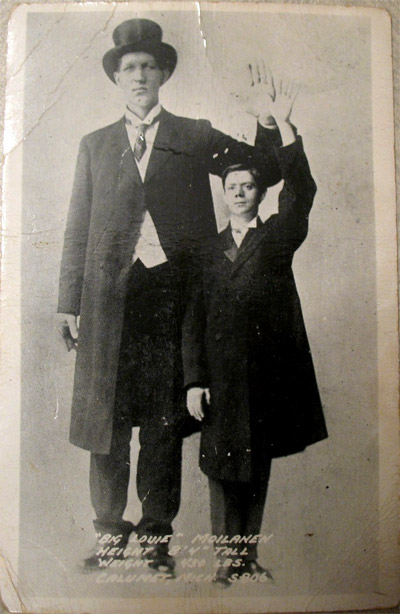
Louis “Big Louie” Moilanen

Our impromptu “Michigan’s Tallest” series continues with the tale of Louis “Big Louie” Moilanen. The entry on Louis Moilanen at thetallestman.com explains:

Louis Moilanen (also known as Lauri Moilanen and Louie Moilanen) came to the Keweenaw at the age of four in 1889, the son of Louis and Annie Moilanen. The family arrived from Finland and homesteaded just north of Hancock in the Salo district. Little Louie thrived in the new environment overlooking Lake Superior and at nine years old he was the height of an average man. Ten years later he was declared to be the tallest man in the world. Big Louie was seven foot nine inch tall, even though his parents were just five foot. When young Louie came to town in his horse drawn buck board it was quite a sight. Buying clothes was difficult, so the Ed Haas Men’s Store in Houghton tailored clothes for Louie and special ordered size 19 shoes and size nine Stetson hats. Louie lived not too far from the Boston mine where he got his first non-farming job as a timber man in the Franklin Junior. Setting and shimming large timbers with block and tackle in the small stopes and drifts was hard work, but fellow miners said he could do the work of two men. Louie’s size was a handicap and he soon found out that the mines were designed for five foot men.

Read on for more about Big Louie (including photos) and his career with Ringling Brothers, as a tavern owner in Hancock and as Justice of the Peace. There’s a little more information at Yooper Steez including Louie’s hometown of Boston, now a ghost town. The comments are especially great, with many memories of Louis and his family. While Louis Moilanen’s height was never verified, he would have ranked between 4th (at 8’4″) and 9th (at 8’4″) among the tallest people in the world. Curiously enough, the tallest person ever recorded, 8’11” tall Robert Wadlow of Alton Illinois, died in Michigan on July 15, 1940. The Daily Mining Gazette adds that:

Although exactly how tall Moilanen was is a matter of debate, with descriptions ranging from 8 feet, 1 inch to 8 feet, 4 inches, Richter said the death certificate he found in the Houghton County Court House indicates he was 8 feet, 1 inch at the time of his death on Sept. 16, 1913. The certificate lists his age as 27 years, 7 months and 12 days.

There’s also information about the Big Louie Monument Project. Donations can be sent to the Houghton County Historical Society P.O. Box 127 Lake Linden, MI 49945.

Michigan’s Titanic: The S.S. Alpena

SS_Alpena

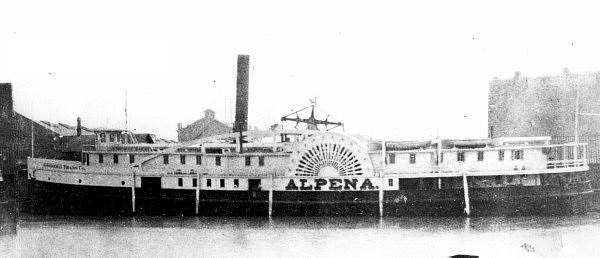
S.S. Alpena, photo from Wikimedia Commons

Over on Absolute Michigan we have a feature from the Archives of Michigan about two Michigan couples who were aboard the Titanic. I thought it would be interesting to see what the worst Michigan maritime disaster was. You might think it would be the immortalized Edmund Fitzgerald but with “only” 29, it’s down on the list. Or perhaps the tragic Carl D. Bradley in which 33 men perished, most from her home port of Rogers City.

It’s actually the sidewheel steamer S.S. Alpena. Michigan Shipwrecks says that this 197 foot Goodrich side wheel steamer was built in Marine City, Michigan in 1866. She was lost with about 80 crew & passengers in the “Big Blow” of 1880.

The Alpena left Grand Haven, Michigan bound for Chicago on Friday evening, October 15, 1880 at 9:30 PM. The weather was beautiful — Indian Summer like. But the barometer was indicating a storm was coming and storm signals were out. She was met on her southwest journey by the steamer Muskegon at about 1:00 AM and everything seemed normal.

At about 3:00 AM Saturday, October 16, 1880 the “worst gale in Lake Michigan recorded history” swept across the lake. The Alpena was seen at 6:00 AM, 7:00 AM and at 8:00 AM by the schooner Irish and by Captain George Boomsluiter of the barge City of Grand Haven about 35 miles off Kenosha, Wisconsin, laboring heavily in the high seas.

She was seen later by several other vessel captains –one of whom reported her lying on her side with one of her paddlewheels out of the water. Ten car loads of apples were stowed on her main deck and some speculate this cargo became unmanageable in the storm, shifted, and led to the capsizing.

…The weekly Holland City News reported on October 23: “The wreck is complete. She is broken into small fragments. The stern part of her hull lies near the harbor. The whole coast for 20 miles is strewn with the debris, freight, etc.” The largest piece to land near Holland was the piano, “it being barely able to float, our sailors concluded that she did not come very far. And the arrival of other heavy pieces of the wreck would seem to corroborate this.”

The wreck has never been found and you can read on for more. FYI, the Great Lakes Shipwreck database pegs the loss of life close to 100 and adds that the first indication that she was lost was when masses of wreckage began washing ashore along the coast near Manistee. It took several days for the magnitude of the disaster to be realized. Her paddlebox nameboard washed ashore at “Alpena Beach” in 1909, after a storm.

The largest loss of life in open water on the Great Lakes was 300 aboard the Lady Elgin that was rammed by the schooner Augusta in September of 1860 off Highwood, IL . An interesting note is that this shipwreck led to the requirement for sailing vessels to carry running lights. The Smithsonian relates that the worst shipwreck on the Great Lakes:

In terms of loss of life, hands down, that’s called the SS Eastland, which went down in the Chicago River on July 24, 1915. For whatever reason, the ship turned over onto its port side right there in the river. Passengers either wanted to see something in the river and they went to port side, or the engineer improperly ballasted the ship, or it wasn’t a stable ship to begin, but she flipped over right into the Chicago River, not terribly deep water maybe 20-30 feet, and killed 844 passengers and crew. It still remains the worst loss of life on any single shipwreck in the Great Lakes.

More shipwrecks on Michigan in Pictures.

We’ve got you covered

DSC02766_tonemapped

DSC02766_tonemapped, photo by ansonredford.

I thought I’d feature a photo from our Michigan Cover Photos Group. You can add pics to it if you want to have them featured on our Michigan in Pictures Facebook and also the Absolute Michigan Facebook.

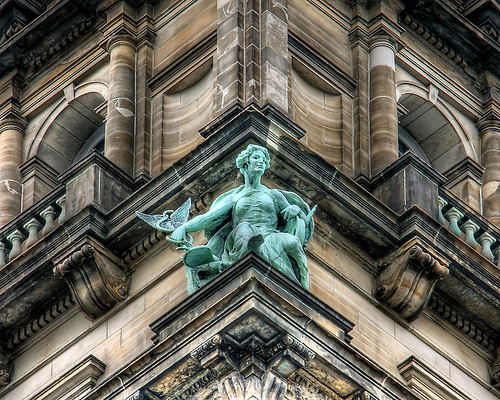
Recently we featured Donald’s photo of one of the sculptures on the Wayne County Courthouse. This is one of four that depict Law, Commerce, Agriculture, and Mechanics. They were executed by sculptor J. Massey Rhind.

Check it out background bigtacular and see some more including an amazing HDR of the courrthouse in Donald’s slideshow.

Eagle Harbor Lighthouse

Eagle Harbor Lighthouse Sunset

Reflecting Light – Eagle Harbor Lighthouse (Eagle Harbor, MI), photo by Aaron C. Jors.

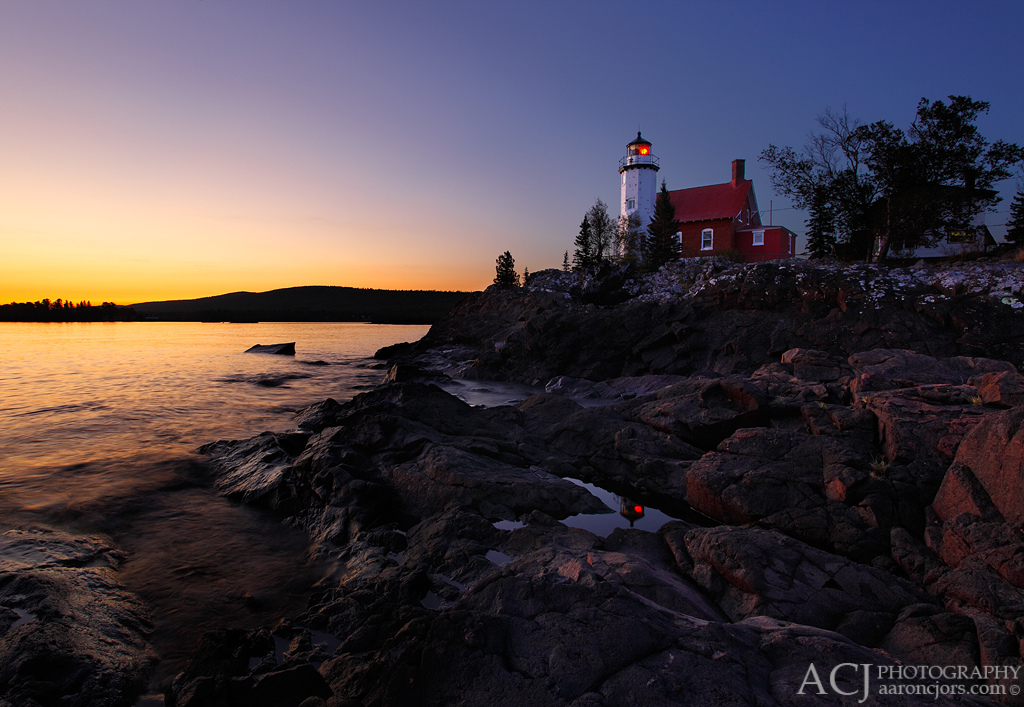
Our tour of the lighthouses of the Keweenaw Peninsula with Aaron Jors continues with the light at Eagle Harbor.

The Eagle Harbor Lighthouse from Terry Pepper’s Seeing the Light tells of the first light built in 1850 at the western point of Eagle Harbor built in 1850 and the rubble stone keeper’s dwelling with a square white-painted wooden tower integrated into one end of the roof. As with many lights built during the penny-pinching Pleasonton administration, the light was judged to be “laid together in the rudest manner” and targeted for replacement.

Rather than creating a unique set of plans for the new station, Eleventh District Engineer Brevet Brigadier General Orlando M. Poe resurrected a plan which had been previously used on Chambers Island in 1867 and at Eagle Bluff in 1868. After blasting out a hole for the cellar, the masons crafted a two-story dwelling red brick dwelling, 29-foot by 25-foot in plan, with an integrated 44-foot tall tower oriented diagonally into its northeastern corner. The exterior of the first and second stories of the tower were approximately ten feet square with buttressed corners, while the tower’s upper portion consisted of a ten-foot octagon. The tower was double-walled, with a circular inner wall approximately four inches thick and eight feet in diameter. This cylindrical inner wall supported a cast iron spiral staircase which wound from the oil storage room in the cellar to a hatch in the lantern floor. Since these spiral stairs also served as the only means of moving between floors in the dwelling, steel doors provided access to landings on both the first and second floors to prevent the spread of any fire in either the dwelling or tower.

Read on for much more and get information of visiting the lighthouse from the Keweenaw Historical Society.

Check this out bigger and in Aaron’s Lighthouses slideshow.

Many (many) more Michigan Lighthouses from Michigan in Pictures.

Mystery Monday: Who Was R.S. Chamberlin?

Mystery!

Mystery!, photo by I am Jacques Strappe.

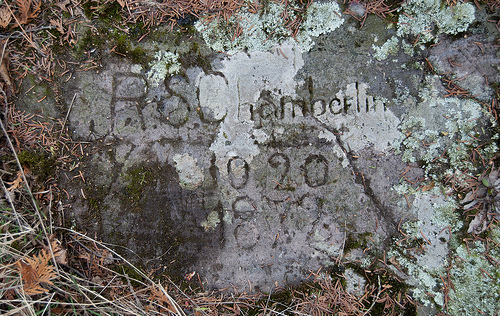
Yesterday Marjorie went hiking on a mountain near Marquette where she came across this carving that reads R.S. Chamberlin 10 20 1872. She writes:

Near the highest point of the mountain was a small outcrop of rock. This was carved into it — though it had been hidden by grass and pine needles until one in our party found it by chance and cleared it all away.

Check it out bigger, see more photos from the day in her slideshow and if you have ideas as to the identity of R.S. Chamberlin, post them here!

PS: Lots more (including a great profile) from Marjorie on Michigan in Pictures!

South Fox Island Lighthouse

South Fox Island ... tower view, spring panorama

South Fox Island … tower view, spring panorama, photo by Ken Scott

The South Fox Lighthouse Association maintains this light, has lots of great history and photos and is a worthy target for your donations.

Recently, I made the acquaintance of Terry Pepper. Terry’s Seeing the Light is hands-down the best Great Lakes Lighthouse website out there and I’ve used him as a resource for years in dozens of lighthouse features on Michigan in Pictures. Terry told me I could lean on him (even more) for photos and information. It seems a shame to waste that gift, so here goes. On his South Fox Island Lighthouse page he begins:

South Fox Island is located approximately seventeen miles off Cat’s Head Point, at the tip of the Leelanau Peninsula. The story of this Island light began with Congress’s appropriation of $18,000 for the construction of a lighthouse there on March 2, 1867.

Work on the light station began immediately, with the construction of the Cream City brick tower. With walls thirteen inches in thickness, the square tower topped-out at forty-five feet in height, and contained a forty-eight step cast iron spiral staircase leading to the lantern room.

The lantern was outfitted with a flashing red Fourth Order Fresnel lens, and the station’s first keeper Henry J. Roe climbed the tower steps to exhibit the light for the first time on November 1, 1867.

Read on for much more including Keeper Warner’s battle with drifting sands and snow that piled so high as to interfere with access to the station’s buildings and more about that Cream City brick from Milwaukee.

View Ken’s photo bigger and see more in his slideshow from South Fox Island.

Corktown, the Irish and St. Patrick’s Day in Michigan

Saint Patrick's Day Parade

Saint Patrick’s Day Parade, photo by *Alysa*.

May your blessings outnumber the shamrocks that grow,
And may trouble avoid you wherever you go.
~Irish Blessing

Happy St. Patrick’s Day everyone! Detroit had their parade last weekend but there are events on tap today and tomorrow in Bay City, Clare, Flint, Kalamazoo, Grand Ledge,  Saugatuck, Traverse City and Muskegon.

Ground zero for the Irish in Michigan is Corktown. Wikipedia notes that it is Detroit’s oldest neighborhood explaining:

The roots of Corktown lie in the Great Irish Potato Famine of the 1840s. The Irish immigrated to the United States in droves, and by the middle of the 19th century, they were the largest ethnic group settling in Detroit. Many of these newcomers settled on the west side of the city; they were primarily from County Cork, and thus the neighborhood came to be known as Corktown. By the early 1850’s, half of the population of the 8th Ward (which contained Corktown) were of Irish descent

The Corktown Historical Society has a cool slideshow of historic photos and brochure images and you might want to check out the Corktown Explorer blog.

The Irish in Michigan from Seeking Michigan has some information about Corktown but adds that:

Irish immigrants to Michigan certainly did not limit themselves to settling in the urban hub of Detroit, with many of them making their way up north. In the 1830s, Irish immigrants settled in fishing camps on Mackinac and Beaver Islands. Today, a large portion of Beaver Island’s year-round residents are of Irish descent. Wexford, Clare, Emmet and Antrim counties in the northern Lower Peninsula are all named after counties in Ireland. Irish immigrants were also instrumental to the copper mining boom in the Upper Peninsula. Nearly one-third of the area’s foreign-born population was from Ireland in 1870, though the Irish population would decline by 1920. Many small Irish communities could also be found scattered throughout the Lower Peninsula in the 1800s and early 1900s.

Wherever you are and whoever your ancestors were, here’s hoping you have a fun and safe St. Patrick’s Day holiday!

Check this out bigger and in Ann Lysa’s slideshow.