Decoration Day

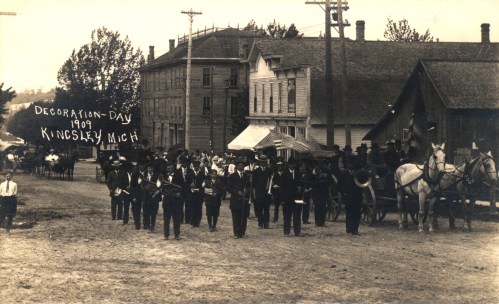
Decoration Day, Kingsley, Michigan, 1909, courtesy Kingsley Branch Library

Decoration Day is the most beautiful of our national holidays…. The grim cannon have turned into palm branches, and the shell and shrapnel into peach blossoms.
~Thomas Bailey Aldrich

Wikipedia’s Memorial Day entry notes that the holiday may have begun as Decoration Day on May 1, 1865 when freed slaves joined with clergy, teachers and citizens of Charleston SC to form a gathering 10,000 strong to memorialize 257 Union prisoners of war and celebrate the “Independence Day of a Second American Revolution.” In 1866, the commander-in-chief of the Grand Army of the Republic, Gen. John Murray, proclamation for “Decoration Day” to be observed nationwide. May 30th was selected specifically because it was not the anniversary of a battle.

Michiganders can feel a measure of pride that Michigan in 1871 was the first to make “Decoration Day” an official state holiday. Read more about in Michigan’s First Memorial Day from Michigan History Magazine on Absolute Michigan.

The photo shows the parade held in Kingsley on Decoration Day in 1909. In foreground is a marching band. The largest building in the background is Brownson Sanitarium. It’s from the collections of the Kingsley Branch Library. Here’s another photo of the “Kingsley Cornet Band.”

Next Saturday you might want to join the library for the first annual Kingsley Adams Fly Festival with fly-tying lessons, music & food with special guest R. W. “Bob” Summers, someone who I once had the good fortune to interview.
Thunder Bay National Marine Sanctuary could grow tenfold

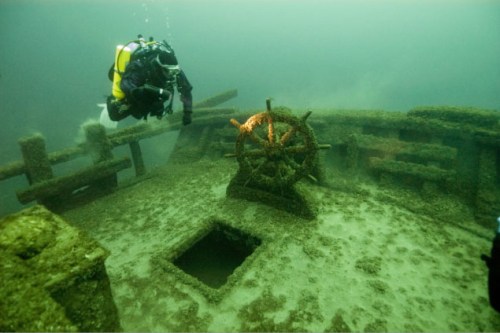
F.T. Barney exploration, photo courtesy Thunder Bay National Marine Sanctuary

The Thunder Bay National Marine Sanctuary is the only federally protected national marine sanctuary in the Great Lakes. It encompasses 448 square miles of Lake Huron’s bottomlands off Alpena. It was established in 2000 to protect a nationally significant collection of nearly 200 shipwrecks, spanning over a century of Great Lakes shipping history. It draws over 70,000 visitors every year and is a haven for protection, education and research for shipwrecks and our maritime heritage.

Now Thunder Bay is poised to grow almost tenfold to over 4,000 square miles including waters off Alcona and Presque Isle counties. The Great Lakes Echo notes that today is the last day for public comment for or against the expansion. You can email your comments to jeff.gray@noaa.gov. Carolyn Sundquist of the Echo explains that vessels can pass through it without restriction and that:

The proposed expansion includes an estimated 200 shipwrecks and would connect the underwater sanctuary from Michigan to the shores of Canada. No public funds are allotted as part of the approval.

“Very positive support has been received from the public comment sessions and many of the local governments have passed resolutions supporting the expansion,” said Jeff Gray, the sanctuary’s superintendent.

Michigan Gov. Rick Snyder, various state senators and officials of adjacent cities have written letters of support. So has the Alpena Area Chamber of Commerce.

The Sanctuary explains that the 126′ two masted schooner F.T. Barney was built in 1856 and wrecked on October 23, 1868 en route from Cleveland to Milwaukee. The F.T. Barney was run into by the schooner T.J. Bronson and sank in less than two minutes in very deep water with a cargo of coal. No lives were lost, and the wreck is one of the most complete of its kind with masts and deck equipment still in place.

See many more shots of divers and shipwrecks in their Fieldwork 2007 gallery – be sure to toggle the “View” link to slideshow in the top left for larger pics.

Many more Michigan shipwrecks on Michigan in Pictures!

Happy Gwen Frostic Day!

Gwen Frostic Studio ~ Benzonia, Michigan

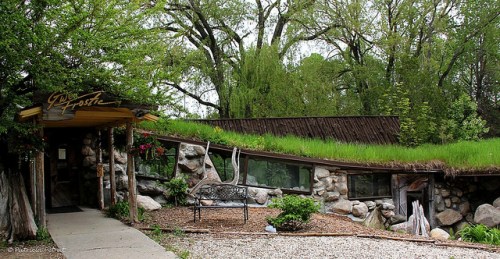
Gwen Frostic Studio ~ Benzonia, Michigan, photo by Trish P. – K1000 Gal

The Elberta Alert tipped me off last year that in 1978, Michigan Governor William Milliken proclamed May 23 Gwen Frostic Day in Michigan, and in 1986 she was inducted into the Michigan Women’s Hall of Fame. Their page for Sara Gwendolyn Frostic (Gwen Frostic) who was born in 1906 and passed away in 2001 says:

Author, artist, lecturer, and founder and sole proprietor of Presscraft Papers in Benzonia, Michigan, Gwen Frostic is known throughout the nation for her images of nature and for illustrated books which reflect her indomitable philosophy.

Frostic was born in Sandusky, Michigan and lived in St. Charles before moving to Wyandotte for her high school years. Interested in art from an early age, she used a band saw to create life-size posters for school events, and later studied art education at Eastern Michigan and Western Michigan Universities. During World War II, she worked in a Ford Motor Company bomber plant where she learned production, a skill she put to good use running the 15 Heidelberg presses in her northern Michigan printing and sales establishment. These presses make impressions from her hand-carved linoleum blocks onto paper and the resulting prints found their way into distinctive books, pamphlets, stationery, and other products she designed.

After beginning her business in Wyandotte, Frostic moved to Benzie County in 1955, starting with 40 acres and gradually creating a 285-acre wildlife sanctuary 35 miles southwest of Traverse City. Her commitment to nature and design is reflected in her home, studio, and print shop which draw thousands of visitors each summer.

The photo shows the Gwen Frostic Studio on River Road in Benzie County. The studio was also the artist’s home – click through for hours and such. Here’s a video interview with Gwen Frostic from 1998.

Check the photo out bigger and see more from the studio (including the massive Heidelberg presses used to print her iconic designs in Trish’s Gwen Frostic slideshow.

Middle Island Lighthouse in Lake Huron

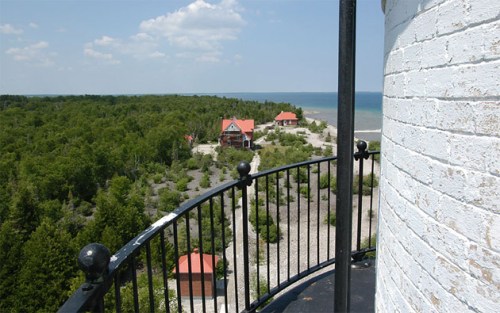
Middle Island Light Station as viewed from the watch room gallery, photo by Terry Pepper

The Middle Island Light Keepers Association (MILKA) and the Great Lakes Lighthouse Festival “Museum” invite you to be a part of history on Monday, May 28, 2012. On that day, the General Service Administration will deliver a quitclaim deed and the U.S. Coast Guard will deliver the key and ownership and responsibility for upkeep, maintenance and preservation to MILKA. To commemorate this historic event, ferry service will be available to Middle Island (weather permitting), where the tower will have its first official opening to the general public. There will be hot dogs, refreshments, a “Joy Ride” Island Tour, tours of Middle Island Light Station and much more!

The Middle Island Lighthouse page at Terry Pepper’s Seeing the Light begins:

Situated approximately 6.5 miles north of Potter Point, Middle Island received its name as a result of its location midway between the North Point of Thunder Bay and Presque Isle. The island had long represented a “triple-edged sword” to mariners. Marking a turning point in the course for vessels making up and down the coast, the island’s lee side also represented an excellent harbor of refuge in which to escape Huron’s fury. However surrounded with shoals with depths of less than six feet on all but its northeast side, the refuge could be hard to find in dark of night or in the thickest weather. In fact, the area was considered dangerous enough that the Life Saving Service built a station on the island in 1881 to help service ships in distress in the area.

As one of the final links in a growing chain of coast lights being constructed along Huron’s western shore, the Lighthouse Board finally recommended that an appropriation of $25,000 be made for a light and fog signal on the Middle Island’s eastern shore in its annual report of 1896. With no appropriation forthcoming, the Board reiterated its request in each of its annual reports for the following six years, until Congress finally responded favorably with the requested appropriation on March 3, 1902.

Read on for more including photos of the station and also see a map with the location of Middle Island Lighthouse. Following the closure of the station, the tower and outbuildings were seriously vandalized. In 1992, a group of concerned citizens in the Alpena area formed the Middle Island Lighthouse Keepers Association in 1992. They converted the fog signal building into the Middle Island Keepers’ Lodge, which opened for business in 2003. Visit that site for photos of the lodge and reconstruction efforts.

Terry Pepper is the Executive Director of the Great Lakes Lighthouse Association and maintains the fantastic Seeing the Light website, a guide to the lighthouses of the western Great Lakes. While he’s appeared as a resource for many of the lighthouse features on Michigan in Pictures, this is the first using his photos!

Movement, from the Detroit Electronic Music Festival to today

man-hour

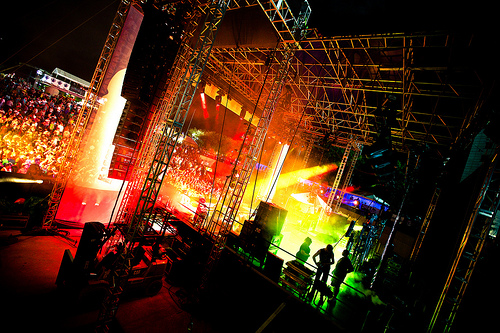
man-hour, photo by TerryJohnston

We were not used to listening to techno outdoors in the day, this was not something that ever happened in Detroit.
~Josh Glazer, 2000 Detroit Electronic Music Festival

Movement (formerly the Detroit Electronic Music Festival aka DEMF) comes to Hart Plaza in Detroit Memorial Day Weekend, May 26-28, 2012. Detroit is widely considered to be the the birthplace of techno, and Movement remains true to those roots. In 2012, 107 acts will perform across five stages with headliners including Zeds Dead, SBTRK, Public Enemy, Claude Vonstroke and Major Lazer.

You can see a great video from 2011 at the link above and you are heartily encouraged to dig into the DEEP story of this festival from 2000 to the modern day at Resident Advisor. It takes you from the first murmurings about a festival celebrating Detroit’s electronic scene, through the planning stages and to the nervous dawn of the first Detroit Electronic Music Festival Memorial Weekend of 2000, all told through photos and the words of the people that have worked on it and followed it through the years:

Richie Hawtin: People who wouldn’t go out to a nightclub, people who had bought a Derrick May record but didn’t really know who was behind it, friends who had stopped going out, people with their kids. The whole family aspect was incredible.

Matthew Dear: Sometime during that first year, I remember walking by a big circle of dancers. Everyone was happy, dancing and watching some guys jit in the center of the circle. Then I realized that the Mayor of Detroit, Dennis Archer was standing on the inside of the circle with his family, smiling, dancing and enjoying the show alongside everyone else.

Phil Talbert: A lot of kids walked up to the Mayor, and said, “You’re the Mayor? I just want to say thank you for doing something for young people.” I think he realized, then, how important it was.

Ernest Burkeen: The Mayor was shocked. Whenever you do a first year event, you’re happy just to make it happen. I never expected the crowds that we saw.

Check this out on black and in Terry’s Movement – DEMF slideshow.

Ernie Harwell, gone but not forgotten

The Old Ball Game

The Old Ball Game, photo by dblstripe

“Ernie (Harwell) is probably the most beloved person who has ever been in Detroit with the Detroit Tigers. He is loved by everybody and rightfully so. He’s a great broadcaster but even a better person. That comes across on his broadcasts.”
~ Detroit Tiger Hall of Famer Al Kaline

Two years ago today, one of the greatest members of the Detroit Tigers organization passed away. It’s no coincidence that Ernie Harwell received a baseball announcer’s highest honor by winning the Ford Frick Award from the Hall of Fame in Cooperstown. Here’s his Hall of Fame induction speech, set to a scrapbook of photos. There’s much more about Ernie Harwell on Michigan in Pictures.

Bryan shot this photo of the pitchers mound at old Tiger Stadium aka Ernie Harwell Park last fall. Check it out background big and in his Detroit slideshow.

We’ll close with words from Harwell’s farewell address that you can read in full at the Baseball Almanac. Click head over to “Ernie” on Absolute Michigan to read about the play about him by Mitch Albom and to see Ernie with thousands of the fans he talks about here…

“Thank you for letting me be part of your family. Thank you for taking me with you to that cottage up north, to the beach, the picnic, your work place and your backyard.

Thank you for sneaking your transistor under the pillow as you grew up loving the Tigers.

Now I might have been a small part of your life. But you have been a very large part of mine. And it’s my privilege and honor to share with you the greatest game of all.”

Omagakii: Frog in Anishinaabemowin

Ribbit Tell'em

Ribbit Tell’em, photo by EEKaWILL

Spring is frog season, and today’s Anishinaabemowin word of the day is Omagakii which means frog. Omagakiins means little frog and Omagakiinsag means little frogs.

Anishinaabemow.in is a very cool (though no longer updated) website that used short videos to teach words and short phrases in Anishinaabemowin. They explain that:

Anishinaabemowin is the traditional language of the Anishinaabe people. It is sometimes referred to as Ojibwe, Ojibway, Saulteaux or Indian by people in the community. Outsiders sometimes refer to it as Ojibwa or Chippewa. On this site we refer to it by the proper name in the language Anishinaabemowin.

Some facts about Anishinaabemowin

  • During the Fur Trade era Anishinaabemowin was referred to as the ‘Lingua Franca’ or trade language of what is now called Canada, meaning at one time if you wanted to conduct business here you had to speak Anishinaabemowin
  • At one time Guiness Book of World Records listed Anishinaabemowin as having the most complex verb structure of any language in the world, a testament to the intellectual capacity of our ancestors
  • A number of English words are adopted from Anishinaabemowing including Totem (used in Freudian studies and to refer to West Coast art) which is adapted from Dodem or clan, Mocassin (leather slipper) which is adapted from Makasin or shoe and countless place names.
  • Anishinaabemowin is spoken in communities from Quebec to British Columbia, From Northern Ontario to the Midwestern United States. The diffusion of speakers means that it is now spoken in places where there never were Anishinaabeg before.
  • Old Anishinaabeg don’t die, they just Maazhiwe.

Check Will’s photo out bigger and also see the Frog slideshow from the Absolute Michigan pool!

Detroit’s First Amusement Park: Electric Park

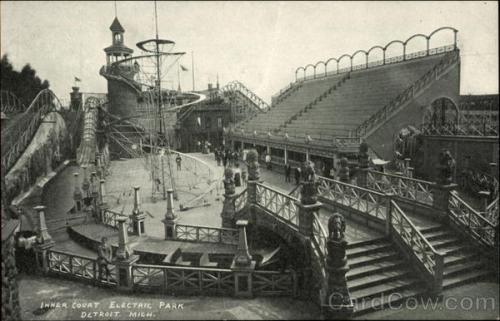
Inner Court Electric Park Detroit, Mich, photo by H.C. Hawkins

Today on Absolute Michigan we’re featuring a new festival called DLECTRICITY that is slated for October 5-6, 2012 on Detroit. DLECTRICITY organizers said that the name for the festival was inspired by Detroit’s first amusement park. The Detroit News Rearview Mirror page on Electric Park explains:

Electric Park, Detroit’s first mammoth amusement enterprise, opened May 26, 1906, near the Belle Isle Bridge approach. The Free Press heralded the opening of the park, “Detroit’s new Electric Park will be one of the largest in the world. Rome, with its seven hills will be a poor second to the roller coaster which is to be installed on the western site of the park. Here will be found l4 hills and any amount of hilarious fun my be derived within the enclosure.”

Owned by the Arthur Gaulker family, Electric Park, before it closed in 1928, went through many name changes and lengthy court battles over property rights. Some oldtimers remember the park’s nicknames: “Pike’s Peak, Lunar Park, Riverside or Granada.” Many of these names came from concessions located along the riverfront grounds.

You can read some more and see a whole bunch of great old photos at Electric Park on Water Winter Wonderland.

Northern Lights squared at Point Iroquois Lighthouse

Iriquois Point Light and th Northern Lights

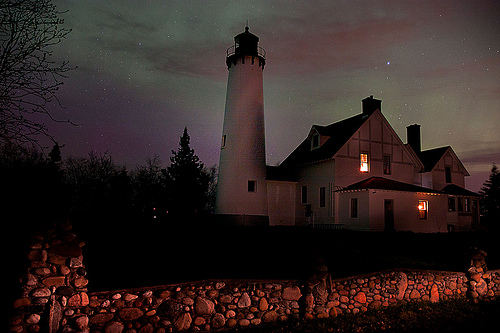
Iroquois Point Light and the Northern Lights, photo by yooper1949

It’s hard to let the Northern Lights go when they come for a visit as they did earlier this week, so here’s one more shot! You can read all about Point Iroquois Light from Terry Pepper’s Seeing the Light.

The Iroquois tribe made their home far away in New York. Point Iroquois is located at the east end of Lake Superior, where the lake narrows into the St. Mary’s River. If you’re wondering like I was how this point came to bear their name, the brochure for Point Iroquois has the answer:

The area around Sault Ste. Marie (“The Soo”), including Whitefish Bay, has been called the “Heartland” of the Chippewa Indians. This tribe is also called Ojibwa, and sometimes refer to themselves as “Anishinabeg,” which is their word for “original people.” The Iroquois lived about 400 miles away, mostly in what is now western New York. In the 1600’s these nations were at war, at least in part because of European influence and fur trade competition. The Iroquois often sent expeditions far from their homeland and attempted to control the trade routes leading east from the Great Lakes.

Accounts of an important battle at Point Iroquois in 1662 have been passed down for over 300 years. They tell how an Iroquois war party camped near the point where the lighthouse now stands, and how the Chippewa secretly watched their movements and mounted a surprise attack near dawn. The Iroquois were defeated decisively, and apparently never again ventured this far west.

Here’s information on visiting Point Iroquois Lighthouse and you can also see it on Google Maps.

Carl seems to have a knack for shooting the Northern Lights at the lighthouses of Northern Michigan. Check it out background bigtacular and see a ton more in his Lighthouse slideshow.

Much more northern lights and lighthouses on Michigan in Pictures!

Arbor Day’s Michigan Roots

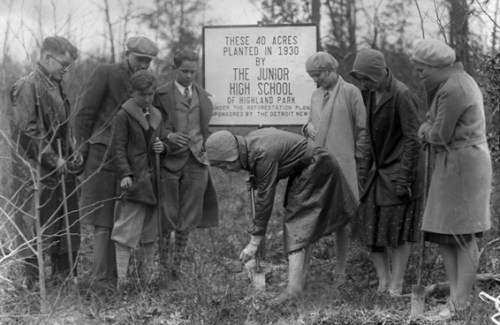
Highland Park Junior High School students plant trees, 1930, courtesy Walter P. Reuther Library, Wayne State University

We plant trees not for ourselves, but for future generations.”
– Caecilius

The Michigan Arbor Day Alliance explains that the first Arbor Day was celebrated in Nebraska on April 10, 1872. It was the brainchild of pioneer & journalist J. Sterling Morton to help restore plains that had been cleared for building materials, fuel and farming. Nebraskans planted over 1 million trees on that first Arbor Day, and Arbor Day became a legal holiday in Nebraska in 1885. Morton’s birthday of April 22 was selected as its observance and the holiday soon spread to other states.

Today, the most common date of state observance for Arbor Day is the last Friday in April, and several U.S. presidents have proclaimed a national Arbor Day on that Friday.

J. Sterling Morton’s love for trees came from his life in Michigan. Morton’s family lived in Detroit and he attended public school in Monroe, then later Albion College (Class of 1850) and the University of Michigan (Class of 1854). Morton missed the array of vibrant green trees he grew up with in Michigan and continued to plant them throughout his life.

…In 1885, the Michigan Legislature resolved “that the Governor is hereby requested to call the attention of the people of the state to the importance of planting trees for ornament and by naming a day upon which the work shall be given special attention to be known as Arbor Day.”

Until 1965, the Upper and Lower Peninsula had separate Arbor Days in the spring because of the difference in weather conditions for tree planting. Governor George Romney proclaimed an Arbor Week for the last week in April 1966. In his proclamation, Governor Romney broke with the traditional one day, “Because of the increased interest in and the importance of the statewide ‘Keep Michigan Beautiful’ program, one or two days do not afford enough time and opportunity for a full and proper observance of Arbor Day.”

“It is well that we bring attention to our trees and the need to continue to plant them about our homes, our places of business, our industries, our schools, our highways, and throughout the landscape so that their majesty will reflect our appreciation of the grandeur of nature and further the culture and economy of our state.”

Each year the Governor and Michigan Legislature proclaim the last week in April as Arbor Week and Arbor Day as the last Friday of that week.

The Michigan Arbor Day Alliance has a photo gallery of tree plantings from all over Michigan, monthly newsletters and their calendar has all kinds of events from across the state.

The photo above is from a great article about reforestation efforts in Michigan from Seeking Michigan.