Ontonagon Lighthouse: Gateway to Copper Country

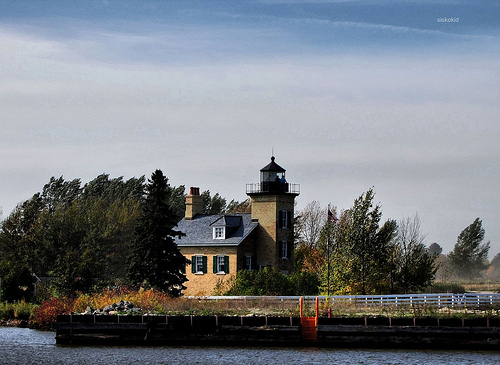
Ontonagon Lighthouse

Ontonagon Lighthouse, photo by siskokid

The Ontonagon Lighthouse is part of the Ontonagon Museum. Their page on the lighthouse explains that:

America’s first mineral rush began in earnest with the opening of the Copper District in Michigan’s Upper Peninsula to the prospectors and mining developers following the Treaty of 1842 with the Ojibwe nation. Suddenly there was a great need for navigational aids. Among the first five lighthouses established on Lake Superior was the one at the mouth of the Ontonagon River, the largest river that flows into Lake Superior from the south shore. In 1851, a wooden lighthouse was constructed on the west side of the river’s mouth to guide ships to the port from which copper was being shipped from the mines upriver. In 1857, the Winslow Lewis light was replaced with a 5th order Fresnel lens, the latest thing in lighting technology.

At that time, there was a sand bar across the river’s mouth, so only smaller craft could enter the bowl-shaped harbor (the name Ontonagon is a corrupted Ojibwe word that infers a bowl or bowl shape). With the opening of the first Soo Lock in 1855, shipping volume increased dramatically. Permanent breakwaters were constructed at Ontonagon, the sandbar was dredged out, and Ontonagon became the busiest port on Lake Superior.

You can get lots more information and photos about the Ontonagon Lighthouse and the copper boom in the region from Terry Pepper’s Seeing the Light.

Jim adds that the light was deactivated in 1963 after an automatic foghorn was installed on the west pier and a battery light was located at the end of the east pier at the  entrance into the Ontonagon harbor and marina. See his photo bigger and see more in his Lake Superior Lighthouses slideshow.
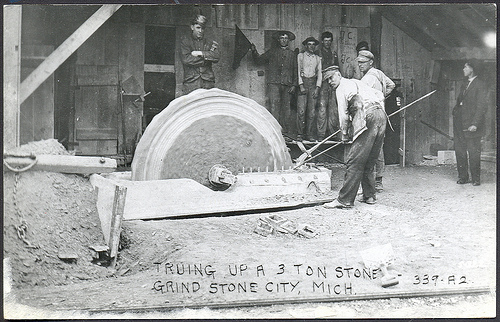


Truing up a 3 ton stone in Grindstone City

Grindstone City MI Lake Huron Village home to the old Grindstone Quarry LL Cook Card S322 1935 vintage Stamp Box Unsent

Grindstone City MI Lake Huron Village home to the old Grindstone Quarry LL Cook Card S322 1935 vintage Stamp Box Unsent, photo by UpNorth Memories – Donald (Don) Harrison.

“Grindstone City received its name in 1870. It happened in this way. Mr. James Wallace, one of the owners of the quarry at that time was talking to Mrs. Sam Kinch Sr., when she remarked that the village was growing so fast that it ought to have a name. They were discussing Stonington as a name when Mrs. Kinch suggested Grindstone and Mr. Wallace added City and from then on the village has been known as Grindstone City.”
from Mabel Cook’s “History of Grindstone City, New River and Eagle Bay” (1977).

The excellent history of Grindstone City from the Michigan State University, Department of Geography tells the fascinating story of the Huron County town that was once where the world turned for grindstones. This was due to the particular qualities of “Grindstone”, a special rock formation from Marshall Sandstone that made the finest sharpening stones. It all began:

In the year 1834, Capt. Aaron G. Peer, with his Schooner, the Rip Van Winkle, was forced to take haven in this natural harbor, during a storm. Capt. Peer is known as the “father” of Grindstone City, and located the first land in what is now Huron County. The sloop took anchorage here in a storm, and that Capt. Peer, his crew and his father came ashore to what was then a wilderness of pine, cedar, ash, beech, and maple, the cedar being so thick that snow remained in places although it was midsummer. In their exploring they found some big flat stone along the beach and on further examination, found evidence that these strata of rock was underlying the area to a lesser or greater extent . Samples were taken to Detroit where they were found superior to the Ohio flagstone which city officials were planning to use to pave some of the streets.

…On one trip, the sailors rigged up in a crude fashion a stone slab and used it to sharpen their tools. That year (1838) Capt. Peer, getting the idea from the sailors began shaping the grindstones at the place later known as Grindstone City.

Definitely read on to learn about the process that produced the grindstones from quarry to turning the stones shown above and ultimately to market.

One of the most commented posts on Michigan in Pictures is Not much remains of Grindstone City which featured a photo of one of the few remaining grindstones by Marty Hogan on a beach that was once covered in them. Here’s the Google Earth of Grindstone City, and there’s also a Grindstone City Facebook page with some photos and folks sharing memories and photos.

Don says the postcard above is from 1935. View it background big or settle back for his Grindstone City postcard slideshow.

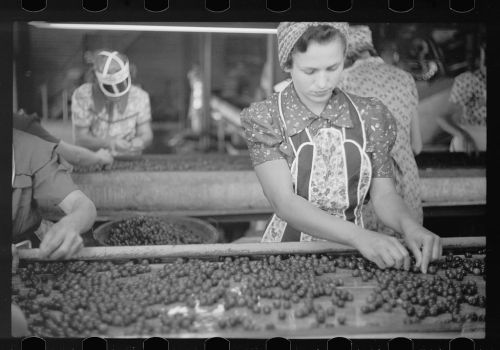
Sorting cherries … and making sense of migrant labor in Michigan

Migrant girls working in cherry canning plant Berrien County, photo by John Vachon

February is National Cherry Month and back in the day (July of 1940 to be precise), the cherry sorting machine was any able body that could tell the difference between a good and bad cherry as they sped past.

Agriculture is a vital part of the northern Michigan economy, and the League of Women Voters in Leelanau County has released an interesting study on migrant worker visas. They study contends that although the care for and harvesting of crops is a critical, labor-intensive aspect of our agriculture, Michigan workers aren’t stepping up to fill seasonal agricultural jobs, risking closure or bankruptcy for farmers and processors. The study notes that it’s an issue that’s been with us for years:

Seasonal workers have been essential to the operation of area farms since the transition from subsistence farming in the early 20th century. Agriculture was the principal livelihood for Michigan residents throughout the 1800s, but by the turn of the century, the Industrial Revolution was transforming agriculture from a small, self-sufficient family art to a large, mechanized, scientific industry. The tractor, the telephone, and the automobile revolutionized cultivation, communication, and transportation, and rural isolation was broken. Although farm conditions improved, people left the farms in droves and resettled in the cities. Rural depopulation became so severe during the 1920s that many farmers and growers had to import migrant labor.

The need for migrant labor has ebbed and flowed over the years. World War II was the catalyst for the Bracero Program, which from 1942 to 1964 brought Mexican migrant agricultural workers to the US legally. The program increased Michigan’s reliance on Mexican farm workers for harvest, and when the program ended, many workers continued to work in US agriculture.

Some crops like cherries have become largely mechanized, but apples, wine grapes and many other crops still have to be harvested by hand. Check out Migrant workers and Michigan agriculture on Absolute Michigan for a lot more about a critical issue for our farms and farmers.

You can get this photo background bigilicious and click to view the Michigan cherries gallery at the Library of Congress and you can also have a look at UpNorth Memories cherries slideshow.

The article on photographer John Vachon from the LOC’s American Memory Project says that his first job for the Farm Security Administration held the title “assistant messenger.” Vachon was twenty-one and had no intention of becoming a photographer when he took the position in 1936, but as his responsibilities increased for maintaining the FSA photographic file, his interest in photography grew. A memoir by his son quotes Stryker as telling the file clerk, “When you do the filing, why don’t you look at the pictures.”

Good advice.

It’s a Free (ice) Fishing Weekend!

Vintage Ice Fishing Michigan

Vintage Ice Fishing Michigan, photo by UpNorth Memories – Donald (Don) Harrison.

Two times a year, the State of Michigan has free fishing weekends, once in the summer (Jun 9 & 10, 2012) and once this weekend (Feb 18 & 19). All fishing regulations still apply, but fishing license fees are waived for residents and out-of-state visitors who can fish on both inland and Great Lakes’ waters for all species of fish.

All over the state there are special fishing events including the Ellsworth Shiverfest in Antrim County, the Winter Festival at the Bay City State Recreation Area, the Dam to Dam Ice Fishing Contest in Newaygo, the Higgins Lake WinterFest and the Free Fishing Weekend Special Event at Brighton Recreation Area.

You can get more on the weekend and some ice fishing videos on Absolute Michigan.

Check this out on black and see a lot more cool old photos, ice fishing decoys and memorabilia in Don’s ice fishing slideshow.

Catch more fish & fishing on Michigan in Pictures!

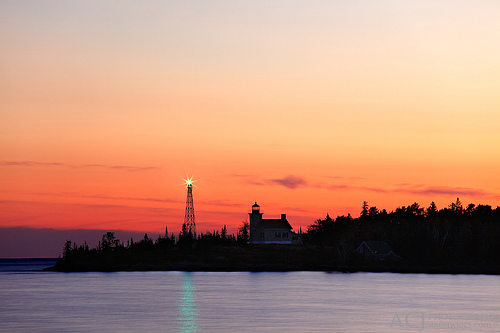
Sunrise at Copper Harbor Lighthouse

Bounded Light - Copper Harbor Lighthouse (Copper Harbor, MI)

Bounded Light – Copper Harbor Lighthouse (Copper Harbor, MI), photo by Aaron C. Jors.

The Freep had a feature on the most romantic places to visit in Michigan. I was happy to see that two of their 5 sunset spots were in my native Leelanau Peninsula. There’s bunches of Leelanau on Michigan in Pictures, so I figured I’d pick another. Since there are also a whole lot of sunsets, how about a romantic sunrise over the Copper Harbor Lighthouse on the Keweenaw Peninsula?

Terry Pepper’s Seeing the Light says that the discovery of copper in the Keweenaw drew so many immigrant Cornish and Finnish miners seeking their fortunes that one pioneer observed that “the shores of the Keweenaw became whitened with tents.” Terry’s entry on the Copper Harbor Lighthouse says that the original light from 1849 was exemplary of the poor planning and tight budgets of the administration of Stephen Pleasonton. Pleasonton was also the man who saved the original copy of the Declaration of Independence, so you win some and lose some I guess. In any case:

By the early 1850’s a cry arose in the maritime community, voicing concern over Pleasonton’s tight-fisted administration of the nation’s aids to navigation. A clerical administrator, Pleasonton had no maritime experience, and it showed-up in the sub standard workmanship and poorly chosen locations of many of the lighthouses erected under his administration. A study commissioned by Congress recommended the establishment of a nine-member Board to oversee the administration of aids to navigation. Staffed with Navy officers and Engineers from the Army Corps of Engineers, the Lighthouse Board was established in 1852, relieving Pleasonton from any further involvement. One of the Board’s first orders of priority was the upgrading of illumination systems from the dim and poorly performing Argand lamps to the far more efficient and powerful Fresnel lenses manufactured in Paris. However, with the Copper Harbor Light not being of major importance in the greater scheme of things, it would be some time before its lens would be upgraded, and thus the Argand lamps continued to light the way into the harbor.

…In 1856, a work crew finally arrived in at the station and removed the Argand lamps from the lantern, and replaced them with a single fixed white Sixth Order Fresnel lens, thus increasing the station’s range of visibility to ten miles at sea. Three years later, the Light was upgraded further through the replacement of the Sixth Order lens with a more powerful fixed white lens of the Fourth Order.
As was the case with virtually all of the lighthouses built on the Great Lakes during the Pleasonton administration, the true costs of inferior materials and shoddy workmanship began to show. After his 1864 visit to the station, the Eleventh District Inspector remarked that the Copper Harbor lighthouse required “extensive repairs.” On subsequent investigation, the condition of the tower was determined to be beyond repair, and the following year the decision was made to raze the old tower and erect a completely new structure.

Read on for more on the construction of the new light and to see some great old photos. Also see Terry Pepper’s explanation of Argand and Fresnel lamps.

Check this out on black and in Aaron’s Great Lakes Lighthouses slideshow.

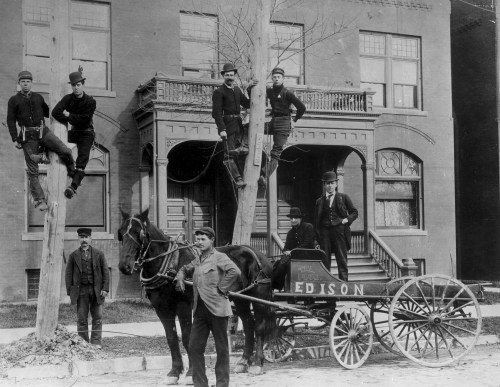
Happy Birthday to you, Thomas Edison

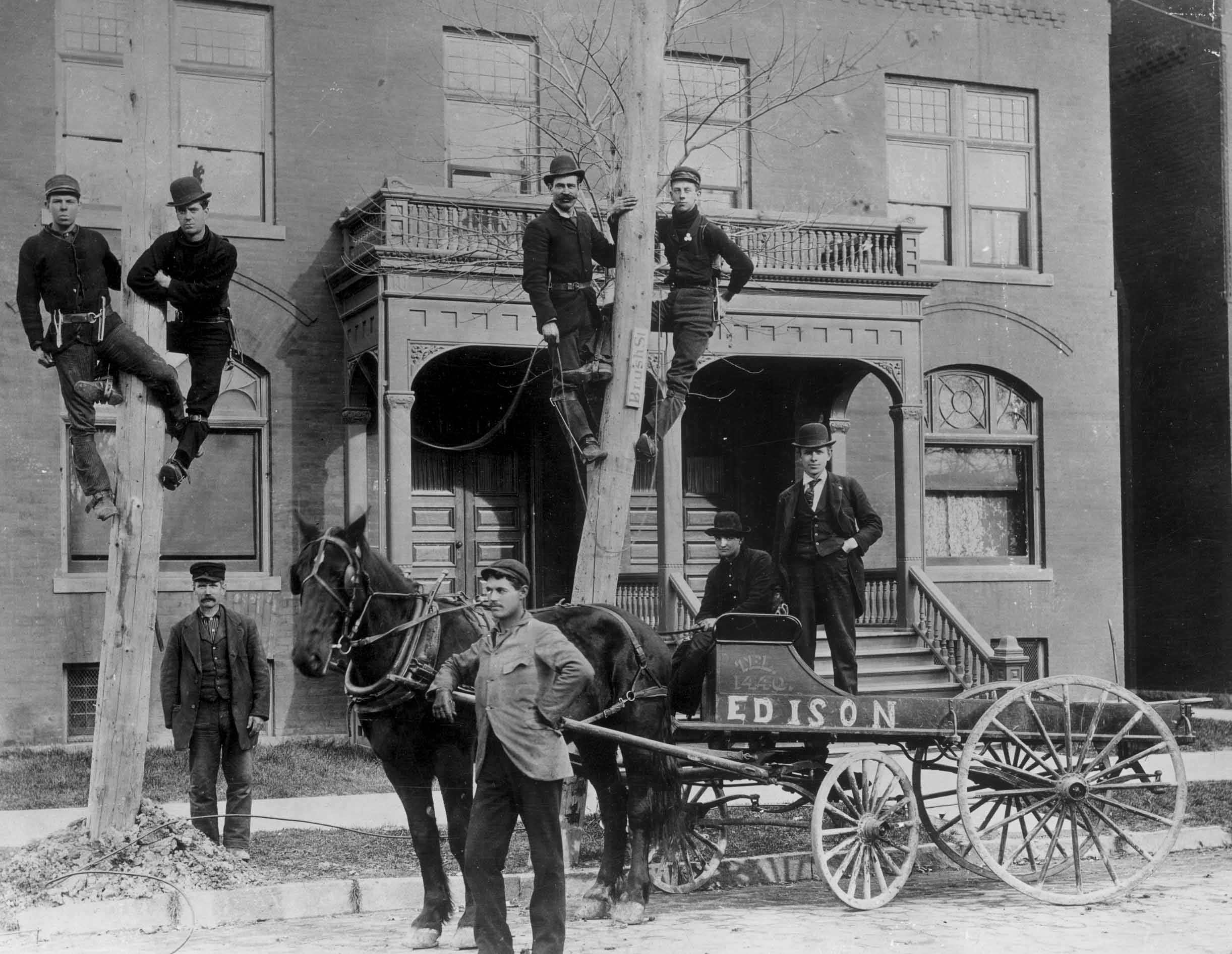
Detroit - Edison Illuminating Company high line crew

Detroit – Edison Illuminating Company high line crew, photo courtesy Seeking Michigan

The Life of Thomas Edison from American Memory at the Library of Congress says that:

Thomas Alva Edison was born to Sam and Nancy on February 11, 1847, in Milan, Ohio. Known as “Al” in his youth, Edison was the youngest of seven children, four of whom survived to adulthood. Edison tended to be in poor health when young.

To seek a better fortune, Sam Edison moved the family to Port Huron, Michigan, in 1854, where he worked in the lumber business.

Edison was a poor student. When a schoolmaster called Edison “addled,” his furious mother took him out of the school and proceeded to teach him at home. Edison said many years later, “My mother was the making of me. She was so true, so sure of me, and I felt I had some one to live for, some one I must not disappoint.”(1) At an early age, he showed a fascination for mechanical things and for chemical experiments.

In 1859, Edison took a job selling newspapers and candy on the Grand Trunk Railroad to Detroit. In the baggage car, he set up a laboratory for his chemistry experiments and a printing press, where he started the Grand Trunk Herald, the first newspaper published on a train. An accidental fire forced him to stop his experiments on board.

Read on for much more, and also see Thomas Edison at Wikipedia. While Edison’s life in Michigan didn’t include much of what one of the architects of our modern lifestyle was famous for, there’s some great places to visit to learn more about him. Two of the best are the Thomas Edison Depot Museum in Port Huron and Edison’s Menlo Park Laboratory at Greenfield Village.

Get this photo from Seeking Michigan big as the 20th Century and see a few more Edison-related photos from Seeking Michigan.

Post #350 on Michigan in Pictures!

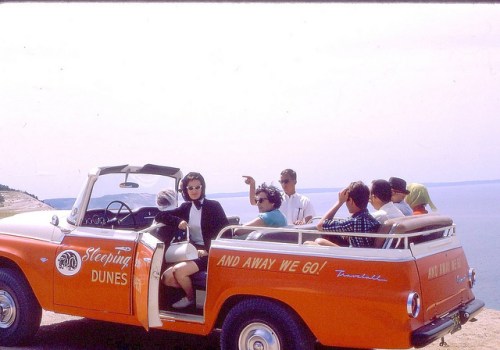
Sleeping Bear Dune Rides

Sleeping Bear Dune ride

Dune rides, photo by creed_400.

This photo prompted me to dig out a ton of information & photos about this vanished part of the Sleeping Bear Dunes experience. Enjoy Sleeping Bear Dune Rides: Remembering the Dunesmobiles at Leelanau.com.

See it background big and in creed_400s Sleeping Bear Dunes National Lakeshore slideshow.

#Mich175 = Happy 175th Birthday Michigan!!

Sugar Cookies - Michigan

Sugar Cookies – Michigan, photo by betsyweber

We, the PEOPLE of the territory of Michigan … mutually agree to form ourselves

into a free and independent state, by the style and title of “The State of Michigan’”

~Constitution of Michigan of 1835

While Michigan’s Constitution was written in 1835, it took until January 26, 1837 for President Andrew Jackson to sign the bill making Michigan the nation’s 26th state (more about that right here but the short answer is, blame it on Ohio). That makes today the 175th birthday of the Great Lakes State. We’ve been making a fuss of it and giving things away on Absolute Michigan all week, and joining a whole lot of people in touting the good things about our great state at #Mich175 on Twitter.

Here’s some fun facts about Michigan:

  • Michigan is derived from the Indian word Michigama, meaning great or large lake. (more about Michigan’s name on Michigan in Pictures)
  • French explorers Étienne Brulé & Grenoble are the first recorded Europeans to set foot in Michigan (you never know though). In 1668 Fathers Jacques Marquette and Claude Dablon established the first mission at Sault Ste. Marie, and in 1701, French officer Antoine de la Mothe Cadillac founded  Fort Pontchartrain in Detroit.
  • The Michigan Territory was created, with Detroit designated as the seat of government and William Hull appointed as our first governor.
  • Michigan became the 26th state on the 26th of January, 1837. Is 26 our lucky number? FYI, our first State governor was Stevens T. Mason, the 25 year old Boy Governor (the youngest state governor in American history).
  • Michigan’s nickname is “the Wolverine State”. It is generally believed to have been coined during the 1835 Toledo War between Michigan and Ohio, when our southern rivals gave us the name due to the wolverine’s reputation for sheer orneriness!
  • The Great Seal of Michigan was designed by Lewis Cass and was patterned after the seal of the Hudson Bay Fur Company. It depicts an elk on the left and a moose on the right supporting a shield that reads Tuebor (“I will protect”).The interior of the shield shows a figure on the shore with the sun rising over a lake. His right hand is raised, symbolizing peace, but he holds a rifle in his left hand, showing readiness to defend the state and nation.Below the shield is the inscription of our state motto Si quaeris peninsulam amoenam circumspice: “If you seek a pleasant peninsula, look about you.” (I just learned that Michigan has an Office of the Great Seal – how cool would it be to say you worked there??)
  • The original State Capitol of Michigan was Detroit, and it moved to Lansing in 1847 to help develop the western side of the state and due to the need to develop the western portions of the state and for easy defense from British troops. Here’s a pic of Michigan’s original Capitol Building and an 1890s view of the current Michigan capitol.
  • Michigan is the 10th largest state by area if you count the water … and who wouldn’t count the water??
  • Speaking of water, we have 3,288 miles of Great Lakes shoreline, good for second to only Alaska in coastline!

More fun facts from the State of Michigan.

Check this out background bigilicious and in Betsy’s Cookies slideshow.

PS: I made a little Michigan Birthday cover photo for Facebook that you are free to grab.

Happy 175th Birthday Michigan!!

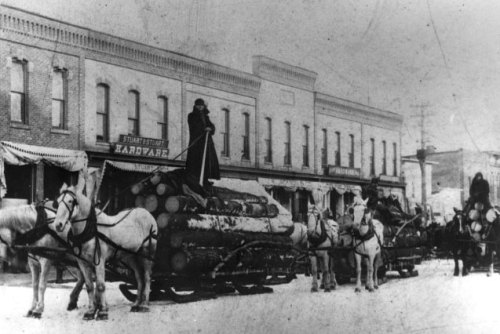
Lumber Day in Saginaw … make that Chesaning!

(Apr 27, 2015) Brett Russell shares: Not to correct your article, but I actually believe the bottom black and white photo was taken in Chesaning, MI. The building in the background looks like the Nason Block, which still stands today. The building far left where the brick color changes I believe to be the Chesaning State Bank. This photo would have been taken on Broad St. just before the intersection of Saginaw St.

Saginaw – Winter street scene, photographer unknown

This black and white photo shows winter carts loaded with lumber on an unidentified street in Saginaw. It’s from Seeking Michigan .

Barton Dam, in ice and history

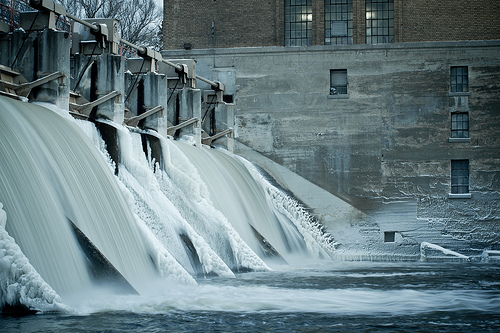
IMG_3373.jpg

Barton Dam 1/21/12, photo by pcaines

ArborWiki’s entry for Barton Dam says that:

Barton Dam is one of Ann Arbor’s four dams on the Huron River. It was designed by engineer Gardner Stewart Williams and architect Emil Lorch and built in 1912-13 as part of the development of hydroelectric power on the Huron River by the predecessor of Detroit Edison. The earthen-construction dam is 34 feet high and 1767 feet long, and has a typical surface area of 315 acres and typical storage of 5050 acre-feet. The dam can be accessed from Huron River Drive from the city park located at the foot of Bird Road.

The City of Ann Arbor purchased the dam from Detroit Edison in the 1960s, and restarted hydroelectric generation in the 1980s. The facility has a 900-kilowatt turbine that generates 4.2 million kWh per year.

In case you’re wondering, Emil Lorch (1870-1963) was the first University of Michigan Dean of Architecture and – as this page from the Bentley Historical Library explains, Gardner Stewart Williams was the engineer who worked with the Detroit Edison Company to identify sites for dams to generate power on the Huron in the early 1900s. There’s also a Flickr group for Barton Dam where you can see a lot more photos!

Be sure to check this photo out bigger and see more in cpcaines Ann Arbor slideshow.