The Ford 999

Henry Ford and Barney Oldfield and the Ford 999 in 1902, photographer unknown (via Wikimedia)

Henry Ford, founder and namesake of the Ford Motor Company, was born on July 30, 1863. He’s shown above with early racing great Barney Oldfield and the Ford 999. The Motorsports Hall of Fame says:

The oldest vehicle in the Motorsports Hall of Fame is the famous Ford 999 racer from 1902. Although it is not the first race car ever built, it is certainly the first car to rise to the status of legend.

Always seeking publicity, Barney Oldfield dubbed the car 999 after the feats of the record-holding New York Central locomotive.

Although the car is equipped with only one seat, a “Mechanician” was often kept busy oiling bearings and making adjustments while the car was being driven! The role more closely resembled that of an active sidecar acrobat than that of a riding mechanic.

The sister car of the 999 was the Arrow. It was a rebuilt Arrow that Henry Ford drove to 91.37 mph on frozen Lake St. Clair in January of 1904, for the new automotive World Land Speed record. After Ford set the record, his racing partner, Tom Cooper, sold both the 999 and the Arrow. The Arrow was renamed the New 999 by the new owner.

…Shortly before his death, Henry Ford is said to have remarked to Barney Oldfield: “You made me and I made you.” Oldfield shook his head and replied “Old 999 made both of us.”

You can see a great gallery of photos of early Ford race cars that includes shots of Ford and his mechanician and a modern photo of the 999 from The Henry Ford Museum on Flickr. The Henry Ford is located in Dearborn and they (of course) have a ton of information about Henry Ford.

More cars on Michigan in Pictures!

Gypsum & Alabaster

Old Off Shore Alabaster Loading facility

Old Off Shore Alabaster Loading facility, photo by hz536n/George Thomas

One of the neatest features for me about Michigan in Pictures are the many things I learn from the photos that are posted. Today’s photo of the Lake Huron loading platform for US Gypsum is a perfect example. The Iosco County Historical Society explains that:

The tramway of the U. S. Gypsum Company at Alabaster has long been a tourist attraction. Built in 1928 the tramway stretches 1.3 miles out into Saginaw Bay. Like a horizontal ski-lift, the cable system carries 72 “buckets” of gypsum to a waiting ship or to the storage bin. Each bucket holds more than two tons. The tramway includes 6,450 feet of one and three-quarter inch steel cable and 14,000 feet of three-quarter inch cable. At a length of 6,350 feet it is the longest over-water bucket tramway in the world.

…Until 1898 when the railroad spur was installed, all shipments were made by sailing vessels that tied up to a 600 foot dock. Marine shipments were resumed in 1929 after the building of the tramway enabled the larger ships to load in deeper water at the end of the tramway. Rail shipments were then made when the boat season was closed.

The tramway was dismantled (though concrete pads which may house wind turbines remain). You can also read an interesting account detailing the history of the town of Alabaster. While I knew that gypsum was used in drywall, I had no idea of its versatility (or Michigan’s status as a leading gypsum producer). You can learn about in great detail from MSU Geology’s page on gypsum:

If you were given a chance to win a jackpot by correctly naming a material that was used in the pyramids and in your toothpaste; that helps peanuts grow and makes movie snow; and that is used in mushroom beds and the walls of your house, chances are at least 100 to 1 that the quizmaster would holler “Sorry, your time is up,” before you could say “hydrous calcium sulphate.”

But, don’t feel badly.

Even though more than 12 1/2 million tons of gypsum were used in the USA last year, and even though the average person is surrounded by gypsum products from dawn to dusk, from the cradle to the grave, people do not know much about gypsum.

Gypsum can be ground up and “boiled” (calcined) at a comparatively low temperature until 75% of its moisture content has evaporated. When that happens, the rock becomes a fine powder, commonly known as Plaster of Paris. By returning the water to the powder, one can make a pliable mortar that can be formed into any shape and hardened. Gypsum is the only natural substance that can be restored to its original rock-like state by the addition of water alone.

Check this photo out background big and see more in George’s Fall 2009 slideshow.

Blue Moon: Apollo 15 and the University of Michigan

Apollo 15: Irwin Scoops up Soil

Apollo 15: Irwin Scoops up Soil, photo by NASA on The Commons

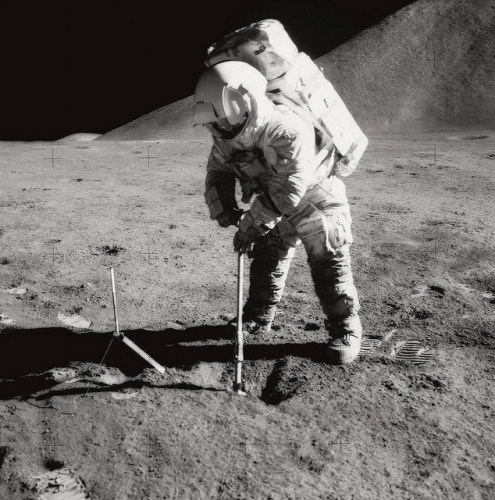
Over on Absolute Michigan we have a feature on the all-UM crew of the Apollo 15 that includes a great video. You can see a lot more images from the Apollo 15 mission from NASA. Here’s their caption for this photo:

This frame from Dave’s Station 8 pan shows Jim standing wide-legged as he digs the partially-completed trench in front of him. He sticks the scoop into the wall opposite where he is standing and propels the scoop-load of regolith back between his legs. The narrow fan of throwback can be seen behind him and, indeed, there seems to be some material still in motion at the far end of the throwback pattern just above the two fiducials at mid-thigh height. Mt. Hadley (14,765 feet tall) is in the background.

Check it out big as the moon and in NASA’s Happy Moon Day! slideshow.

More University of Michigan on Michigan in Pictures.

Sorry folks – the spammers took a liking to this post for some weird reason so I had to close comments!!

Peaches in Michigan

Peaches

Peaches, photo by Alissa Holland

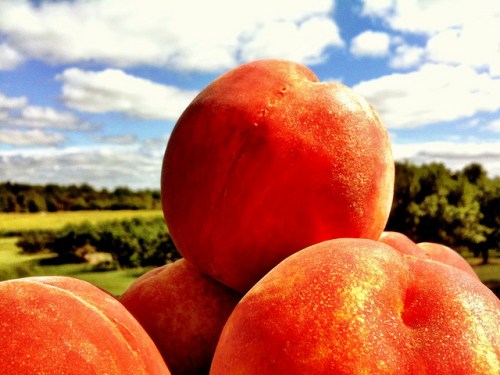
Peaches (like everything else) are ripening earlier this year and South Haven peaches are starting to show up at farm markets across the state. This nice Michigan Peach Industry History article from the Michigan Peach Sponsors begins:

The first peach tree in western Michigan was probably planted by William Burnett, who established a trading post on the west bank of the St. Joseph River a mile upstream from Lake Michigan in the 1780s. Burnett planted an orchard near his post and was credited with having taken great pains in caring for it. When the first permanent settlers reached the area in the late 1820s they found Burnett’s orchard healthy and still bearing fruit. Besides a few peach trees, the settlers also found a few seedling peach trees growing along the east bank of Hickory Creek and at the future site of the community of St. Joseph.

The next peach trees planted in Berrien County were at the Carey Mission in present-day Niles Township. In 1826 the Reverend Isaac McCoy, founder of the mission, had a peach orchard of “two or three hundred” trees.

Berrien’s earliest permanent settlers brought seedling fruit trees with them and planted enough trees to provide for their personal needs. Because trees took a long time to mature, some of the more resourceful pioneers budded their fruits on the roots of wild plum trees to acquire crops more quickly. Most early settlers planted apple and pear trees that were hardy and relatively disease resistant. They also planted a considerable number of the more delicate peach trees. Nearly every pioneer family had at least one. The growing of peaches was slow to catch on, but when settlers realized the region was suited for successful cultivation of the climate-sensitive fruit, peaches quickly gained popularity.

Read on for more and also see Ready to Pick: Peaches on Absolute Michigan.

Check Alissa’s photo out bigger and see more in her slideshow.

More great Michigan foods on Michigan in Pictures!

July 10, 1887 was a Grand day

Grand Hotel Pano (3 photo pano)

Grand Hotel Pano (3 photo pano), photo by raddad!

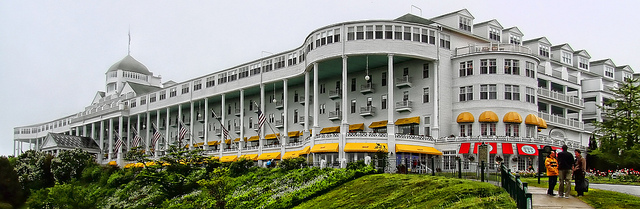
Today is the 125th birthday of the Grand Hotel on Mackinac Island which opened on July 10, 1887. Wikipedia’s Grand Hotel (Mackinac Island) entry explains:

In 1886, the Michigan Central Railroad, Grand Rapids and Indiana Railroad, and Detroit and Cleveland Steamship Navigation Company formed the Mackinac Island Hotel Company. The group purchased the land on which the hotel was built and construction began, based upon the design by Detroit architects Mason and Rice. When it opened the following year, the hotel was advertised to Chicago, Erie, Montreal and Detroit residents as a summer retreat for vacationers who arrived by lake steamer and by rail from across the continent. At its opening, nightly rates at the hotel ranged from US$3 to US$5 a night.

Grand Hotel’s front porch is purportedly the longest in the world at some 660 feet (200 m) in length, overlooking a vast Tea Garden and the resort-scale Esther Williams swimming pool.

Also see the History photo gallery from The Grand Hotel and a cool old travelogue on Mackinac Island.

Be sure to check Randy’s great panorama out bigger and in his Mackinac Island slideshow.

Big Sable Sunset

Big Sable Sunset

Big Sable Sunset, photo by Robby Ryke

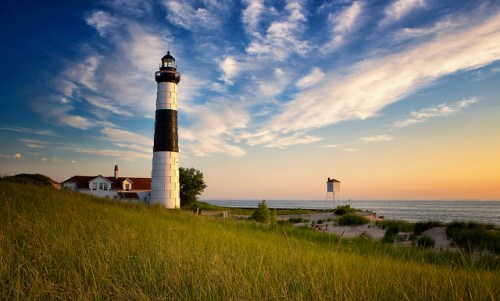
Terry Pepper’s Seeing the Light has all the history on Big Sable Point Light Station. One interesting fact is that it holds the distinction of being the last Great Lakes light to become electrified in 1949.

Terry notes that electrification was always a double-edged-sword, because it paved the way for automation in 1968 which in turned paved the way for vandalism and deterioration. In 1977 waves came perilously close to undermining the tower before the seawall could be replaced, but the Sable Point Lighthouse Keepers Association has helped restore this light to its former glory.

Check this photo out bigger and in Robby’s great Pure Michigan slideshow.

Of Michigan, Mosquitoes & Malaria

Mosquito

Mosquito, photo by stepponme123456789

If you think you’re too small to have an impact, try going to bed with a mosquito.
~Anita Roddick

Today on Absolute Michigan we posted a weird little cartoon from the early 1900s by Michigan animator Winsor McCay who is often known as “The Father of Animation” titled “How a Mosquito Works.” That seemed to me to be good enough reason to take a closer look at these pesky pests.

Wikipedia’s Mosquito entry says that mosquitoes are a family of small, midge-like flies: the Culicidae. The word mosquito is from the Spanish and Portuguese for “little fly”. You can click that link for likely more than you want to know about how they feed. The Michigan Mosquito Control Association claims that:

Mosquitoes are by far the most dangerous animals on earth. It is hard to comprehend the amount of disease and the resulting sickness, death, and economic loss caused by the mosquito. Some scientists estimate between 500 and 700 million people get malaria worldwide each year. That’s more than twice the entire population of the United States each year. Malaria has since been virtually eliminated here in Michigan , but the threat of mosquito-borne disease is still very real. Of the 60 different species of mosquitoes found in Michigan many are known to be vectors (carriers or transporters) of important diseases such as West Nile virus, Eastern Equine Encephalitis, St. Louis Encephalitis, and the California Group of encephalitis.

An interesting thing I learned was that Michigan was once a hotbed of malaria as Daniel Hager from the Mackinac Institute of Public Policy explained:

Willis F. Dunbar in “Michigan: A History of the Wolverine State,” writes that the disease “was so prevalent that it was rather unusual to escape it.” Ruth Hoppin, who grew up in a pioneer family in St. Joseph County near Three Rivers, recalled that “the pale, sallow, bloated faces of that period were the rule; there were no healthy faces except of persons just arrived.” A. D. P. Van Buren, whose family came to Calhoun County near Battle Creek in 1836, noted that the first question asked of new settlers was whether or not they had contracted malaria yet, and “if answered in the negative, the reply would be, `Well, you will have it; everybody has it before they’ve been here long.'”

The settlers’ common word for malaria was ague (pronounced “ag-yew”), which derived from the Latin word acuta, as in febris acuta, or “sharp fever.”

The state of Michigan has a ton of information about mosquito control in Michigan. You might also enjoy an interview with MSU Entomologist Howard Russell about mosquitos and this detailed article on Gallinipper mosquitoes, which are native to Michigan and large enough to bite through canvas shorts.

Check this out background big and see some more great shots in Stephanie’s Bugs slideshow.

Happy Birthday to you, U.S. Coast Guard Icebreaker Mackinaw!

The USCGC Icebreaker Mackinaw at Cheboygan HDR

The USCGC Icebreaker Mackinaw at Cheboygan HDR, photo by hz536n/George Thomas

The United States Coast Guard Cutter Mackinaw (WLBB 30) has its 6th birthday tomorrow. MightyMac.org has this to say about the United States Coast Guard Cutter Mackinaw:

Commissioned June 10, 2006 Mackinaw (WLBB 30) assumed the “Mackinaw” name and heritage and now stands as the largest United States Coast Guard Cutter on the Great Lakes. WLBB 30 is configured to better handle a variety of roles including buoy maintenance, and handling of environmental spills.

The Mackinaw is powered by 3 Caterpillar 3612 Turbocharged V-12 engines – 3360 KW each. Prolusion comes from 2 ABB azimuthing electric propulsion drives where the propulsion motor is installed inside a submerged azimuthing (unlimited 360 degrees) pod and coupled directly to an extremely short propeller shaft.

Click for more including lots of photos, and definitely don’t miss this sweet panoramic tour of the Mackinaw. You can see the Mackinaw every year at the Grand Haven Coast Guard Festival (July 27 – August 5, 2012). Her predecessor is now the Icebreaker Mackinaw Maritime Museum in Mackinaw City.  Michigan in Pictures has more about icebreakers on the Great Lakes and you can also see a video of the Mackinaw at work from Boatnerd on YouTube.

Check this out big as a boat and see more in George’s massive Photomatix HDR slideshow.

More Michigan ships & boats on Michigan in Pictures.

Michigan author James Oliver Curwood and the Curwood Festival

curwood castle

curwood castle, photo by LightuptheDarkn3ss

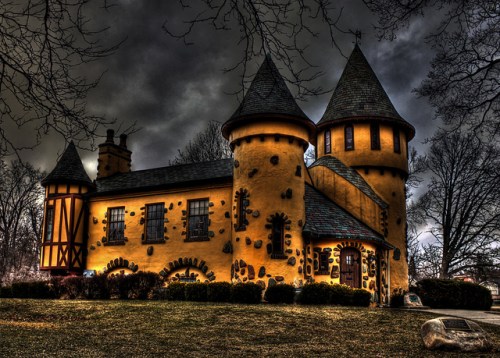
This weekend (June 7-10) Owosso holds their annual Curwood Festival honoring Michigan author James Oliver Curwood. The Shiawasse District Library says that James Oliver Curwood was born in Owosso, Michigan on June 12, 1878. He was in the University of Michigan journalism program for 2 years before quitting to become a reporter for the Detroit News-Tribune. Wikipedia’s entry on James Oliver Curwood says that:

By 1909 he had saved enough money to travel to the Canadian northwest, a trip that provided the inspiration for his wilderness adventure stories. The success of his novels afforded him the opportunity to return to the Yukon and Alaska for several months each year that allowed him to write more than thirty such books.

By 1922, Curwood’s writings had made him a very wealthy man and he fulfilled a childhood fantasy by building Curwood Castle in Owosso. Constructed in the style of an 18th century French chateau, the estate overlooked the Shiawassee River. In one of the homes’ two large turrets, Curwood set up his writing studio. He also owned a camp in a remote area in Baraga County, Michigan, near the Huron Mountains as well as a cabin in Roscommon, Michigan.

Curwood was an avid hunter in his youth; however, as he grew older, he became an advocate of environmentalism and was appointed to the Michigan Conservation Commission in 1926. The change in his attitude toward wildlife can be best expressed by a quote from The Grizzly King: “The greatest thrill is not to kill but to let live.”

Nearly 100 films were made from his books. You can visit Curwood Castle Museum in Owosso and definitely have a look at this great video from Michigan Magazine TV on Curwood and his castle.

Check this out bigger and also see LightuptheDarkn3ss’s Flickriver.

Also see the Curwood Castle slideshow in the Absolute Michigan pool and lots more Michigan history on Michigan in Pictures!

Michigan’s Leonard Halladay, Mayfield Pond and the Adams Dry Fly

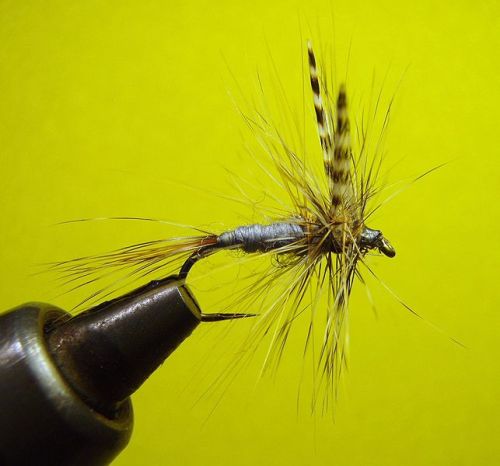
Adams Dry Fly, photo by Mike Cline

This Saturday (June 2, 2012) the Kingsley Library hosts the 1st Annual Adams Fly Festival. They will have northern Michigan fly rod maker R.W. Summers on hand (click for an interview with him on Absolute Michigan today). There will also be fly tying lessons, a silent auction with some great items, music, food and an original Adams fly on display.

In The Adams: History Revisited in Hatches magazine, Tom Deschaine writes that the Adams fly is probably the most famous fly in all of history.

It’s carried in the fly boxes of fishermen in every country where trout are found. It would probably be an understatement to claim that the Adams fly, with all its variations, has collectively caught more trout then any other fly pattern in existence. It can be used in a variety of waters, and, with its brownish-grayish coloration it imitates generally acceptable food items found almost anywhere in trout fishing environments. Most fishermen would agree that if they were allowed to use only one dry fly pattern — it would be the Adams (or some variation there of).

The story of the Adams begins just 12 miles south of Traverse City, Michigan, off County Road 611 in the small township of Mayfield. It was here, in 1922, at the Mayfield Pond where Leonard Halladay created the famous Adams fly.

Leonard Halladay (1872-1952) was originally from New York but his family, lured by the lumber industry, migrated to Mayfield when Leonard was just a young boy. As a growing young man he would see the last of the grayling and brook trout whose demise was brought about by over fishing, and habitat destruction from the logging industry. It was around this time when Michigan began introducing the German brown trout to its rivers.

…The historically accepted story goes on to say that on a summer’s day in 1922 at the impoundment of Swainston Creek known as the Mayfield Pond, Mr. Halladay said: “The first Adams I made I handed to Mr. Adams who was fishing in a small pond in front of my house, to try on the Boardman that evening. When he came back next morning, he wanted to know what I called it. He said it was a ‘knock-out’ and I said we would call it the Adams, since he had made the first good catch on it.”

Mike Cline took the photo and tied the fly. Click through to see it bigger.

You can visit Mayfield Pond in the Boardman Valley Nature Preserve, and you can see how to tie the Adams fly in this video.