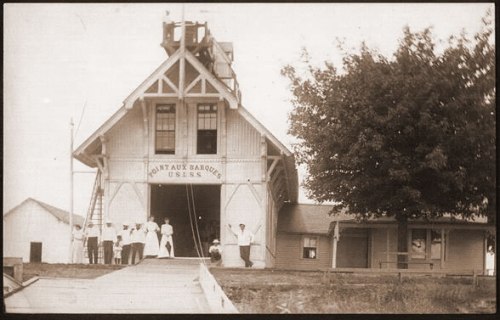
The Great Storm of 1913 at Pointe Aux Barques

The U.S. Life Saving Station, early 1900s, photo courtesy Pointe Aux Barques Lighthouse Society

Glen Willis of the Pointe Aux Barques Lighthouse Society has an excellent article on The Great Storm of 1913 that explains that most historians agree that the most significant and most dreadful storm on Lake Huron took place over the weekend of November 8-10, 1913. Known by all mariners simply as “The Storm”, it was first detected on the western end of Lake Superior on Thursday, November 6th then progressed rapidly south and east, dropping temperatures and spawning marine warnings.

At Pointe aux Barques as the temperature dropped, it began to rain. As the wind picked up the rain turned to sleet. The sleet began to ice up everything it touched. The waves offshore quickly reached 10 to 12 feet, and then more. Then the snow came, thick and wind driven. Shipmasters out on the lake were finding sailing conditions that were unlike any they had seen before. The sleet that had coated their vessels turned the pilothouse windows opaque. It sealed and froze the doorways. To step outside a cabin meant that the skin would be painfully pelted by frozen bits of sleet & snow…

By midday Sunday at Pointe aux Barques, the snow was so thick and so heavily driven by the wind that vessels out on the lake could not see the rays of the light. At nearby Harbor Beach waves had already destroyed some lakefront buildings and had run the 552-foot D.O. Mills ashore. At mid-lake the wheelsman on the 500 foot Howard M. Hannah, Jr. found that the forward motion of the ship had ceased and that the bow had fallen off into the trough of the waves. Without enough power to drive it the ship was at the mercy of the elements. Waves were higher than the ship is tall and as they crashed down upon the ship the windows and the cabins were stove in. The ship was not under command and as it drifted into Saginaw Bay the master could see the flash of the Port Austin Reef Light. He then knew that his ship would not be saved.

Read on for much more and also check out several articles on the deadliest storm in Great Lakes history on Michigan in Pictures and Freshwater Fury on Absolute Michigan.

Pointe aux Barques is the oldest continuously operating Light on the Great Lakes, and the Pointe Aux Barques Lighthouse Society preserves the light and operates a museum. Visit them for more!

More shipwrecks on Michigan in Pictures.
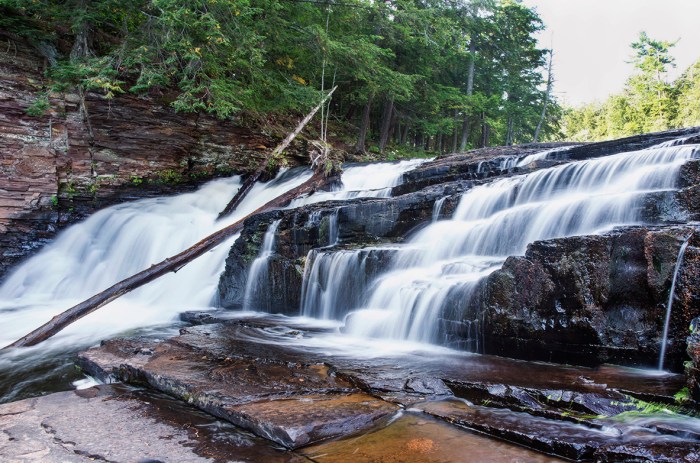
Nawadaha Falls and the Sweet Singer of Hiawatha

Nawadaha Falls

Nawadaha Falls, photo by Jason W Lacey

Should you ask me, whence these stories, whence these legends and traditions,
With the odors of the forest, with the dew and damp of meadows,
With the curling smoke of wigwams, with the rushing of great rivers,
With their frequent repetitions, and their wild reverberations,
As of thunder in the mountains.

I should answer, I should tell you: “From the forests and the prairies,
From the great lakes of the Northland, from the land of the Ojibways,
From the land of the Dacotahs, from the mountains, moors, and fenlands,
Where the heron, the Shuh-shuh-gah,  feeds among the reeds and rushes.
I repeat them as I heard them.
From the lips of Nawadaha, the musician, the sweet singer.”

~Henry Wadsworth Longfellow, The Song of Hiawatha

You may already be aware that one of the main purposes of this blog is to allow me to indulge in my passion for Michigan and its history. Names of the first people who dwelt in Michigan are of particular interest to me, and I was very gratified to discover not only that nawadjiwan is an Ojibway word meaning in the midst of the rapids, but also that it was the name of the singer who taught Longfellow The Song of Hiawatha.

I almost had to leave it there, but then I found a reference in Michael Witgen’s book An Infinity of Nations: How the Native New World Shaped Early North America.

Longfellow acknowledges Schoolcraft’s influence on veiled fashion, when he tells the reader he learned Hiawatha’s story “from the lips of Nawadaha.”  Few readers would realize that this was the Indian agent’s Ojibwe name. Logfellow asserts that Nawadaha had merely repeated these stories, not unlike himself and not unlike an Indian sitting in his lodge on long winter nights telling stories to amuse the children.

You can read on for the author’s puzzlement that Michigan Indian agent Henry Rowe Schoolcraft – himself married to a native woman Jane Johnston Schoolcraft (Oshauguscodawaquat) – would tell tales that are in large part false. As the Wikipedia entry on the Song of Hiawatha notes however,  Longfellow was far more concerned with excitement over accuracy and made numerous editorial decisions in the construction of his epic poem.

GoWaterfalling.com says that Nawadaha Falls is the upper most of the three falls along the Presque Isle Rivers final stretch.

This is a low, wide waterfall. Its width varies greatly depending on the water levels. Nawadaha Falls is similar to but a little higher than Manido Falls. The steepest part of the falls is on the eastern side, and when the river is low, most of the water flows there. There is a nice natural overlook out in front of this drop easily reached from the trail on the east side of the river.

South Boundary Road is not to far beyond Nawadaha Falls. You can cross river here and hike down the other side to make a loop around all the Presque Isle Falls. The eastern side is much wilder, but the whole hike is very enjoyable.

They add that Manabezho Falls is the larger and most interesting but that the whole hike is well worth it. To bring this full circle, the figure that Hiawatha is modeled on is the trickster god and emissary of the Great Spirit, Manabezho.

Check this out background bigtacular and see more in Jason’s great Michigan slideshow.

Many more Michigan waterfalls on Michigan in Pictures!

The Strongest Storm Ever on the Great Lakes

"October Gale" Grand Haven lighthouse, Grand Haven Michigan

“October Gale” Grand Haven lighthouse, Grand Haven Michigan, photo by Michigan Nut

As the eastern seaboard braces for Hurricane Sandy, a storm of possibly unprecedented power, I thought I’d take a look back and see what the strongest October storm ever was. I didn’t have to look far, as it’s actually the Great Lakes storm of late October 2010:

On October 26, 2010, the USA recorded its lowest pressure ever in a continental, non-hurricane system, though its pressure was consistent with a category three hurricane. The powerful system was dubbed the “Chiclone” by the media as it hit the Chicago area particularly strongly, as well as Minnesota, Wisconsin and Michigan. It was also meteorologically referred to as a bombogenesis due to the rapid drop of barometric pressure experienced.

…The storm also produced some of the highest officially recorded waves by weather buoys stationed in Lakes Superior and Michigan. Specifically, on Wednesday, October 27, 2010, buoy no. 45136, operated by Environment Canada, in northern Lake Superior recorded a significant wave height of 26.6 feet (this is average height of 1/3 of the highest waves over an hour), and buoy no. 45002, operated by the National Data Buoy Center (NDBC), recorded a significant wave height of 21.7 feet in northern Lake Michigan. The NDBC and many models indicate that multiplying significant wave height by a factor of approximately 1.3 will equal the approximate average height of the highest 1/10 of waves recorded -here that would translate into such average wave heights of approximately 34.5 feet and 28.2 feet on Lakes Superior and Michigan respectively [please verify]. This would appear consistent with the NOAA forecast for northern Lake Michigan calling for 21-26 foot waves that day. The persistence and strength of the storm’s westerly winds also piled the waters of Lake Michigan along the Michigan shoreline leading to declines in lake levels on the Illinois and Wisconsin side of the lake. Based on NOAA lake level sensors, an updated analysis of Wednesday, October 27, 2010 water levels on Lake Michigan revealed a two-day decrease of 42 inches at Green Bay, WI and 19 inches at Calumet Harbor, IL—while NOAA sensors at Ludington, MI and Mackinaw City, MI measured lake level rises of 7 and 19 inches respectively.

A 78 mph gust was recorded the afternoon of October 27, 2010 at the Harrison-Dever Crib, three miles offshore of Chicago in Lake Michigan.

You can read a detailed account of the damage in the October North American Storm Complex on Wikipedia and also read Dr. Jeff Masters’ analysis of the storm at Weather Underground.

Check this out on black and see more in John’s Grand Haven Lighthouse slideshow.

More Michigan weather on Michigan in Pictures.

The Ghost Keeper of Old Presque Isle Lighthouse

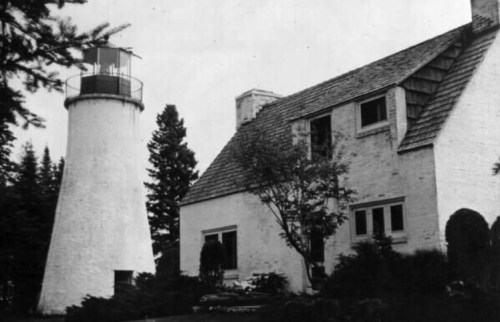
Old Presque Isle Lighthouse, photo courtesy Archives of Michigan

The Lightkeeper’s Ghost tells the tale of George and Loraine Parris who became the beloved caretakers of the Old Presque Isle Lighthouse, running the small museum and giving tours. George was something of a trickster and delighted in playing harmless tricks on visitors. He passed away in 1992, but the story doesn’t end there.

As Loraine was driving to the property on Grand Lake Road, which had a clear view of the lighthouse, she saw that it was illuminated.

She knew that the Coast Guard had rendered this impossible, but there it was before her. By the time that she arrived at the keeper’s house, though, everything was dark. The next day she climbed the steps of the lighthouse to make sure that everything was in order, and she saw that there was no way that someone could have turned the light on. Yet, this same pattern repeated itself again and again. Loraine never said anything about it because she thought that people might think her crazy.

Soon other folks began to see the light, however – a yellowish glow was reported from the lighthouse by several people. Some thought that the light had been put back into operation, but others drove out for a closer look, only to find that it was dark once again.

It was even spotted by members of the Air National Guard, who flew a few missions over the area, and by the Coast Guard, who investigated to make sure that no one could fire the light back up. It had been permanently disabled years before, so there was no way that the light could be shining. Yet it was. Many people believe that the spirit of playful old George is occasionally paying a visit to the lighthouse that he loved so much, just to let folks know that he’s doing just fine and to keep alive the stories of the lighthouse that he loved so much.

Read more about the history of the lighthouse from TexasEscapes.com and learn more about the light and visiting from the Presque Isle Township Museum Society.

This photo from Seeking Michigan and the Archives of Michigan was taken in 1963 at Old Presque Isle Light. See it bigger and check out more of their photos of the old and new lighthouses on Presque Isle.

More ghosts and ghost stories on Michigan in Pictures.

Michigan’s Most Haunted: Detroit Masonic Temple

NOTE: Upon further research, it appears that George Mason did not leap to death from the roof of the Masonic, but instead died in bed at the age of 92 in 1948. In my defense, the story of Mason’s suicide has been reported by a number of news outlets!!

The Masonic Temple

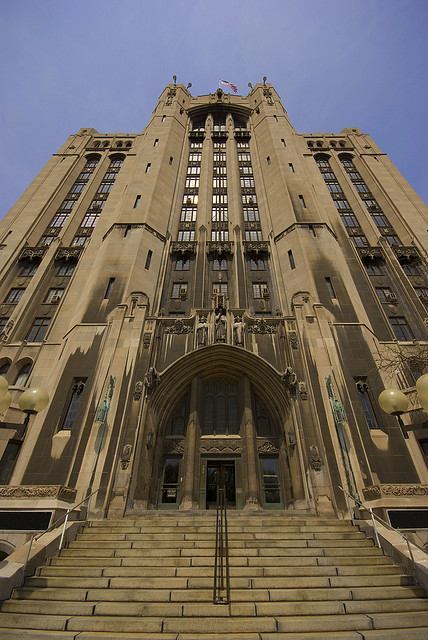
The Masonic Temple, photo by kc Jacoby Photography

Halloween is fast approaching and the Awesome Mitten has a great post on the Ten Most Haunted Places in Michigan. We’ve visited a few of those places on Michigan in Pictures, but #4 on the list, The Masonic Temple in Detroit, was spooky, cool and new:

Built in 1912 by a wealthy gentleman named George D. Mason, the Detroit Masonic Temple has over 1,000 rooms, and several secret staircases, concealed passages, and hidden compartments in the floors. Mr. Mason went slightly overboard when financing the construction of the building, and eventually went bankrupt, whereupon his wife left him. Overwhelmingly depressed about his financial and personal circumstances, Mason jumped to his death from the roof of the temple. Security guards claim to see his ghost to this day, ascending the steps to the roof. The temple, abundant with cold spots, inexplicable shadows, and slamming doors, is known to intimidate visitors with the eerie feeling of being watched…

Read on for more and share any thoughts you have on these or other haunted Michigan places in the comments below!

The Detroit Masonic Temple is the largest masonic temple in the world, and you can get all kinds of pictures and history including some shots from construction on their website. The theater has its own site as well for events and this weekend they are going Beyond the Other Side.  One note about George Mason is that in addition to the masonic temple, he also designed several other Michigan buildings including the Detroit Yacht Club and the Grand Hotel on Mackinac Island. See Historic Detroit for more.

While it may feel like the Ken Jacoby show with 2 appearances in just a week, his shot was the most brooding of the many interior and exterior photos of the temple in the Absolute Michigan pool. Check it out on black and see more in Ken’s The Masonic Temple slideshow.

More ghostly fun on Michigan in Pictures and also at absolutemichigan.com/ghost!

Mackinac Island’s Devil’s Kitchen and the Red Geebis

mackinaw island

mackinaw island, photo by amanda vanvels

One of my favorite books as a kid was Lore of the Great Turtle by Dirk Gringhuis. The book has some of the rich legends of Mackinac Island. One is the tale of the Red Geebis and Devils Kitchen, retold by Tehuti_88. It begins:

A long time ago an old man, Aikie-wai-sie, was left behind on Mackinac Island when the rest of the tribe departed for the winter hunting grounds on the mainland. Left behind with him was his young granddaughter, Willow Wand, and the old man was greatly upset that she too would have to remain with him since they had no canoe by which to escape the island. Still, Willow Wand had refused to leave the old man behind, since he was blind and couldn’t fend for himself; but her decision pained him.

“You should have returned with them to the mainland, because Keewenaw will seek you there,” he told her, referring to her beloved.

Willow Wand shook her head. “I’ve left a white deerskin with vermillion spots upon the cliff,” she said. “The fishermen will see it, and Keewenaw will come to rescue us.”

That having been done, they moved up onto a cliff projecting from the side of the bluff, to live upon until they should be rescued. This cliff, and the cave upon it, were just above a cave known as the Devil’s Kitchen, for in this cave lived the Red Geebis, who were cannibal giants. The Geebis were known to roast and eat humans inside this cave, and so Willow Wand and her grandfather had to remain upon their ledge and out of the Geebis’ sight in order to remain safe. Because of this, they could not even go down to the lake for water, even though the shore was just below. They had not been left with much food and so the old man knew that their time there would be rough…

And how. Read on for the rest of the story of Devil’s Kitchen on Mackinac Island.

See Amanda’s photo on black.

More from Mackinac on Michigan in Pictures.

Detroit Tigers are headed to the World Series!

Tigers get ALCS sweep

Tigers get ALCS sweep, photo by Detroit News

Last night the Detroit Tigers completed a 4-0 shellacking of the New York Yankees in the American League Championship Series. Watch the final out of last night’s 8-1 victory from the Tigers and many more video highlights from the celebration.

Wikipedia’s Detroit Tigers entry notes that the Tigers have won the American League pennant 11 times, winning the World Series four of those times in 1935, 1945, 1968, and 1984.

With a lineup that featured four future Hall of Famers (Hank Greenberg, Mickey Cochrane, Goose Goslin and Charlie Gehringer), the Tigers won the World Series in 1935, defeating the Cubs, 4 games to 2. Game 6 concluded with Goslin’s dramatic game-ending single, scoring Cochrane to seal a 4–3 victory.

With the end of World War II and the timely return of Hank Greenberg and others from the military, the Tigers took the 1945 American League pennant. With Virgil Trucks, Hal Newhouser and Dizzy Trout on the mound and Greenberg leading the Tiger bats, Detroit responded in a Game 7 for the first time, staking Newhouser to a 5–0 lead before he threw a pitch en route to a 9–3 victory over the Cubs.

In the 1968 World Series, the Tigers met the defending World Series champion St. Louis Cardinals, led by starter Bob Gibson (who had posted a record 1.12 ERA during the regular season) and speedy outfielder Lou Brock. In Game 7 at Busch Memorial Stadium, Lolich, also pitching on two days’ rest, faced Gibson. Both men pitched brilliantly, putting zeros up on the scoreboard for much of the game. For his three victories that propelled the Tigers to the World championship, Lolich was named the World Series Most Valuable Player.

The Tigers led their division wire-to-wire in 1984, from opening day and every day thereafter, culminating in the World Series championship over the against the San Diego Padres. This had not been done in the major leagues since the 1927 New York Yankees. With the win Sparky Anderson became the first manager to win the World Series in both leagues.

See this photo on black and see more in the Detroit News’ slideshow.

More Detroit Tigers photos & history from Michigan in Pictures!

Castle Rock, a Natural Lookout

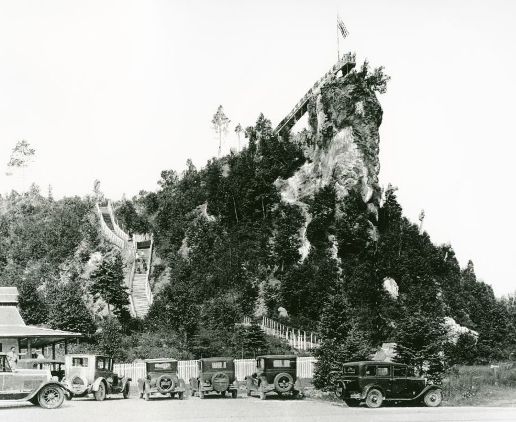
Castle Rock, circa late 1920s or early 1930s, photo courtesy Seeking Michigan

This morning I saw a photo of Castle Rock in the Absolute Michigan group on Flickr that made me wonder about the history of this iconic UP tourist stop. Bob Garrett of the Archives of Michigan has the story in A Natural Lookout at Seeking Michigan:

The Upper Peninsula contains a wealth of great scenery. One might wish to climb to a high point and “take it all in.” Fortunately, nature sometimes provides a natural lookout. One such lookout is Castle Rock.

Castle Rock is located near St. Ignace, on the Upper Peninsula side of the Straits of Mackinac. The Rock is a natural limestone tower, standing nearly two hundred feet above lake level. Wind and water erosion have shaped it into a sort of “castle.” Visitors who climb the 170 steps to the top will receive a stunning view. Looking left to right, one can see St. Martin Island, Marquette Island in Les Cherneaux (on a clear day), the town of St. Ignace, ferries coming to and from Mackinac Island and the top of the Mackinac Bridge.

Castle Rock had been an ancient lookout of the Ojibway tribe, who often called it “Pontiac’s Lookout.” A company named Norton and Lund purchased the site around 1927. Norton and Lund built a stairway to the top of the Rock, opened a souvenir stand and made cabins available for tourists.

Shortly thereafter (Sources differ on the date.), a St. Ignace photographer and businessman named Charles Clarence Eby (1890-1961) bought the property. Eby hoped to increase tourism, and he used his photography skills toward that end. He launched a high volume postcard business, and his postcards and other promotional material drew people to the Upper Peninsula and the St. Ignace area.

Around 1958, statues of the mythical lumberjack Paul Bunyan and his blue ox, Babe, were built at the foot of the stairs. These were handcrafted by Calvin Tamlyn, who was Eby’s son in law. They still greet visitors today.

Castle Rock can be found north of St. Ignace, along I-75. Take exit 348, and you’ll be there. For more information, see the Castle Rock Web site.

You can head over to Seeking Michigan for more including some books in Michigan libraries, a photo of Paul & Babe and also a stereoscopic pic from the 20s. There’s a little more info on Wikipedia, including a panorama of the view from the top of the rock.

Seeking Michigan is the web site of the Archives of Michigan and it’s packed full of articles like this in their Look section and also an extensive & searchable Michigan photo archive.

More roadside attractions on Michigan in Pictures.

Remembering the Mad Duck, Alex Karras of the Detroit Lions

Alex Karras of the Detroit Lions, 1971 AP file photo

“It takes more courage to reveal insecurities than to hide them, more strength to relate to people than to dominate them, more ‘manhood’ to abide by thought-out principles rather than blind reflex. Toughness is in the soul and spirit, not in muscles and an immature mind.”
~Alex Karras

Yesterday Alex Karras, All-Pro defensive lineman for the Detroit Lions passed away at the age of 77. Karras followed up with a sucessful career as a pro wrestler and as an actor in movies and on TV’s Webster. The New York Times obituary of Alex Karras reads in part:

Karras, at 6 feet 2 inches and 248 pounds — large then but smaller in comparison with today’s N.F.L. linemen — first earned fame as a ferocious tackle for the Lions. He anchored the defensive line for 12 seasons over 13 years, 1958 to 1970.

It was an era when the N.F.L. had abundant talent at the position; Karras’s contemporaries included the Hall of Famers Bob Lilly and Merlin Olsen. But Karras was an especially versatile pass rusher, known around the league for his combination of strength, speed and caginess. His furious approach — Plimpton described it as a “savage, bustling style of attack” — earned him the nickname the Mad Duck.

“Most defensive tackles have one move, they bull head-on,” Doug Van Horn, a New York Giants offensive lineman who had to block Karras, said in 1969. “Not Alex. There is no other tackle like him. He has inside and outside moves, a bull move where he puts his head down and runs over you, or he’ll just stutter-step you like a ballet dancer.”

Karras was named to four Pro Bowls, and he was a member of the N.F.L’s All-Decade team of the 1960s. He was not elected to the Hall of Fame, however, which has sometimes been attributed to the fact that the Lions fielded mostly undistinguished teams during his tenure. In Karras’s only playoff game, the Lions lost to the Dallas Cowboys by the unlikely score of 5-0 in 1970.

Read on at the Times for lots more. Some of my favorite Karras items:

Greensky Hill … and Greensky Bluegrass

Greensky Hill Indian Mission Church

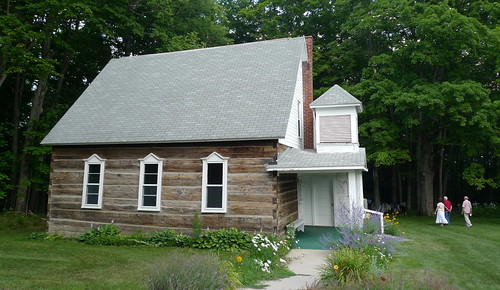
Greensky Hill Indian Mission Church, photo by jhhymas

Today’s post is in the “Stories I Found When Exploring Other Stories” category. Over on Absolute Michigan today we’re giving away two pairs of tickets to the October Festival at the Commons this Friday night in Traverse City. Greensky Bluegrass is a great band that tours nationally but hails from Michigan, and if you’re interested in seeing them and enjoying this festival in my backyard, click here to check it out & enter to win.

The Michigan Historical Marker text for Greensky Hill Mission via michmarkers.com reads:

Here in the 1840’s the Chippewa Indian missionary, Peter Greensky, established a Protestant mission in an area where legend says Indian chiefs once held their councils. New trees have been planted in an arrangement similar to that of the trees that made up the original council circle. Mission services first were held in a rude building of boughs and bark. In the 1850’s the Indians built the present church. It is a fine example of the old log style construction with hand-hewn timbers and notched corners. Windows, doors, and much of the lumber were brought by canoe from Traverse City to Pine Lake (now Lake Charlevoix) and then carried two miles to this site. Methodist services for the Indian congregation have been held here regularly to the present.

The Greensky Hill Indian Mission United Methodist Church adds that Peter Greensky started his preaching in the Leelanau area in the 1830s, serving as a guide and interpreter for his missionary Peter Doherty before acquiring a following of his own as a strong preacher with great influence among his people. His congregation traveled with him to the Charlevoix area. In 1860 he was put in charge of the all-Indian Pine River Mission, now known as Greensky Hill where he served there until his death in 1866.

June adds that her son-in-law’s mother was Ovenia Greensky Shomin, a direct descendant of the founder of this church. Check this out background big and see lots more photos of the mission and grounds (including details of the logs) in her Greensky Hill slideshow.

More Michigan churches on Michigan in Pictures.