McGulpin Point Lighthouse on the Straits of Mackinac

McGulpin Point Lighthouse Emmet County

McGulpin Point lighthouse circa 1900, courtesy Emmet County Davenport collection/Terry Pepper

Terry Pepper’s Seeing the Light says that McGulpin Point Lighthouse entry tells the story of this point at the tip of Michigan’s mitten from circa 1000 BC when the great Odawa war chief Sagemaw more or less wiped out the Mus-co-desh tribe for an insult to the Odawa to when John McAlpine and his Native American wife settled on McGulpin Point in the 1760s. Their son Patrick McGulpin was given the patent on this land and the first recorded deed in Emmet County in 1811.

With the opening of the Erie Canal in 1825, Americans started to flood to the Chicago area. During the 1850s, vessel traffic through the Straits of Mackinac was increasing rapidly, and while the Waugoshance Light marked the western entry into the Straits, and the Bois Blanc Island light marked the eastern entry, the absence of a navigational aid within the shoal-ridden Straits themselves made passage during darkness and periods of low visibility extremely dangerous. To answer that need, the Lighthouse Board petitioned Congress for the construction of a lighthouse and fog bell at McGulpin Point, approximately two miles west of Fort Michilimackinac. Congress responded favorably to the request on August 3, 1854 with the appropriation of $6,000 for the station’s construction.

However, as a result of difficulties in obtaining clear title to the land, no action was taken on the station’s construction for more than a decade. With the original appropriation unspent and expired, the Board again petitioned Congress for the construction of a station at McGulpin Point in 1864, this time receiving $20,000 for the project on July 26, 1866.

Work began at McGulpin Point early in 1869, and the station was built as a mirror image of the design used at Chambers Island and Eagle Bluff lights under construction in the Door County area that same year. This plan, which is sometimes referred to as the “Norman Gothic” style, was also later also used at Eagle Harbor in 1871, White River in 1875, and at Passage and Sand Islands in 1882. (click for photos of these lights)

The keepers dwelling and integrated tower were constructed of Cream City brick with the tower integrated diagonally into the northwest corner of the dwelling. The first and second stories of the tower were approximately ten feet square with buttressed corners, while the tower’s upper portion consisted of a ten-foot octagon. Similar to other stations built on this plan, the tower is double-walled with a circular inner wall approximately four inches thick and eight feet in diameter to house a set of cast iron spiral stairs. The tower was capped with a prefabricated decagonal cast-iron lantern and outfitted with a fixed white Third-and-a-half Order Fresnel lens.

You can learn a lot more if you read on at Seeing the Light including the role the light played in knowing when the lakes would be opened for navigation, the role of Keeper Davenport and his 9 children in the rescue of the Waldo A. Avery, how the light was decommissioned in 1906 after the construction of Old Mackinac Point Lighthouse and passed into private hands and its return to the public domain.

Today McGulpin Point Lighthouse is an Emmet County park and open to the public. There’s many resources including the McGulpin Point brochure and some photos from a 2012 CMU archaeological dig.

You can see more photos by clicking through. Also check out the McGulpin Point slideshow from the Absolute Michigan pool on Flickr for some modern day photos!

Many more Michigan lighthouses on Michigan in Pictures.
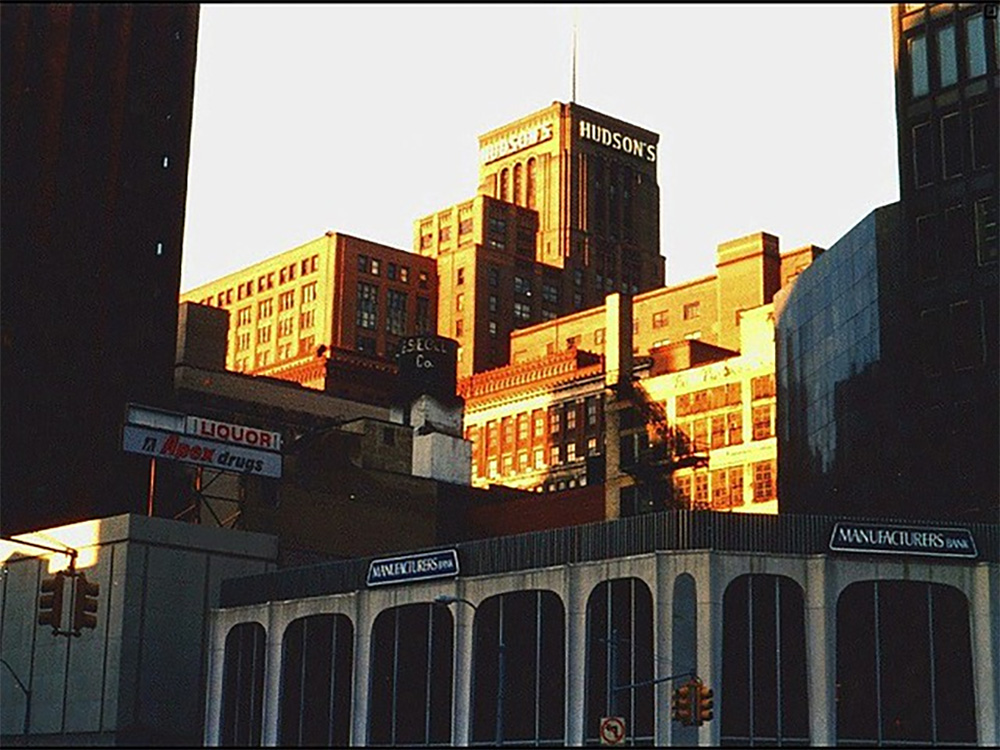
Hudson’s, a Detroit Icon

JL Hudsons Detroit by John Honeyman

hudsons, photo by johnhoneyman

One of the signs that the holidays are approaching that I see on Michigan in Pictures is a surge of visits to the post about Holiday Shopping at J.L. Hudson in Detroit. Hudson’s was demolished in 1998, but the store remains a cherished memory for many.

Wikipedia’s entry for the J.L. Hudson Department Store and Addition says that the building was designed by Smith, Hinchman, & Grylls and named after the company’s founder, Joseph Lowthian Hudson. Construction began in 1911 with many additions throughout the years before being “completed” in 1946. Hudson’s Department Store at Historic Detroit has some great photos and a lot of facts:

  • The store was 2,124,316 square feet, making it second in size among department stores to only Macy’s in New York. Even then, Macy’s is only 26,000 square feet bigger.
  • The store was spread out over 32 floors: 25 floors, two half-floors, a mezzanine and four basements.
  • At 410 feet, Hudson’s was the tallest department store in the world.
  • The building had 51 passenger elevators, 17 freight elevators, eight employee elevators and 48 escalators. Its largest freight elevator could accommodate a semi trailer.
  • Hudson’s had to have three transformer centers in the store: They generated enough juice to power a city of about 20,000.
  • The store had 39 men’s restrooms, 50 for women and 10 private ones for executives. The largest was a women’s lounge on the fourth floor that had a whopping 85 stalls.
  • It had 705 fitting rooms, a world record.
  • The dining rooms and cafeterias served an average of 10,000 meals a day – not counting the 6,000 meals a day served in the employee cafeteria on the 14th floor. The 13th floor dining room was renowned for its Maurice salad and Canadian cheese soup.
  • The store originally had 18 entrances and 100 display windows, which were changed weekly.
  • The store featured more than 200 departments across an incredible 49 acres of floor space, and it featured about 600,000 items from 16,000 vendors from 40 countries. The building had 51 elevators serving its 17 floors of retail.

Much more at Historic Detroit and you will also want to check out Hudson’s in the Department Store Museum, a Hudson’s photo tour from Detroit Yes and a nice video of photos of Hudson’s.

Check this out on black and see more in John’s arkitektura slideshow.

Support Michigan in Pictures with Patreon

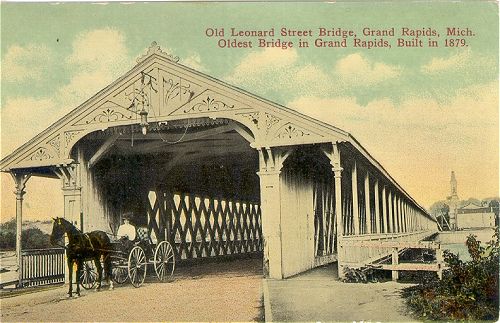
Old Leonard Street Bridge in Grand Rapids

leonard street bridge

Old Leonard Street Bridge, by Peter Oosse

When I was researching last week’s post on Michigan’s longest covered bridge, I found a neat feature about the historic bridges of Grand Rapids. It looks at three bridges, the Bridge Street Bridge, the Pearl Street Bridge and the Leonard Street Bridge:

In 1879, at a time when other bridges were being replaced by wrought iron spans, a new covered bridge was erected by City Engineer William Seckel at the Leonard Street crossing. This bridge, at a length of 832 feet, earned the distinction of being the longest covered bridge ever built in the State of Michigan. This ornately portaled, lattice truss bridge served the city’s traffic until 1913.

Click through for more and also see another view of Leonard Street Bridge.

The photo reads Old Leonard Street Bridge, Grand Rapids, Mich. Oldest Bridge in Grand Rapids, Built 1879. It’s from early 1900s by photographer Peter Oosse and you can see more shots from turn of the century Grand Rapids in the collection of William Blik at WellWooster.com. There’s a lot more Grand Rapids history there too!

Much more Michigan history on Michigan in Pictures.

Michigan Architect Minoru Yamasaki

Roofline: DeRoy Auditorium, Wayne State University--Detroit MI

Roofline: DeRoy Auditorium, Wayne State University–Detroit MI, photo by pinehurst19475

“When people go into good buildings there should be serenity and delight.”
~Minoru Yamasaki

Minoru Yamasaki  (December 1, 1912 – February 7, 1986) was an American architect best known for his design of the Twin Towers of the World Trade Center who ended up making his home in Michigan.

The Detroit News has a feature titled world-class architect Minoru Yamasaki that gives a good overview of the architect and his somewhat tumultuous life, and you should also read the Seeking Michigan feature on Yamasaki and his Michigan architectural practiceMichigan Modern has a list of Yamasaki designed buildings in Michigan as well.

Check this out background bigtacular and see more in Anthony Lockhart’s Wayne State and the Cultural Center slideshow.

More architecture on Michigan in Pictures.

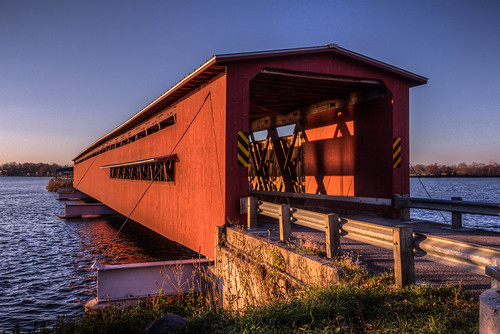
Langely Covered Bridge is Michigan’s longest

Langley Covered Bridge, Centreville, Michigan

Langley Covered Bridge, Centreville, Michigan, photo by bill.d

Bill writes this of the Langely Covered Bridge over the St. Joseph River, a Michigan Registered Historic Site:

This is the longest of Michigan’s few remaining covered bridges. It is 282 feet long with three, 94-foot spans of the Howe-truss construction. The bridge was built in 1887 by Pierce (?) Bodner of Parkville, using the best quality white pine for the frame timbers. The bridge’s name honors a pioneer Centreville family. When the Sturgis Dam was built in 1910, the Langley Bridge had to be raised eight feet. In 1950-51 extensive repairs and replacement of parts on the bridge were carried out by the St. Joseph County Road Commission to preserve for the future this historic link with a bygone era.

Personal note – the bridge is only one lane wide. Drivers take turns crossing the bridge, but this is a part of Michigan that doesn’t see much traffic anyway, so the wait is seldom long. The speed limit on the bridge is 15 mph.

Wikipedia’s entry on the Langley Covered Bridge adds that it was named for Thomas W. Langley and his family, the first settlers who helped establish the village of Centreville in St. Joseph County in the mid-19th century.

Check it out as big as a bridge and see more in Bill’s Michigan: Saint Joseph County slideshow.

More Michigan bridges on Michigan in Pictures!

The Iron River Meteorite and the Meteorites of Michigan

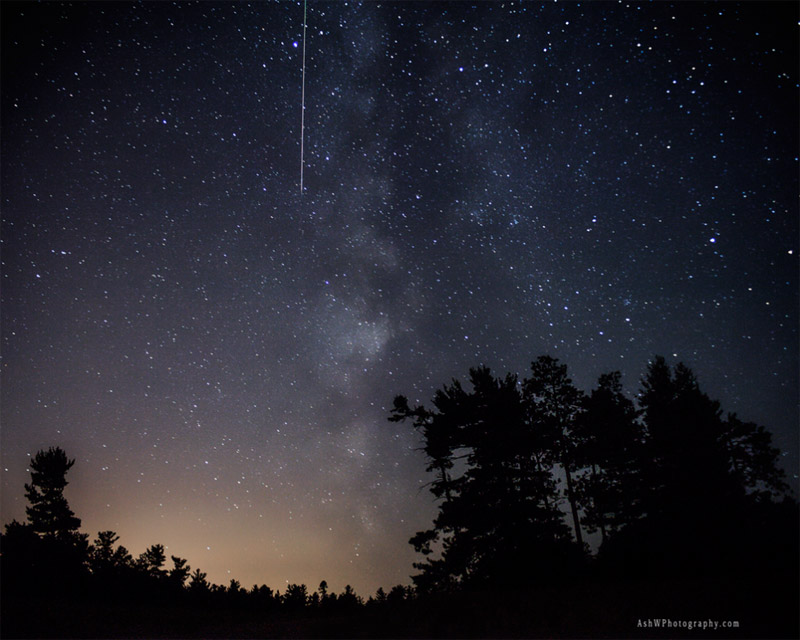
Meteor-Over-Marquette

Meteor over Marquette, photo by Ash W Photography

Recently in Peter Peterson and the Iron River Meteorite on Yooper Steez, Alice Rossignol remembered a day in 1889:

…when a six-year old boy named Peter Peterson (yes, this was actually his name) was helping his father clear rocks from a field near Iron River.

Things were proceeding as usual (I’m assuming) when little Peter noticed that one rock was much heavier than others of the same size. He showed the 3.13-pound whopper to his father who told him to toss it like the others.

But Peter, being a six-year old boy, kept it.

According to Von Del Chamberlain, a former MSU professor who recounts this story here, the rock was later identified as a meteorite, a fact which he later confirmed.

How rare are confirmed meteorites? There have only been 10 verified in Michigan, and this meteorite is currently the only verified meteorite in the Upper Peninsula. Read on for more about this story and some meteorwrongs (mis-identified meteorites) and dig into Prof. Del Chamberlain’s account for the scientific lowdown and how it ended up in Chamberlain’s hands almost 80 years later. You can also read the entirety of Chamberlain’s publication Meteorites of Michigan online.

Ashley took this photo in August 2012 during the Perseid meteor shower. Check it out big as the sky and in her Nature Gallery.

More meteors on Michigan in Pictures. If you’re wanting to see some, the Geminids are on tap for the night of December 13th!

111 Years of over the river at Hines Park

Hines Park, Livonia, MI, November, 2012

Hines Park, Livonia, MI, September, 2012, photo by Norm Powell (napowell30d)

Nice shot from Hines Park in Livonia. Here’s hoping everyone and their guests have safe travels this holiday whether you’re headed over the river, through the woods or somewhere else.

Check this out background big and see more in Norm’s slideshow.

More bridges on Absolute Michigan.

Remembering Helen Milliken

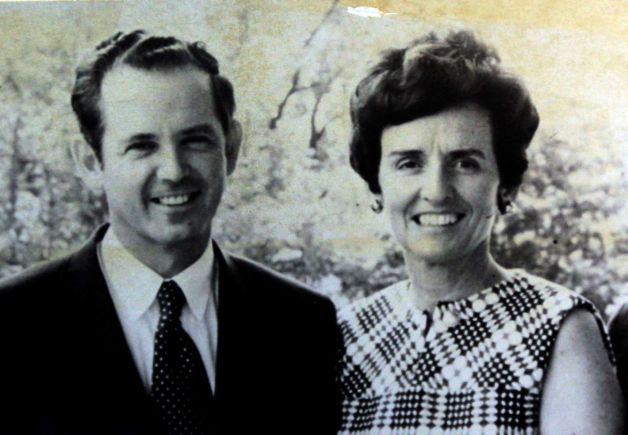
Bill and Helen Milliken, photo from AP archives

My beliefs are not particularly unique. It’s just that I’m now in a position to do something about them.
~Helen Milliken

Yesterday Helen Wallbank Milliken passed away at the age of 89 in Traverse City. Helen was the wife of Michigan’s longest serving Governor William Milliken. Her entry in the Michigan Women’s Hall of Fame says in part:

Helen Milliken, wife of the former Governor of Michigan, has long been identified with women’s issues and concerns. She was a distinguished national co-chair of ERAmerica and traveled throughout the country speaking on behalf of the Equal Rights Amendment. She also freely gave her time and energy to raising needed funds to support this major cause. In addition, she was a convener of the International Women’s Year Delegation in Michigan and a member of the delegation to the IWY Conference, which met in Houston in 1977. She is associated with The Women’s Research in Education Institute in Washington, D.C., and chaired the National Women’s Conference Committee.

Helen Milliken has been a major patron of the arts in Michigan. She was in no small measure responsible for the development of a state public arts project and for the growth in public support of the arts.

…Independent, committed, and principled, Helen Milliken never sought, but never shrank from controversy. When her commitment to equality conflicted with her political loyalties, she clearly chose the former. Her choice, her service, and her spirit have enriched the lives of countless Michigan citizens.

The Detroit Free Press has an excellent article that includes a photo gallery of Helen Milliken. along with reminisces by those who worked with her in public life.  One of these, former press secretary & chief of staff to Gov. Milliken George Weeks,  looks at the many causes Helen championed.

The Michigan Land Use Institute has a page where some of the people who remember their longtime board member and supporter Helen Milliken – click to view it.

Remembering Detroit Boxing Legend Emanuel Steward

Emanuel Steward's boxing clinic

Emanuel Steward’s boxing clinic, photo by yousef_anani

Boxing legend Emanuel Steward, one of the greatest trainers ever, was remembered yesterday in Detroit. The entry for Emanuel Steward at the International Boxing Hall of Fame begins:

Steward, who was born in West Virginia in 1944, has been one one of the most successful trainers and managers in the last two decades of the 20th century.

Like many young men, he started boxing after receiving a pair of boxing gloves as a gift. The youngster boxed in informal matches that his father set up. When his parents separated, he moved with his mother to Detroit. By age 12, he was training at the Brewster Recreation Center, which had been the boxing home of Joe Louis and Eddie Futch. As an amateur, he ran up a record of 94-3, which culminated with a 1963 National Golden Gloves title. Steward than began training amateur fighters, but eventually gave that up and found full-time employment as an electrician.

But boxing was in his blood. In 1971, he was asked to look after his half-brother James, who was 15 at the time. Steward took him to a nearby gym called, the Kronk. It wasn’t long before Emanuel was coaching again. In 1971, his charges dominated the Detroit Golden Gloves, winning seven championships. A year later, he left the security of a full-time electrician’s job, and turned his attention to boxing, and the Kronk.

By the mid-70s he had built the gym into a national power, and two of his charges, Thomas Hearns and Hilmer Kenty came close to making the ’76 Olympic Team. A year later, the two turned pro with Steward serving double duty as their trainer and manager. On March 2, 1980, Kenty became Steward’s first world champion when stopped Ernesto Espana in the fourth round to win the WBA lightweight crown.

Five months later Hall of Famer Thomas Hearns stopped Pipino Cuevas with a blistering second-round kayo to become champion No. 2.

Wikipedia’s Emanuel Steward entry lists some of the fighters he trained including Hearns, Evander Holyfield, Wladimir Klitschko, Lennox Lewis and Julio César Chávez. It adds that his heavyweight fighters had a record of 34-2-1 combined in title fights. The Freep has a nice video with boxers Thomas Hearns, Sugar Ray Leonard and Lennox Lewis remembering Steward that also includes a bit of Aretha Franklin singing. You may also want to read this article in the New York Times or watch this ESPN tribute to Steward.

Yousef Anani took this photo at an Emanuel Steward’s boxing clinic in London last year. See it bigger and view more in his Emanuel Steward slideshow.

The Armistice Day Storm of 1940

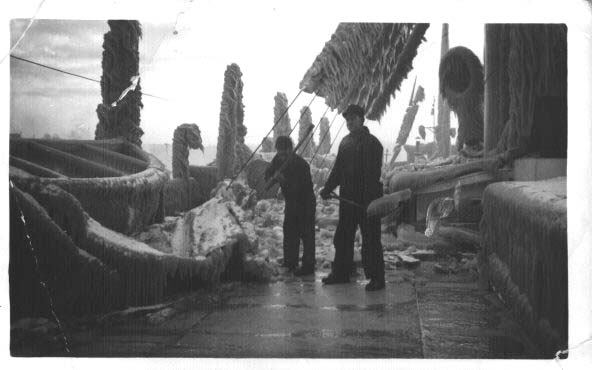
Chipping ice from the City of Flint

Chipping Ice on the City of Flint, photo by Captain John Meissner

Wikipedia explains that the Armistice Day Blizzard struck November 11  (Armistice Day) and November 12, 1940. The intense early-season “Panhandle hook” winter storm cut a 1,000-mile-wide path through the middle of the country from Kansas to Michigan.  Carferries.com has a great article on The Armistice Day Storm of 1940 that begins:

The “storm” of November 11, 1940 was one of the worst storms in the recorded history of Lake Michigan. In all, the storm claimed 5 vessels, and 66 lives. The storm occurred on Armistice Day, which celebrated the end of World War I in 1918.

The storm hit late Monday afternoon, November 11th, with winds of hurricane proportions. The winds struck suddenly from the southwest at about 2:30 P.M. and were accompanied by drenching rain, which later changed to snow. The winds reached peak velocities of 75 miles per hour, the highest in local maritime history. Telephone and power lines were down by the hundreds around Mason County. Several local firms had “gaping” holes where roofs once were. Trees were uprooted, small buildings were overturned, and brick walls were toppled, causing at least 1 serious injury. Very few places escaped without damage. Ludington, on the morning of November 12th, appeared to be a deserted city.

The Pere Marquette carferry City of Flint 32, attempted to make the harbor but wound up on the beach about 300 yards from the shore. She was ordered by her relief captain, Jens Vevang, to be scuttled to avoid being pounded by the incoming seas. On November 12th, a breeches buoy was strung and 27 year old crewman Ernest Delotowski of 406 First Street, Ludington, was brought ashore. Delatowski made a good portion of the trip in the icy waters of Lake Michigan. As a precautionary measure, he was taken to Paulina Stearns Hospital and was released later that day. He said he carried a message with him, but it got lost in the water. Later the buoy was used to carry a message to the ship, and then crewman Luther Ryder of S. Washington Avenue (Ludington) was brought ashore.

You can read more including first-hand recollections of the storm and also see more photos taken by Captain John Meissner and also photos of the grounding and other wrecks as a result of the storm at carferries.com.

More shipwrecks on Michigan in Pictures.