April 4th: The Battle for Wexford County

manton-michigan

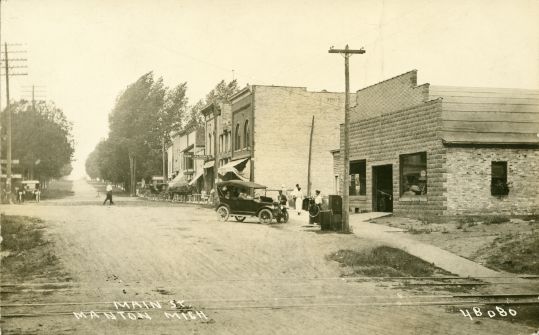
Main Street in Manton, circa 1915, photo courtesy Seeking Michigan

Battle for Wexford County by Brenda Irish of Seeking Michigan begins:

The fight for the Wexford County seat is a story of bribery, corruption, intimidation, inebriated county officials and the organization of illegal townships to boost votes.

Cadillac’s decade-long struggle for the county seat came to a head on April 4, 1882, when ballots were cast throughout the county to determine whether the coveted prize should be moved from Manton to Cadillac. Twelve months earlier, residents of Cadillac and Manton had united to remove the county seat from Sherman to Manton. Now Cadillac was determined to secure the prize for itself.

Feeling duped by Cadillac, Manton residents were furious. A couple of townships destroyed their ballots, refusing to make a return. But when the “official” count of the April 4 vote was totaled, the results were overwhelming: 1,363 “yes” voters favored moving the county seat to Cadillac, while 309 voted “no.”

In the early dawn following the election, a train left Cadillac with the sheriff and twenty “specially deputized” men and headed to Manton to collect the county property. Legend has it that the train backed quietly into a sleeping Manton, coming to a halt in front of the courthouse. Within a half hour, most of the county records and much of the furniture was aboard the train. As the Cadillac faction attempted to remove the first of three safes from the courthouse, however, Manton residents awoke…

Read on at Seeking Michigan for the contested conclusion and more photos from Wexford County.

More history on Michigan in Pictures.

Holland Harbor’s Big Red Lighthouse and the Red Right Return

Big Red

Big Red, photo by Rick Lanting

Sometimes I see photos of certain places so much that I figure I’ve said all there is to say about them. Such was the case with one of one of Michigan’s most iconic lighthouses. I realized that although I’d seen hundreds of photos, I had no idea how “Big Red” in Holland got its name. Terry Pepper’s Seeing the Light tells the story of the Holland Harbor Light from the construction of a timber frame beacon on the south pier in 1870 up until the 1930s when:

The Holland Lights were electrified in 1932. Equipped with a 5,000 candlepower incandescent electric bulb, the Fourth Order lens was now visible for a distance of 15 miles. The old steam-operated ten-inch fog whistle was removed from the fog signal building the following year, and replaced with an air operated whistle powered by an electric motor-driven compressor. In 1936, a square tower was erected at the west end of the fog signal building roof peak, and capped with an octagonal cast iron lantern, the lens from the pierhead beacon moved into the new lantern. The steel pierhead beacon was then removed from the pier and shipped to Calumet, where it was placed at the south end of the breakwater.

A Coast Guard crew arrived in Holland in 1956, and gave the combined fog signal building and lighthouse a fresh coat of bright red paint in order to conform to its “Red Right Return” standard, which called for all aids to navigation located on the right side of a harbor entrance to be red in coloration. Local residents thus began referring to the fifty year old structure as “Big Red,” a name which has stuck through the years. The Fourth Order lens was subsequently removed from the fog signal lantern in the late 1960’s, and replaced with a 250 mm Tidelands Signal acrylic optic.

Much more including photos at Seeing the Light.

Check this out Big Red big and see more in Rick’s Lighthouses or Hipstamatic slideshows.

Many more Michigan lighthouses on Michigan in Pictures!

La Marche du Nain Rouge

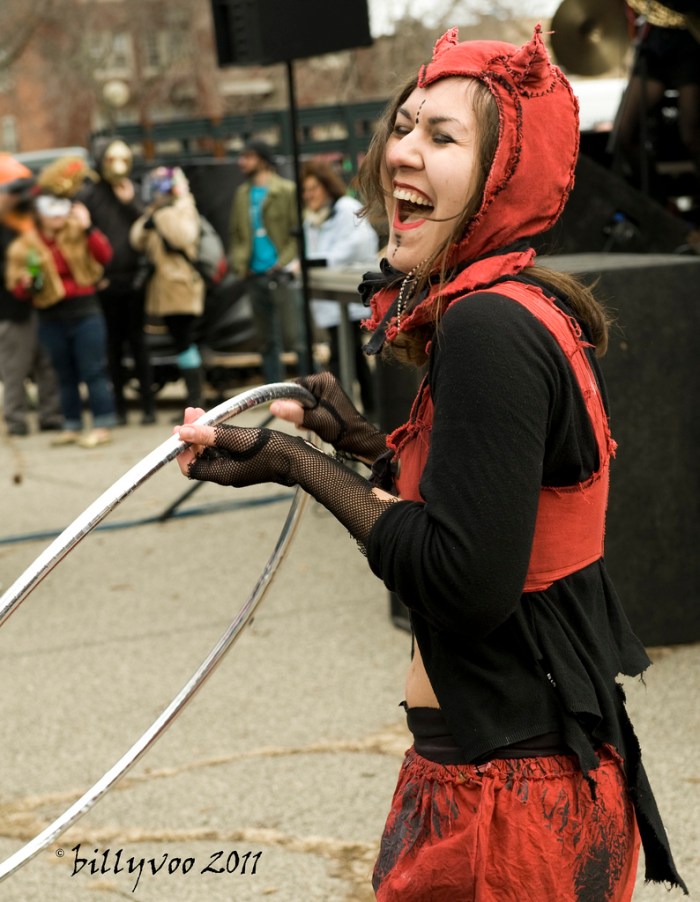
Ms Nain Rouge

Detroit MI, photo by billyvoo

Over 300 years ago, around the same time the city of Detroit was founded, an evil was discovered in and around the city. An evil that has plagued the people and the city, and even wrecked havoc upon the founder of Detroit, Antoine de la Mothe Cadillac. This ‘evil’ was said to have been a Nain Rouge, other wise known as the “red dwarf of Detroit.”
~La Marche du Nain Rouge

La Marche du Nain Rouge is held every year on the Sunday following the spring equinox. That’s Sunday March 24, 2013, and they explain:

La Marche du Nain Rouge is an annual Detroit tradition that purportedly dates back to shortly after the city’s founding by the French in 1701. Annually held on the Sunday closest to the Vernal (Spring) Equinox, it is parade and street theater similar in sensibility to Mardi Gras and other Carnival celebrations. However the impetus for La Marche is different.

La Marche drives Le Nain Rouge (The Red Dwarf) out of Detroit, preventing its evil spirit from plaguing the people of the city for the rest of the year. By forcing Le Nain Rouge from the city (and into the spirit plane), Le Nain is banished, transforming Detroiters’ fears and doubts into the hopes of new life and the coming Spring season.

Tradition holds that a citizen of Detroit dresses up as Le Nain Rouge, temporarily embodying its spirit, wearing a mask to conceal identity. As Le Nain Rouge, this person accepts responsibility for leading people through the streets of Detroit to La Marche’s final destination.

Read on for more including pictures and definitely head over to Absolute Michigan to learn much more about one of Michigan’s spookiest stories, Nain Rouge: The Red Dwarf of Detroit.

Billy took this in March of 2011 at the 300th anniversary of La Marche. See it bigger and see more in his La Marche du Nain Rouge slideshow and also check out billyvoo.com.

More portraits on Michigan in Pictures.

Great Lakes water levels: Then & Now Edition

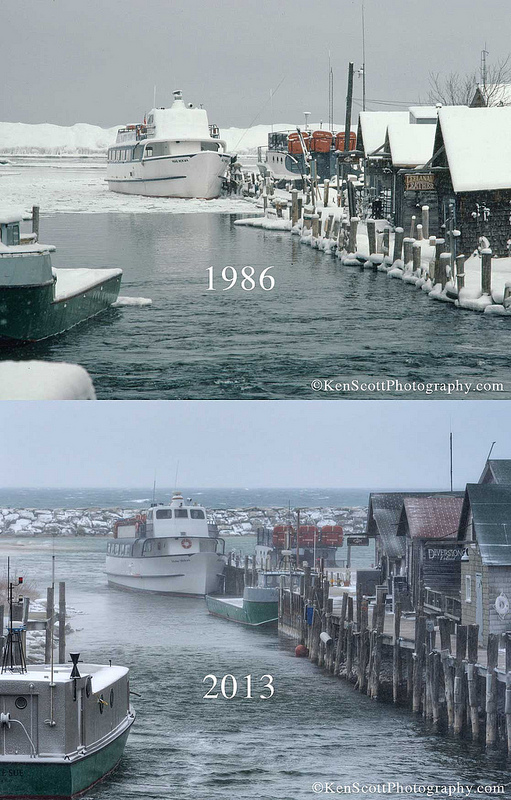
"... is the Lake Michigan water level low?" ...

“… is the Lake Michigan water level low?”, photo by Ken Scott

This photo is from a feature on today’s Leelanau.com blog about the historic water lows on the Great Lakes. It includes a great video so definitely check it out.

Leland is my home town and to see the difference from just 27 years is astonishing!

See it bigger, view more in Ken’s massive Leland/Fishtown slideshow and read an extensive discussion on Facebook.

More Lake Michigan on Michigan in Pictures.

January 26th is Michigan’s Birthday!

Leaping in a Winter Wonderland

Leaping in a Winter Wonderland, photo by karstenphoto

Today is Michigan’s 176th birthday. For the 175th birthday last year we compiled some fun facts that you can check out. Here’s hoping that you get a chance to get out and celebrate what Michigan has to offer this weekend!

If you’re staying warm inside, consider reading about Michigan’s statehood and associated documents at Seeking Michigan.

Check Steven’s photo out big as Michigan and see this and more winter fun in his winter slideshow.

Bishop Baraga, the Snowshoe Priest

Bishop Baraga Shrine, L'Anse

Bishop Baraga Shrine, L’Anse, photo by RPM-Photo

Bishop Frederic Baraga passed away 145 years ago on January 18, 1868. He was born on June 29, 1797* in the castle of Mala vas in the Northwestern part of Slovenia, and for over half of the 71 years of his life Baraga covered a vast territory of over 80,000 square miles in Michigan, Wisconsin, Minnesota and Canada. The history page at the campaign for sainthood of Bishop Baraga explains that:

Father Baraga arrived in the New World on December 31, 1830. For the next 37 years he travelled the length and breath of the Great Lakes area to minister to the Ottawa and Chippewa Indians. His first mission (Arbre Croche, 1833-1835) was established along the shore of Lake Michigan at present day Harbor Springs to Cross Village. Fr. Baraga labored two years at Grand River (1833-1835) presently known as Grand Rapids, before moving his mission to LaPointe (1835-1843) and L’ Anse (1843-1853) on Lake Superior. During the summer months, Father Baraga traveled on foot and by canoe. During the winter months, he traveled on snowshoes thus giving him the titles of “Apostle of the Lakelands” and “Snowshoe Priest.” He wrote long and frequent accounts of his missionary activities including a three-volume diary. He also wrote seven Slovenian prayerbooks and authored 20 Native American books which inlcudes his monumental Grammar and Dictionary of the Chippewa Language , still in use today. He was the first bishop to write a pastoral letter in both the English and Chippewa languages.

From 1840 to his death, he ministered to the immigrants who came to the Upper Peninsula of Michigan to work in the iron and copper mines of the region. About the same time, he began the practice of rising at 3 a.m. in the summer and 4 a.m. in the winter to spend three hours in prayer, which he continued until the end of his life. His responsibilities grew even greater when he was named bishop of the newly created Vicariate of the Upper Michigan. He was consecrated bishop in Cincinnati on November 1, 1853. The lack of priests and money weighed heavily on his heart. Due to his hard work and dedication, Bishop Baraga was able to report to the Holy See a year before his death that his diocese rested on a firm foundation, with enough priests and churches for the fast-growing area. Sault Ste. Marie was his See City until 1866, at which time he moved to Marquette-a more centrally located and accessible city by both ship and train. In the Fall of 1866 while attending the Council of Baltimore, Bishop Baraga suffered a severe stroke. Afraid that his fellow bishops would not allow his return to the severe climate and remote regions of Lake Superior, he begged the priest who accompanied him (Rev. Honoratus Bourion) to take him back to Marquette. Understanding his bishop wanted to die among his flock, Rev. Bourion practically carried Baraga to the train for the long trip back to Marquette.

There’s a lot more about Baraga there including an excellent tour of Baraga’s life in the Upper Peninsula that I imagine would make a great vacation.

You can have a look at Bishop Baraga right here and read more in the entry for the Venerable Frederic Irenaeus Baraga in Wikipedia where I found the link for an online version of Father Baraga’s 1853 Ojibwe Dictionary. Here’s the direct link to the dictionary. You can read more about the Baraga shrine at Roadside America.

View RPM’s photo on black and see more in his Mich-ellaneous slideshow.

*Coincidentally enough, that’s my birthday too!

The Ruins of the Cheboygan Point Lighthouse

Cheyboygan Lighthouse

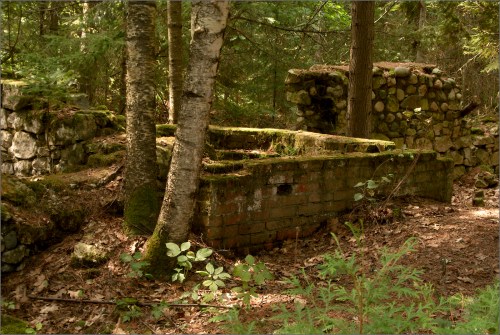
The Cheboygan Point Lighthouse Ruin, photo by joeldinda

Terry Pepper’s Seeing the Light has information about the ruins of the Cheboygan Main Light Station, explaining:

Located directly across the three mile width of the Straits from the southernmost point of Bois Blanc Island, the eastern prominence of Duncan Bay marked a natural turning point for vessels entering the Straits, and the growing bounty of Lake Michigan beyond.

On December 21, 1850, Congress appropriated the sum of $4,000 for the purchase of a 41.13 acre reservation on what would become known as “Lighthouse Point” at the western end of Duncan Bay for the construction of the first Cheboygan light station … The tower was evidently poorly located, as high water was found to be undermining the stone foundation soon after construction. Fearing collapse was imminent, in 1859 the newly-formed Lighthouse Board decided to build a new station and demolish the original tower, only eight years after its construction.

The replacement station, was similar in design to that built at Port Washington the following year, consisting of a combined keeper’s dwelling and tower, with the tower located at the north apex of the hipped roof. The tower stood thirty-one feet above the foundation, and was capped with an octagonal iron lantern into which the Fresnel from the old tower was carefully relocated. The lights’ thirty-seven foot focal plane provided a twelve mile range of visibility, thereby providing coverage throughout the Straits.

Read on the story of how the second lighthouse ultimately met its end and some great old photos of the lighthouse. It’s located in Cheboygan State Park.

Joel writes that they walked the park’s Yellow Trail to the long (2 miles in the park) beach and walked along Lake Huron’s Mackinac Strait. View his photo background bigtacular, see it on his map and check out more great shots in his Cheboygan slideshow.

Many more Michigan lighthouses on Michigan in Pictures.

Megatron Monday: Calvin Johnson sets single-season receiving record!

Megatron-Calvin-Johnson

Calvin Johnson, photo by Gavin Smith / Detroit Lions

“He’s unreal … I’m just proud to be associated with him.”
~Lions QB Matthew Stafford

With 11 catches for 225 yards against the Atlanta Falcons, Detroit Lions wide receiver Calvin Johnson strode into the record books to set the single-season yardage record for a wide receiver with 1892 yards. ESPN reports:

Johnson surpassed Jerry Rice’s single-season yards receiving record of 1,848 with his 10th catch in the fourth quarter Saturday night. That put Johnson over the 200-yard mark in the game against the Atlanta Falcons. He needed 182 to surpass the mark Rice set in 1995 with the San Francisco 49ers.

Johnson had more than 100 yards receiving for an eighth straight game, breaking an NFL record set by Charley Hennigan in 1961 and matched by Michael Irvin in 1995. Johnson broke another league mark with 10 receptions in a fourth game in a row.

It was Johnson’s 11th game with 100 yards receiving this season, tying Irvin’s NFL mark.

In the first quarter, Johnson surpassed Herman Moore’s single-season franchise record of 1,686 yards.

You might also enjoy Mitch Albom’s column on Calvin Johnson, who seeks the 2000 yeard milestone this Sunday against the Bears. View more photos from Megatron’s record-setting game and also see shots of Calvin and his dad post-game. You can get a Facebook cover of the catch from the Detroit Lions Facebook page, and there’s video of the catch as well.

More Detroit Lions on Michigan in Pictures.

Hill of Beans: The Michigan Bean Elevator in Saginaw

Michigan Bean Elevator - Saginaw, Mi

Michigan Bean Elevator – Saginaw, Mi, photo by jhoweaa

I know that many of you have been losing sleep because you don’t know the location of the world’s biggest bean elevator. You can rest easy now, because Waymarking.com explains that the largest bean elevator in the world is in Saginaw MI:

As a young man, (Albert L.) Riedel was one of the organizers of the Producers Elevator Company of Port Huron which later grew into the Michigan Bean Company. He was elected secretary of Michigan Bean when it moved its headquarters to Saginaw’s Bearinger Building and he was only 27 when he was named general manager of the company.

…In 1937, Riedel became president of the company as well as general manager and served in that capacity until the firm was sold to the Wickes Corporation in 1955. As president of Michigan Bean, Al Riedel pushed the idea of selling packaged, trademarked beans to the retail market instead of relying on bulk sales.

He was instrumental in making the Jack Rabbit brand of beans known all over the world. And it was while Riedel was president that the famous Bean Bunny neon sign was erected at the top of “the world’s largest bean elevator”.

The Bean Bunny, now proudly relit, has become one of Saginaw’s most beloved symbols. During World War II, too old for active service, Riedel volunteered as a dollar-a-year-man and served as a consultant attached to the Quartermaster Corp. He revamped purchasing and shipping programs and designed and developed waterproof bags for shipping food overseas.

You can learn a lot more about the Bean Bunny sign and see photos at mLive. The Michigan Bean Commission has tons of information about Michigan beans.

James also has some information about the bean bunny on his blog as well. You can also buy a print or a card there. View his photo on black and see more in his Interesting slideshow.

More from Saginaw on Michigan in Pictures.

Low water exposes Grand Haven shipwreck graveyard

Grand Haven Shipwrecks

Grand Haven Shipwrecks, photo by Kevin Ryan

mLive has a feature on how our historically low water levels have revealed a number of shipwrecks in Grand Haven:

Maritime archaeologist and director of the Tri-Cities Historical Museum Kenneth Pott said the area around Harbor Island was an apparent dumping zone for abandoned vessels and 1930s aerials held by the museum and the city of Grand Haven show that additional wrecks exist there. If the water line were to recede even more, then more vessels may be exposed.

“We’re quite sure that there are more in the area,” Pott said. “This is something akin to a graveyard for vessels. This is very unusual.”

The wooden sections of the 290-foot steamer Aurora, once the largest wooden steamer on the Great Lakes, and parts of at least four other shipwreck hulks were exposed recently by the low water levels and area residents alerted maritime historians to the find. The Aurora was identified by members of Holland-based Michigan Shipwreck Research Associates and local historians earlier this week.

Read on for more info including the publicly-accessible location. You can also read more about the Aurora right here and see a photo gallery.

Check this out background big and see a couple more views including a nice one of the rough outline of the wreck in Kevin’s slideshow.

More Michigan shipwrecks on Michigan in Pictures.