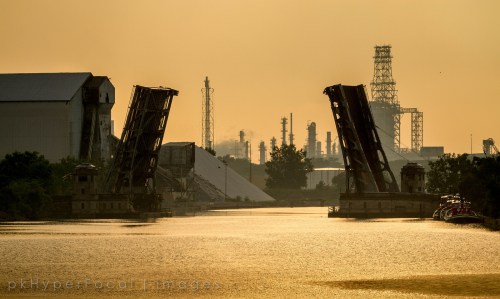
Golden Hour on the Rouge River

The Golden Hour on the Rouge

The Golden Hour on the Rouge, photo by pkHyperFocal

The Rouge River Gateway Project relates that the Potawatami referred to the river as Minosa Goink which means “Singeing Skin River” – the place where game animals were dressed. The history continues (with my links to other fun stuff):

The French first settled on the banks of the Rouge River in the 1780s. They named the river “Rouge”, or red. Settlers would claim a few hundred feet of river frontage and extend their farms deep into the forest. Remnants of these “ribbon farms” still exist today in land ownership patterns along the river. Europeans continued to immigrate into the region to take advantage of its resources. They used the reddish clay for brick, mined the area’s salt deposits, and built farming communities along the riverbanks. The native prairie oak savannah and hardwood forests were cleared to make room for agriculture and industry.

Rapid growth and industrial development characterized the late nineteenth century. Henry Ford purchased extensive land holdings along the river. He built a factory in Dearborn to manufacture farm tractors, but kept a good portion of his land in agricultural production, partially for testing equipment. In 1914, he started construction of a permanent residence on the banks of the Rouge River.

A defining moment in the history of the river transpired with the construction of the Ford Rouge Plant during World War I. The development of the plant was motivated by Henry Ford’s desire to supply submarine chasers to the US military. The Ford Rouge Manufacturing Complex grew into a massive self –contained industrial complex that daily employed over ninety thousand men in the early 20th century. Raw materials including coke, iron ore, and rubber were brought in and transformed into cars in less than thirty hours, a process that set a new global standard for industry. The Rouge Manufacturing Complex became the largest manufacturing site in the world.

In his book Burning Rivers, Allen Park native John Hartig relates how heavy manufacturing and population growth seriously impacted the river to the point where the river became one of the most polluted waterways in the nation, catching fire in 1969 shortly after the famous Lake Erie/Cuyahoga River fire.

In 1986, in a Sunday feature on a new organization seeking to restore the Rouge, the Detroit Free Press called it the “sewer for a metropolis, discharge drain for industry, dumping ground for junk and garbage”. They went on to say that “the Rouge River has become so polluted that a cleanup seems unthinkable.”

While the Rouge is certainly far from restored, the organization the Freep was talking about, Friends of the Rouge, has been dedicated along with other public and private efforts to the preservation & restoration of the river. I encourage you to check them out for more information and to learn about their good work on the behalf of the river. Lots more at the Rouge River Project and Wayne County’s Rouge Project.

View pkHyperFocal’s photo big as a boat and see more in their Man Made slideshow.

More industry on Michigan in Pictures.

Bears, it’s what’s for (Thanksgiving) dinner!

Thinking About the Zoo Visitors?

Thinking About the Zoo Visitors?, photo by Maia C

A very happy Thanksgiving to all of you. I remain very thankful that I have such a great group of photographers and readers for Michigan in Pictures. I love doing this blog, and your support makes it possible!

Maia suggests that this lion is perhaps thinking about zoo visitors, but my personal theory is that he’s thinking about bears, Chicago Bears to be exact! Thankfully, the NFL has given us the opponent who started it all, as the Detroit Lions share the history of the Thanksgiving Day game:

The game was the brainchild of G.A. Richards, the first owner of the Detroit Lions. Richards had purchased the team in 1934 and moved the club from Portsmouth, Ohio to the Motor City. The Lions were the new kids in town and had taken a backseat to the baseball Tigers. Despite the fact the Lions had lost only one game prior to Thanksgiving in 1934, the season’s largest crowd had been just 15,000.

The opponent that day in 1934 was the undefeated, defending World Champion Chicago Bears of George Halas. The game would determine the champion of the Western Division. Richards had convinced the NBC Radio Network to carry the game coast-to-coast (94 stations) and, additionally, an estimated 26,000 fans jammed into the University of Detroit Stadium while thousands more disappointed fans were turned away.

Despite two Ace Gutowsky touchdowns, the Bears won the inaugural game, 19-16, but a classic was born. Since 1934, 69 games have been played with the Lions holding a series record of 33-34-2 (.493). And each game, in its own way, continues to bring back memories of Thanksgiving, not only to Lions’ fans, but to football fans across the nation.

View Maia’s photo big as a lion and see more in her Detroit Zoo Spring/Summer 2008 slideshow.

More Thanksgiving features & photos and more Detroit Lions on Michigan in Pictures.

Cooler Tour … Fishtown

Cooler Tour ... fishtown, dam view

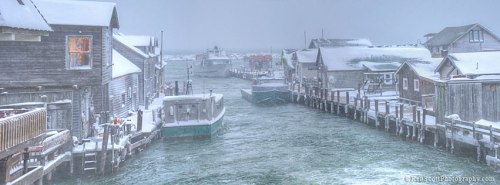
Cooler Tour … fishtown, dam view by Ken Scott Photography

Ah, November in Michigan. The Fishtown Preservation Society explains:

Fishtown is a unique historical attraction composed of weather-beaten fishing shanties and small shops lining the mouth of the Leland River. The site has endured and adapted over the last 150 years as an ever-evolving working waterfront that still operates as one of the only unmodernized commercial fishing villages in the state of Michigan.

One of the most important characteristics of Fishtown is its core of historic shanties. Though only a few are still used for commercial fishing operations, most of the structures in Fishtown had their origins as commercial fishing buildings. These buildings served many purposes, including net-mending sheds, ice houses, smoke houses, and storage. Though processes like ice-making are now mechanized in a commercial fishery, running a fishery still requires extensive space for equipment storage and net repairs.

Many buildings have come and gone from the Fishtown landscape with the changing fortunes of the industry, yet Fishtown survives as a rare working waterfront and an authentic and active commercial fishing village.

Head over to fishtownmi.org for more.

Click to see Ken’s photo bigger, check out his Cooler Tour photos and be sure to follow him at Ken Scott Photography on Facebook.

#TBT: Wreck of the Carl D. Bradley

Carl D. Bradley

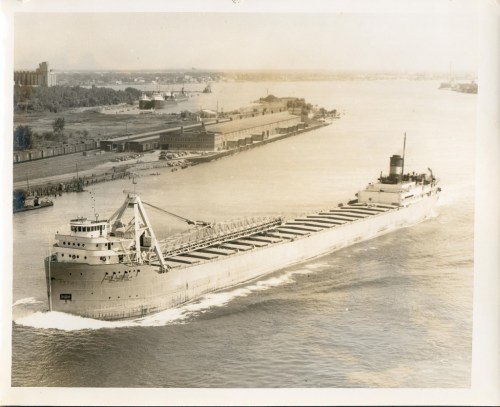
Carl D. Bradley, photo by John Rochon

If you know of any shipwreck on the Great Lakes, chances are it’s the S.S. Edmund Fitzgerald. While that was no doubt a terrible tragedy, my vote for the most grievous loss is the S.S. Carl D Bradley which sank 56 years ago next Tuesday on November 18, 1957. I found a really excellent article on the ship and shipwreck at Lake Effect Living titled Lost To The Lake: The Wreck of the Carl D. Bradley:

Known as ‘Queen of the Lakes’, the Carl D. Bradley was the largest ship on the Great Lakes from 1927 to 1949. At 639 feet, it was the longest freighter on the Lakes until the launch of the SS Wilfred Sykes twenty-two years later. The largest self-unloading ship for its time, the Bradley was the Bradley Transportation Company’s flagship. Named after the president of Michigan Limestone, Carl David Bradley, this state of the art freighter had its maiden voyage in the summer of 1927. Since Michigan Limestone’s company base was in Rogers City, Michigan, the freighter drew most of its crew from this small community.

…On Monday, November 17, 1958, the steamer left Buffington, Indiana bound for Port of Calcite harbor in Rogers City, Michigan.

The Bradley’s captain was 52-year old Roland Bryan, a veteran seaman. Manned by a crew of thirty-five and carrying a light cargo, the Bradley headed out onto Lake Michigan at 9:30pm. But signs of severe weather were already in evidence when they left Buffington, where winds gusted at more than 35 miles an hour. It was the first ominous indications of an extreme cold front forming over the plains. Temperatures in Chicago plummeted twenty degrees in one day, and thirty tornadoes were sighted from Texas to Illinois.

Aware that gale winds were forecast, the crew readied the steamer for bad weather. They traveled along the Wisconsin shore until reaching Cana Island, where they shifted course for Lansing Shoal which lay across Lake Michigan. The winds on the lake reached 65 miles an hour by 4pm the following day. Still, the Bradley seemed to be weathering the gale force winds and heavy seas with little problem. This changed at 5:30pm when the Port of Calcite received a radio message from First Mate Elmer Fleming informing them that the Bradley, approx. twelve miles southwest of Gull Island, would arrive home at 2am. As soon as this message was sent however, a loud thud or bang was heard on the ship.

When the day was done, 33 of the 35 member crew were dead, 23 of the from Rogers City, Michigan. For a town of less than 4000, it was a heavy blow. Read on for much more and also see Seeking Michigan: The Wreck of the Carl D. Bradley on Absolute Michigan and the tribute site at carldbradley.org.

John Rochon shared this photo of the Bradley was taken from the Blue Water Bridge by Schjelderup Marine Studio and shows the ship heading towards the mouth of Lake Huron. View it big as the Bradley and see more in his massive Great Lakes Ships & Shipping slideshow.

More shipwrecks on Michigan in Pictures.

Armistice Day Blizzards, yesterday & today

Super Storm on Superior

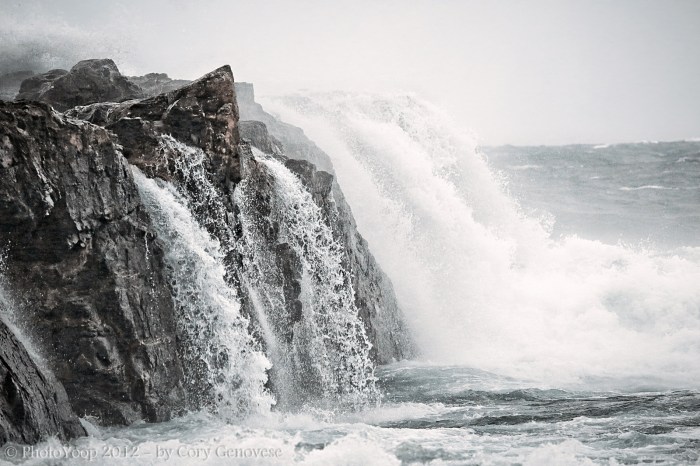
Super Storm on Superior, photo by Cory Genovese

74 years ago today on November 11, 1940, Michigan got blasted by one of the most severe November storms on record, the Armistice Day Blizzard. The Michigan Historical Marker in Ludington regarding the Armistice Day Blizzard says:

On November 11, 1940, a severe storm swept the Great Lakes area. As it crossed Lake Michigan, ships and seamen fought to reach safety away from its blinding winds and towering seas. Between Big and Little Points Sable the freighters William B. Davock and Anna C. Minch foundered with the loss of all hands. The crew of the Novadoc, driven aground south of Pentwater, battled icy winds and water for two days before being rescued by local fishermen. At Ludington the car-ferry City of Flint 32 was driven ashore, her holds flooded to prevent further damage. Elsewhere lives were lost and ships damaged in one of Lake Michigan’s greatest storms.

Also see the entry on the Armistice Day Blizzard at carferries.com. Wikipedia’s entry for the Armistice Day Blizzard adds that 66 people lost their lives on Lake Michigan on three freighters, the SS Anna C. Minch, the SS Novadoc, and the SS William B. Davock, as well as two smaller boats that sank and (at least) another 4 perished on land. There was one positive outcome though:

Prior to this event, all of the weather forecasts for the region originated in Chicago. After the failure to provide an accurate forecast for this blizzard, forecasting responsibilities were expanded to include 24-hour coverage and more forecasting offices were created, yielding more accurate local forecasts.

While it’s nothing like what happened in 1940, the Upper Peninsula is currently under a winter storm warning and looking at 8-16″ of snow today as an early season blizzard barrels through.

Cory took this shot on Lake Superior during the most severe late fall storm in recent times, Superstorm Sandy. View it bigger and see a lot more in his U.P. Winter ’12 & ’13 Gallery on his PhotoYoop page at Facebook.

More wild Michigan weather on Michigan in Pictures!

Faygo founding Feigenson brothers with their first truck

Founders of Feigenson Bros. Bottling Works  Faygo

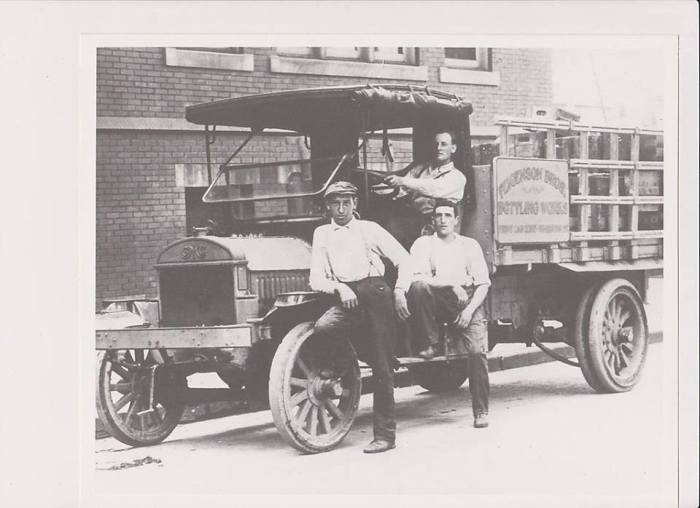
Founders of Feigenson Bros. Bottling Works

Tomorrow (November 4th) is the 107th birthday of Detroit-based Faygo. The Encyclopedia Of Detroit entry for Faygo Pop at the Detroit Historical Society says:

In 1907, Russian immigrant brothers and bakers, Ben and Perry Feigenson, began playing around with the idea of creating soft drinks based on their frosting flavors. They bottled their soda – which they called “pop” because of the sound it made when the lid was removed – in fruit punch, strawberry and grape flavors at a factory on Pingree Street. They sold their soda pop from their horse-drawn wagon the day after it was made.

Soon, the brothers developed the Feigenson Brothers Bottling Works, but they changed the name to Faygo in 1921 because “Feigenson” was too long to fit on the labels. They moved their growing bottle works to Gratiot Avenue in 1935, which is still used today to create Faygo pop.

The brothers ran Faygo until the mid-1940s, when they gave the company to their sons. Faygo was sold only in Detroit and Michigan until the late 1950s because it had a limited shelf life. At that time, company-hired chemists determined that impurities in the water prevented the pop from staying carbonated. The company then developed a water filtering system that stretched the shelf life to more than a year.

Faygo became popular outside of Michigan in the late 1960s when the company began advertising during televised Detroit Tigers games. Today, Faygo, which comes in over 30 flavors, is sold in many states east of the Mississippi River.

In 1987, the Feigenson family sold the Faygo company to National Beverage Company which is based in Florida. National Beverage, which also owns Shasta, kept the Detroit bottling works and the company’s employees. Many have worked for Faygo for over 30 years.

Today, the most popular Faygo flavor remains one of the earliest the Feigenson brothers developed: Redpop.

Click through for a couple fun items in their collection and also check out Faygo’s history page for a nice timeline.

#TBT: Detroit Trolley 1980 and Detroit’s Municipal Vehicle Auction

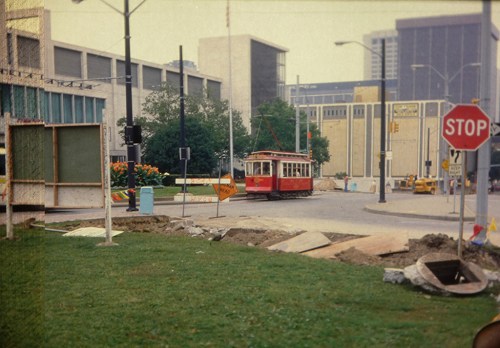
Detroit trolley 1980
Detroit trolley 1980, photo by creed_400

FOX News Detroit reports that the city of Detroit will be auctioning off hundreds of municipal vehicles on November 5th to raise money for the city:

“This is an opportunity to put out to the general public some high quality equipment and property we are hoping will generate some cash will go back to the departments and help buy equipment to serve the city of Detroit,” said Gary Brown, chief of staff.

The auction will begin on Nov. 5 and run for two days in a webcast/onsite public auction.

According to published reports there will be more than 450 vehicles including 115 automated side load garbage trucks, 79 transit buses and historic trolley cars. Also available will be 41 truck-mounted snow plows and 130 public lighting service vehicles.

Read on for more and note the picture of the trolleys – pretty sure this is one of them. I guess that’s one of the advantages of having 200,000+ photos available to choose from!! Here’s the full info from the City with links to the online auction site and information about the vehicles being auctioned.

View creed’s photo background big and see lots more in his Grandpa Molt’s slides slideshow.

More #TBT on Michigan in Pictures!

#TBT: The Bear of Sleeping Bear Dunes

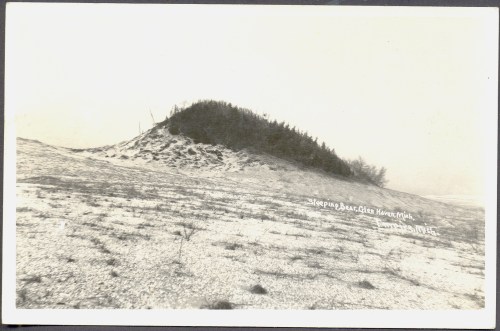
Glen Haven MI Sleeping Bear Dunes Empire and Glen Haven Marked RPPC Kodak Stampbox Unsent what looks like a hump of low scrub bushes is actually a forest hill buried in sand

Glen Haven MI Sleeping Bear Dunes, photo by Don…The UpNorth Memories Guy… Harrison

Tuesday was the 44th anniversary of the founding of the Sleeping Bear Dunes National Lakeshore. You may have heard the Chippewa tale that inspired the name of the park:

“Long ago, along the Wisconsin shoreline, a mother bear and her two cubs were driven into Lake Michigan by a raging forest fire. The bears swam for many hours, but eventually the cubs tried and lagged behind. Mother bear reached the shore and climbed to the top of a high bluff to watch and wait for her cubs. Too tired to continue, the cubs drowned within sight of the shore. The Great Spirit Manitou created two islands to mark the spot where the cubs disappeared and then created a solitary dune to represent the faithful mother bear”.

You might not be aware, however, that “the Bear” was also an actual formation atop a dune about a mile north of the Pierce Stocking Overlook. The Lakeshore says that the formation pictured above…

…hardly looks like a bear now, for it has been changing rapidly in recent years. At the turn of the century, it was a round knob completely covered with trees and shrubs. You can still see some of the thick vegetation that gave it a dark shaggy appearance.

…For a long time, the Sleeping Bear Dune stood at about 234 feet high with a dense plant cover. However, through most of the twentieth century, erosion has prevailed. By 1961, the dune was only 132 feet high, and by 1980, it was down to 103 feet. The process is a continuing one. The major cause of the dune’s erosion was wave action wearing away the base of the plateau on which the dune rests. As the west side of the dune loses its support, it cascades down the hill. The wind, too, is a major agent of erosion, removing sand and destroying the dune’s plant cover.

You can see what the area looks like now and read more right here.

View Don’s photo background bigtacular and get daily blasts from the past in his Northern Michigan Photo Postcards – Our History and Heritage group on Facebook!


Wooly Weatherman

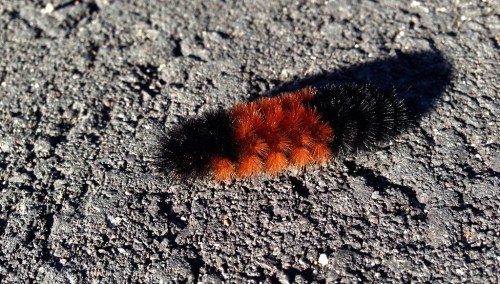
Hmmm...thick or thin? And what does it mean anyways?

Hmmm…thick or thin? And what does it mean anyways?, photo by dan bruell

Predicting Winter Weather: Woolly Bear Caterpillars at the Farmer’s Almanac says that in 1948, Dr. C. H. Curran, curator of insects at the American Museum of Natural History in New York City sought to determine the average number of reddish-brown segments and use that to forecast the coming winter weather. For eight years, he continued to try and prove scientifically a weather rule of thumb that the wider that middle brown section is (and the more brown segments there are) the milder the coming winter will be, while a narrow brown band means a harsh winter.

Between 1948 and 1956, Dr. Curran’s average brown-segment counts ranged from 5.3 to 5.6 out of the 13-segment total, meaning that the brown band took up more than a third of the woolly bear’s body. As those relatively high numbers suggested, the corresponding winters were milder than average. But Curran was under no scientific illusion: He knew that his data samples were small. Although the experiments popularized and, to some people, legitimized folklore, they were simply an excuse for having fun. Curran, his wife, and their group of friends escaped the city to see the foliage each fall, calling themselves The Original Society of the Friends of the Woolly Bear.

…Mike Peters, an entomologist at the University of Massachusetts, doesn’t disagree, but he says there could, in fact, be a link between winter severity and the brown band of a woolly bear caterpillar. “There’s evidence,” he says, “that the number of brown hairs has to do with the age of the caterpillar—in other words, how late it got going in the spring. The [band] does say something about a heavy winter or an early spring. The only thing is . . . it’s telling you about the previous year.”

Read on for more!

View Dan’s photo background bigtacular and see more in his Fall 2014 slideshow.

More weather on Michigan in Pictures!

Happy Michigan Indian (Anishinaabek) Day

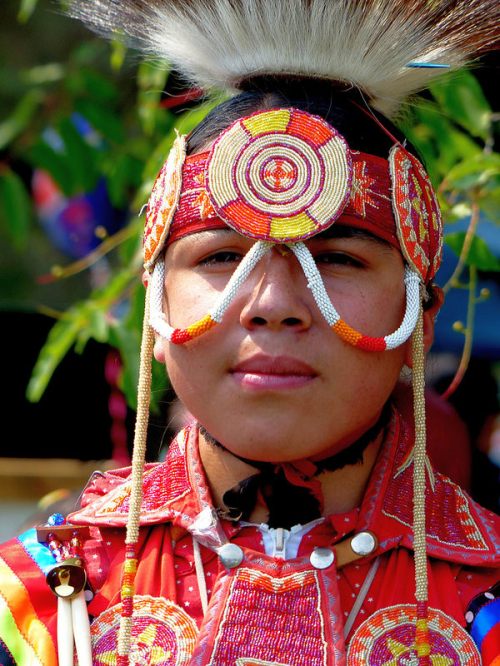
Odawa Indian Boy

Odawa Indian Boy, photo by Sharon

Michigan Indian Day was established as the 4th Friday in September by the State of Michigan in 1974.

The Little River Band of Ottawa Indians & Kenny Pheasant, Director of their Anishinaabemowin Program created a cool site to help people learn Anishinaabemowin, the language of the Anishinaabe nation. The history page begins:

In the beginning, Gizhemanidoo created the universe as we know it today. He created Grandfather Sun and Grandmother Moon, Mother Earth and Father Sky. And on the earth he created all things, living and nonliving. He created life in the earth, on the earth, in the sky and in the water. He created the plants, rivers, four-legged and winged creatures, and the swimmers. After this was done, he created one of the greatest mysteries of all – the four seasons – to bring harmony and balance to all.

After all creation was complete, he created man. After he created the first Anishinaabe, he came to him in a dream and instructed him that he was to name all things in the language that he gave him, Anishinaabemowin. So the first man went about on his journey and named all things he saw – all the animals, insects, birds and fish – however long this took. Afterward, he spoke to the Creator Gizhemanidoo in his dream and said, “I have finished what you have told me to do.” Then the Creator Gizhemanidoo spoke back to him and said, “Yes, you have indeed done so, and now it is time for me to give you your name. Your name shall be Nanabozho, and whenever your people meet and greet one another, they will say a part of your name. That is why whenever the Anishinaabe people greet one another, they say the word Bozhoo.

Our creation story tells us that we originally migrated to the Great Lakes region from the East Coast. There are many settlements of our original homes that still exist to this day, like Manitoulin Island, the Island of the Great Spirit.

We have always been a nation, and we knew one another as the Anishinaabek. It was not until the French and European settlers arrived on this part of the continent that we became known as the tribes now called Ojibwe, Odawa and Bodwe’aadamiinh.

Read on for more.

Sharon took this at the 2014 Odawa Homecoming Pow Wow in Harbor Springs. View it bigger and see more in her slideshow.

More portraits on Michigan in Pictures.