Remembering Red Wings legend Gordie Howe

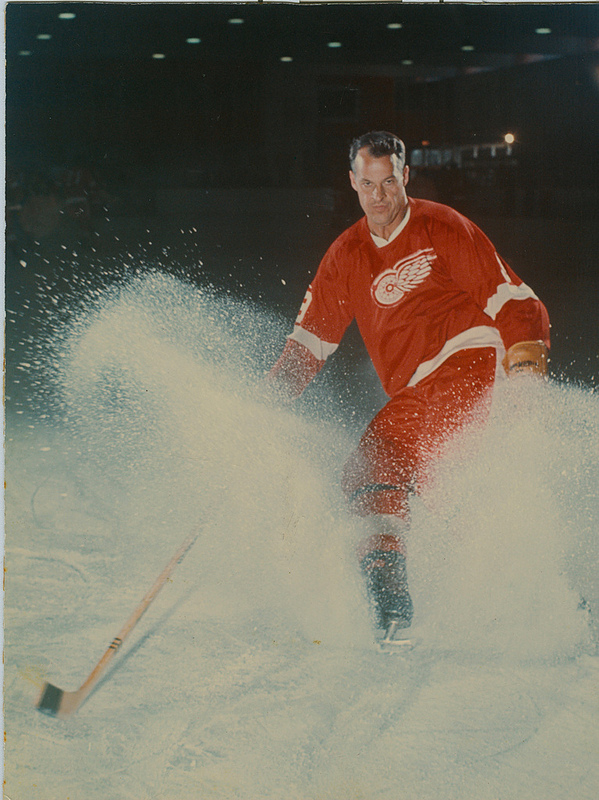
Gordie Howe Detroit Red Wings

Gordie Howe 1960s, photo by Edward Noble (via Wayne T. ‘Tom’ Helfrich)

The Detroit Red Wings shared the sad news that hockey legend Gordie Howe passed away yesterday morning. The Hockey Hall of Fame has an excellent profile of Gordie Howe that reads (in part):

Gordie Howe is referred to as simply “Mr. Hockey”. World War II had just ended when he first entered the National Hockey League, and when he played his final NHL season 33 years later, Wayne Gretzky was playing his first. Over those five decades, Howe didn’t just survive, he was dominant – on the scoring lists, in battles in the corners, on game-winning goals and when the year-end awards were handed out. He was a big man, though by modern standards no behemoth, but what set him apart was his incredible strength.

Though other superstars could be deemed somewhat better scorers, tougher fighters or faster skaters, no player has approached Gordie Howe’s sustained level of excellence. Incredibly, Gordie finished in the top 5 in NHL scoring for 20 straight seasons. To endure and excel, Howe needed a unique set of qualities, both physical and mental, and the foundations for his astonishing career were laid in him from an early age.

Howe grew and matured quickly, and when he was 15 he made a bid to play with the New York Rangers, attending the team’s training camp in Winnipeg. He was homesick, however, and before the end of the camp he returned to Saskatchewan. He made a better impression with the Detroit Red Wings the next year, joining a group of Red Wing veterans and untried youngsters to work out in front of Detroit boss Jack Adams. The ambidextrous Howe drew Adams’ attention from the start with a sizzling rush down the left wing and a sharp shot. The next minute he escaped down the right wing, switched his stick to the other side and still with a forehand zipped another shot at the goal.

Howe made his professional debut when he was 18, taking up the right wing for Detroit at the beginning of the 1946-47 season. He was 6′ tall and just over 200 pounds, making him one of the heavier players in the league…

…Apart from his forbidding temperament, Howe’s athletic and savvy playing style also contributed to his longevity. He never wasted energy if he didn’t need to, especially after he cut down on the number of fights he’d take part in early in his career. He was economical with his movements, anticipating when and where the play would intersect with his effortless progress around the ice. He often played 45 minutes of a game when the average total was 25. Observers noticed that when his exhausted line returned to the bench, Howe was the first to recover and raise his head, ready for another shift.

In all, Howe was selected to 21 NHL All-Star squads, 12 times to the First Team. Six times he led the NHL in scoring to capture the Art Ross Trophy and six times he won the Hart as the league’s most valuable player. His Detroit teams won the Stanley Cup four times.

Howe had been in his prime during a defensive era, the 1940s and 1950s, when scoring was difficult and checking was tight. When he was 40, in 1967, the league expanded from six to 12 teams and the number of offensive opportunities grew with it. Howe played the 1968-69 season on a line with Alex Delvecchio and Frank Mahovlich, the mercurial but talented star who had moved to Detroit from Toronto. Mahovlich was big, fast and skilled and Delvecchio was a gifted playmaker. The three were dubbed “the Production Line 3” and Howe’s scoring returned to the levels of his youth and then beyond. He topped 100 points for the first time, scoring 44 goals and adding a career-high 59 assists.

Read on for much more and watch the Legends of Hockey profile of Gordie Howe below.

Wayne T. ‘Tom’ Helfrich shared this photo by longtime Michigan news photographer Ed Noble, then of the Pontiac Press and later of the Oakland Press. Tom writes that Ed had a photo shoot with Gordie and knew he was a big fan and brought him this print. View the photo bigger and see more great old shots in his Detroit Red Wings slideshow.
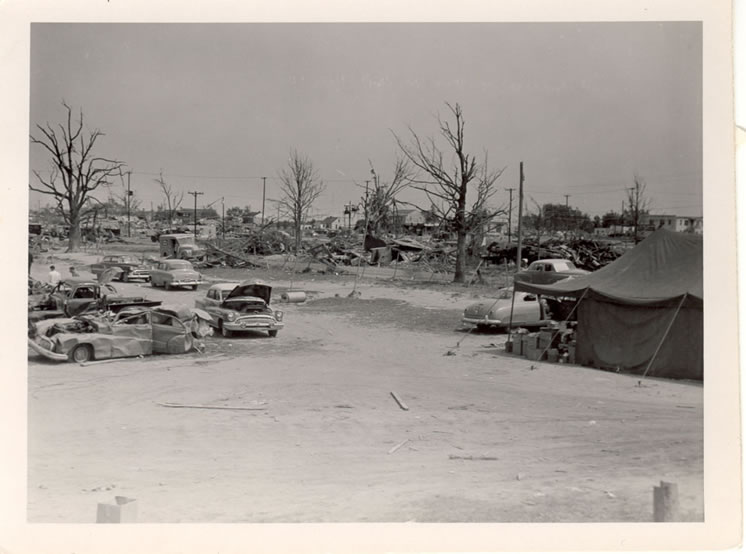
June 8, 1953: Remembering the Flint-Beecher Tornado

via Absolute Michigan

Tornado Damage in Beecher

Tornado Damage in Beecher, courtesy Flint Public Library

“The noise sounded like two freight trains going over a trestle right over your head; it was an ugly roar. My wife said the noise when the house went was like a giant pencil sharpener working.”
-Tornado Survivor Robert Blue

The National Weather Service relates that the Flint-Beecher tornado was Michigan’s worst natural disaster in terms of deaths and injuries:

This was the last tornado to kill over 100 people in a single tornado event anywhere in the United States. On June 8th, 1953, 116 people lost their lives in the Flint-Beecher community, and 844 people suffered injuries. The Flint-Beecher Tornado was just one of eight tornadoes that occurred that horrible evening across the eastern portion of the Lower Peninsula. Those other seven tornadoes resulted in an additional 9 deaths, 52 injures, and damage stretching from Alpena to Erie.

The Flint-Beecher tornado was rated as an F5, the highest rating on the Fujita scale of damage. Winds were likely in excess of 200 mph as the 800 yard wide tornado moved on its 27 mile path through Genesee and Lapeer counties. Approximately 340 homes were destroyed, 107 homes had “major damage”, and 153 homes had “minor damage”. In addition farms, businesses and other buildings were destroyed and had damage. These totaled another 50 buildings destroyed and 16 with damage. The damage was estimated around $19 million (about $125 million adjusted for inflation).

So great a number were killed by the monstrous tornado that the National Guard Armory building, along with other shelters, was turned into a temporary morgue. The scene of bodies pouring into the Armory (as an intermittent light rain poured outside) was incredibly bleak and horrifying, especially for the families and friends of the victims. At least 100 people waited outside into the rainy night before they could move inside to try and identify the bodies.

Read on for more at Absolute Michigan.

See more in the Flint Public Library’s Beecher Tornado gallery and watch this video account from tornado survivors below.

More history and more from Flint on Michigan in Pictures.

Float Like a Butterfly, Sting Like a Bee

Float Like a Butterfly Sting Like a Bee

Float Like a Butterfly, Sting Like a Bee, photo by Kristina Austin Scarcelli

Float like a butterfly, sting like a bee.
His hand can’t hit what his eyes can’t see.
Now you see me, now you don’t.
George thinks he will, but I know he won’t.
-Muhammad Ali

As you almost certainly know, Muhammad Ali passed away over the weekend. You may not know that Ali and his family lived in Berrien Springs, Michigan for years after his retirement from boxing.

Mitch Albom has a nice column about Ali’s unique blend of ego, principles, and deep compassion:

Let there be no argument. The man who just died was the most famous face on Earth. I contend he still is. Name a rock star, athlete or politician whose visage is instantly as recognizable in a New York boardroom, an African village or a Bedouin tent. We’ll save you time. There is no one. And remember, Ali achieved such worldwide fame without computers, without Internet, without DVRs or YouTube.

He did it through the magnificence of his boxing, the magnitude of his personality, and the causes he championed at a time when sitting down was more common than standing up.

…High-profile athletes rarely took such stances and certainly not with such consequences. It was a mark of Ali’s sense of principle and perspective (he famously claimed that the Vietnamese never called him the N-word, never put dogs on him, never lynched him, etc.) that while many Americans — and understandably, Vietnam vets who did go and fight — reviled him during those years, most have come around on him in time. I believe it is because he never wavered. He took his punishment. And he showed, in his later years, that his anti-Vietnam stance wasn’t a singular moment. He did things on principle for decades. He stood up for poor people. He was a civil rights advocate and champion. He gave a voice to young African-Americans in the 1960s and a hero to their children in all the years that followed. He also raised tens of millions to fight disease.

Read on for lots more at the Freep.

Kristin caught this bumblebee and a monarch butterfly sharing a snack at the National Wildlife Refuge in Seney. See her photo background big, view more in her Scenic Michigan slideshow, and visit her website at KristinaScarcelli.com.

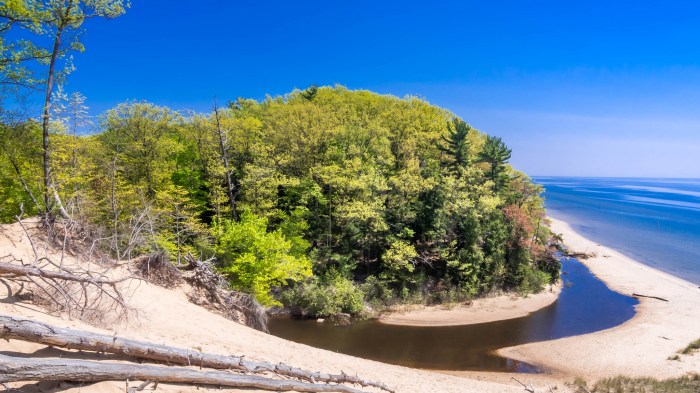
Hammock with a view at P.J. Hoffmaster State Park

View from my hammock Hoffmaster State Park

View from my hammock, photo by Bailiwick Studios

The photographer says that the outlet of Little Black Creek was the view from his hammock at Hoffmaster State Park near Muskegon. Not too shabby!

The Gillette Nature Center’s page on P.J. Hoffmaster State Park says (in part):

P.J. Hoffmaster State Park was established in the 1960s in honor of Percy James Hoffmaster, the longest acting Director of Conservation and the first chief of state parks in Michigan. The park encompasses 1200 acres, including 3 miles of Lake Michigan shoreline, and represents one of the finest examples of high relief, parabolic dunes and forested backdunes on the Great Lakes. The undisturbed quality of the habitat makes the park a refuge for 460 species of plants, nearly 90 species of birds and a rich array of mammals, reptiles, amphibians and insects. Hoffmaster is home to several listed species of plants, reptiles and birds.

The park’s pristine sandy beach is often described in magazines and travel guides as one of the wildest and most scenic beaches in Michigan.

…The park’s ten miles of trails and diversity of birds provides a birding experience unparalleled in the region, especially in the spring at the peak of migration. The park’s 293 site campground provides the opportunity for an overnight stay, and the surrounding landscape abounds with outdoor adventure for overnight or day visitors alike.

View the photo background bigtacular and see more in Bailwick Studios’ slideshow.

More summer wallpaper on Michigan in Pictures.

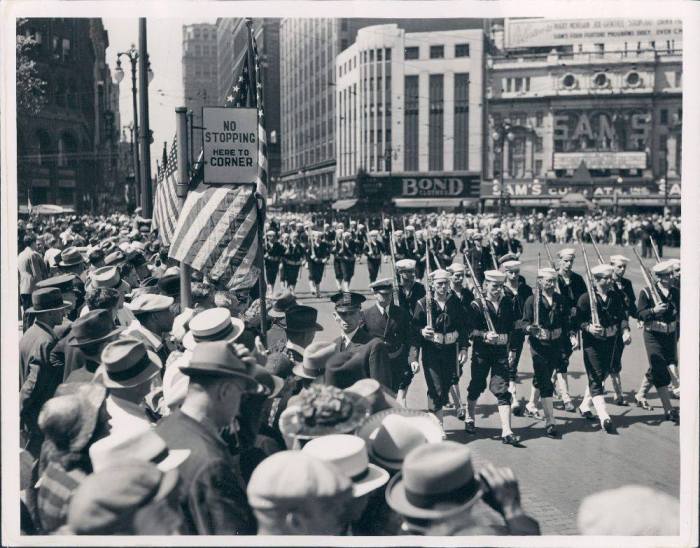
1939 Detroit Memorial Day Parade

1939 Detroit Memorial Day Parade down Woodward

1939 Detroit Memorial Day Parade, photo by Buildings of Detroit

Buildings of Detroit shared this photo back in 2013 saying:

Tonight the Wayback Machine continues to show us views of Detroit’s Memorial Day Parade down Woodward, this time in 1939. Most of the structures remain as they were in the previous 1920 image (click to see it!). We can clearly see Kern’s and an expanded Hudson’s, as well as Eaton Tower, Bond Clothing, and the Majestic Building along with the Detroit Opera House, now transformed into Sam’s Cut Rate clothing store.

View the photo bigger and definitely follow Buildings of Detroit on Facebook for lots more about Detroit’s unique architectural heritage.

Lots more Detroit on Michigan in Pictures!

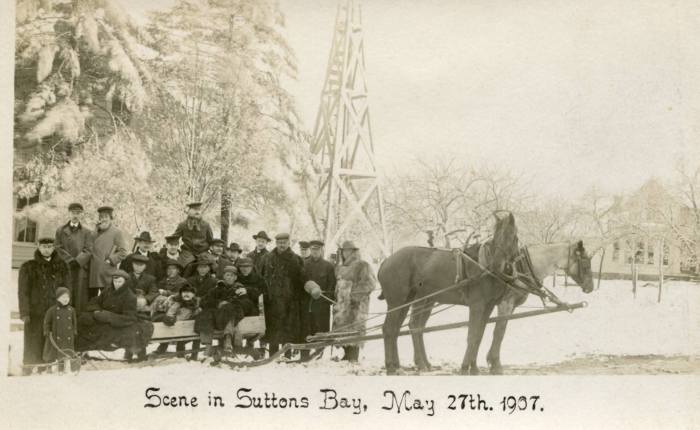
Memorial Day in Michigan: 1907 Edition

via leelanau.com

Suttons Bay May 27th 1907

Scene in Suttons Bay, May 27th. 1907, photo courtesy Leelanau Historical Society

Here’s the scene 110 years ago on Memorial Day in the village of Suttons Bay. Yikes!!

Hoping you have a safe and fun holiday weekend with the absolute minimum of snow!!

View the photo bigger, follow the Leelanau Historical Society on Facebook for more great photos, and check out their online photo archive for fun stuff like this search of Suttons Bay.

World War II Training on Lake Michigan

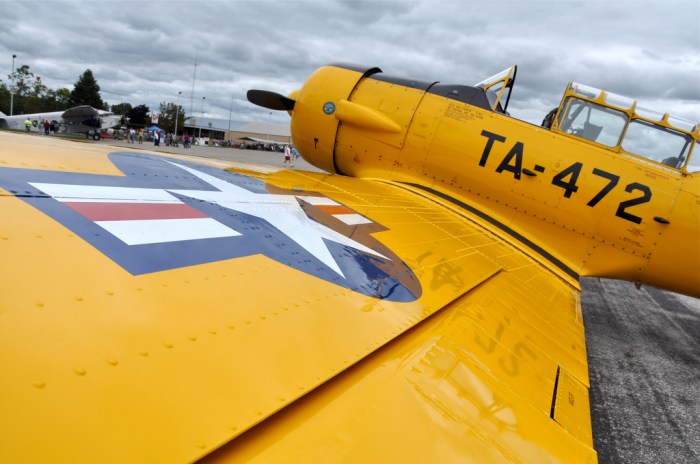
Wingspan

Wingspan, photo by Phil Squattrito

in advance of Memorial Day, the New York Times reviewed Heroes on Deck: World War II on Lake Michigan (trailer below) that tells the tale of how dozens of wrecked planes came to be on the bottom of that body of water. They write:

The film, by John Davies, recounts the training of pilots in how to land on aircraft carriers. Two passenger liners were stripped down and fitted with long decks (though not as long as the decks on actual aircraft carriers) and floated on Lake Michigan, where the training could take place without the threat posed by enemy submarines. Landing a plane on a floating airstrip was easier for some young men than others.

…Vintage footage shows crash after crash, though only a few fatalities resulted, in part because preflight training included how to escape if your plane were to go into the drink.

The film, showing on many public television outlets (including NJTV on Saturday and WLIW World on Sunday; check local listings), does more than just revisit an interesting tidbit of military history. It also chronicles present-day efforts to raise some of the planes from the lake bottom and restore them for display in museums and airports.

View Phil’s photo of this World War II fighter plane from the 2009 Gratiot County Airport open house background big and see more in his Transportation slideshow.

Here’s the trailer…

Michigan Front Porch is the World’s Longest!

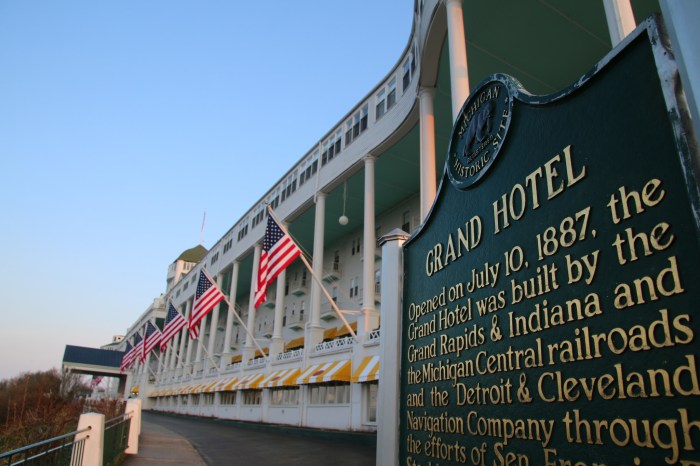
Grand Hotel

Grand Hotel in the Early 2016 Season, photo by Corey Seeman

The Grand Hotel opened on Mackinac Island in the summer of 1887. At 660 feet, Grand Hotel’s Front Porch is the world’s largest. They note that early on the porch became the principal meeting place for all of Mackinac Island, a promenade for the elderly, and a “Flirtation Walk” for island romantics. Their History photo gallery has a couple of cool photos of the porch from back in the day.

Corey took this last weekend when the Hotel opened for the season. View it background bigtacular and click for tons more of his Mackinac Island photos.

More about the Grand Hotel on Michigan in Pictures, and here’s a video look at the porch:


Fiborn Quarry

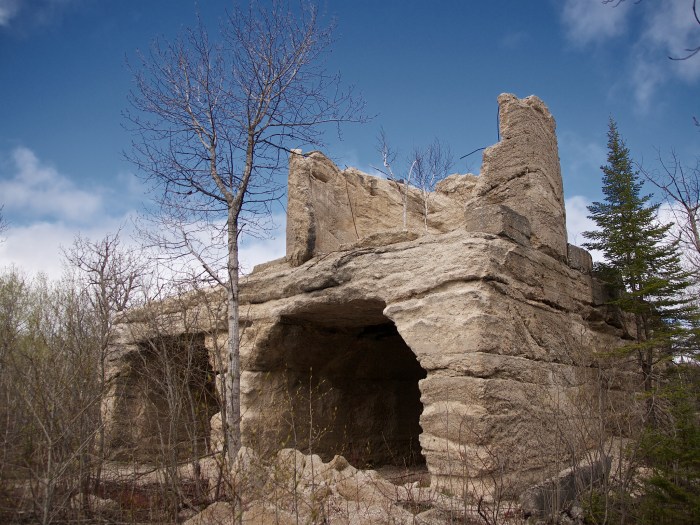
Fiborn Quarry

Fiborn Quarry, photo by David Marvin

The Michigan Karst Conservancy’s page on Fiborn Quarry begins:

The unusually pure limestone found in what is now the Fiborn Karst Preserve led to development of Fiborn Quarry, which operated from early 1905 until January 1936. The quarry mined, crushed and shipped limestone for use mostly in steelmaking, but also calcium carbide manufacturing and road building.

A small town grew up next to the quarry, which included an elementary school, a boarding house, a company store and housing for employees and their families.

“You just felt like you were living in a little world all of your own. Just like there was no other place,” recalled one former resident who was 13 years old in 1930. “You had your grocery store. You had your post office. You had your school. You had your minister that came in there and gave services. And it just seemed like it was real private.”

Workers broke up the limestone with dynamite, steam shovels loaded the rock into cars which hauled it to a crusher. Crushed limestone was sorted into different sizes hauled on the railroad spur 3-4 miles north to Fiborn Junction and the main rail line to Sault Ste. Marie.

View David’s photo background big and see more from Fiborn in his slideshow.

Not In Kansas Anymore: L Frank Baum, the Wizard of Oz & Michigan

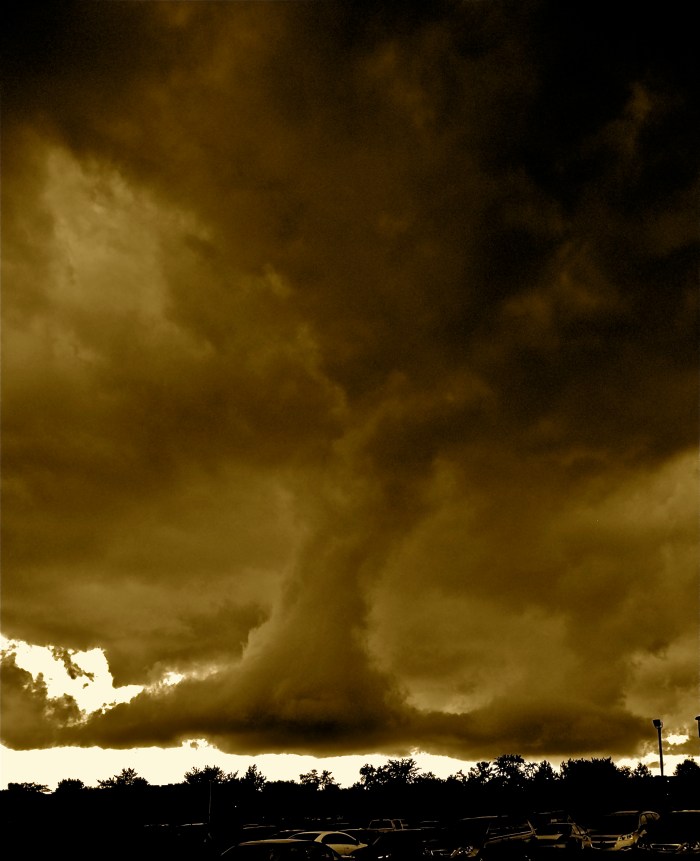
Not in Kansas Anymore

We’re Not In Kansas Anymore!, photo by Tina :O)

The Wizard of Oz rolled off the presses May 17, 1900. It’s one of my all-time favorite books. What you may not know is that L. Frank Baum, author of the beloved series, purchased a large, multi-story Victorian summer home on the southern end of the Macatawa peninsula on Lake Michigan.

Several years ago the Holland Sentinel published a cool piece about Baum and his Macatawa summer home that says (in part):

“The Wonderful Wizard of Oz” supposedly was written in Chicago, but some of the forest scenes look just like the pathways that run through the dunes, the younger Baum said.

He assumes Macatawa was where part of the book had been worked on or written, as Baum might have found inspiration from the castle in Castle Park for the yellow brick road, some say, or even based some of the characters in the book on personalities he encountered in the small lakeshore community.

“Especially in the Oz stories, a lot of characters and situations that we may not recognize … he drew lots of inspiration from Macatawa for the book.”

Check out L. Frank Baum, The Goose Man of Macatawa on Absolute Michigan for more about the author’s Michigan ties and information about the Wizard of Oz festival slated for June in Ionia.

About the photo, Tina shares:

This freakie cloud formation started at the end of our wedding photo shoot. There were clouds swirling all over us but luckily no tornados formed. I added some sepia for a little Wizard Of Oz effect.

View her photo background bigtacular and see more in her Pure Michigan slideshow.