Pier Energy at Frankfort North Breakwater Lighthouse

pier-energy-by-aaron-springer

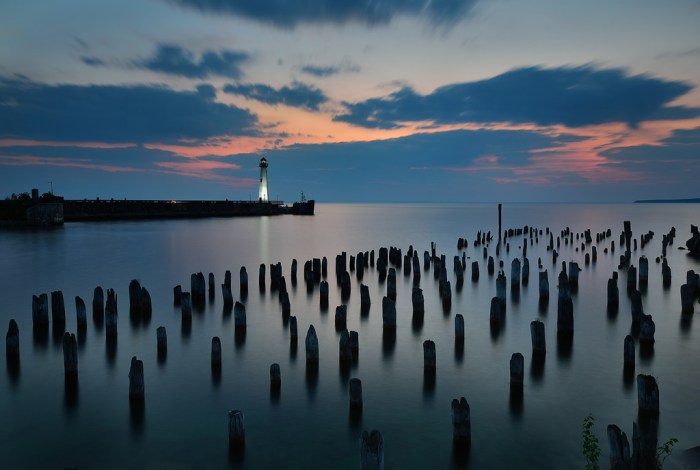
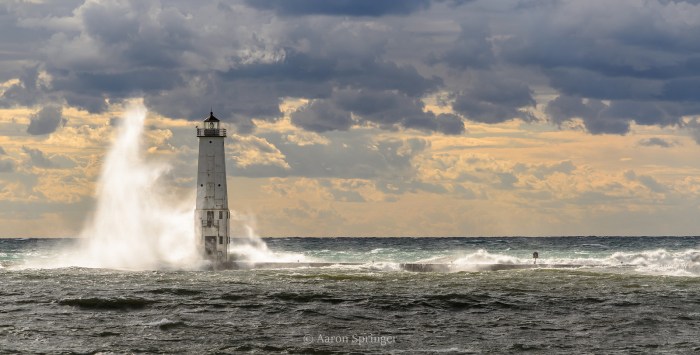
Pier Energy, photo by Aaron Springer

The Frankfort North Breakwater Lighthouse entry at Terry Pepper’s excellent Seeing the Light says the tip of the light is 72 feet off the water, making that spray over 80′ tall!! Click above for a ton more, but here’s something about the light tower:

1912 saw significant a significant change in the lighting of the Frankfort harbor entrance. A new square steel pyramidal tower was erected on the North Pier. Fully sheathed in steel plates, the white painted structure stood 44 feet from its base to the top of the ventilator ball. Outfitted with a fixed red Fourth Order Fresnel lens, the tower’s location on the north pier provided the new light with a focal plane of 46 feet, and a visible range of 12 miles in clear weather. The air siren from the South Pierhead light was relocated into this new structure, and set up to emit a characteristic isophase characteristic of alternating periods of 3 second blasts and 3 seconds of silence. An elevated walkway, similar to that installed on the south Pier, was erected from the new light to the shore.

…By 1924, the total car ferry tonnage through Frankfort Harbor was twenty five times greater than that prior to the establishment of the ferries. To better serve this vital commerce, the Army Corps of Engineers began construction of a pair of reinforced concrete arrowhead-type breakwaters at the harbor entrance in order to create a large stilling basin to protect the opening into the harbor. With the completion of these breakwaters in the early 1930’s, the twin piers at the entry into Lake Betsie no longer served any purpose. With plans in place to shorten them into short stub piers, the North Pierhead Light was lifted from the pier onto the deck of a barge and carried out to the end of the North Breakwater. A square steel base 25 feet in height had been erected on the end of the breakwater to receive it, and the tower was lifted onto the new base. After being bolted into position, the new tower stood 67 feet in height from the upper level of the pier to the top of the lantern ventilator ball. By virtue of its location on the concrete pier, the light stood at a focal plane of 72 feet, and the 17,000 candlepower incandescent electric light within the Fourth Order Fresnel was visible for a distance of 16 miles in clear weather.

Read on for lots more about the lighthouse including some great old photos.

View Aaron’s photo bigger and see more in his slideshow,.

Tons more lighthouses on Michigan in Pictures.

Tom Izzo: Definitely One of the Most Famous Natives of Michigan

tom-izzo-michigan-state-spartans

Tom Izzo, photo by Hillary Higgens

TRUE CONFESSION: Page-at-a-time slideshows make me want to smash my screen, but I have to say that what mLive is doing with slideshows has been pretty cool. Their feature on the Most Famous Natives of Michigan has their pick for the most famous person from each of Michigan’s 83 counties. Definitely worth a read. Share your thoughts here on on the Michigan in Pictures Facebook!

It’s hard to argue with their choice for the most famous person from Dickinson County, Michigan – Michigan State University Spartan coach Tom Izzo:

Since 1995, Tom Izzo has led the Michigan State men’s basketball team as head coach. Born Jan. 30, 1955, Izzo was recently inducted into the Naismith Memorial Basketball Hall of Fame. Under his watch, the Spartan team has made it to the Final Four seven times and taken home an NCAA Men’s Division I Championship.

Hillary took this photo back in 2011. View it background big and see more in her 2011 Champion’s Class slideshow.

Michigan’s Second Oldest City: Looking back on St. Ignace

st-ignace-lighthouse-explore-july-20-2012

St Ignace Lighthouse, photo by Sheldon Spurrell

You may know that Père Jacques Marquette founded Michigan’s oldest city Sault Sainte-Marie in 1668, but do you know Michigan’s second old city? If you can read titles, you know that’s St. Ignace, founded in 1671 and named in honor of Saint Ignatius of Loyola. Here’s some of the history of St. Ignace from the St. Ignace Visitor’s Bureau:

The natives of the St. Ignace region were migratory. In the spring, the Anishinabeg gathered maple sugar and fished sturgeon and smelt. Summer found them in settlements surrounded by crops of corn, potatoes and squash, and near the abundant supplies of wildlife, fish and berries. They developed efficient housing, watercraft, hunting and farming tools.

The heritage of the Straits evolved and changed over the centuries beginning with the arrival of Roman Catholic missionaries and then French and British explorers and fur traders … The natural waterway joining Lakes Michigan and Huron at the Straits of Mackinac generated extensive water traffic, and prompted the establishment of an outpost during the period of French occupation. The outpost – Fort de Buade – became the seat of King Louis XIV’s authority in the interior of North America. French notables including Rene-Robert Cavalier, Sieur de La Salle and Antoine Lamothe Cadillac spent time at the post. St. Ignace was among the largest settlements in New France from the last decade of the 15th century until the establishment of Detroit in 1701. The British arrived in the St. Ignace region with the defeat of the French during Seven Years War.

St. Ignace played a pivotal role in the fur trade until this industry began to wane. By the mid-1800’s the financial importance of commercial fishing to the economic well-being of the area eclipsed that of the fur trade. Ancillary industries including curing, packing and shipping augmented the fishery. It was during this period that the Mackinaw Boat became a familiar sight on the waters in and around the Straits. As the lumber industry in Michigan evolved, St. Ignace became a center for mill yards and its proximity to the shipping lanes added to its importance as a commercial hub in the northern Great Lakes area.

Read on for more including travel information.

Sheldon took this photo back in July of 2012 at sunrise. View it bigger and see more in his Michigan slideshow.

More from St. Ignace on Michigan in Pictures.

Today & Yesterday at Point Iroquois Lighthouse

point-iroquois-lighthouse-fall-michigan

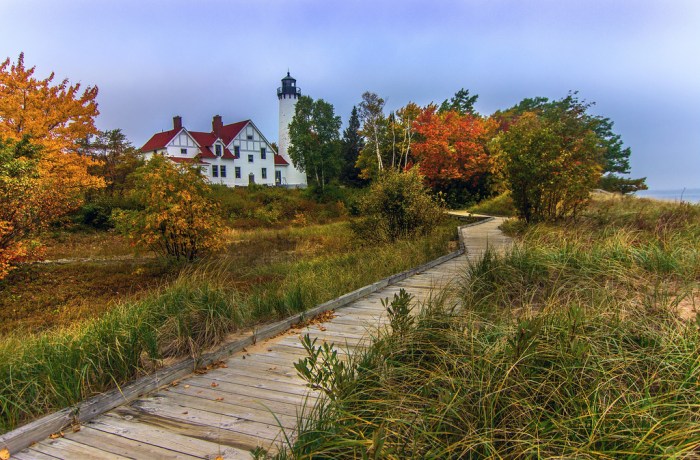
Point Iroquois Lighthouse on Whitefish Bay, photo by Cole Chase Photography

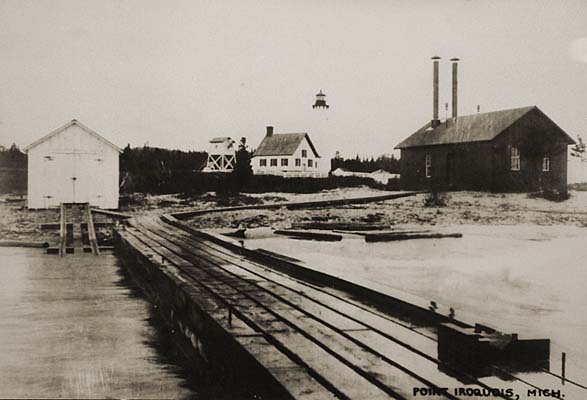
The Point Iroquois Lighthouse page at Terry Pepper’s Seeing the Light has a 100+ hear old photo of the light taken from almost exactly the same angle as Cole’s! View his bigger and see more great shots from fall of 2014 in his Autumn in Upper Michigan slideshow.

port-iroquis-lighthouse-1905

Point Iroquois Light Station in 1905, showing the fog signal building constructed in 1890. Note that the 1885 bell tower is still in place to the immediate left of the dwelling.

The photo is courtesy of the Point Iroquois Lighthouse and Historical Museum, and you can click the link for more about the museum!

Sunrise on McCarty’s Cove & Marquette Harbor Lighthouse

%22mccartys-cove%22-marquette-harbor-lighthouse-marquette-michigan

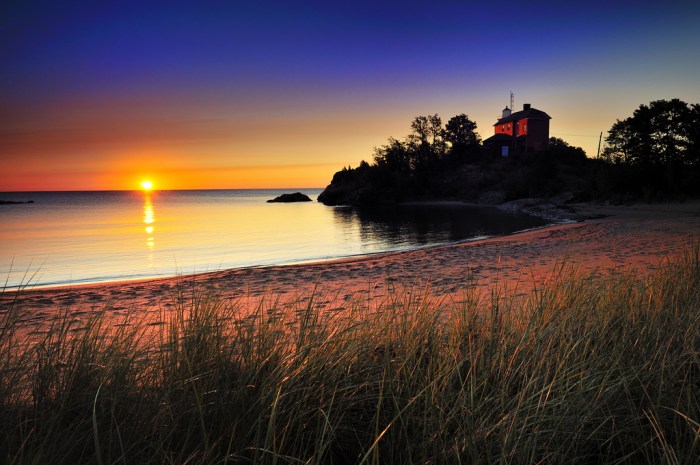
“McCarty’s Cove” Marquette Harbor Lighthouse, photo by John McCormick

Just got back from Marquette, and I have to say, this is one cool city!!

John took this photo back in August of 2011 at sunrise at McCarty’s Cove, one of Marquette’s best beaches according to Travel Marquette. I really had to dig (seriously, a Mining Journal history quiz was all I had to go on) to learn that McCarty’s Cove is named after Mike McCarty whose business, Lake Superior Ice, operated at that location. I’m not sure how long, but in 1919 they took over the Marquette Ice Company. Know more? Post it in the comments!

UPDATE:  Ann Fisher (who is a contributing photographer to Michigan in Pictures) shares:

“McCarty’s ice business lasted at least into my childhood (late 50’s, early 60’s). I remember going there to buy ice when we were making homemade ice cream in our hand-cranked ice cream maker.”

The Marquette Harbor Lighthouse is now a museum – click for more.

View John’s photo bigger, see more in his Sunsets/Sunrises slideshow, and view and purchase his work at michigannutphotography.com (FYI you can buy this photo right here).

The Curse of Bobby Layne

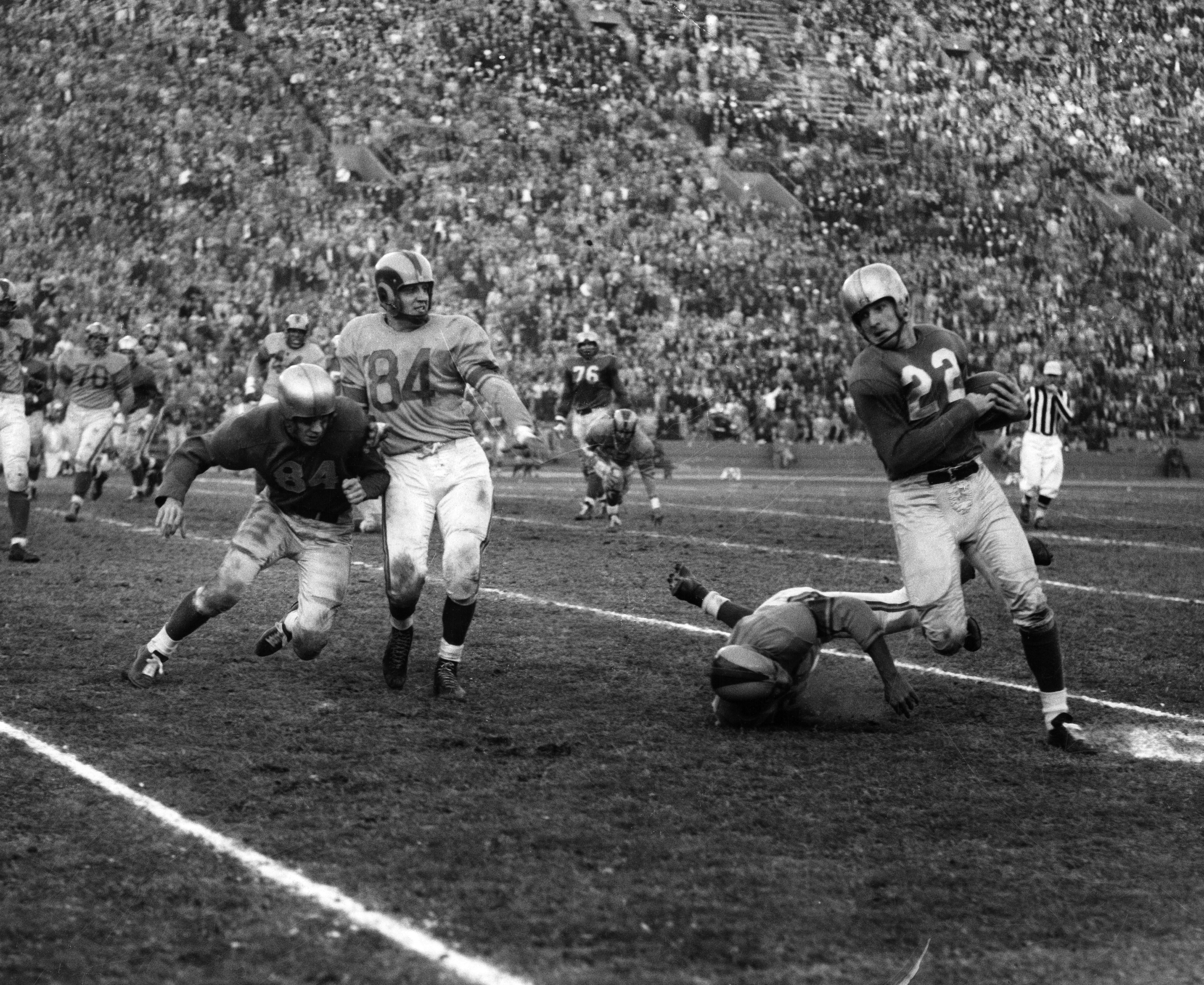
Bobby Layne Detroit Lions

Well, football season is almost here and Detroit Lions’ fans are probably feeling optimistic, so it’s probably time to explain The Curse of Bobby Layne:

In 1958, after leading the Lions to 3 NFL Championships and providing Detroit nearly decade of Hall of Fame play, the Lions traded Bobby Layne. Bobby was injured during the last championship season and the Lions thought he was through and wanted to get what they could for him. According to Legend, as he was leaving for Pittsburgh Bobby said that Detroit “would not win for 50 years”. In the pages that follow we present evidence that supports and confirms the existence of this curse which has been plaguing this team for nearly half a century.

Read on for more. You can also watch an ESPN feature on the origin of the Curse of Bobby Layne and check out Bobby Layne in the Pro Football Hall of Fame.

View the photo background bigtacular.

More Detroit Lions on Michigan in Pictures.

Remembering Labor on Labor Day

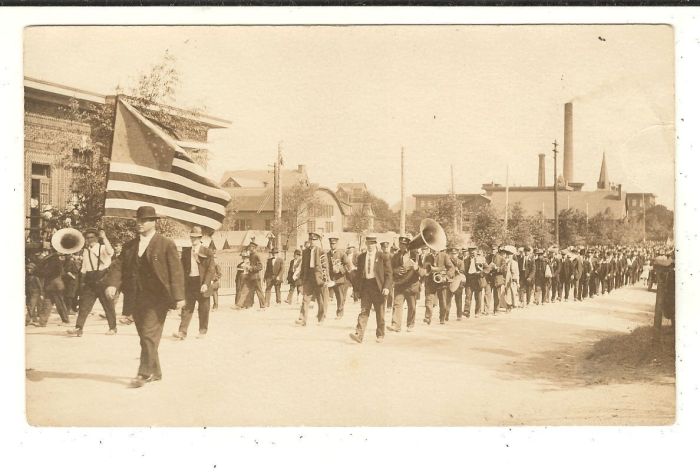
Parade, Copper Miners' Strike, Calumet, Michigan, 1913

Parade, Copper Miners’ Strike, Calumet, Michigan, 1913, photo by Wystan

Labor Day has become little more than a three day weekend, and labor and labor unions are often frowned upon. Before you go out and enjoy that extra day off, you might take a moment to reflect that the 5-day week of 8-hour days that we take for granted was won with the sweat and tears and blood of dedicated men and women who put it all on the line. Many of these were from Michigan, like these Keweenaw copper miners who risked everything from the loss of their livelihood to outright murder.

As a friend said, as we honor the sacrifice of soldiers on Memorial Day, let us also honor all the hard-working people of today and days gone by who have fought for a better life.

View Wystan’s photo background big and dive into his slideshow for many more great old photos from Michigan!

More Labor Day on Michigan in Pictures.

#TBT Tawas Point US Lighthouse Service Crew Training

Tawas Point Lighthouse USLSS Life Saving Service Crew Training on Tawas Bay

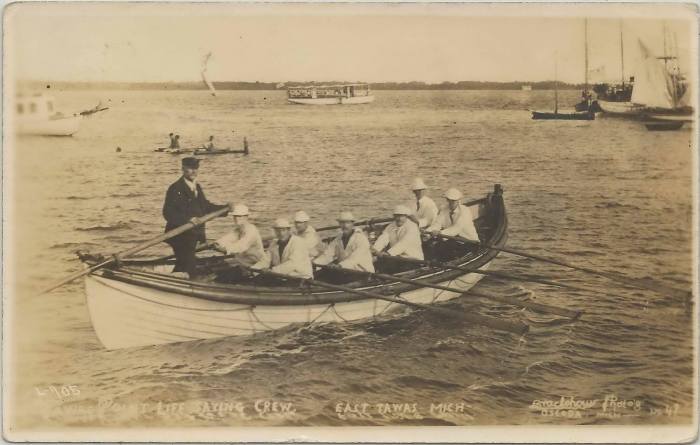
Tawas Point Lighthouse Crew Training, photo by UpNorth Memories

The U.S. Life-Saving Service Heritage Association has an excellent history of the U.S. Life-Saving Service that says in part:

In 1878 the growing network of lifesaving stations was finally organized as a separate agency of the Treasury Department and named the U.S. Life-Saving Service. Sumner I. Kimball was chosen as the General Superintendent of the Service. Kimball held tight reign over the Service and, in fact, remained the only General Superintendent of the organization. The law which created the U.S. Coast Guard in 1915, also provided for the retirement of Kimball. The Service’s reputation for honest, efficient, and non-partisan administration, plus performance of duty, can be largely attributed to the efforts of this one man.

The stations of the Service fell into three broad categories: lifesaving, lifeboat, and houses of refuge. Lifesaving stations were manned by full-time crews during the period when wrecks were most likely to occur. On the East Coast this was usually from November to April, and was called the “active season.” By the turn of the century, the active season was year-round. Most stations were in isolated areas and crewmen had to be able to perform open beach launchings. That is, they were required to launch their boats from the beach into the surf. Before the turn of the century, there were very few recreational boaters and most assistance cases came from ships engaged in commerce.

Lifeboat stations were located at or near port cities. Here, deep water, combined with piers and other waterfront structures, allowed the launching of heavy lifeboats directly into the water by marine railways on inclined ramps. In general, lifeboat stations were located on the Great Lakes, but some lifesaving stations were situated in the more isolated areas of the lakes. The active season on the Great Lakes stretched from April to December.

…The U.S. Life-Saving Service had two means of rescuing people on board ships stranded near shore: by boat and by a strong line stretched from the beach to the wrecked vessel. The Service’s boats were either a 700 to 1,000 pound, self-bailing, self-righting surfboat pulled by six surfmen with twelve to eighteen foot oars, or a two to four ton lifeboat. The surfboat could be pulled on a cart by crewmen, or horses, to a site near a wreck and then launched into the surf. The lifeboat, following a design originated in England, could be fitted with sails for work further offshore and was used in very heavy weather. Some crews, at first, viewed the lifeboat with skepticism because of its great weight and bulk. The skepticism soon changed and crews began to regard it as “something almost supernatural,” for it enabled them to provide assistance “when the most powerful tugs and steam-craft refused to go out of the harbor. …”

Terry Pepper’s Seeing the Light has a bunch of information and photos of the Tawas Point Lighthouse.

This photo shows the crew of the Tawas Point Lighthouse participating in USLSS crew training on Tawas Bay. Check it out bigger and join the Northern Michigan Photo Postcards – Our History and Heritage group for more great old photos from Don and others.

More history from Michigan in Pictures.

High above Houghton, Michigan

Houghton Michigan

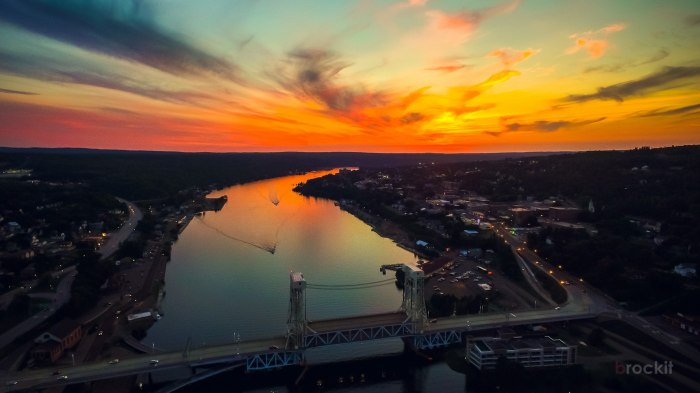
goodnight, pretty little town, photo by brockit, inc.

This wonderful photo made me want to know more about Houghton, Michigan, so here’s an edited profile of Houghton via Wikipedia:

Houghton is located on the south shore of Portage Lake, across from Hancock. (see map) Native Americans mined copper in and around what would later be Houghton thousands of years before European settlement. French explorers had noted its existence in the area as early as the seventeenth century, and in 1772 Alexander Henry had prospected for copper on the Ontonagon River near Victoria. When Horace Greeley said, “Go West, young man” he wasn’t referring to gold, but rather the copper rush in Michigan’s western Upper Peninsula.

The city is named after Douglass Houghton, physician-naturalist on Henry Rowe Schoolcraft’s Lake Superior expedition whose 1841 report on the quantity and superior qualities of UP copper earned him the title of “father of copper mining in the United States.” The news brought many Cornish and Finnish immigrants to the area, along with smaller numbers of French-Canadian immigrants arrived in Houghton (or Copper Island as they called it) to work in the copper mines. These groups have had and continue to have a great influence on the area’s culture and cuisine.

In Houghton’s first days it was said that “only thieves, crooks, murderers and Indians” lived there. The post Civil War boom and increasing demand for copper wiring fueled the development of Houghton in the 1860s and 1870s. The Keweenaw Waterway, a dredging and extension of the Portage Lake, the Portage Shipping Canal and Lily Pond that turned the northern part of the Keweenaw Peninsula into “Copper Island” was completed in 1873. By 1880 Houghton had become “a burgeoning city” and in 1883, the railroad was extended from Marquette.

The last nearby mines closed in the late 1960s, but in 1885 the Michigan State Legislature foundedthe Michigan College of Mines to teach metallurgy and mining engineering. The school continues today as Michigan Technological University – the primary employer in the city.

Houghton has the distinction of being the birthplace of professional ice hockey in the United States when the Portage Lakers were formed in 1903, and Houghton’s Dee Stadium (formerly the Amphidrome) is the home of the Portage Lake Pioneers Senior Hockey Team.

Click for more from Wikipedia and please feel free to share tidbits in the comments.

View Adam’s photo background bigilicious on Facebook and definitely follow brockit for tons more cool photos!

More Houghton on Michigan in Pictures.

Happy Internaut Day, Michigan!

Lets Dance Audaciously by Ryan Munson

Let’s Dance Audaciously, photo by Ryan Munson

Today (August 23, 2016) is, Internaut Day, the 25th anniversary of the official launch of the the World Wide Web. Some fun facts and some not so fun ones:

  • At least 40 percent of the world has access to the internet
  • Detroit has the worst rate of Internet access of any big American city, with four in 10 of its 689,000 residents lacking broadband (NYT)
  • There are 3.4 billion internauts as of 1 July 2016, half of these are on Facebook.
  • The Michigan Infrastructure Commission is looking for input on citizen hopes for Michigan’s future connectivity.
  • There are at least 1 billion websites on the WWW
  • At least 48.5 percent of internet traffic in 2015 was generated only by bots
  • We search for 56,000 items per second on Google
  • We send 2.5 million emails per second
  • Lolcats is worth $2 million

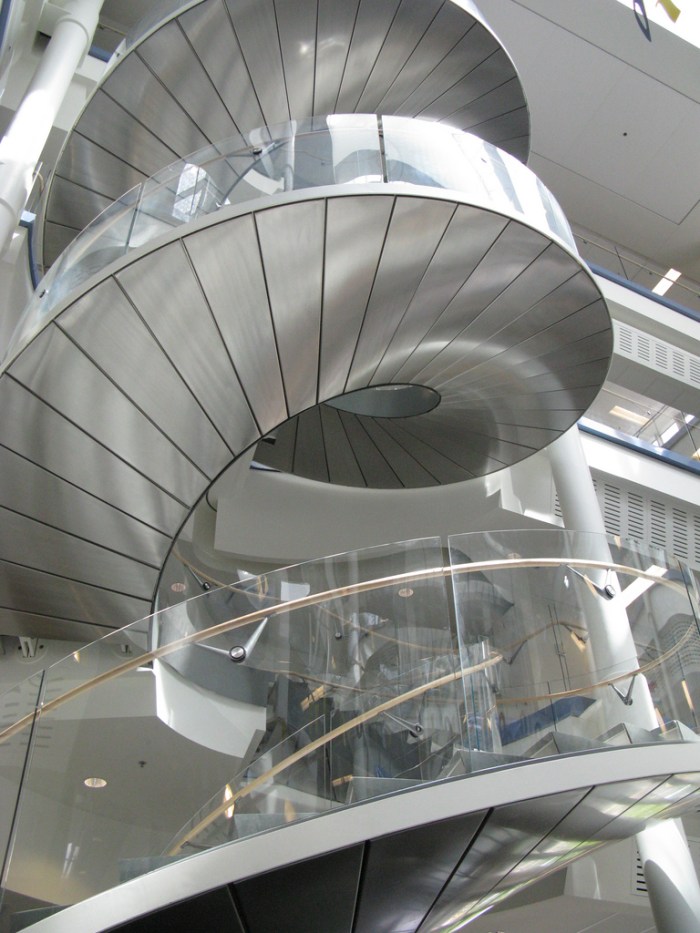
Ryan took this photo at the University of Michigan Computer Science & Engineering building. View it background big and see more in his slideshow.