
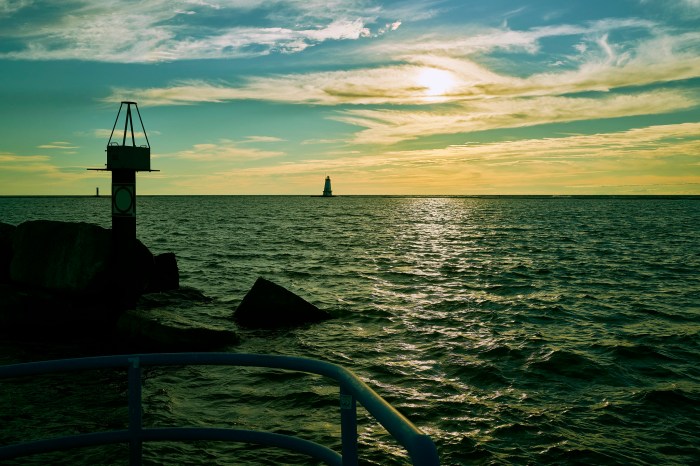
The Magic Of That Day Was Written In The Sky by David Hoffman
Sweet shot of the view of Lake Michigan from Ludington. See more in David’s Lighthouses gallery on Flickr!
Have a great weekend everyone & see more lighthouses on Michigan in Pictures.

The Magic Of That Day Was Written In The Sky by David Hoffman
Sweet shot of the view of Lake Michigan from Ludington. See more in David’s Lighthouses gallery on Flickr!
Have a great weekend everyone & see more lighthouses on Michigan in Pictures.
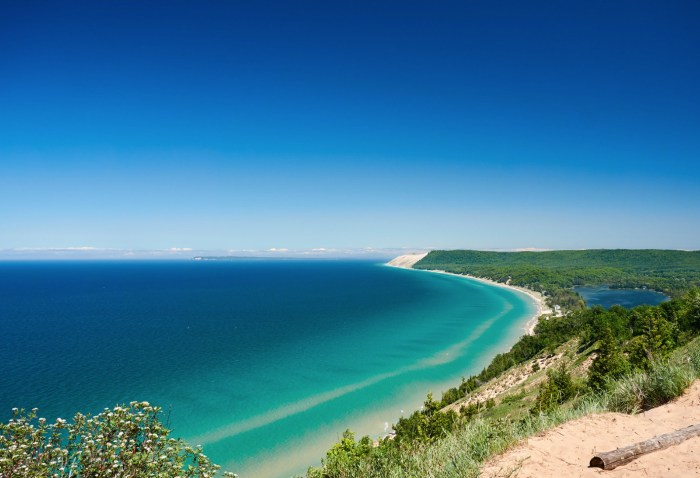
Sleeping Bear Dunes National Lakeshore by Thomas DB
(via leelanau.com) On October 21st, 1970 the Sleeping Bear Dunes National Lakeshore became the third US National Lakeshore. The online book A Nationalized Lakeshore: The Creation & Administration of the Sleeping Bear Dunes National Lakeshore has a good overview of what was a remarkably contentious issue back in the day:
Beginning in 1919 a small portion of what is now the national lakeshore was set aside as a state park. The idea of a national park in northwestern Michigan did not surface until the National Park Service’s Great Lakes Shoreline Survey visited the area in 1958. Between 1959 and 1970 there was a continuous and controversial effort in Congress to create a park unit around the Sleeping Bear Dune. The legislative leader of the Sleeping Bear park proposal was United States Senator Philip A. Hart. The senator’s persistence and patience in the end led to the creation of Sleeping Bear Dunes National Lakeshore on October 21, 1970.
Opposition to the creation of the lakeshore was very strong among local summer homeowners. More than 1,400 tracts of private land had to be acquired to create the lakeshore. A heavy-handed, poorly planned land acquisition program reinforced the bitterness that surfaced during the decade of struggle that preceded authorization. The legacy of those actions has been twofold. On one hand the National Park Service has been vilified by many local property owners and the park staff have had to work in an environment that is unnecessarily confrontational. On the other hand, the presence of an organized local populace wary of National Park Service policy has influenced for the better the development of the national lakeshore. Local sentiments played an important role toning-down the agency’s initial plans to intensively develop the area’s recreational assets. More recently local sentiment has influenced the agency’s approach to the lakeshore’s rural cultural landscapes. Unfortunately, resistance to the National Park Service in the region has also hindered opportunities to bring more land under protection and to develop scenic drives for park visitors.
The National Park Service conceived the Sleeping Bear Dunes lakeshore at a time when the shores of Lake Michigan were rapidly undergoing privatization. Subdivisions of vacation and year round homes threatened to keep ordinary citizens from enjoying Michigan’s broad, sandy shoreline. A nationalized lakeshore along the beaches and bluffs of the Sleeping Bear made available for all what might have been enjoyed only by a select few. The cost was millions of dollars of federal funds and the hopes and dreams of hundreds of small property owners. Sleeping Bear Dunes was a tragedy for the latter and a wise investment of the former.
Indeed. You can read lots more in A Nationalized Lakeshore.
It was hard to pick a photo for this post, but I ended up going with Thomas’s beautiful shot from June of 2016 of my favorite view in the Lakeshore atop the Empire Bluffs where you can see South Bar Lake, the southern end of the main dune complex, and the Manitou Islands in the distance. See more in Thomas’s 6/1-6/3/16 Grand Traverse & Leelanau gallery on Flickr.
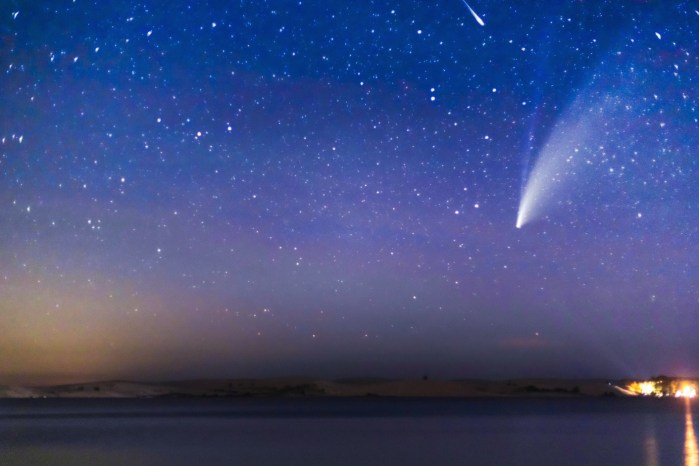
Neowise and meteor by Gary Syrba
In addition to being the season of cider, changing leaves, and Halloween, October also brings a pair of meteor showers. Our friends at EarthSky give you all you need to know to see the Draconid & Orionid meteor showers:
The Draconids, October 8th
In 2021, watch the Draconid meteors at nightfall and early evening on October 8. You might catch some on the nights before and after, as well. Fortunately, the thin waxing crescent moon sets before nightfall. It won’t hinder this year’s Draconid shower … This shower is usually a sleeper, producing only a handful of languid meteors per hour in most years. But watch out if the Dragon awakes! In rare instances, fiery Draco has been known to spew forth many hundreds of meteors in a single hour.
The Orionids, October 21st
Unfortunately a full moon accompanies 2021’s Orionid shower. Try watching for these meteors in the wee hours before dawn on October 21. You won’t escape the moon, though. On a dark, moonless night, the Orionids exhibit a maximum of about 10 to 20 meteors per hour. More meteors tend to fly after midnight, and the Orionids are typically at their best in the wee hours before dawn. The Orionids sometimes produce bright fireballs, which might be able to overcome a moonlit glare. If you trace these meteors backward, they seem to radiate from the Club of the famous constellation Orion the Hunter.
Gary took this shot last summer. Head over to his Flickr for the latest!
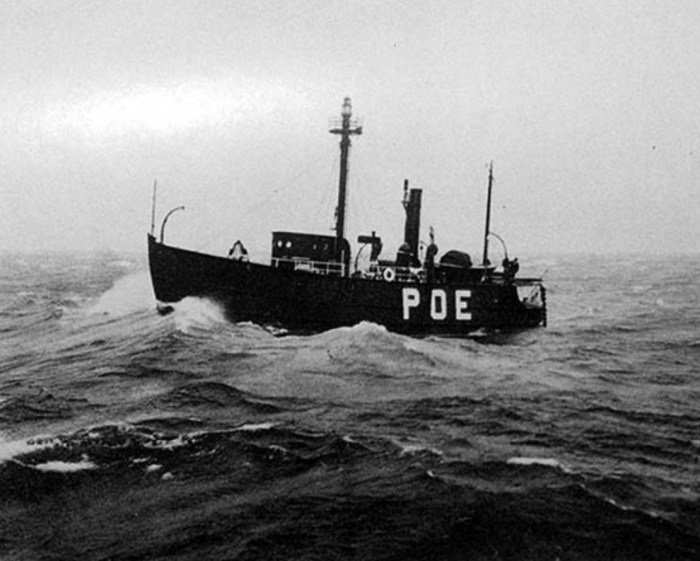
Poe Reef lies just eight feet beneath Lake Huron’s surface between Bois Blanc Island and the Lower Peninsula mainland. Terry Pepper’s Seeing the Light shares the story of Poe Reef Lightship LV62, launched on this day in 1893:
In 1892 two contracts totaling $55,960 were awarded to the Craig Shipbuilding Company in Toledo for the construction of four lightships. Designated as Lightships LV59, LV60, LV61 and LV62, all four vessels were built to similar specifications. Framed and planked of white oak they measured 87′ 2″ inches in length, 21′ 6″ inches in the beam, with a draft of 8 feet. In a cost-cutting effort, the vessels were un-powered, outfitted with only a small riding sail carried on a short after mast. Equipped with a cluster of three oil-burning lens lanterns hoisted on their foremasts, each was also equipped with 6″ steam whistles and hand-operated bells for fog use. Work was completed on the four vessels the following year, and after sea trials, all four were commissioned by the Board and placed into service, LV59 being assigned to Bar Point, LV60 to Eleven Foot Shoal, LV61 to Corsica Shoal and LV62 to Poe Reef.
With the words POE REEF brightly painted in white on her fire engine red hull, LV62 was towed to Poe Reef by the lighthouse tender Marigold, and anchored on station to begin her vigil on September 29, 1893. For the next seventeen years LV62 spent every shipping season faithfully guarding the shoal. With the end of each shipping season, one of the lighthouse tenders would make the rounds of all lightship stations in the Straits area, and tow them into Cheboygan harbor for winter lay-up. While in Cheboygan, necessary repairs and improvements would be made in preparation for the following season. At some time in March or April, the ice would break up sufficiently to allow the vessels to be towed back to their stations to stand guard for yet another season.
Head over to Seeing the Light for more about Poe Reef Lighthouse & the stories of all Michigan’s lighthouses compiled by a champion for their preservation who has gone too soon.
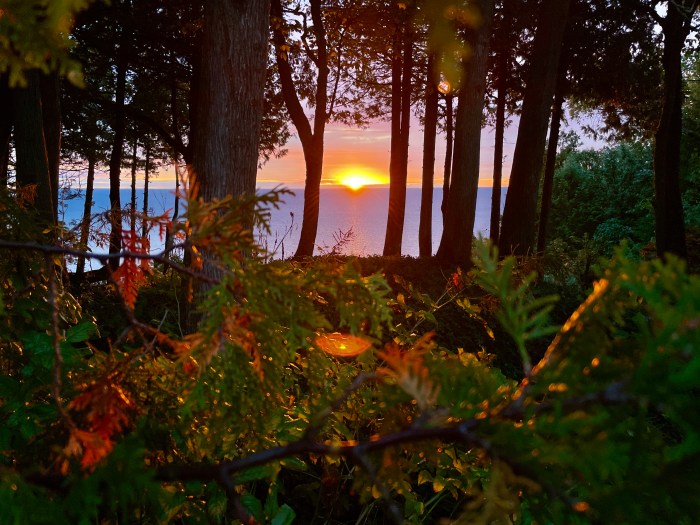
“Every single day, sunrise provides a tiny opportunity to celebrate life, and it’s available to everyone of us. Today will be a good day to celebrate life.””
-Bugsy Sailor
Bugsy shares that on January 1, 2019, he made the ambitious resolution, to watch and photograph every sunrise of the year:
I sought the sun, but what I found was so much more. So much in fact, that I have yet to miss a sunrise.
What started as Year of the Sunrise has grown into life of the sunrise. To date I have photographed 1001 consecutive sunrises, primarily from the Lake Superior shoreline in Marquette County, Michigan.
Along the way, sunrise has slowed my approach to life, opened my heart, introduced me to love, navigated me through a global pandemic, and given me witness to more beauty than I can express. There have been -30º windhills, downpours, thunderstorms, blizzards, and no matter how gray the day, the sun still rises.
Photographs have been the tangible output of this journey, but it has never been about the photos, it has always been about the wind on my face, the sand between my toes, and feeling the sunrise. I stand by the notion that, no photograph of a sunrise is better than a sunrise in person.
You can purchase a commemorative print & learn much more at Year of the Sunrise.
PS: Bugsy is one of the founders of the awesome Fresh Coast Film Festival which takes place October 14-17, 2021 in Marquette and celebrates the outdoor lifestyle and resilient spirit of the Great Lakes Region!!
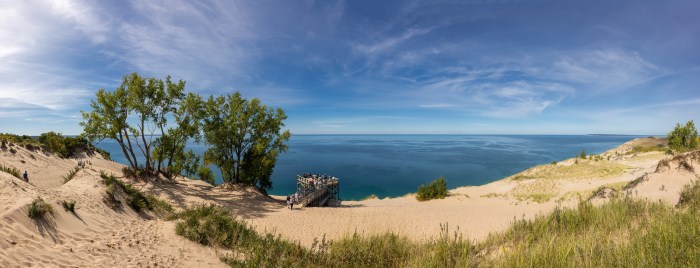
Good to the Last Drop by Rudy Malmquist
Rudy got a stunning shot of the view from the Pierce Stocking Overlook in the Sleeping Bear Dunes National Lakeshore. Head over to his Flickr for more!
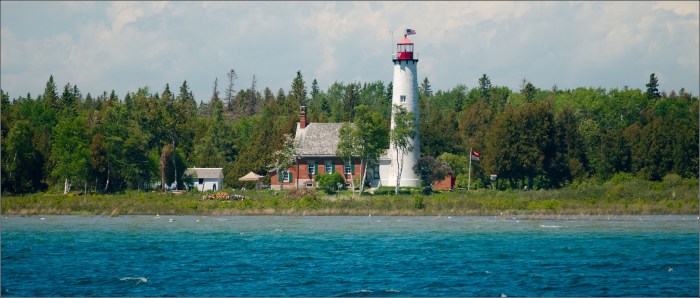
On September 20th way back in 1873, the beacon of the the St. Helena Island Lighthouse was lit for the first time. CMU’s Clarke Historical Library explains:
Because several ships had been wrecked on the dangerous shoals near the island of St. Helena in 1872, Congress authorized construction of a lighthouse at the southeast tip of the island. Since September 20, 1873, the beacon of the St. Helena Lighthouse has helped guide vessels safely through the Straits of Mackinac.
The light was first automated in 1922 and the modern lighthouse uses solar batteries to power the light.
In 1988, the lighthouse was added to the national Register of Historic Places. Recently restored to excellent condition by the Great Lakes Lighthouse Keepers Association, the St. Helena Island Lighthouse continues to light up the Straights and provide a glimpse of the golden age of the Great Lakes’ lights.
Definitely check the Clarke Historical Library out – some great Michigan history there for sure!
Joel took this photo back in 2014 on a Lighthouse Cruise with Shepler Ferry / Great Lakes Lighthouse Keepers Association. See more shots in his Lighthouse Cruise 6/16/2014 gallery.
More lighthouses on Michigan in Pictures!
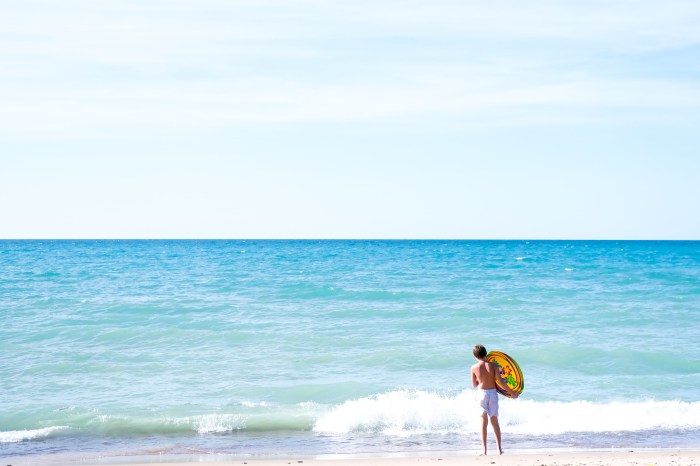
The Great Lake Michigan by Kate Dailey
Michigan has 3,288 miles of coastal shoreline, more than any other state except Alaska, and this weekend is the perfect time to get yourself to the Great Lakes coast before summer is gone!
Kate took this photo earlier in August. See more on her Flickr!
PS: With 1640 miles of shoreline, Lake Michigan has just about half of that coastline! See much more of Lake Michigan on Michigan in Pictures!
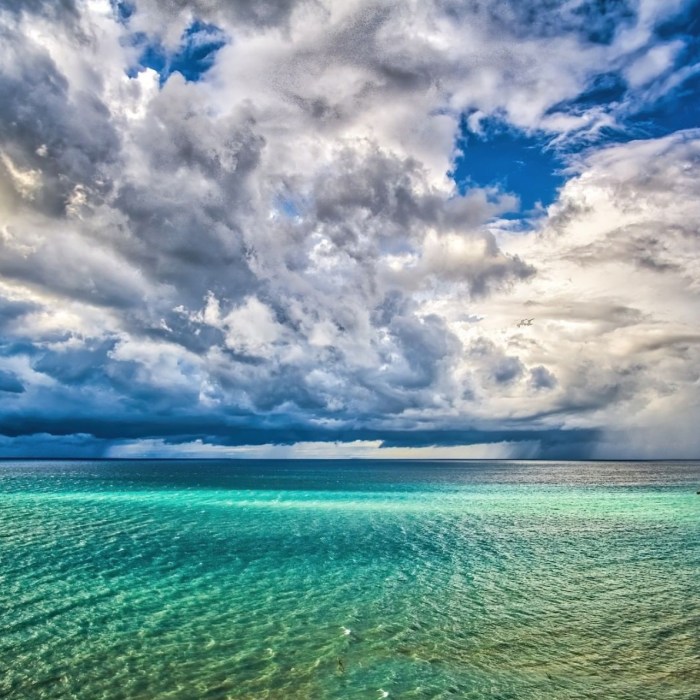
Riders on the Storm by Mark Smith
Here’s a simply stunning shot by Mark Smith of a stormfront rolling over the Manitou Islands. Follow Mark on Instagram @downstreamer7 for more & view & purchase his work at Leelanau Landscapes Photography.
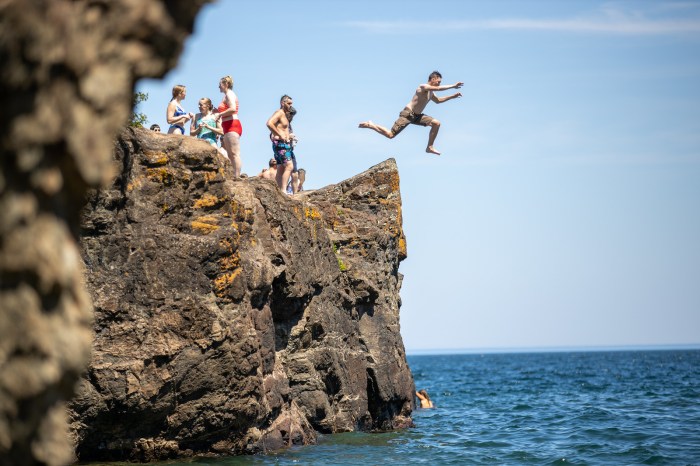
Slip & Splash by Rudy Malmquist
“Black Rocks is one of Marquette’s coolest attractions, in my opinion. There are many, to be sure, but cliff diving into a frigid Lake Superior is a rush. And if you wait until the middle of August, the water isn’t too cold by most people’s standards. Which is to say not too cold. Not warm, but not cold.”
~ Jesse Land, Awesome Mitten’s Resident Yooper
Awesome Mitten shares tips & directions to Black Rocks in Marquette’s Presque Isle Park:
As one of the coolest attractions in Marquette, the Black Rocks are an ancient rock formation that stands 20-30 feet above Lake Superior. Aside from the height, the dark color of the cliffs adds a dramatic landscape to the shoreline along the tip of Presque Isle Park.
Rudy took this photo last summer. See his latest on his Flickr!
 Michigan in Pictures