Great Egret (Ardea alba) in Flight

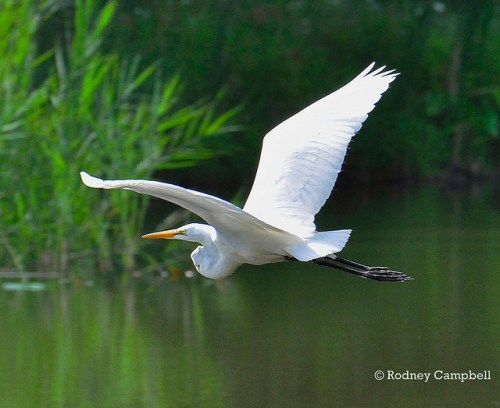
Great Egret (Ardea alba) in Flight

Great Egret (Ardea alba) in Flight, photo by AcrylicArtist

The Michigan Bird Atlas has a nice document on the Great Egret in Michigan that says (in part):

Today, the Great Egret is a powerful symbol of early conservation efforts mounted to safeguard it and other species from overhunting for their feathers in the 1800s. Protection in the early 1900s is credited with population recovery and establishment of the Great Egret as a breeding species in Michigan approximately 50 years ago.

…Great Egrets reach the northern edge of their U.S. distribution in Michigan. Historically, there is no evidence that this species nested in Michigan until the 1950s. For example, Barrows (1912) and Wood (1951) did not report Great Egrets as breeders in Michigan at the time of their studies, but Kelley et al. (1963) confirmed nesting in 1954 by nine pairs on Stoney Island (Detroit River) and seven on Dickinson Island (Lake St. Clair). These colonies appear to have persisted into the mid-1970s when W. Scharf et al. (1978) documented egrets at these sites in 1976. Although these colonies were no longer active at the time of the 1989-91 Great Lakes Colonial Waterbird Census, Sharf and Shugart (1998) reported new colonies in Saginaw Bay and at Pte. Mouillee State Game Area, Monroe Co.

The UM Animal Diversity Web has some information, calls and photos for Ardea alba, and also Great Egret (Ardea alba) on Michigan in Pictures.

Check this photo out background big and see more in Rodney’s Animals slideshow.

More Michigan birds on Michigan in Pictures.
Start your (lake effect snow) engines?

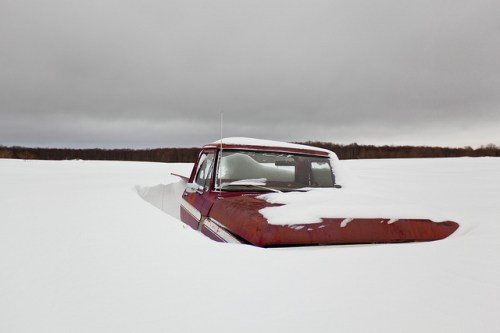
Parked for the Season

Parked for the Season, photo by Rudy Malmquist

Jennifer Kalish of the Great Lakes Echo writes that our summer heat could produce more winter snow:

The record high temperatures this summer could mean some Great Lakes coastal residents will get buried in snow this winter.

“There’s certainly a lot of evidence to suggest that we will go into this fall with warmer than normal lake temperatures,” said Jeff Andresen, state climatologist for Michigan. “That could lead to an increase in the amount of lake-effect precipitation we see, but it isn’t certain.”

Lake-effect snow happens when cold dry air that moves south over Canada meets the warm waters of the Great Lakes, Andresen said.

The cold air picks up moisture as the warm water evaporates from the lake, forms into clouds and then dumps snow onto nearby cities and towns, Andresen said. The greater the difference in temperature between the warm water and cold air, the more snow will fall.

That means the warm summer is only part of the recipe for lots of lake-effect snow.

Read on at the Echo.

Check this photo out bigger and see more in Rudy’s snow slideshow.

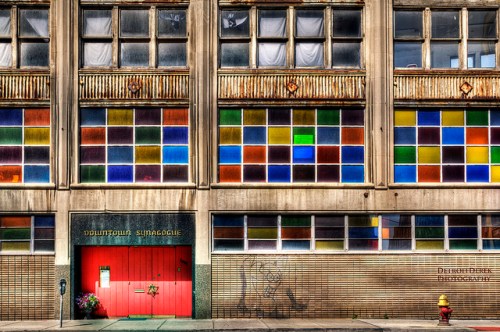
Downtown Synagogue of Detroit

An Amassment of Colors

An Amassment of Colors, photo by DetroitDerek Photography

The Isaac Agree Downtown Synagogue (of Detroit) explains that:

The Isaac Agree Downtown Synagogue (IADS) was established in 1921, at a time when there were many synagogues located in Detroit. Its principal mission was to address the unmet needs of the Jewish community ― particularly for those who worked downtown, were unaffiliated with another synagogue, or were visiting the city―by providing a traditional (Conservative) Jewish presence in the heart of Detroit.

…As much of the Jewish community migrated to suburban Detroit, the IADS―like the city itself―has suffered from a shrinking population and a depletion of resources. In recent years, daily services have, of necessity, been eliminated. However, the Downtown Synagogue proudly continues to offer weekly Sabbath services, as well as High-Holiday services, the latter of which attracts hundreds of worshippers.

The Synagogue is currently housed in a historic four-story building, a building that it has occupied and owned since the early 1960s. Located at 1457 Griswold Street, it is well situated, but is in serious need of major repair. Currently, parts of it are unusable. However, the unique triangular design creates an uncomparable, interesting space. The potential for this building is far from being realized.

This Sunday (August 19), they are offering J-Cycle, a bicycle tour of historic Jewish Detroit. A portion of the proceeds will be donated to the Back Alley Bike Project, at the Hub of Detroit, a non-profit organization providing cycling education and services with a focus on youth development, sustainable practices and community access.

See Derek’s photo on black and in his massive and amazing Detroit slideshow.

Also see a few more pics from the Absolute Michigan pool.

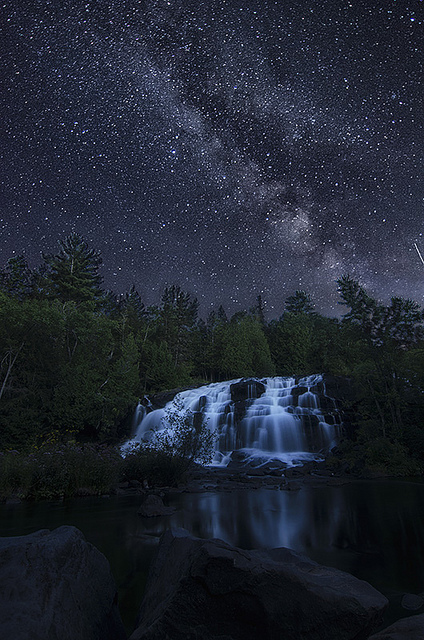
The Bond Falls under the Milky Way

The Bond Falls under the Milky Way

The Bond Falls under the Milky Way, photo by adonyvan

Jiqing Fan takes some incredible photos, some of which we’ve featured on Michigan in Pictures.

Definitely check this shot from the Perseid Meteor Shower out on black and in his Houghton & UP MI slideshow.

More about Bond Falls and the surrounding area and also the Perseid shower (which you’ll still be able to catch all week) on Michigan in Pictures.

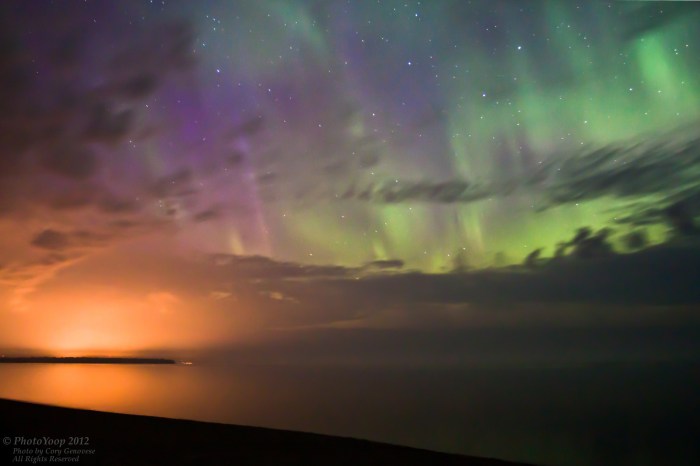
The Northern Lights of Superior

The Northern Lights of Superior

The Northern Lights of Superior, photo by PhotoYoop

Happy Saturday – I hope that lots of you are getting out to see the Perseid meteor shower tonight and tomorrow night!

Cory took this a couple of weeks ago in another auroral outburst in what has been a great year for the northern lights in Michigan.

Check it out on black, see a couple more shots in his slideshow or check out more of Cory’s great photos from after dark in his Night Time slideshow.

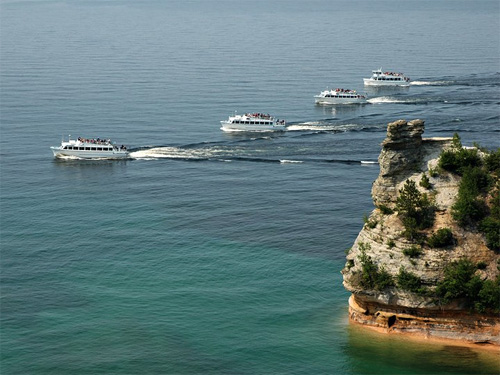
Pictured Rocks fleet at Miners Castle

Pictured Rocks fleet at Miners Castle, photo by ExploreMunising.com

The above photo was posted to the ExploreMunising.com Facebook last July. It shows four boats from the Pictured Rocks fleet passing Miner’s Castle in the Pictured Rocks National Lakeshore.

The tour boats are a great way to see the many formations the Lakeshore offers. Visit their website for tour highlights and also a nice photo gallery.

More Miner’s Castle photos on Michigan in Pictures.

Get ready for the 2012 Perseid Meteor Shower!

Sleeping Bear Twilight

Sleeping Bear Twilight, photo by Unified Photography

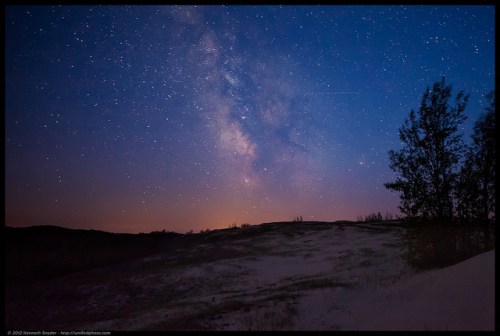
Here’s a gorgeous shot from just after sunset on the Sleeping Bear Dunes. That little meteorite reminded me to check on the Perseids. EarthSky’s Meteor Shower Guide says that the Perseids will grace the sky August 10-12, 2012 with the peak the evening of the 11th.

Meteors are typically best after midnight, but in 2012, with the moon rising into the predawn sky, you might want to watch in late evening as well … The Perseids are typically fast and bright meteors. They radiate from a point in the constellation Perseus the Hero. You don’t need to know Perseus to watch the shower because the meteors appear in all parts of the sky. The Perseids are considered by many people to be the year’s best shower, and often peak at 50 or more meteors per hour in a dark sky.

The Perseids tend to strengthen in number as late night deepens into midnight, and typically produce the most meteors in the wee hours before dawn. These meteors are often bright and frequently leave persistent trains. Starting in late evening on the nights of August 10/11, 11/12 and 12/13. The Perseid meteors will streak across these short summer nights from late night until dawn, with only a little interference from the waning crescent moon. Plus the moon will be near the bright planets Venus and Jupiter in the eastern predawn sky.

If you want to keep up on when the meteors are showering, the Meteor page at Stardate.org is a great resource!

See it on black and be sure to check out Kenneth’s small but gorgeous Sleeping Bear Dunes slideshow for more including a great photo of the northern lights over Sleeping Bear Bay!

More on meteors from Michigan in Pictures!

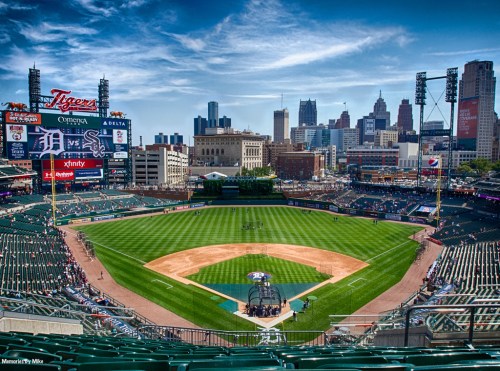
Comerica Park, home of the Detroit Tigers

Tigers Game_2012-07-21_15-08-05_P7210017_©MikeBoening_2012_HDR (1)

Tigers Game, July 21, 2012, photo by memories_by_mike

It may come as a surprise to regular readers that despite all the posts about the Detroit Tigers here and at Absolute Michigan, I’ve never been to Comerica Park. Today I not only get to go – I get to sit on the 3rd base line (2nd row!!)as the red-hot Detroit Tigers face the New York Yankees tonight!

Wikipedia’s entry for Comerica Park (edited a bit by me) explains that:

Groundbreaking for a new ballpark to replace Tiger Stadium for the Tigers was held on October 29, 1997 and the new stadium was opened to the public in 2000. In December 1998, Comerica Bank agreed to pay $66 million over 30 years for the naming rights for the new ballpark. Comerica Park sits on the original site of the Detroit College of Law.

In contrast to Tiger Stadium, which had long been considered one of the most hitter-friendly parks in baseball, Comerica Park is considered to be extremely friendly to pitchers. Except for dead center – 420 feet versus Tiger Stadium’s 440 feet – the outfield dimensions were more expansive than those at Tiger Stadium. This led to complaints from players and fans alike, and engendered the sarcastic nickname Comerica National Park.

Although a few public figures—notably radio announcer Ernie Harwell—supported the dimensions, most agreed that the left-field wall, in particular, needed to be brought closer to home plate. Before the 2003 MLB season the club did so, moving the distance from left-center field from 395 to 370 feet. In place of the old bullpens in right field, 950 seats were added for a new capacity of 41,070.

At the time of construction, the scoreboard in left field was the largest in Major League Baseball. The first playoff game at Comerica was played on October 6, 2006 against the New York Yankees. It hosted its first World Series later that month. The stadium also includes many baseball-themed features, including a “Monument Park” in the deep center field stands, complete with statues of former Tigers Ty Cobb, Hal Newhouser, Charlie Gehringer, Hank Greenberg, Al Kaline, and Willie Horton.

A few neat things I found are Comerica Park from Ballparks.com, baseball writer Geoff Baker touring Comerica,  Calvin Johnson hitting a HR in BP, Comerica on Michigan in Pictures, a time-lapse of the installation of the new high-def scoreboard, the slightly bizarre Comerica UFO footage and a very cool RC plane fly-over of Comerica.

Check this photo out big as a ballpark and in Mike’s slideshow.

A Map of the Wind

Breakwall Waves

Breakwall Waves, photo by Gary of the North

The Great Lakes Echo’s Jennifer Kalish has a feature on an animated wind map that’s driven by real-time data.

Two digital artists recently released an animated map illustrating the speed and direction of surface winds across the U.S.

Its ever changing patterns are driven by wind data from the National Digital Forecast Database kept by the National Oceanic and Atmospheric Administration.

The database also feeds information to the administration’s Great Lakes current map released last month to help the public better understand lake currents.

Click here to see the Wind Map.

Terry Pepper’s Seeing the Light says that the iron pier light is 55 feet tall, and Gary’s photo from Sunday at the breakwall in Grand Marais shows what wind can do to the waves of Lake Superior! See this photo as big as the big lake or jump into his slideshow for a couple more shots of the wave action!

Read more about the Grand Marais Pier Light on Michigan in Pictures.

The Beauty of Lake Charlevoix

Lake Charlevoix Yacht Race

Lake Charlevoix Yacht Race, photo by Innerspacealien

Last week USA Today released their list of the best lakes in America. The Great Lakes were not eligible and Lake Tahoe was the winner, but Lake Charlevoix in Northern Michigan managed to grab the runner-up spot. Click that link to read what some of their readers wrote. The Lake Charlevoix Lake Association says:

Lake Charlevoix is the third largest lake in the state with a surface area of over 17,200 acres and approximately 60 miles of shoreline. The maximum depth in the main basin is 122 feet and in the south arm, 58 feet. It is located at 45 degrees north latitude and 85 degrees west longitude. It has direct access to Lake Michigan via dredged channels in and out of Round Lake in the city of Charlevoix. There are close to 1,700 lots on the lake, with approximately 1,200 different owners. The lake is usually frozen for about three months of the year from near the end of January to early April.

There are three cities at the ends of the lake. Boyne City is at the east end of the main lake and is a historic lumber and tannery town. It is now a year round recreation center with the lake in the summer and Boyne Mountain ski resort in the winter. East Jordan is at end of the south arm and was also important in lumbering in the nineteenth century as well has having a large iron works that is still there today. The city of Charlevoix is at the mouth of the lake and is both a historic and present day resort town.

The city of Charlevoix is named after Pierre François Xavier de Charlevoix, a French explorer who traveled the Great Lakes and was said to have stayed the night on nearby Fisherman’s Island one night during a harsh storm. Lake Charlevoix had been named “Pine Lake” until 1926 when it was decided to change the name because, among other reasons, most of the pines had been harvested in the previous century and there were 25 other lakes in Michigan with that name.

They also have some great historic photos you can check out.

See Craig’s photo background big and see more photos from the area in his Up North slideshow.

More great Michigan lakes on Michigan in Pictures!