
Seney National Wildlife Refuge

Seney, MI

Seney, MI, photo by lilrhgerl.

lilrhgerl took this Holga photo – do yourself a favor and check out her Holga slideshow. She writes that Seney is the most amazing place, and anyone who has spent time there would probably agree.

The Seney National Wildlife Refuge encompasses nearly 100,000 acres in the central Upper Peninsula. Seney was established in 1935 for the protection and production of migratory birds and other wildlife. It supports a variety of wildlife including a profusion of birds: bald eagles, common loons, trumpeter swans, Canada geese, hooded mergansers, mallards, black ducks, ring-necked ducks, wood ducks and sandhill cranes. Animals include black bear, white-tailed deer, coyote, river otter and beaver. There’s also black flies, deer flies, and mosquitoes during warmer months.

The wetlands, which are also known as the Great Manistique Swamp provide a great haven for all these animals and birds have their roots when:

…Over a century ago, lumbering operations altered the landscape of the Upper Peninsula’s great forests. The ring of the lumberman’s axe echoed through the forests as local mills depleted the region’s valuable supply of red and white pine. After the pine forests were cut, mill owners turned their axes and saws to the Refuge’s northern hardwood and swamp conifer communities.Following the lumbering operations, fires were often set to clear away the debris. These fires burned deep into the rich organic soil, damaging its quality and killing the seeds that would have produced a new forest. On many areas of the Refuge, the scars from these lumbering operations remain visible to this day.

After the fires, a land development company dug many miles of drainage ditches throughout Seney. This drained acreage was then sold using extravagant promises of agricultural productivity. But the new owners quickly learned that these promises were unfounded. One by one, the farms were abandoned, and the exploited lands reverted to state ownership.

In 1934, the Michigan Conservation Department recommended to the Federal Government that the Seney area be developed for wildlife. This proposal was accepted and Seney National Wildlife Refuge was established in 1935.

Check out Seney National Wildlife Refuge on the Absolute Michigan map and click for the Seney slideshow from the Absolute Michigan pool!
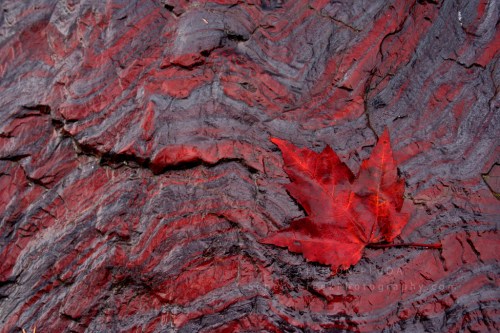
Banded Iron Formation at Jasper Knob in Michigan

Banded Iron Formation

Banded Iron Formation, photo by Allie.P.

Alison writes that this formation is billions of years old and is the main evidence of showing when photosynthetic life first arrived on earth. This photo is part of her Fall set (slideshow) and you can order a copy online from Seneca Creek Photography.

UPDATE! Alison emailed me some great information that makes this a lot clearer!

The Banded Iron Formations (BIFs) are about 2 billion years old and are made of alternating layers of Magenetie (Fe3O4) or Hematite (Fe2O3) which are the grey shiny layers, and red layers of iron stained chert (SiO2) often called jasperite. This photo is part of the Negaunee Iron Formation. Fe2+ is soluble in water, but when iron is oxidized to Fe3+, it is insoluble in water and will precipiate and become a solid. So, the alternating layers represent Iron being oxidized, and precipitation out to form a red layer, and then iron not being oxidized so that you dont get precipitation and get a hematite layer. It is this cycle of there being oxic (oxygen present) and anoxic (no oxygen) conditions in the ocean that has scientists wondering how that could happen.

There are many models that have been put together of how this could happen, but the most interesting one says that ancient bacteria used to use iron as a nutrient. The first bacteria that photosynthesized on our planet produced oxygen, which could explain how the iron was oxidized, precipitated and formed the red layers. Some have said the layers represent the death and birth of algal blooms. Eventually, bacteria produced so much oxygen that all the iron was oxidized, and thus we don’t get BIFs forming in our oceans today since it is impossible to dissolve any iron in it. They even found bacteria in some of the BIFs in Minnesota!

-90% of the world’s BIF (>1014 tons of ore) is located in Australia (~ 27 tons), South Africa, Brazil, and the Lake Superior Region in the US and Canada. The iron that is mined in the UP is extracted from BIFs by grinding them to a powder, taking the iron out through magnets, adding bentonite clay, and then rolling it up into pellets more commonly known as taconite pellets.

She adds that she has some journals about these she would be glad to send to anyone interested, as she have done some research on these as well. Contact her through her web site!

Read more about banded iron formations, fossils in the Negaunee Iron Formation, Jasper Knob and cool spots for rock collecting in the Eastern UP.

Here’s a link to more or less the location of Jasper Hill (Jasper Knob) on the Absolute Michigan map!

Detroit Nighthawks: the core at night

the core at night

the core at night, photo by g. s. george.

When not vanquishing evil, it appears Spiderman likes to indulge in a little photography.

You can (and should) see Geoff’s photo bigger in the Detroit Nighthawks group slideshow.

Autumnal Equinox: the start of fall

Start of fall

Start of fall, photo by eric.whalen81.

The First Day of Fall article says that fall officially begins at September 22, 2008 at 11:44 am EDT. There’s some more information there including the reminder to put fresh batteries in your smoke detectors today!

Wikipedia’s Equinox entry says that equinox (from the Latin words aequus/equal and nox/night) can refer to the moment when the Sun is positioned directly over the Earth’s equator OR the apparent position of the Sun at that moment or the time at which the vernal point, celestial equator, and other such elements are taken to be used in the definition of a celestial coordinate system. Click through for much more Equinoxical information that appears in dire need of some editing for readability.

The outlook for fall on A Bright Spot Opposite the Sun relates:

Astronomers call Monday the autumnal equinox. Equinox means roughly “equal night”, which isn’t quite the case on Monday. The sun will rise on Monday at 7:34 AM and set at 7:41, making the day about seven minutes longer than the night. It isn’t until Thurs., Sept. 25 that the sun sets exactly twelve hours after it rises. On Monday, the day is a bit longer than the night because the sun is a disk, and sun rise and set are measured from the very top part of the sun. Anyway, it’s just a matter of minutes.

But on the equinox one thing is true: the sun rises due east and sets due west for every observer on earth. For us in West Michigan, where most of the roads are laid out east-west and north-south like the rulings on a sheet of graph paper, the equinox sun rise and set can be blinding on the commute to and from work. Take an extra pair of sunglasses with you in the car.

OK class, how about the Fall Color slideshow courtesy the Absolute Michigan group on Flickr??!!

it’s that time of year

it's that time of year

it’s that time of year, photo by amy_kilroy.

Amy writes I like leaves year round, but I look like less of a lunatic taking pictures of trees in the fall.

I love leaves and trees too, and am always struck by the depth that autumn adds to the experience of being outdoors as trees suddenly become identifiable from a distance by their color. Hope you get out to see some of it this weekend!

This photo is part of her (mostly) Michigan flora (slideshow). All background/wallpaper sized!

More autumny goodness on the Fall Wallpaper page.

Menominee North Pier Light

Menominee Michigan Lighthouse

Menominee Michigan Lighthouse, photo by Lara Salonen.

You can see more photos of this cool pier light (and see them bigger) in Lara’s Menominee slideshow.

Terry Pepper’s page on the Menominee North Pier Light (at the mouth of the Menominee River on Green Bay) says that after harbor improvements were completed in 1927:

… a prefabricated octagonal cast iron tower was delivered by vessel, and lowered onto the pier.

Click to view enlarged imageThe thirty-four foot tower was painted white, and integrated with an attached fog signal building. An elevated wooden catwalk stretched along the wooden pier to provide the keepers with safe access to the light during periods when waves crashed across the surface of the pier. The octagonal cast iron lantern room was outfitted with a Fourth Order Fresnel lens of unknown manufacture.

At some point thereafter, the wooden pier was replaced by a concrete structure with a forty-foot diameter circular crib at its offshore end. At this time, the fog signal was eliminated with the inclusion of an automated electrically operated signal in the tower. With automation of the light in 1972, the need for daily maintenance of the light was also eliminated, and the iron catwalk was removed from the pier.

Dave Wobster’s page on the Menominee Light has some great photos and says that the 10-sided lantern no longer contains the original Fourth-Order lens, which has been moved to the restored Sand Point Lighthouse in Escanaba.

Under the Falling Leaves Moon

Hunter's Moon

Hunter’s Moon, photo by Kari Melissa.

This weekend (September 18-20) they celebrate the Festival of the Falling Leaves Moon, which honors the the heritage of Mackinac Island’s Native peoples and the fall bounty.

Binaakwe-giizis is Anishnaabe (Chippewa/Ojibwe) for falling leaves moon. This moon celebrates the time of year when the trees were told to stay awake for seven days and seven nights and only the cedar, pine and spruce obeyed. As a reward the are ‘ever-green’ and those that were unable to stay awake must shed their leaves each fall.

The Falling Leaves Moon illuminates the remnants of the harvested crops which provided cover for animals during the growing season.

During the founding days of America, European farmers used the bright moonlight to hunt game, fish and gather rice while the Anishnaabe tribes hunted, fished, gathered and prepared to move to their winter camps in order to protect and sustain themselves through the long, cold winters in the Upper Midwest and collect furs for trade value.

Moons of Harvest and Hunters

Wikipedia says that the Hunter’s Moon is also known as Blood Moon or Sanguine Moon. It’s the first full moon after the Harvest Moon, which is the moon closest to the autumnal equinox.

Clare Union Station

tracks pano

tracks pano, photo by scott.gosnell.

Click the photo to see this excellent panorama larger and to see it on a map. Michigan in Pictures often features stories of historical structures that are being preserved. As near as I can tell, this is not one of those.

The Michigan Passenger Stations page on Clare Union Station begins:

The Clare depot was built by the Pere Marquette and Ann Arbor Railroads in 1898 at a total cost of $6585. The Queen Ann style depot has wings paralleling each set of tracks. There are two bay windows, presumably for agents of both railroads. The door and window arrangement suggests waiting rooms and freight rooms for both roads also.

The Pere Marquette built through Clare around 1870. This was part of the original PM land grant railroad…

Passenger service on the Ann Arbor ended in 1950 and after being used for many years for storage, the building was abandoned. Click to read more and see some more views of the station, including historical photos.

For more photos of the station you can check out Clare, Michigan at Michigan’s Internet Railroad History Museum.

Fallpaper

Untitled, photo by jacalynsnana.

Every day about 50 people wander over to Michigan in Pictures looking for “fall backgrounds” and “fall wallpaper”. The Google sends them to our Michigan fall … and the Michigan Fall Wallpaper Series page, which is a good place to go as the flames of autumn begin to lick at the leaves.

See more fall photos from jacalynsnana has more in her Autumn in Michigan set and at her autumn tag.

Michigan Plums and Slashfood

P1020310.JPG

P1020310.JPG, photo by benderbending.

Yesterday we did a feature on Michigan Plums on Absolute Michigan. As I was searching for information, I came across this photo on the uber-foodie blog Slashfood.

In his post, I’m on Slashfood!, Brian explained:

One of my pics from my travels in Michigan is on Slashfood today! Neat!

The plums are from Bargy’s Farm Market in Kewadin, Michigan.

The bowl was made by a good friend and excellent potter, Emily Murphy.

He has uploaded it wallpapery-big, so click through to check it out!