

Sunflowers, photo by Sharon
Sharon caught these beautiful sunflowers at the Petoskey Farmer’s Market. View the photo background bigilicious and see more in her Michigan slideshow.
More summer wallpaper on Michigan in Pictures.
Sunflowers, photo by Sharon
Sharon caught these beautiful sunflowers at the Petoskey Farmer’s Market. View the photo background bigilicious and see more in her Michigan slideshow.
More summer wallpaper on Michigan in Pictures.
Definitely watch Ken’s Perseid video at the end!
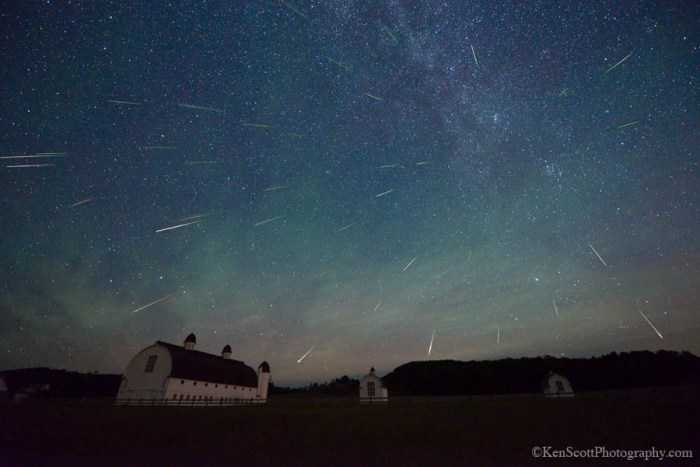
D H Day Farm … perseid meteor shower, photo by Ken Scott
I’ve shared this before, but Space.com has an interesting story about how the upcoming Perseid Meteor shower (peak August 11-13) came to be known as “The Tears of St. Lawrence” and also some of the science behind this annual August sky show:
Laurentius, a Christian deacon, is said to have been martyred by the Romans in 258 AD on an iron outdoor stove. It was in the midst of this torture that Laurentius cried out: “I am already roasted on one side and, if thou wouldst have me well cooked, it is time to turn me on the other.”
The saint’s death was commemorated on his feast day, Aug. 10. King Phillip II of Spain built his monastery place the “Escorial,” on the plan of the holy gridiron. And the abundance of shooting stars seen annually between approximately Aug. 8 and 14 have come to be known as St. Lawrence’s “fiery tears.”
…We know today that these meteors are actually the dross of the Swift-Tuttle comet. Discovered back in 1862, this comet takes approximately 130 years to circle the Sun. With each pass, it leaves fresh debris — mostly the size of sand grains with a few peas and marbles tossed in.
Every year during mid-August, when the Earth passes close to the orbit of Swift-Tuttle, the bits and pieces ram into our atmosphere at approximately 37 miles per second (60 kps) and create bright streaks of light.
Read on for more including diagrams and viewing tips.
Ken Scott captured these Perseid meteors last August over a 2 1/2 hour period at the D.H. Day Farm in the Sleeping Bear Dunes National Lakeshore. He says that the barn is lit by rogue lightning and that this is a composite of many meteor images, where each photo is rotated around the north star so that the ‘point of origin’ of the shower can be seen better. He understands it visually but not scientifically – anyone have a simple explanation for him?
View his photo bigger, see more in his Skies Above slideshow, and view and purchase his work at kenscottphotography.com.

Can’t Wait, photo by Jiafan(John) Xu
Osprey Watch of Southeast Michigan shares some information about Michigan Osprey:
An Osprey is a large bird with a length of 22-25 inches, a wingspan of 4.5-6 feet, and a weight of approximately four pounds. The Osprey has a dark brown back and a white belly, as well as a white head, which features a dark stripe running from its yellow eyes to the back of its head. Female Ospreys are slightly larger than males and may sport a dark speckled necklace
..The Osprey dines almost exclusively on live fish, often catching its meals by hovering over the water at an altitude of 50 to 200 feet, then diving feet first into the water to catch its prey. The Osprey’s feet are uniquely adapted to “air fishing.” Each Osprey foot has a reversible front toe, as well as barbs, called spicules, which help it hold onto a slippery fish in flight. Normally, an Osprey will aerodynamically position a fish headfirst in its talons before it returns to the nest.
These talons definitely look like fish hooks – read on for more!
View Jiafan’s photo bigger and see more in his slideshow where you can also see shots from a trip out west.
More Michigan birds on Michigan in Pictures.
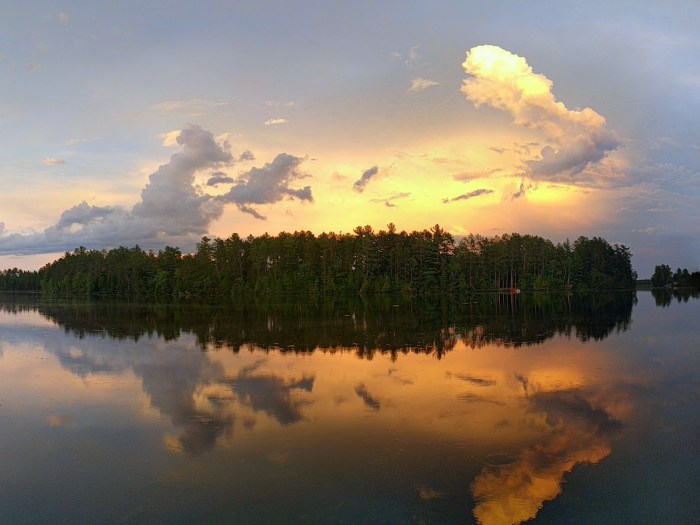
Evening clouds after rain, photo by Anne Fisher
Ann says she never tires of Bass Lake in the Upper Peninsula near Gwinn. I can see why! View her photo background big and see more in her 2016 UP slideshow.
More summer wallpaper on Michigan in Pictures and here’s a link to a map of Bass Lake.
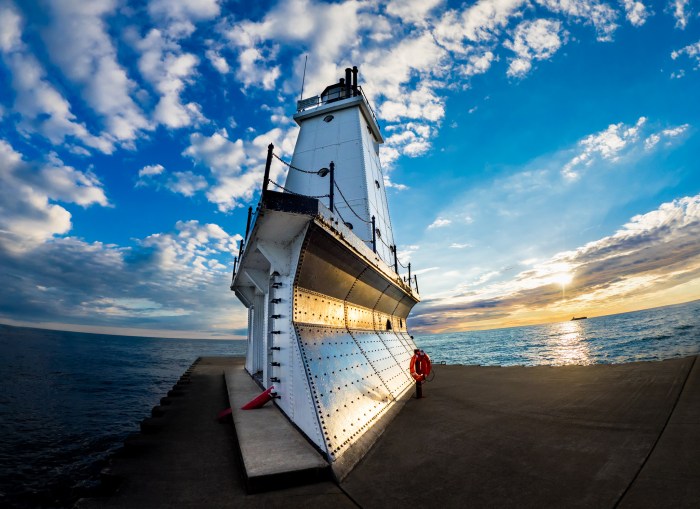
North Breakwater Light, photo by Mark Miller
The entry for Ludington North Breakwater Light at Terry Pepper’s Seeing the Light details a ton of the history of this lighthouse including the reason for its interesting appearance:
Over the summer of 1924, a unique structure took shape at the end of the North Breakwater. The main tower, fabricated of steel plates over an internal steel skeleton, took the form of a four-sided pyramidal tower with four round porthole windows on each of the three decks within. With plans calling for the installation of an air diaphragm fog signal operated by an electrically powered compressor, there was no need for a large fog signal building, and thus the signal building took the form of a relatively small structure integrated into the base of the landward side of the main tower. In order to help protect the structure from the force of waves crashing across the breakwater, the concrete foundation at the base of the structure was formed with angled surfaces designed to deflect the force of wave action up and away from the building.
The white painted tower was capped by a square gallery and an octagonal iron lantern installed at its center. Since the standard lantern design being used by the Lighthouse Service in new construction at this time was of circular conformation with diagonal astragals, it is likely (but unconfirmed) that the lantern used on this new light was transferred from the South Pierhead beacon which the new light was designed to replace.
Click through for more including a number of old photos.
View Mark’s photo background bigtacular and see more in his slideshow.
More lighthouses and more summer wallpaper on Michigan in Pictures.
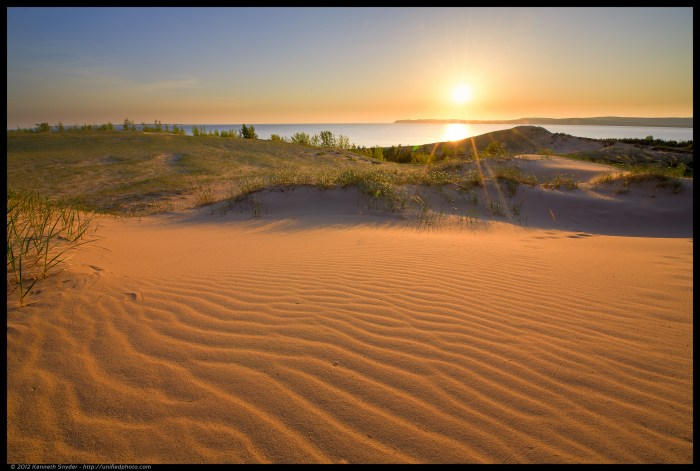
Steps of the Sun, photo by Kenneth Snyder
Here’s a shot from high atop one of the many dunes in the Sleeping Bear Dunes National Lakeshore from August 1, 2012.
View Kenneth’s photo background bigilicious and see more in his Sleeping Bear Dunes slideshow that includes some awesome northern lights pics!
More dunes and more summer wallpaper on Michigan in Pictures.
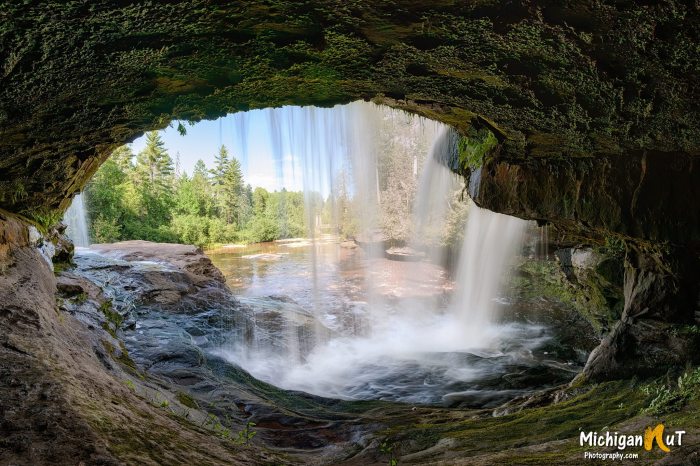
Behind O-Kun-de-Kun Falls, photo by Michigan Nut Photography
See a view from the front and get directions in Don’t Lose Your Bowl at O-Kun-de-Kun Falls. The waterfall is in Ontonagon which came to be named in a pretty hilarious story:
The name “Ontonagon” is derived from the Ojibway word “nontounagon,” which means “I lost my bowl.” Local legend surrounding the name stems from the story that a member of Chief O-Kun-De-Kun’s band was washing bowls near the mouth of the river when she was startled by an unkempt stranger in a canoe. The woman inadvertently dropped one of the bowls into the river and exclaimed “nontounagon”. The white man took her declaration to be a reply to his question about the name of the area.
John writes that a few years ago, he didn’t see a way to get behind the wild and scenic O-Kun-de-Kun Falls, but he found a way this time … and got a nice shower in the process!
See his photo bigger and view & purchase photos at Michigan Nut Photography.
More Michigan waterfalls on Michigan in Pictures.
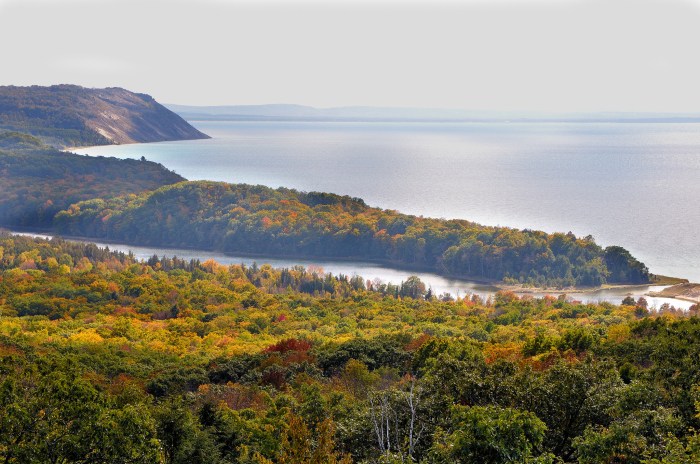
North Bar Lake, Sleeping Bear Dunes, photo by jdehmel
The Sleeping Bear Dunes National Lakeshore pages on North Bar Lake and the North Bar Lake Overlook say (in part):
The small lake below is North Bar Lake. The name describes how the lake formed: it is ponded behind a sand bar. At times, the sand bar builds up and separates North Bar Lake from Lake Michigan. At other times, a small connecting channel exists between the two lakes. North Bar Lake occupies part of a former bay on Lake Michigan. This ancient bay was flanked by headlands on both sides: Empire Bluffs on the south and Sleeping Bear Bluffs on the north. Shorelines have a natural tendency to become straighter with time. Wave action focuses on the headlands and wears them back, while shoreline currents carry sediment to the quiet bays and fill them in. Deeper parts of the bay are often left as lakes when sand fills in the shallower parts. The same process that formed North Bar Lake also formed many of the other lakes in northern Michigan: Glen, Crystal, Elk and Torch Lakes, for example.
…North Bar Lake is one of the most popular beaches in the Lakeshore because it has shallow, clear water over a sandy bottom makes for warmer swim than in Lake Michigan. But for those who like the refreshing cool water and wave action of the big lake, you can walk across the low dunes that separate the two lakes in just a couple of minutes. The beaches of pure sand and the small outlet to Lake Michigan is ideal for the kids to play.
View jdehmel’s photo background bigilicious and see more in his Sleeping Bear Dunes slideshow.
More dunes and more summer wallpaper on Michigan in Pictures.
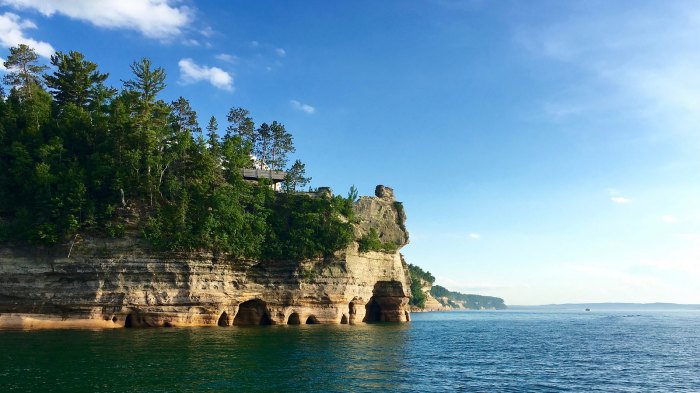
Pictured Rocks National Lakeshore, photo by supernova9
Maybe if I looked at this view every day for 50 years I would get tired of the Pictured Rocks National Lakeshore.
Maybe.
View supernova9’s photo bigger and see more in his Michigan’s Upper Peninsula slideshow.
More Pictured Rocks on Michigan in Pictures.
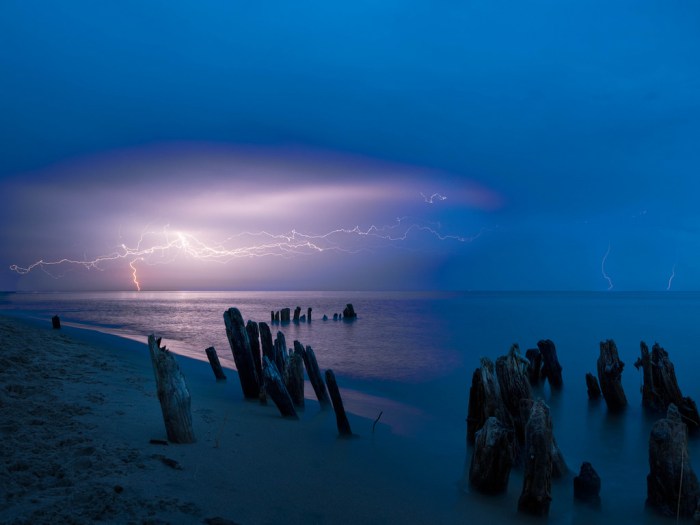
Fury Approaches, photo by Jamie MacDonald
Pow!
View Jamie’s photo from Kirk Park Beach in West Olive bigger, see more in his Stormy Weather slideshow, and visit jmacdonaldphoto.com for more of his work.
 Michigan in Pictures