Warren Dunes, Michigan’s Most Popular State Park

Warren Dunes State Park Sawyer Michigan

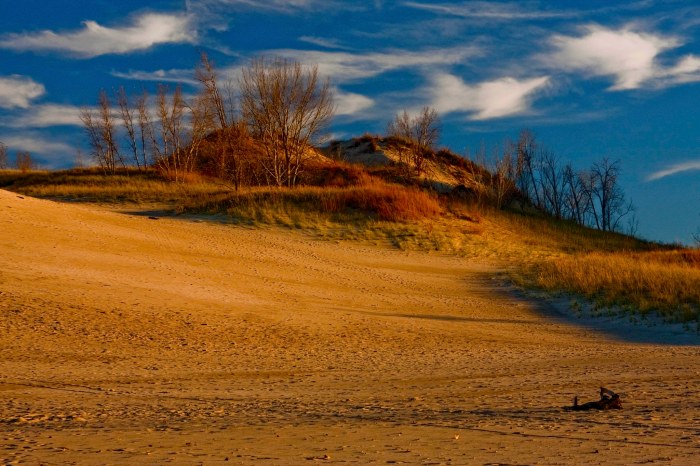
Warren Dunes State Park, Sawyer Michigan, photo by Charles Edward Miller

Beautiful scene earlier in November at Warren Dunes State Park in southwest Michigan, just north of the state line. The History of Sawyer from HarborCountry.org explains:

Edward K. Warren, of Three Oaks, was a pioneering conservationist. Long before he acquired his enormous wealth, Warren bought 300 acres of woodland in an effort to preserve a forest primeval. Wildlife abounds around the trails, which meander through Warren Woods that remains undisturbed and a natural treasure. Not surprisingly, Warren Woods can be found Warren Woods Road between Three Oaks and Lakeside. Warren Dunes State Park is a 1500-acre preserve located on Red Arrow Highway between Sawyer and Bridgman. Warren bought this land at the turn of the century again with conservation as his goal. Although most in the area saw the land as worthless, Warren wanted to preserve the majestic dunes that soar to more than 240 feet. The Park has a pristine two-mile beach as well as wildflowers and mature forests. Over a million people visit Warren Dunes annually [the state’s most popular park].

View Charles’s photo background bigtacular and see more in his massive Warren Dunes State Park Sawyer Michigan slideshow.

More about Warren Dunes and more dunes on Michigan in Pictures.

Haunted Michigan: The Dogman

Nightmare at Muskegon State Park II

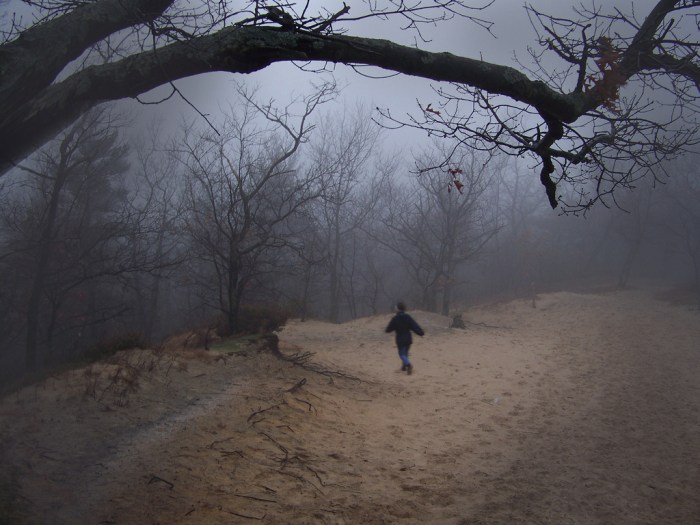
Nightmare at Muskegon State Park II, photo by otisourcat

When legends are way back in the past, they aren’t as scary. This one isn’t, and the fact that many of the sightings take place in my own backyard make me reluctant to share it. So, reluctantly, via Steve Cook’s Michigan-Dogman.com, I give you a Dogman tale from Oceana County, Michigan in 2005. Italics are the notes from Cook to the witness’s account.

Most dogman encounters are very brief, and usually rather benign. Very few witnesses have ever had more than a single encounter (a fact which makes most of them quite grateful). Our next event is unique in that the witnesses shared repeated encounters in a very narrow window of time. All of these events took place in Oceana County in Michigan’s Lower Peninisula. The contributor wishes to remain anonymous.

“The first incident happened while I was home alone. I had moved my bed into my closet to further open up my room. My dog was in there with me and we were getting ready for bed. Then my dog began to growl, which was very unusual. He never growls. I had maybe heard him growl or bark twice in his entire ten years of life. This growl was so fierce and mean that it actually made me scared. He was looking up at the ceiling and his hair was standing on end.

Then I heard it. It was loud, like something big was walking across the roof. There was snorting and light growls, so at first I feared that a bear had wandered into the area. I tried to keep my dog quiet, but he was shaking and going wild. There was a lot of scratching, like something was trying to dig through the roof – then it was gone, suddenly and without warning. A few minutes later my uncle arrived, I rushed out to tell him the story, he looked around but found nothing. He tried to pass it off as a raccoon. Let me tell you – there is no way on earth that a raccoon could have caused that reaction from my dog or made that much noise.”

A few weeks later, the witness had convinced herself that her uncle was probably correct. She had a friend spending the night, and they decided to camp out in the yard. They built a small campfire in a firepit, and were sitting next to it talking. Hearing a sound, they looked toward the woods. Just beyond the light cast by the fire…

“Something was walking out there. The features were canine; legs were shaped like a wolf, bushy tail, everything. But, it was way too tall to be a regular dog or even a wolf, it stood a bit higher than a deer and it was very thin. I only caught the back end of it walking behind a lilac bush, but it was enough for me. I calmly told my friend that we needed to go inside. I told her to walk slowly, since I live in the middle of no mans land, I know that wild animals are attracted to fast moving objects, and the last thing I wanted was to get up close and personal with whatever that thing was.”

Safely back inside, they talked about what they had seen. Whatever it was had seemed more curious than threatening. Later that same night, that assessment would change.

“…we were having a cigarette out my window, and my friend dropped hers. She put a chair up to the window and crawled out. She walked a few steps, paused, looked back at me. “Did you hear that?” she asked. I hadn’t heard anything, but apparently, she had heard rustling from the field beside her. Then we both heard it, a very close and very loud snarl. It was like nothing I have ever heard before and hope to never hear again. No animal that I know of sounds or looks like that. “

Lots more available from The Legend of Michigan’s Dogman including a 1961 encounter in Big Rapids that includes a purported photo of the Dogman! There’s also a DVD you can purchase that’s pretty cool. Best of all, proceeds have raised over $60,000 for charities, primarily those involved in domestic animal rescue, rehabilitation, and placement in permanent homes.

Wikipedia explains that the Michigan Dogman is a cryptozoological creature first reported in 1887 in Wexford County. Sightings have been reported in several locations throughout Michigan, primarily in the northwestern quadrant of the Lower Peninsula. In 1987, the legend of the Michigan Dogman gained popularity when a disc jockey at WTCM-FM (Steve Cook) recorded a song about the creature and its reported sightings.

You should also check out Linda Godfrey’s writings about the Dogman from her books including Weird Michigan, and also my buddy Rick Brauer’s movie Dogman and Dogman 2: Wrath of the Litter.

Muskegon County borders Oceana to the south, and has had its own Dogman sightings. View the photo bigger and see more of otisourcat’s Muskegon photos.

Happy Halloween everyone! More ghost stories & haunted tales on Michigan in Pictures!

The Science of Sand Waves, Silver Lake Dunes Edition

Sand Waves

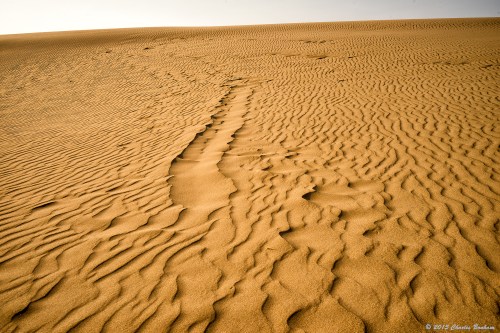
Sand Waves, photo by Charles Bonham

Confession: I probably don’t give Silver Lake Dunes State Park enough love. What an incredible place.

In Scientific American Robert S. Anderson, associate professor of earth sciences at the University of California at Santa Cruz explains why regular, wavelike shapes form when the wind blows over the sand on the beach for a long time:

Ripples in sand, found on both beaches and dunes, are one of nature’s most ubiquitous and spectacular examples of self-organization. They do not result from some predetermined pattern in the wind that is somehow impressed on the surface, but rather from the dynamics of individual grains in motion across the surface. They arise whenever wind blows strongly enough over a sand surface to entrain grains into the wind. The subsequent hopping and leaping of these grains is called saltation. Saltating grains travel elongated, asymmetric trajectories: Rising relatively steeply off the bed, their path is then stretched downwind as they are accelerated by drag forces. They impact the sand surface centimeters to tens of centimeters downwind, typically at a low angle, around 10 degrees. It is this beam of wind-accelerated grains impacting the sand surface at a low angle that is responsible for ripples.

“An artificially flattened sand surface will not remain flat for long. (Try it on the beach or on the upwind side of a dune and see for yourself.) Small irregular mottles in the sand surface, perhaps a couple centimeters in wavelength, rapidly arise and grow once the wind starts to blow hard enough to initiate saltation. They then slowly organize themselves into more regular waves whose low crests are aligned perpendicular to the wind direction and begin to march slowly downwind. Typical ripple spacing is about 10 centimeters, whereas the typical height of the crests above the troughs is a few millimeters. The pattern is never perfect, but instead the ripple crests occasionally split or terminate, generating a pattern that looks remarkably like one’s fingerprint.

Read on for a whole lot more including Michigan Sea Grant educator Walt Hoagman explaining how the speed of wind (and water) over sand influences the waves.

View Charles’s photo background bigilicious and definitely check out his incredible Silver Lake Dunes photos.

More science, more dunes and more summer wallpaper on Michigan in Pictures.

Hiking to happiness

expedition

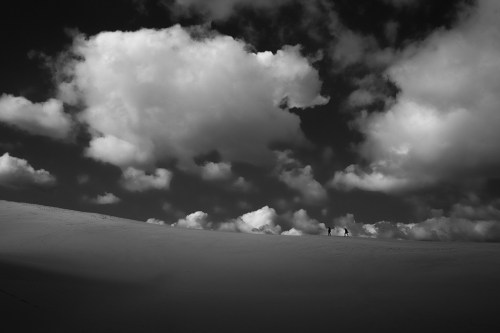
expedition, photo by brian

A couple months ago, Trish P shared an article from Outside Magazine about findings from British & Michigan researchers that Hiking Makes You Happier:

Researchers from the University of Michigan and Edge Hill University in England evaluated 1,991 participants in England’s Walking for Health program, which hosts nearly 3,000 walks per week for more than 70,000 regular participants. They found that the nature walks were associated with significantly less depression in addition to mitigating the negative effects of stressful life events and perceived stress. The findings were published in the September issue of Ecopsychology.

Sara Warber, associate professor of family medicine at the University of Michigan Medical School and senior author of the study, said that the large sample was a defining factor.

“We observed behaviors of a large group, in which some chose to walk and some chose not to, instead of us telling them what to do,” she said. “After 13 weeks, those who walked at least once a week experienced positive emotions and less stress.”

Easy enough! Read on for more, and explore Michigan’s vast trail network at Pure Michigan.

Brian took this shot at Silver Lake Dunes State Park. View it bigger and see more in his Fractions slideshow.

More black & white photography and more dunes on Michigan in Pictures.

#TBT: The Bear of Sleeping Bear Dunes

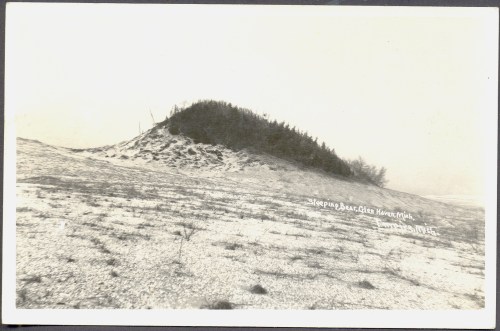
Glen Haven MI Sleeping Bear Dunes Empire and Glen Haven Marked RPPC Kodak Stampbox Unsent what looks like a hump of low scrub bushes is actually a forest hill buried in sand

Glen Haven MI Sleeping Bear Dunes, photo by Don…The UpNorth Memories Guy… Harrison

Tuesday was the 44th anniversary of the founding of the Sleeping Bear Dunes National Lakeshore. You may have heard the Chippewa tale that inspired the name of the park:

“Long ago, along the Wisconsin shoreline, a mother bear and her two cubs were driven into Lake Michigan by a raging forest fire. The bears swam for many hours, but eventually the cubs tried and lagged behind. Mother bear reached the shore and climbed to the top of a high bluff to watch and wait for her cubs. Too tired to continue, the cubs drowned within sight of the shore. The Great Spirit Manitou created two islands to mark the spot where the cubs disappeared and then created a solitary dune to represent the faithful mother bear”.

You might not be aware, however, that “the Bear” was also an actual formation atop a dune about a mile north of the Pierce Stocking Overlook. The Lakeshore says that the formation pictured above…

…hardly looks like a bear now, for it has been changing rapidly in recent years. At the turn of the century, it was a round knob completely covered with trees and shrubs. You can still see some of the thick vegetation that gave it a dark shaggy appearance.

…For a long time, the Sleeping Bear Dune stood at about 234 feet high with a dense plant cover. However, through most of the twentieth century, erosion has prevailed. By 1961, the dune was only 132 feet high, and by 1980, it was down to 103 feet. The process is a continuing one. The major cause of the dune’s erosion was wave action wearing away the base of the plateau on which the dune rests. As the west side of the dune loses its support, it cascades down the hill. The wind, too, is a major agent of erosion, removing sand and destroying the dune’s plant cover.

You can see what the area looks like now and read more right here.

View Don’s photo background bigtacular and get daily blasts from the past in his Northern Michigan Photo Postcards – Our History and Heritage group on Facebook!


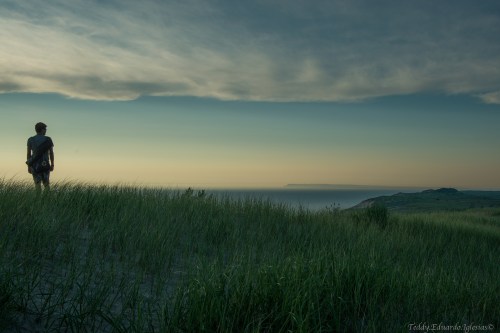
Adventurer

Sleeping Bear Dunes National Lakeshore

Sleeping Bear Dunes National Lakeshore, photo by teddy eduardo iglesias

I’ve stood in this spot, and it felt almost as amazing as this picture.

View Teddy’s photo background bigtacular and see more in his Michigan Outdoors slideshow.

Lots more from the Sleeping Bear Dunes National Lakeshore on Michigan in Pictures!

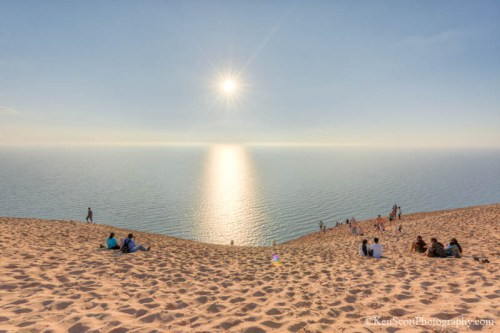
Bye Bye Summer

Summer ... bye bye

Summer … bye bye, photo by Ken Scott

Probably the best thing I’ve heard about “Summer 2014” being over is that it really wasn’t much of one anyway.

I hope everyone enjoys their last weekend of summer, and that we have a warm & long fall!

View Ken’s photo bigger, see more in his massive Sleeping Bear Dunes slideshow and definitely follow him on Facebook.

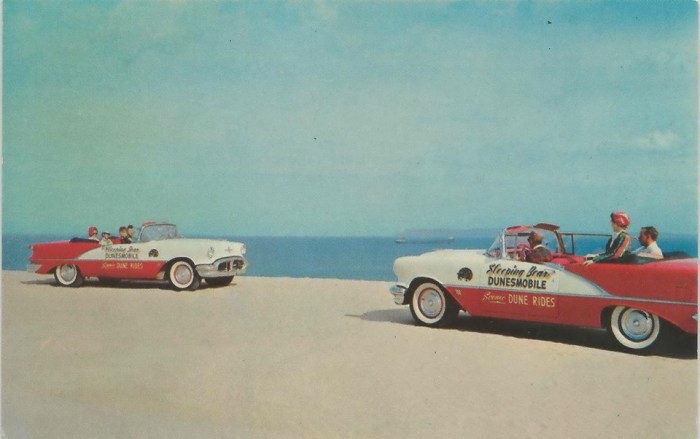
The Dunesmobiles by Phil Balyeat

The Dunesmobiles

The Dunesmobiles, by  Phil Balyeat

Don Harrison operates UpNorth Memories and shares many of the historical post card photos I feature on Michigan in Pictures. Yesterday in honor of photographer Phil Balyeat’s 99th birthday he posted an incredible collection of photos Phil had taken over the years from the Traverse City area including this one.

View Phil’s photo bigger on Facebook and see LOTS more via UpNorth Memories  here, here and here!

More about the Dunesmobiles at Leelanau.com!

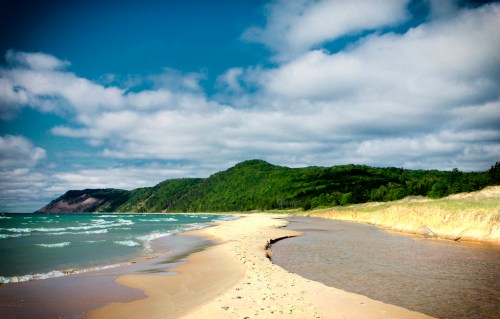
Michigan’s Blue Economy

Where Two Waters Meet

Where Two Waters Meet, photo by Robby Ryke

Michigan State University, the University of Michigan and Wayne State University, the three universities that make up Michigan’s University Research Corridor (URC), have released a report titled “Innovating for the Blue Economy“. The report cites nearly $300 million in awards for water-related research and outreach from 2009 to 2013 that have led to innovations from dealing with invasive species and monitoring water quality to finding ways to optimize water use in agriculture. Their news release on the report prepared by the Anderson Economic Group (AEG) says in part:

AEG’s analysis showed that Michigan ranked fourth in the nation in the percentage of jobs associated with industries related to water, at 718,700.

“One in five Michigan jobs is tied to having good and plentiful water,” said AEG founder and CEO Patrick Anderson. “It is an important economic driver in Michigan, and extends to Great Lakes shipping, advanced manufacturing, agriculture and fishing, and over 80 other industry subsectors where Michigan workers are employed today.”

While most of Michigan’s water-related jobs are in water-enabled industries such as agriculture, mining and manufacturing, about 138,000 are in core water products and services producing water treatment facilities and solving water quality and quantity issues.

“Water isn’t just Michigan’s defining characteristic but the foundation of life on earth,” said Michigan State University President Lou Anna K. Simon. “Our three universities make significant commitments to support water-related research and programs. These not only support Michigan’s economy and quality of life, but position the state as a knowledge wellspring for the world’s most precious natural resource.”

Read on and read the full report right here. The report is chock full of interesting facts including that those 718,700 jobs represent 21.3% of Michigan’s total employment (4th in the nation) and details many of the accomplishments of Michigan’s investment in our “Big Three” university research programs. Also note that “downstream” industries like tourism that rely on healthy water resources aren’t included in the numbers.

Robby writes that Otter Creek Beach has to be the reason why Sleeping Bear Dunes was Voted “Most Beautiful Place in America” by Good Morning America. View his photo bigger and see more in his slideshow.

Michigan in Pictures has over 40 pages of water-related photos – drink deep!

Lunar Eclipse Tonight!

Inside the Ghost Forest

Inside the Ghost Forest, photo by jimflix!

There’s an eclipse of the full moon tonight! It begins at 2 AM Eastern time with the total eclipse lasting 78 minutes and starting about 3 AM. While the forecast is not great, it looks like there’s a chance that those brave souls who trade sleep for a shot at viewing the eclipse won’t be disappointed.

Eastern Daylight Time (April 15, 2014)
Partial umbral eclipse begins: 1:58 a.m. EDT on April 15
Total eclipse begins: 3:07 a.m. EDT
Greatest eclipse: 3:46 a.m. EDT
Total eclipse ends: 4:25 a.m. EDT
Partial eclipse ends: 5:33 a.m. EDT

If you’re up in the Sleeping Bear Dunes area, they are having a star party tonight. If anyone knows of other viewing gatherings, post them in the comments! If the eclipse ends up getting clouded out locally, you can always take to the net and watch via the live stream from the Griffith Observatory. As I wrote about last week, this eclipse is the first of four total eclipses without a partial in between known as a Lunar Tetrad.

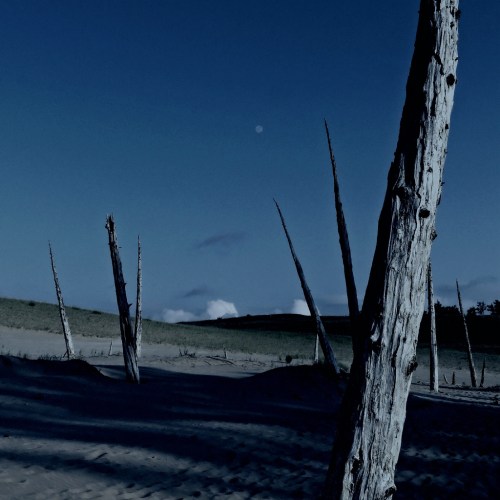
This photo is of the ghost forest on Sleeping Bear Point created when sand of the world’s largest shifting sand dune covered living trees.

View Jim’s photo background bigtacular and see more in his Sleeping Bear Dunes slideshow.

More of the moon and more dunes on Michigan in Pictures!