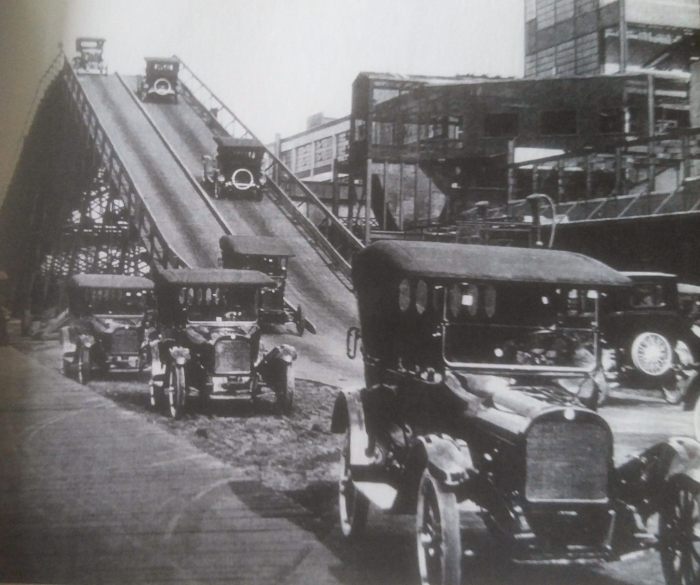
#TBT: 1915 Dodge Main

1915 Dodge Main

1915: Dodge Main, photo courtesy Eddie Abbott/Macomb County Memories

Eddie Abbott shared this photo in the Macomb County Memories group on Facebook, saying:

1915: Dodge Main; The Dodge Brothers’ Factory complex was built on a 30 acre site in rural Hamtramck in 1910 and featured a test track and hill climb adjacent to the manufacturing plant. Within a decade, it employed 20,000 workers and produced 145,000 cars, making the Dodge nameplate on of the most popular in the country and transforming Hamtramck into an automotive boom town along the lines of Highland Park. Five years after the brother’s deaths, their widows sold the company to a New York investment firm for $146 million, which in turn sold it to Walter P. Chrysler.

Head over to AllPar for a lot more about Dodge Main and some cool photos courtesy the Chrysler Club!

View the photo background bigtacular and see lots more cool pics in the Macomb County Memories group on Facebook!

More Throwback Thursdays (#TBT) on Michigan in Pictures!

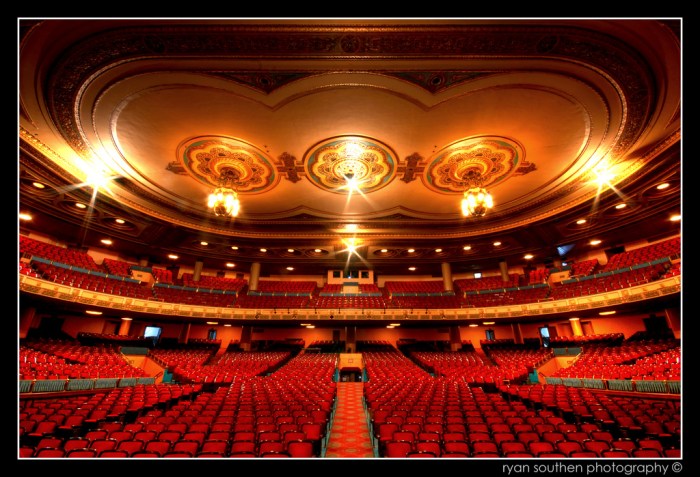
#TBT: Detroit’s Masonic Temple

masonic temple auditorium detroit

masonic temple, photo by ryan southen

On April 27, 1764, a charter for the “Zion Lodge of Masons, No. 1” – the first Masonic Lodge west of the Alleghenies – was granted to Masons in Detroit. Since I’m going to see Portugal the Man/Cage the Elephant there next weekend, that’s close enough for me to learn a little bit more…

Detroit’s Masonic Temple (aka The Masonic) is the largest building of its kind in the world. Construction began in 1920 and was completed in 1926. They explain:

By 1908, interest and membership in Masonic fraternities had grown to such an extent that the Masonic Temple Association of Detroit began to consider either enlarging the existing Masonic Temple on Lafayette Boulevard or building a new, larger facility.

Land on Bagg Street (now Temple Avenue) was acquired and by 1920, the architectural firm George Mason and Company had completed an integrated design of a multi-function complex. Ground was broken on Thanksgiving Day, 1920. The cornerstone was laid on September 18, 1922, during a ceremony attended by thousands of Detroiters, using a trowel previously used by George Washington during the construction of the U.S. Capitol.

Significantly, the opening of the theater was celebrated during a concert by the Detroit Symphony Orchestra, conducted by Ossip Gabrilowitsch, on February 22, 1926–George Washington’s birthday. The formal dedication of the building took place on Thanksgiving Day, 1926. Once again, thousands of Detroiters were present for the ceremony.

George Mason’s unique design included three theaters (one was never completed, but is sometimes used by movie-production crews), a Shrine building, the Chapel, eight lodge rooms, a 17,500 square foot drill hall, two ballrooms, office space, a cafeteria, dining rooms, a barber shop, 16 bowling lanes–1037 rooms in total–in addition to a powerhouse that generated all electricity for the complex.

Mason also incorporated the artistic conceptions of the sculptor, Corrado Parducci, in the building’s magnificent lobby, which was an adaptation of the interior of a castle he had visited in Palermo, Sicily. Parducci also designed light fixtures and chandeliers, decorative arches, medallions, plaster decorations, and a myriad of other artistic details that are unique to the many varied spaces in the building.

Head over to The Masonic for lots of panoramic tours and also a panoramic view of the Corner Stone Laying. Also, if the name George Mason rings a bell, click that link to learn about this prolific architect whose works include Mackinac Island’s Grand Hotel!

View Ryan’s photo bigger, see more in his HDR slideshow, and follow him on Facebook at Ryan Southen Photography.

PS: Lots more Michigan architecture on Michigan in Pictures.

PPS: It’s also supposedly very haunted!

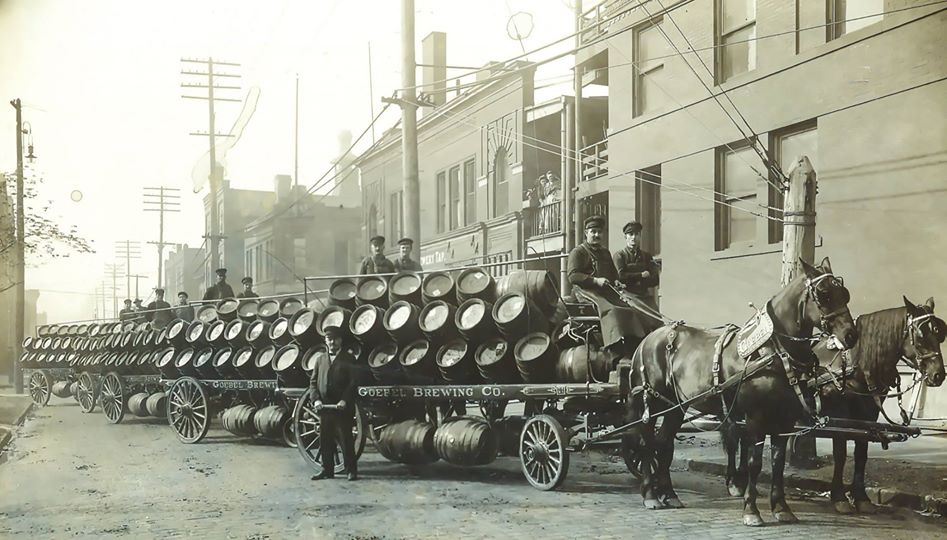
#TBT: Beer Wagons Leaving Detroit’s Goebel Brewery

Goebel Brewing Company

Beer Wagons at Goebel Brewery, photo courtesy David Tinder / Up North Memories

Don Harrison writes:

SE Detroit MI Heavily laden Beer Wagons prepare to leave the Goebel Brewery to quench the thirst of late 19th century Detroiters … AWESOME Photo from my good friend David V. Tinder and his friends at the U of M Clemens Library “Tinder Collection”.

View the photo bigger on Facebook and join the Up North Memories Photo Postcards Facebook group for more great old photos from Michigan!

The Wikipedia entry for the Goebel Brewing Company adds:

Goebel Brewing Company was a brewing company in Detroit, Michigan from 1873 to 1964 eventually acquired late in its existence by Stroh Brewery Company. The beer was locally popular in Detroit from the company’s inception, but grew in popularity and was eventually available in many states for a brief period in the 1940s, with an ad campaign in Life magazine that featured restaurant ads from many famous eateries around the country using Goebel beer as an ingredient. The beer, billed as a “light lager”, was golden in color, and was noticeably drier than most everyday beers of the era. Their longtime mascot was a bantam, called Brewster Rooster, who wore attire with Goebel’s logo, and the beer was a long-time sponsor of Detroit Tigers baseball broadcasts on radio.

Prohibition forced the closure of the brewery in 1920 though the space was rented out to various industries. In 1932 the company was reorganized. Though Prohibition was repealed in 1933 the brewery would not begin new production until the Spring of 1934. Otto Rosenbusch, the retired brewmaster from Stroh Brewery Company, was brought on to help Goebel compete against his old employer at Stroh’s and his son Herman who was the head brewer there. Upon the elder Rosenbusch’s passing in 1935, Charles Elich, the brewmaster at the Pabst Brewing Company agreed to become both the brewmaster and superintendent at Goebel.

You can also check out some old Goebel cans and be sure to watch the commercial below – it’s a gem and an early example of a brewery marketing to women.

More historical photos on Michigan in Pictures.

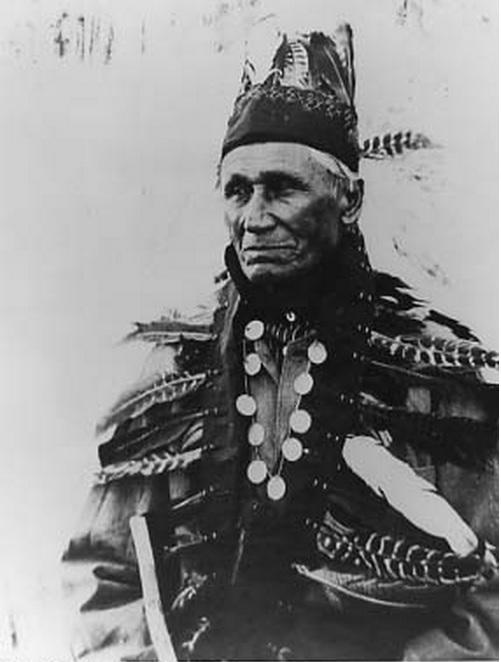
#TBT: Marquette’s Chief Kawbawgam

Chief Kawbawgam

Chief Kawbawgam, photo via Michigan’s Past & Superior View Gallery

Michigan’s Past shares all kinds of great old photos on Twitter. This one shows Chief Kawbawgam, a Chippewa who was reportedly over 100 years old when he died in Marquette in 1903.  According to the January 1903 edition of the The Lake Superior Journal:

Charley Kaw-baw-gam’s long life was brought to a close about 2 o’clock Sunday afternoon, when the old chief passed peacefully away at St. Mary’s hospital at Marquette, where he had been lying ill for the past couple of months.

Charley was one of the best known figures in Marquette, and he enjoyed this distinction from the first day when white men began to frequent the spot where the city was to grow. Charley’s reputation was not local alone. He was known throughout the upper peninsula and even below the straits his name and fame were familiar to many people.

He was an excellent type of the original owners of the soil, and an unusually creditable specimen. He was a full blooded Chippewa and a chief by blood. What is more he was a good Indian, and he lived a good life, according to his lights.

Kaw-baw-gam was also remarked upon time and again for his great age. It is believed that he was over 100 years old at the time of his death.

In 1849 when Peter White first landed on the shores of Iron bay it is well known that the first Indian to greet him and the party of which he was a member was the same chieftain. In the same year 1849, Mr. White, in carrying on a conversation in Chippewa with Charley asked him, for the sake of having something to say, “How old are you, Bawgam?” Charley replying said: “I am fifty. I spent twenty at the Soo; twenty years on the Tonquomenon bay and ten years on the Canadian side.” If Charley spoke the truth on that occasion he was about 103 years of age when he died, and there was no reason to doubt that this was the case. The Indians of his day were a notoriously long lived race and Charley was a find Indian physically, strong, tireless and healthy. Furthermore his countenance was that of a patriarch.

You can see Chief Kawbawgam’s grave in Marquette’s Presque Isle Park.

View the photo bigger and definitely follow @MichiganHist on Twitter for lots more great photos.

More Throwback Thursdays and more portraits on Michigan in Pictures.

#TBT: Icebound Car Ferries in Ludington

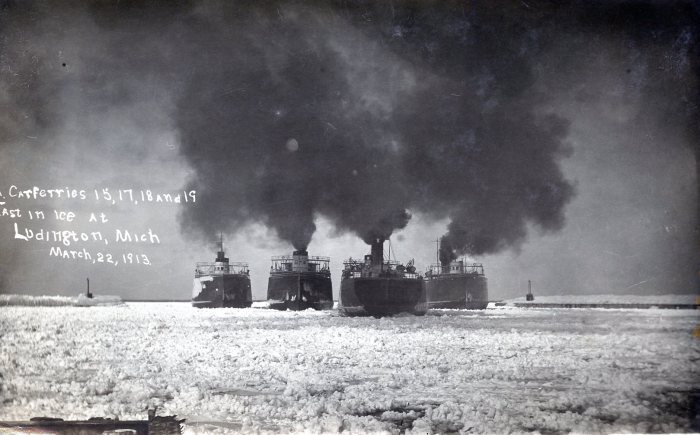
Carferries Icebound in Ludington 1913

Icebound Carferries at Ludington, photo courtesy Karl Bahle

The caption reads “Carferries 15, 17, 18 and 19 – Fast in ice at Ludington, Mich March 22, 1913” and from that, I was able to dig up some tasty history! Carferries.com has great information on the Pere Marquette fleet of ferries that was based in Ludington. They say (in part):

At various times between 1897 and 1947, the Pere Marquette operated a total of 13 ferries on Lake Michigan, running between Ludington, Mich. and Milwaukee, Manitowoc and Kewaunee, Wis. These ships were then an efficient means of bypassing the congested rail yards in Chicago. They plied routes varying between 60 and 97 miles in length, and were often plagued by violent storms and heavy ice. Given the fact that most of the cross-lake runs were made at speeds of 12 to 14 miles per hour, a remarkable volume of freight was carried.

In those fifty years the Pere Marquette car ferries made well over 160,000 lake crossings and transported roughly 4.5 million railroad cars loaded with over 75 million tons of freight. Even these numbers are somewhat conservative, as early records no longer exist. They also carried approximately 1.6 million passengers and after the mid-1920’s, about 380,000 automobiles. Additionally, over the course of its history, the railroad operated a total of 4 river car ferries. These ran between Port Huron, Mich. and Sarnia, Ont., and between Detroit, Mich. and Windsor, Ont., connecting the PM’s Michigan and Canadian lines.

  • Pere Marquette 15 – launched in December of 1896 as the original Pere Marquette. She reportedly burned 30 tons of coal on an 1897 round trip from Ludington to Milwaukee. In 1924, the vessel was renamed Pere Marquette 15, and scrapped in Manitowoc in 1935.
  • Pere Marquette 17 – launched in 1901, hauled 2 “Jack Johnson” battleship guns in 1915, sold to the State of Michigan to be the car ferry “City of Petoskey” <-great info and photos there!
  • Pere Marquette 18 – here’s where the history gets a little murky, as the ship that was launched in 1902 sank in 1910 off Sheboygan, Wisconsin, so either the date is wrong on the photo above or that’s another ship! UPDATE: Karl informed me that the original 18 did sink in 1910, a new one was put into service in 1911 and sailed until 1954!
  • Pere Marquette 19 launched in 1903, ran aground numerous times before being sold for scrap in 1940. She was reduced to a barge profile and renamed the Hilda.

If you’re wondering “What happened to Pere Marquette 16?” that link has great info on the 16, only wooden car ferry in their fleet!

View Karl’s photo bigger and check out his Lake Boats album for many more photos!

#TBT: Winter Comes to Michigan

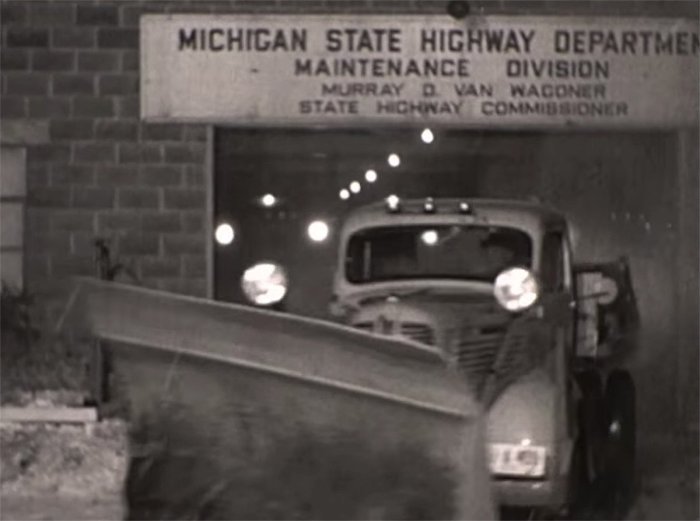
1930s Michigan Snowplow

1930s Snowplow, via Michigan Highway Department (now MDOT)

The Michigan Department of Transportation shared this awesome newsreel from the 1930s featuring all kinds of winter fun including ski jumping. Their predecessor, the Michigan Highway Department also used the video to talk up Michigan’s road system and winter road maintenance.

It was discovered by Nancy and Barbara Sleeper of Newberry, daughters of former Luce County Road Commission superintendent Sanborn Sleeper, and it’s super awesome!

#TBT: Remembering the Crew of Apollo 1

Remembering the Crew of Apollo 1

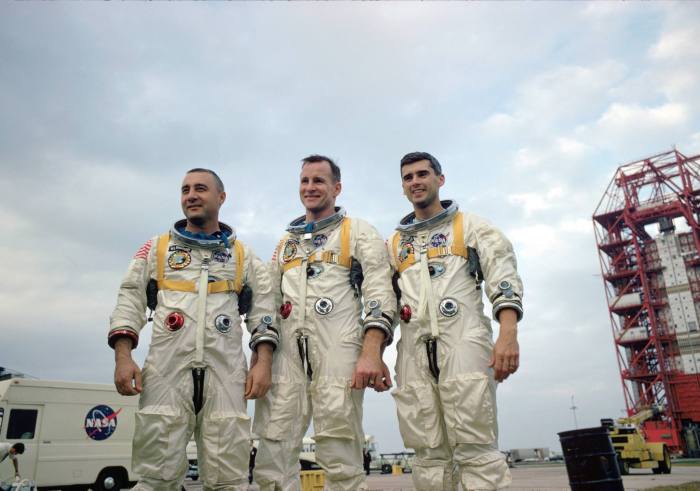
Remembering the Crew of Apollo 1, photo by NASA

“You’ll be flying along some nights with a full moon. You’re up at 45,000 feet. Up there you can see it like you can’t see it down here. It’s just the big, bright, clear moon. You look up there and just say to yourself: I’ve got to get up there. I’ve just got to get one of those flights.”
-Roger Chaffee (The New York Times, January 29, 1967, p. 48.)

Thanks to longtime Michigan in Pictures contributor Rudy Malmquist for the find on this. By total coincidence, Rudy will be back tomorrow with a photo!!

The National Air & Space Museum at the Smithsonian shared this photo yesterday, saying:

Remembering the crew of Apollo 1. On January 27, 1967, astronauts Virgil I. “Gus” Grissom, Edward H. White II, and Roger B. Chaffee perished in a fire during a pre-launch test for what was to be the first crewed Apollo mission.

Rudy pointed out that Chaffee was from Grand Rapids, and you can read a very detailed biography on Roger B. Chaffee from NASA’s History Office.  Here’s a few choice bits about his early life … and here’s hoping that Michigan in Pictures readers can do their best to instill a love of service, science and following ones dreams in the young folk in their lives:

“On my honor, I will do my best…” are the first eight words of the Scout Oath for the Boy Scouts of America. Individually, the words are short and simple. Collectively, however, they speak volumes and serve to inspire millions of boys to strive for excellence. Lieutenant Commander Roger Bruce Chaffee was a Scout for whom the Oath was more than just mere words. He took the pledge to heart and accepted the challenge to fully live the words of the Oath. Whether he was meticulously hand crafting items from wood or training to be the youngest man ever to fly in space, Chaffee always did his best by putting one hundred percent of himself into the effort.

…Earlier in his career, Don Chaffee had been a barnstorming pilot who flew a Waco 10 biplane. He was a regular sight at fairgrounds and made a bit of extra money on the side by transporting passengers. He also piloted planes for parachute jumpers. Later, Don worked for Army Ordnance in Greenville and in 1942, he was transferred to the Doehler-Jarvis plant in Grand Rapids, Michigan where he served as Chief Inspector of Army Ordnance.

Don shared his love of flying with his son and at the age of seven, Roger enjoyed his first ride in an airplane when the family went on a short excursion over Lake Michigan. Although it was a relatively brief flight, Roger was absolutely thrilled. To satisfy his continued interested in planes, Don set up a card table in the living room where he and Roger would create model airplanes piece by piece. By the time he was nine, Roger would point to a plane flying overhead and predict, “I’ll be up there flying in one of those someday”.

…By the time Roger was fourteen, he had developed an interest in electronics engineering and tinkered with various radio projects in his spare time. In high school, he received excellent grades and maintained a 92 average. Vocational tests showed that Roger’s strongest abilities were in the area of science. He also scored high mechanically and artistically. Mathematics and science were his favorite subjects, with chemistry being particularly appealing. Once the family switched to a gas heating system, Roger transformed the outdated coal bin area into his own private workshop where he spent countless hours experimenting with his chemistry set. By the time he was a junior in high school, he was leaning toward a career as a nuclear physicist. As a senior, he established a lofty goal for himself: he wanted to someday have his name written in history books. Before the world’s super powers took their first halting steps into space, Roger Chaffee had shared his dream of being the first man on the moon with his closest friends.

Here’s an article about the fire, and if you’re in Grand Rapids, check out the Roger B Chaffee Planetarium at the Grand Rapids Museum.

#TBT: Rephotographing Michigan, Baraga Edition

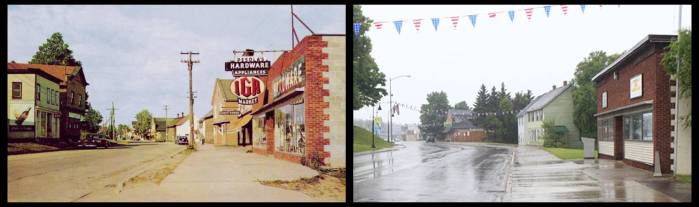
Downtown Baraga Michigan

Downtown Baraga, photo by Rephotographing Michigan

Paul started Rephotographing Michigan a few months ago. It’s a project to take old postcards of Michigan and photograph what the scene looks like today.

This photo shows downtown Baraga – check it out bigger and see lots more on the Rephotographing Michigan Facebook page!

#TBT: The Boblo Boat aka the Ste. Claire

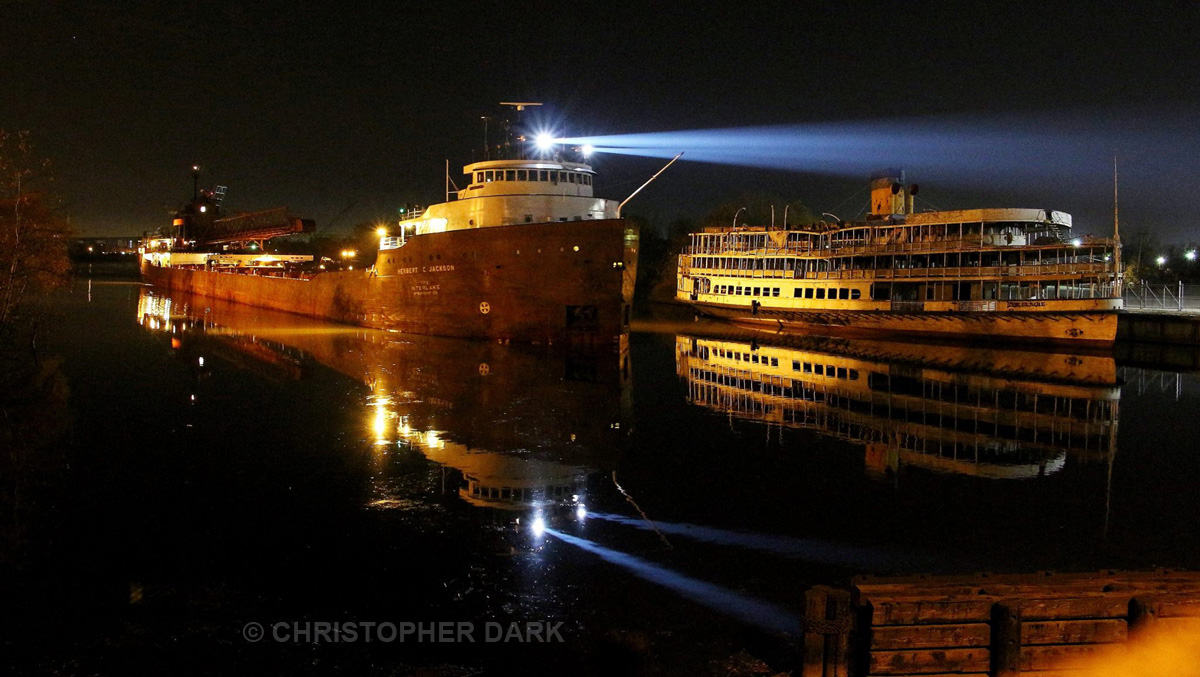
Herbet Jackson and Boblo Boat Ste Claire

Herbert C Jackson and the Bob-Lo Boat, photo by Christopher Dark

One of the Boblo Boats, the Ste. Claire, is shown here at its new berth, where it was moved a couple of weeks ago.

The Ste. Claire Restoration Project’s History page explains:

The steamer Ste. Claire represents the typical propeller-driven excursion steamer of the turn of the century, a type once found in many parts of the country. Excursion steamers are steamships built primarily for passengers for day trips. Ste. Claire and her running mate Columbia represent the “ocean-going” type of excursion vessel although they were used on lakes.

The steamer Columbia and Ste. Claire are the last two remaining classic excursion steamers in the country; and the last essentially unaltered passenger ships designed by Frank E. Kirby; and for their essentially unaltered propulsion machinery of a type becoming increasingly rare ; as the two last vessels of the Detroit and Windsor Ferry Co.; as two of the few surviving vessels built by the Detroit Dry Dock Company, and for their unaltered propulsion machinery, which is of a rare type. Columbia is the oldest passenger steamer in the United States, excepting vessels properly classed as ferries. Columbia and her running-mate Ste. Claire are the last two steamers of their type with integrity left in the United States. The pair shared their original run from Detroit to Bob-Lo Island for 81 years, a record of service on a single run unequalled in U. S. history

There’s a ton of cool stuff on the Boblo Boat website including their media center, plans for the restoration and of course donations!

Christopher got this great shot of the Herbert C Jackson upbound on the Rouge River as she passed the Ste. Claire. Click to view it bigger and see more of his photos on Facebook.

More great night photography and more ships on Michigan in Pictures.

#TBT Big Waves on Lake Michigan Edition

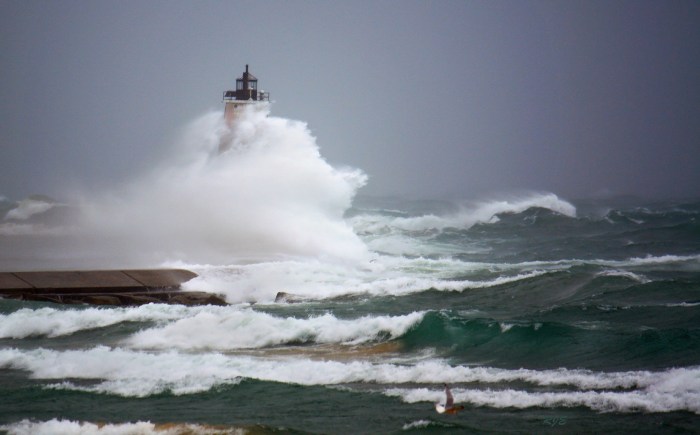
And they call this a lake

And they call this a Lake, photo by RJE

The Detroit Free Press reports that massive waves of up to 20 feet in height are forecast for Lake Michigan:

An intense low pressure system is still projected to slam into the western Great Lakes on Wednesday night.

The main hazard with this storm will be incredibly strong winds in excess to 45 m.p.h. at times. This will cause numerous issues, including downed trees and the potential for power outages.

In addition to impacts on land, Lake Michigan will also suffer the wrath of this strong fall storm, where waves could reach as high as 20 feet offshore. A gale watch has been issued by the National Weather Service in Grand Rapids for the Lakeshore and will be in effect from Wednesday evening through Friday afternoon.

NOAA’s Great Lakes Coastal Forecasting System has a ton of resources for visualizing live data and forecasts for all of the Great Lakes. Be sure to check out the animation of forecasted wave heights on Lake Michigan – pretty cool to watch. In case you’re wondering, the tallest (recorded) wave on Lake Michigan is 23′ from September of 2011. Of course the bouys shut down for the winter in December, and they only started measuring in 1988.

Also check out the Grand Haven Surfcam for a live look! 

RJE caught this massive wave breaking against the Ludington lighthouse back in November of 2011. View the photo of  big as Lake Michigan and see more of his great photos of Ludington on Flickr!

More Michigan lighthouses, more waves and more about the Ludington North Breakwater Light can all be found on Michigan in Pictures.