Waterfall Wednesday: Great Conglomerate Falls on the Black River

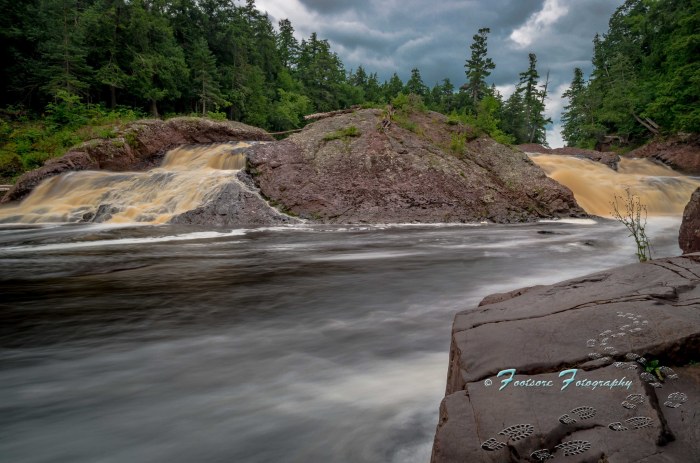
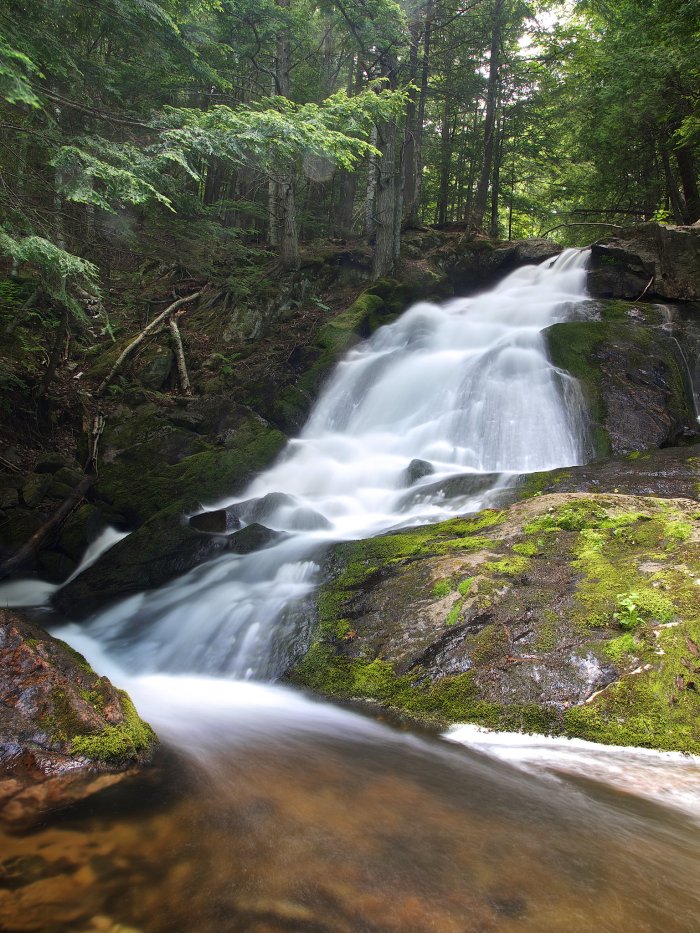
Great Conglomerate Falls

Great Conglomerate Falls, photo by Gray McCormick

GoWaterfalling’s entry on Great Conglomerate Falls says (in part):

The first of the five main waterfalls on the Black River. This waterfall is named for the large piece of conglomerate rock that divides the two segments. It is hard to see all of this waterfall at once, but that is no reason not to visit.

Great Conglomerate Falls is the first of the five main waterfalls on the Black River Scenic Byway. Here the river slides down 20 feet around a large chunk of conglomerate rock, hence the name of the falls. It is hard to get a picture of the full waterfall from the observation area. The two segments of the waterfall are pictured separately below plus a composited image of the entire falls.

Read on for directions and info about other nearby falls!

View Gary’s photo background big and see more in his Black River slideshow.

More Michigan waterfalls on Michigan in Pictures!
Bridge with a view

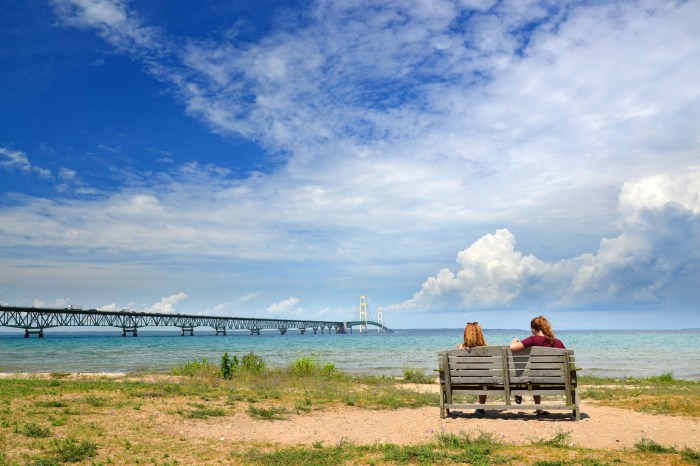
Bridge with a View

Mackinac Bridge from Michilimackinac State Park, photo by Todd Marsee, Michigan Sea Grant

Todd took this a couple of weeks ago from Michilimackinac State Park in Mackinac City. One thing that continually strikes me about Michigan is how easy it is to find space to enjoy our scenic beauty in relative isolation. What’s your favorite spot for quiet contemplation of Michigan’s beauty?

View Todd’s photo background big, see more in their Summer Fun slideshow and definitely follow Michigan Sea Grant on Flickr for all kinds of great pics from the Great Lakes!

Tons more about the Mighty Mackinac Bridge on Michigan in Pictures!

Get away from it all at Alder Falls

Alder Falls Marquette Michigan

Alder Falls, photo by David Marvin

GoWaterfalling’s page on Alder Falls says this waterfall:

…is located about 20 miles north of Marquette on County Road 550. This is Canadian Shield country and the falls is typical of the falls found there. The falls is a slide about 30 feet high cascading down at a 45 degree angle. It falls into a deep, secluded and well shaded gorge. The gorge adds to the sense of wildness and isolation of the falls, even though it is only a mile from the main road.

Finding this waterfall is not trivial because Marquette does not seem big on marking their waterfalls or their rivers and creeks…

Upstream of the main falls are three more drops each around 5 feet high. The first of these is a short distance above the main falls and easy to reach from the north side of the creek. Upstream of that the creek has carved its way through an enormous rock, creating a narrow gorge. A second, not easily seen, drop is in the gorge. A third drop is beyond that.

Read more including detailed directions to what appears to be one of the more difficult waterfalls to get to at Go Waterfalling.

View David’s photo background bigtacular and see a bunch more shots from Alder Falls in his slideshow.

More Michigan waterfalls on Michigan in Pictures!
Glory Lake Sunrise and Kettle Lakes

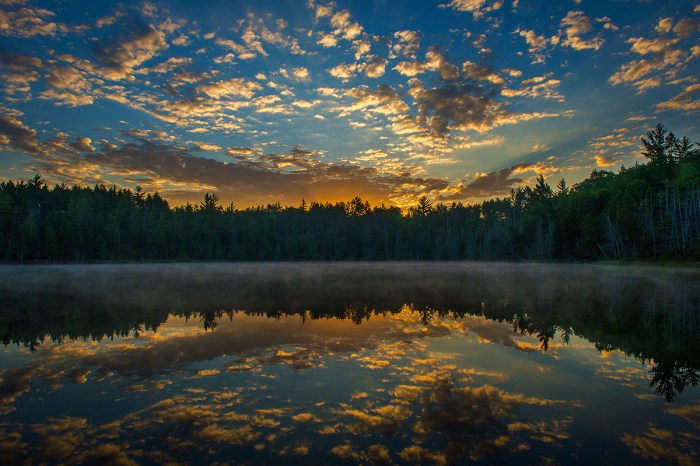
Glory Lake Sunrise

wGlory sunrise 1, photo by Jeff Caverly

The Michigan DNR’s page on Bright and Glory Lakes near Grayling includes maps. They say that both lakes have floating piers & boat launches for fishing – species include largemouth bass, rainbow trout, smallmouth bass, sucker, sunfish, yellow perch:

These lakes are called Kettle Lakes as they are shaped like tea kettles. They are roundish and deep in the center (more than 40 feet). The lake bottom is marl, so wading and swimming are prohibited as people would sink in the marl.

Here’s more about Kettle Lakes from MSU’s Geology department:

Kettles are depressions left behind after partially-buried ice blocks melt. Many are filled with water, and are then called “kettle lakes”. Most lakes in Michigan could be described as kettle lakes, and the term “kettle lake” describes the way the lake basin was formed. Kettle lake basins were formed as the glaciers receded. While this was happening, a block of ice broke off the glacier, and just sat there. As the glacier continued to melt, the debris from the glacier (soil, rocks, stones, gravel, etc.) filled in around the block of ice. When the block of ice finally melted, all the debris surrounding it fell into the hole, creating the kettle type basin, which when filled with water, became a lake as we know it.

Many of our small, deep lakes in Michigan are kettle lakes. Some have since been infilled with vegetation and plant matter, to form bogs. Even some of our larger, deep lakes, like Higgins Lake and Walled Lake, are kettles.

View Jeff’s photo background big, see more including another view of the sunrise in his slideshow, and follow Jeff Caverly Photography on Facebook.

Sunflower Saturday

Sunflowers

Sunflowers, photo by Sharon

Sharon caught these beautiful sunflowers at the Petoskey Farmer’s Market. View the photo background bigilicious and see more in her Michigan slideshow.

More summer wallpaper on Michigan in Pictures.

Evening clouds after rain

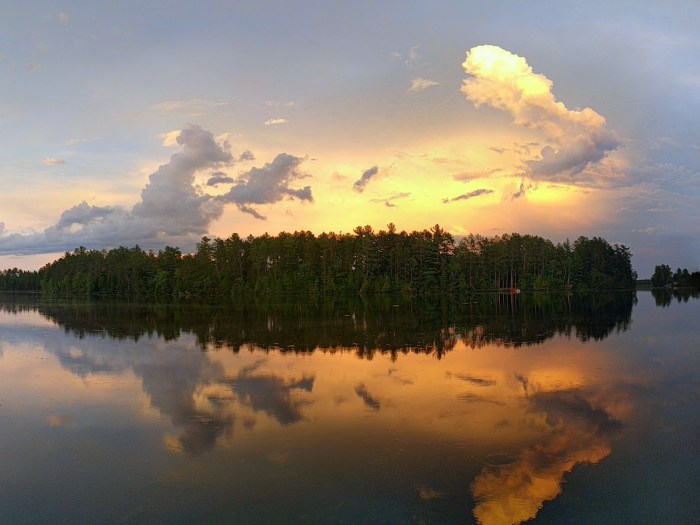
Evening Clouds After Rain

Evening clouds after rain, photo by Anne Fisher

Ann says she never tires of Bass Lake in the Upper Peninsula near Gwinn. I can see why! View her photo background big and see more in her 2016 UP slideshow.

More summer wallpaper on Michigan in Pictures and here’s a link to a map of Bass Lake.


Steps of the Sun at Sleeping Bear Dunes

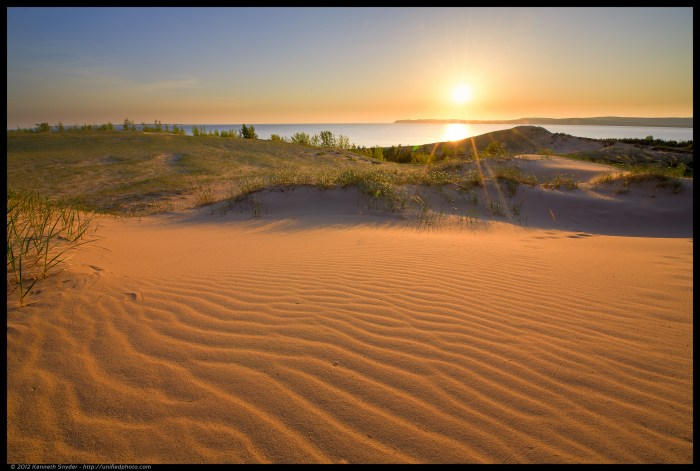
Steps of the Sun

Steps of the Sun, photo by Kenneth Snyder

Here’s a shot from high atop one of the many dunes in the Sleeping Bear Dunes National Lakeshore from August 1, 2012.

View Kenneth’s photo background bigilicious and see more in his Sleeping Bear Dunes slideshow that includes some awesome northern lights pics!

More dunes and more summer wallpaper on Michigan in Pictures.


Behind O-Kun-de-Kun Falls

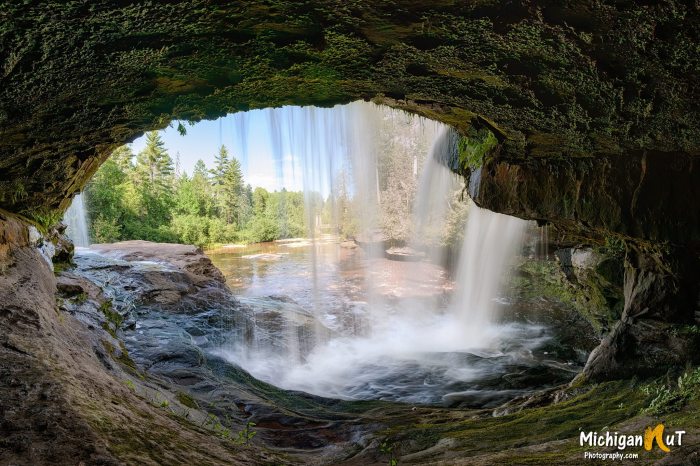
Behind O-Kun-de-Kun Falls

Behind O-Kun-de-Kun Falls, photo by Michigan Nut Photography

See a view from the front and get directions in Don’t Lose Your Bowl at O-Kun-de-Kun FallsThe waterfall is in Ontonagon which came to be named in a pretty hilarious story:

The name “Ontonagon” is derived from the Ojibway word “nontounagon,” which means “I lost my bowl.” Local legend surrounding the name stems from the story that a member of Chief O-Kun-De-Kun’s band was washing bowls near the mouth of the river when she was startled by an unkempt stranger in a canoe. The woman inadvertently dropped one of the bowls into the river and exclaimed “nontounagon”. The white man took her declaration to be a reply to his question about the name of the area.

John writes that a few years ago, he didn’t see a way to get behind the wild and scenic O-Kun-de-Kun Falls, but he found a way this time … and got a nice shower in the process!

See his photo bigger and view & purchase photos at Michigan Nut Photography.

More Michigan waterfalls on Michigan in Pictures.

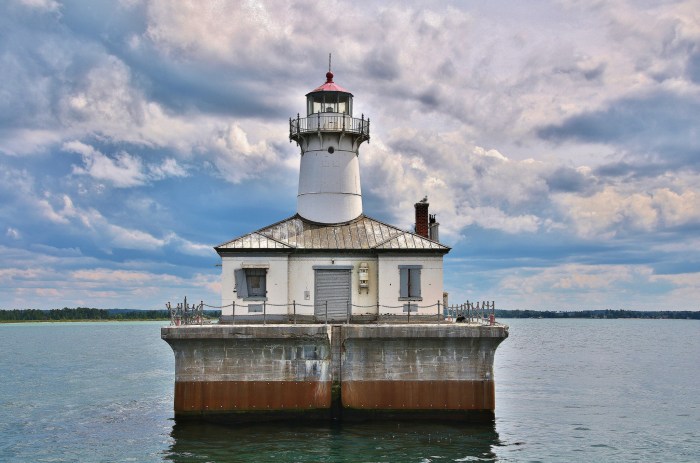
Fourteen Foot Shoal Lighthouse in Lake Huron

14 foot shoal lighthouse by David Juckett

14 foot shoal lighthouse, photo by David Juckett

Terry Pepper’s Seeing the Light remains the gold standard for information about the lighthouses of the Great Lakes. Terry writes (in part) of the process of constructing Fourteen Foot Shoal Light near the entry into Cheboygan Harbor:

With completion of the work at Poe Reef in 1929, the work crew turned their attention to work at Fourteen Foot Shoal. While the new light was of a totally different design, and considerably smaller than the twin lights built at Martin and Poe Reefs, the construction of the crib proceeded in much the same manner, with the construction of a wooden crib at the shore station on the Cheboygan Pier. After an area on the shoal was leveled, the crib was eased down wooden ways into the water, and towed to the shoal by the Lighthouse Tender Aspen. Once over the leveled area, the crib was sunk to the bottom by filling its empty pockets with rocks and gravel.

This timber foundation then served as a core, upon and around which wooden forms were constructed and filled with concrete loaded from the Lighthouse Service scow. As was the case with both the Martin and Poe stations, the upper edge of the crib was formed into a graceful flare, designed to deflect waves away from the pier, in order to help protect the structures which would be erected on the deck. With the completion of the concrete work, the pier stood fifty feet square, and its deck level fifteen feet above the water.

The steel framework for the single story equipment building was erected at the center of the deck. Standing thirty-four feet by twenty-eight feet in plan, on completion, the entire exterior of the building was sheathed with 1/4-quarter inch steel plates, each riveted to the steel framework beneath. Centered on the roof ridge, a cylindrical steel tower was integrated into the roof, standing six feet in diameter and twenty-four feet above the ridge line. The tower was capped with an octagonal cast iron lantern and outfitted with a flashing white Fourth Order Fresnel lens.

Read on for lots more and photos!

View David’s photo background bigtacular and see more in his slideshow.

Many more Michigan lighthouses on Michigan in Pictures!

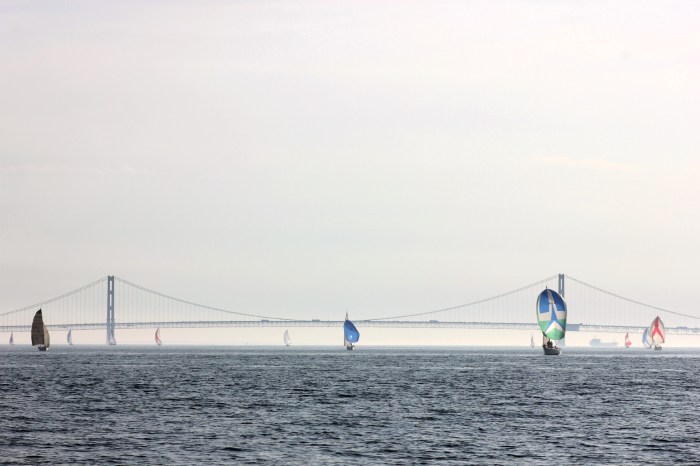
2016 Chicago to Mackinac Sailing Race

Chicago to Mac Sailboats & Mackinac Bridge

Sailboats and Mackinac, photo by Alex Duncan

On July 23, 2016, over 350 sailboats will leave the Chicago Yacht club for the longest annual freshwater race in the world. 2016 marks the 108th annual Chicago Yacht Club Race to Mackinac aka the Chicago to Mac. On their Race History page the CYC shares that:

Starting in 1898 with a mere five boats, The Mac has evolved into a world-class sporting event. After the first race in 1898, the Race to Mackinac was not held for five years until the second race in 1904. By 1906, the race had developed a healthy following and, in that year, the original Mackinac trophy was purchased. The race has seen occasional sustained violent weather in the blows of 1911, 1937 and 1970. After gale force winds took down most of the fleet in the Mac of 1911, the finish in the 1912 and 1913 races was changed to Harbor Springs on Little Traverse Bay instead of Mackinac Island. Race organizers felt the shorter distance was safer.

From 1914 until 1916 the Mac was back to its full distance until WWI. From 1917-1920 there were no Mac races due to the strains of the War, which took away yachtsmen and put many boats out of commission. Since 1921, the Race to Mackinac has run consecutively every year, remains the longest annual freshwater distance race, and is recognized as one of the most prestigious sailing races in the world.

Read on for lots more including an account of the first race. If you’re wondering when to catch a glimpse of them, Pyewacket set the monohull record in 2002 with a time of 23 hours, 30 minutes and 34 seconds. The race starts at noon on Saturday and usually takes between 40-60 hours to finish.

View Alex’s photo from 2011 background bigtacular and see more in his Pure Michigan slideshow.

More summer wallpaper on Michigan in Pictures!