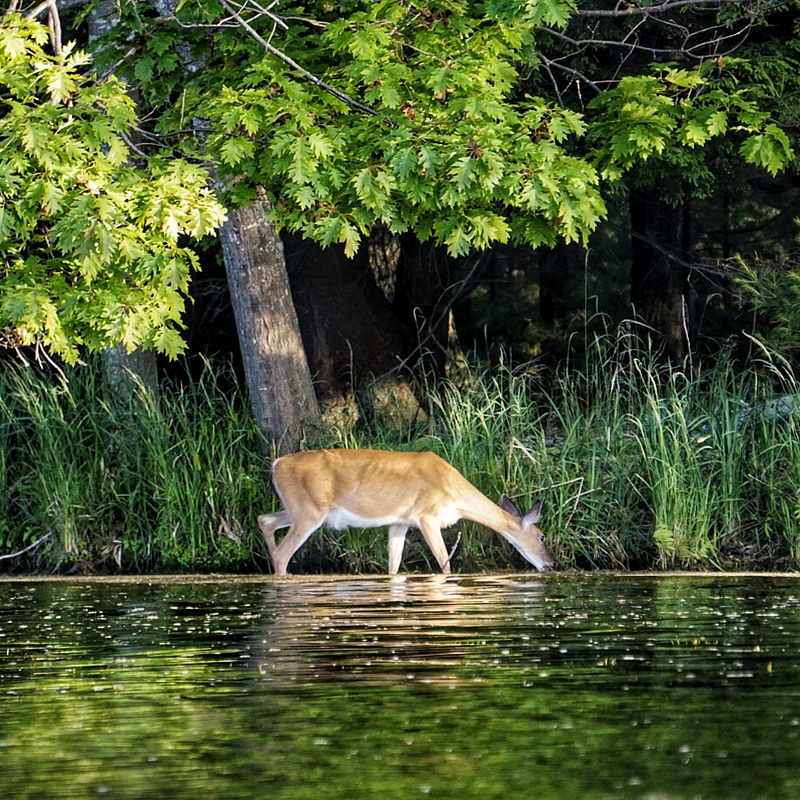
Arnie quietly paddled his kayak closer to get this awesome shot of our state animal, the White-tailed deer on the shore of Hamlin Lake. View it bigger and see more in his Summer slideshow.
In 1997, the White-tailed deer (Odocoileus virginianus) was designated the state game mammal after the successful lobbying efforts of a group of Zeeland fourth graders. Found in every Michigan county, the white-tailed deer is an important natural and economic resource.
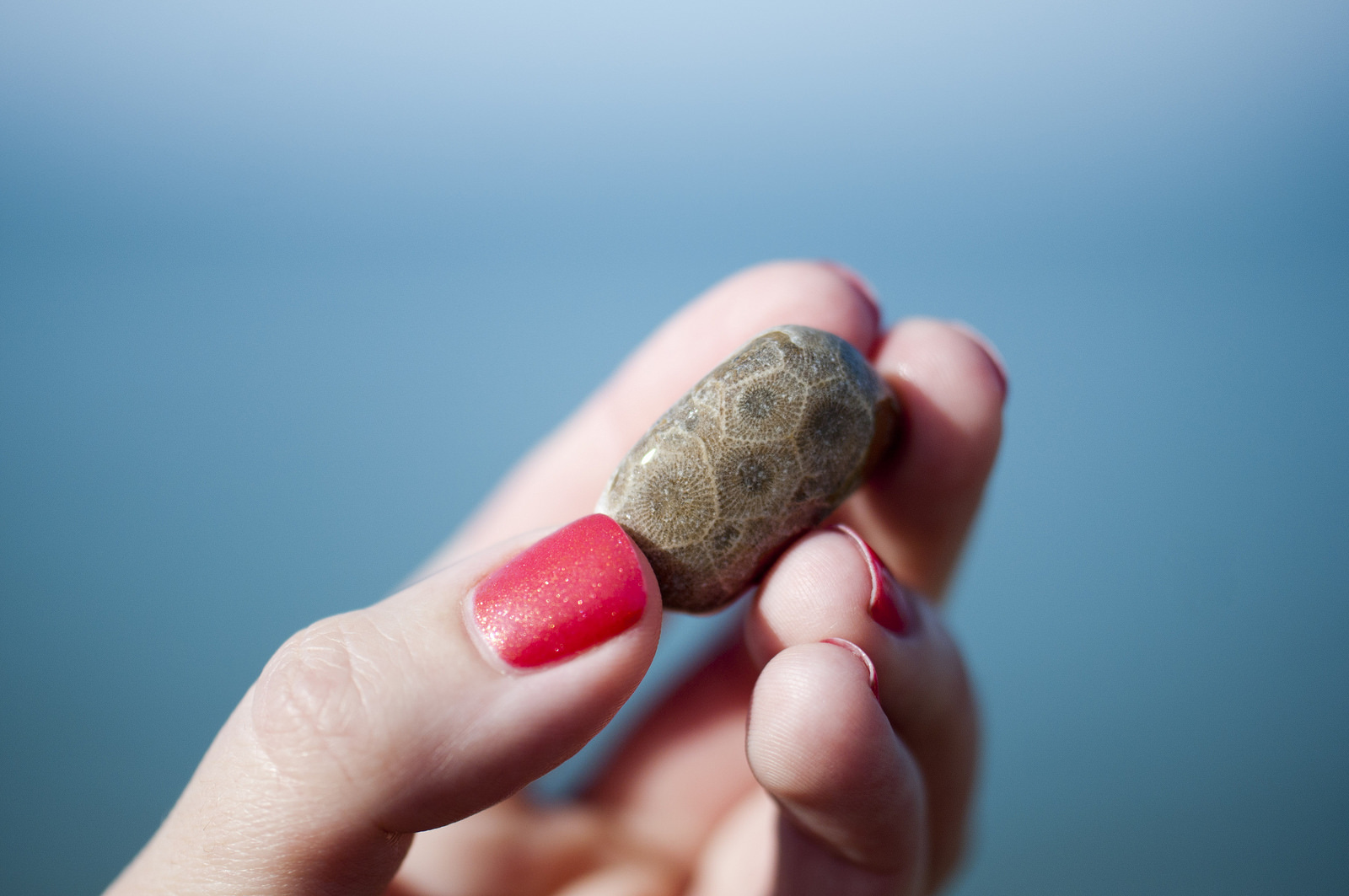
The Michigan Tech Geology Department explains that Michigan’s state stone is the Hexagonaria percarinata, the Petoskey stone. It is a fossil colonial coral that lived in the warm Michigan seas during the Devonian time around 350 million years ago. They can be found from Traverse City area across the state to Alpena in gravel pits, road beds, and of course beaches, with the largest concentration found on and around Lake Michigan’s Little Traverse Bay near the town of Petoskey. In June of 1965 the Petoskey Stone was named Michigan’s official State Stone and Miss Ella Jane Petoskey, the only living grandchild of Chief Petoskey, attended the formal signing.
Several years ago I shared the story behind the name as told by a young woman I know, Rose Petoskey:
My name is Noozeen (Rose) Nimkiins (Little Thunder) Petoskey (Rising Sun) and I am Anishinaabek.
Many people would associate the word Petoskey with the souvenir stone found on the northern Lake Michigan shorelines. However, to my family, the word Petoskey represents much more than a souvenir.
In the Odawa language, the word Petoskey (Bii-daa-si-ga) means the rising sun, the day’s first light, or the sun’s first rays moving across the water. The Petoskey stone is a fossilized coral created by impressions made in limestone during the last Michigan ice age. These stones were named “Petoskey” because the impressions resembled the rising sun coming up over the water. Just as the image of the rising sun is implanted within the Petoskey stone, the archaeology of a person’s names is implanted within. All names within our Anishinaabek culture reflect an individual’s personal history. Rocks go deep, but names go much deeper to reveal the stories of the past.
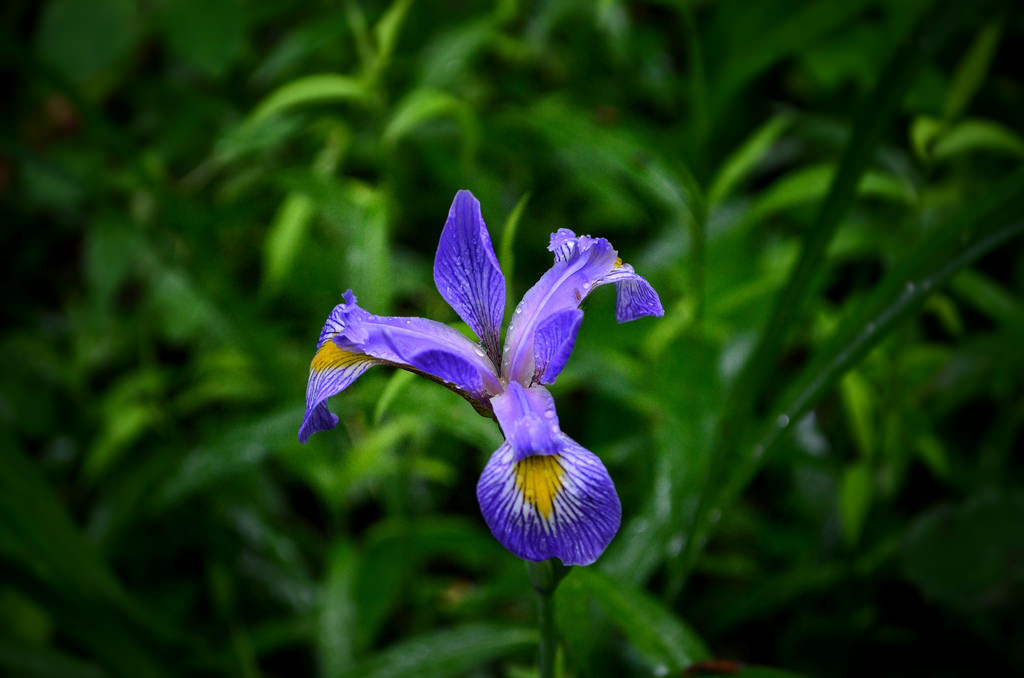
The Michigan DNR relates that Michigan’s state wildflower, the Dwarf Lake Iris (Iris lacustris): grows nowhere else but in the Great Lakes region, and most within Michigan’s boundaries:
In Michigan, Dwarf Lake Iris is especially concentrated along certain stretches of the northern Great Lakes shoreline, where it may occur for miles, interrupted only by habitat destruction, degradation, or unsuitable habitat such as rocky points or marshy bays.
Dwarf Lake Iris usually occurs close to the Great Lakes shores on sand or in thin soil over limestone rich gravel or bedrock. It tolerates full sun to near complete shade, but flowers mostly in semi open habitats. These areas can be very long and narrow strips bordering the high water line, or large flat expanses located behind the open dunes of the Great Lakes shoreline. Many iris locations are on old beach ridges of former shores of the Great Lakes. Fluctuating water levels of the Great Lakes play a vital role in opening up new habitat for Dwarf Lake Iris. During high water years, trees and shrubs along the shoreline may be flooded out. This flooding may open up patches within the forest where the Dwarf Lake Iris may spread. It is usually found growing under White Cedar, although White Spruce, Balsam Fir, and Aspen are also frequently present.
…”Lacustris” translates literally to mean “of lakes” and refers to where this beautiful iris grows. Dwarf Lake Iris was first found on Mackinac Island in 1810 by Thomas Nuttall, a renowned naturalist and explorer. Nuttall reached Mackinac Island after travelling from Detroit by canoe with French Canadian voyagers and the surveyor for the Michigan Territory. At least 1/3 of the species that Nuttall reported from the Great Lakes were new to science.
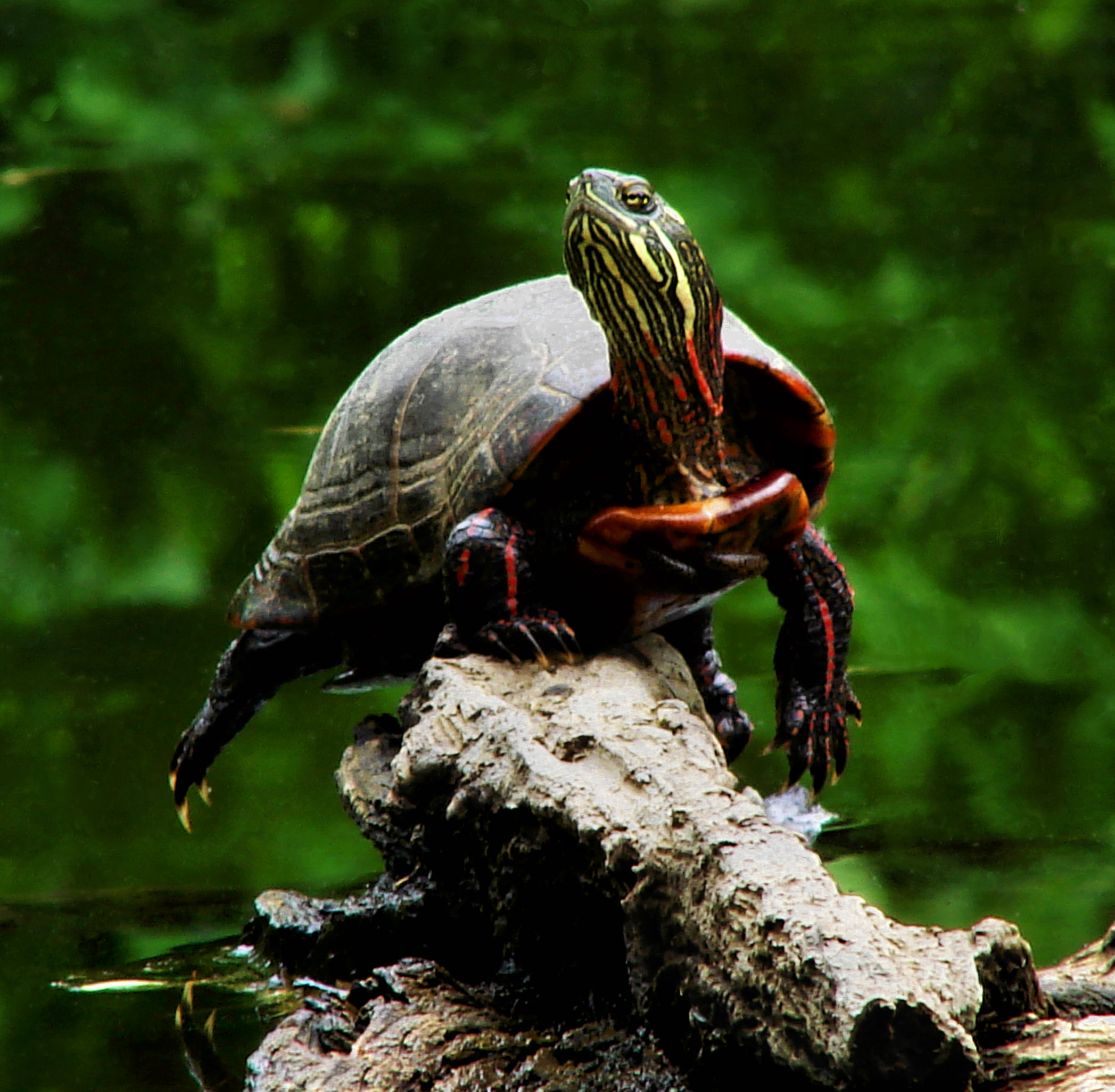
It appears the turtle above is aware that Michigan’s state reptile is the painted turtle.
I thought it perfect for my day-late post celebrating World Turtle Day (May 23), an annual day of recognition that was started in 2000 by American Tortoise Rescue. They offer some tips to help preserve endangered turtles worldwide including not buying turtles or tortoises from pet shop (it increases demand from the wild), not removing turtles from the wild unless they are injured, and something that we can all do when we’re on the roads: if a turtle is crossing a busy street, pick it up and send it in the same direction it was going – if you try to make it go back, it will turn right around again!
It might surprise you to learn that Michigan is home to 10 native turtle species. Learn about all of them on Michigan in Pictures:
Speaking of Turtle Lore, I always like to shout out a book I read as a kid that did more to foster my love of Michigan than any other: Lore of the Great Turtle. It was filled with Indian tales of Mackinac Island , and one of these was the formation of the island. While this version adapted by Basil Johnston is not quite the same, I think you’ll enjoy it!
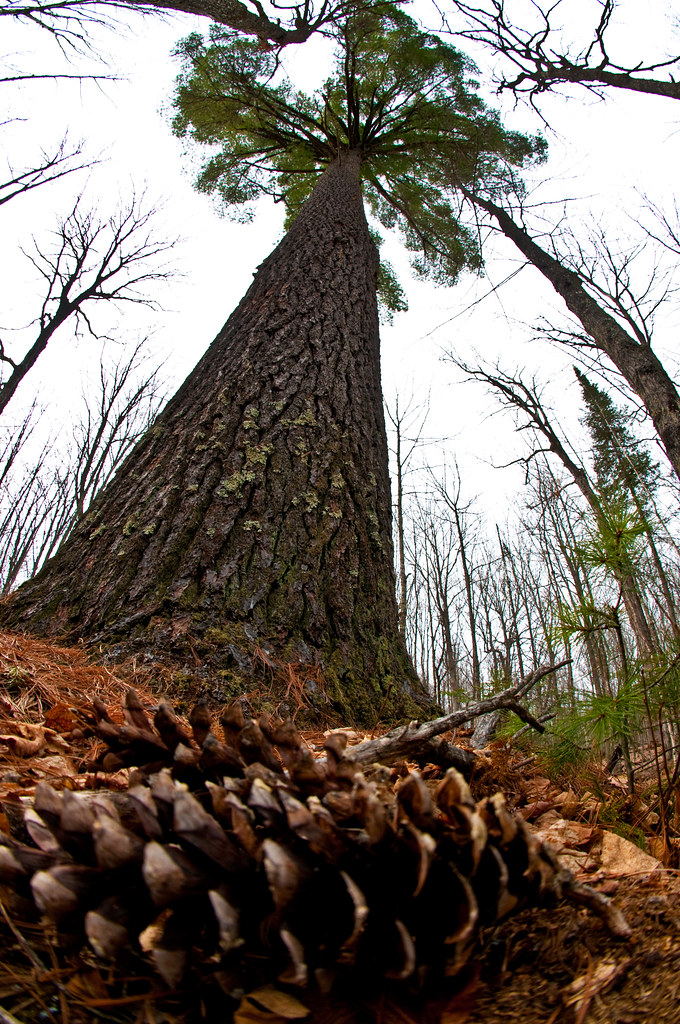
This week is Arbor Week, a week dedicated to celebrating and planting trees. One tree for Michiganders to celebrate is the eastern White Pine (Pinus strobus), which was adopted as our official State Tree by Act 7 on March 4, 1955. Here’s an edited summary of what I’ve learned about white pines.
The eastern white pine, is also known as “soft pine.” It was called the Tree of Peace by the Iroquois and in Ojibway, Zhingwaak. Mature white pines can easily live 200+ years of age, with some Michigan trees that have approached 500 years in age. The eastern white pine has the distinction of being the tallest tree in eastern North America, and pre-colonial stands were reported over 200′ in height.
It was said that when settlers arrived, a squirrel could travel in the forest canopy from one side of the state to the other. With this amazing resource, Michigan led the nation in lumber production in the 1880s and 1890s, and by the early 1900s, over 100 million of Michigan pine trees worth more than all the gold mined in California had been felled in the Lower Peninsula. Most of that value was in white pine, an when the forest was depleted, timber companies moved to the UP.
Small white pines are popular as Christmas trees due to their ability to hold needles, while large white pines were prized as ship masts and known as mast pines by the British navy. These trees were marked with a broad arrow by agents of the crown, a very controversial action that was one of the factors leading to the Revolutionary War. The original masts on the USS Constitution (aka Old Ironsides) were single trees before they realized that laminated trees were better about to withstand cannon fire.
More about the White Pine in Michigan
According to the Michigan Big Tree Program, the largest white pine in Michigan is a 143 ft. Eastern White Pine in Luce County. Click here to see it being climbed!
If you want to see some remainders of Michigan’s old growth pine forest, consider a visit to Harwick Pines State Park near Grayling. The park features a 49-acre forest and extensive lumbering exhibits – a definite treat!
Scott writes that this mighty 200+ year old White Pine was spared the lumberjack’s axe, but he’s glad to have this remnant of the forest that once covered Upper Michigan standing sentinel in the forest surrounding his cabin. Check it out bigger and in his Fisheye slideshow. More of Scott’s work on his Facebook.
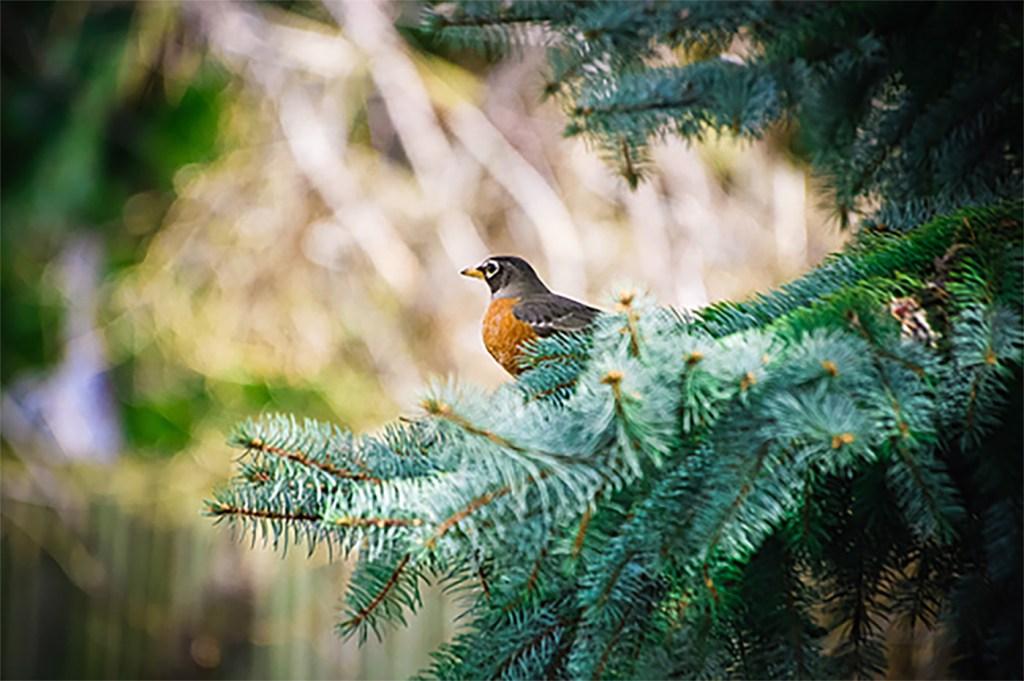
“WHEREAS, A widely and generally conducted contest to choose a State bird, carried on by the Michigan Audubon Society, resulted in nearly 200,000 votes being cast, of which Robin Red Breast received many more votes than any other bird as the most popular bird in Michigan; and WHEREAS, The robin is the best known and best loved of all the birds in the State of Michigan; therefore BE IT RESOLVED BY THE HOUSE OF REPRESENTATIVES (THE SENATE CONCURRING), That the robin be and the same is hereby designated and adopted as the official State bird of the State of Michigan.” ~Michigan House & Concurrent Resolution, April 8, 1931
A sign of spring in Michigan is the sighting of your first robin. Like daffodils, they’ve showed up early this year. American Robin (Turdus migratorius) at All About Birds has some great facts and photos about our state bird:
The quintessential early bird, American Robins are common sights on lawns across North America, where you often see them tugging earthworms out of the ground. Robins are popular birds for their warm orange breast, cheery song, and early appearance at the end of winter…
An American Robin can produce three successful broods in one year. On average, though, only 40 percent of nests successfully produce young. Only 25 percent of those fledged young survive to November. From that point on, about half of the robins alive in any year will make it to the next. Despite the fact that a lucky robin can live to be 14 years old, the entire population turns over on average every six years.
Although robins are considered harbingers of spring, many American Robins spend the whole winter in their breeding range. But because they spend more time roosting in trees and less time in your yard, you’re much less likely to see them. The number of robins present in the northern parts of the range varies each year with the local conditions.
Robins eat a lot of fruit in fall and winter. When they eat honeysuckle berries exclusively, they sometimes become intoxicated.
Robin roosts can be huge, sometimes including a quarter-million birds during winter. In summer, females sleep at their nests and males gather at roosts. As young robins become independent, they join the males. Female adults go to the roosts only after they have finished nesting.
Robins eat different types of food depending on the time of day: more earthworms in the morning and more fruit later in the day. Because the robin forages largely on lawns, it is vulnerable to pesticide poisoning and can be an important indicator of chemical pollution.
The oldest recorded American Robin was 13 years and 11 months old.
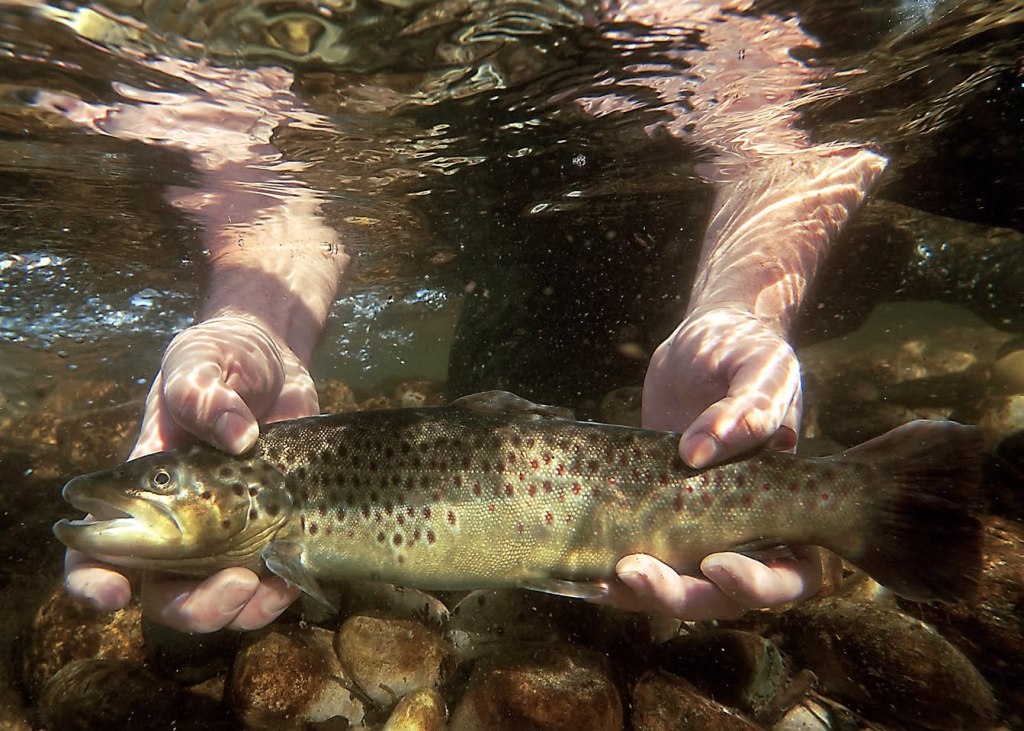
Brook trout have a long, streamlined body with a large mouth that extends past the eye. Color variations include olive, blue-gray, or black above with a silvery white belly and wormlike markings (vermiculations) along the back. They have red spots sometimes surrounded by bluish halos on their sides. The lower fins have a white front edge with black and the remainder being reddish orange. The tail fin is square or rarely slightly forked. During breeding time in the fall male brook trout can become very bright orange-red along the sides.
The brook trout is native to Michigan’s waters and is the state fish of Michigan. They can be found throughout most of the state in many creeks, streams, rivers, lakes, and in the Great Lakes. Brook trout require cool, clear, spring-fed streams and pools. They can be found under cover of rocks, logs, and undercut banks and have been described as stationary. Larger brook trout often inhabit deep pools moving to shallow water only to feed. They prefer temperatures from 57–60 degrees F.
…Brook trout have been described as voracious feeders with the potential to consume large numbers of zooplankton, crustaceans, worms, fish, terrestrial insects, and aquatic insects. Ephemeroptera, Trichoptera, and Diptera often make up a large component of their diet. However, they will often feed on whatever is most readily available. Brook trout are avidly sought after by sport anglers, for food as well as for the sport. They can be caught by using various bait and lures including worms, crickets, grasshoppers, wet and dry flies, spoons, and spinners.
Trout Unlimited’s Brook Trout Atlas adds: Brook trout are the only trout native to much of the eastern United States and serve as indicators of the health of the watersheds they inhabit. Strong wild brook trout populations demonstrate that stream or river ecosystem is healthy and that water quality is excellent. A decline in brook trout populations can serve as an early warning that the health of an entire aquatic system is at risk.


 Michigan in Pictures