
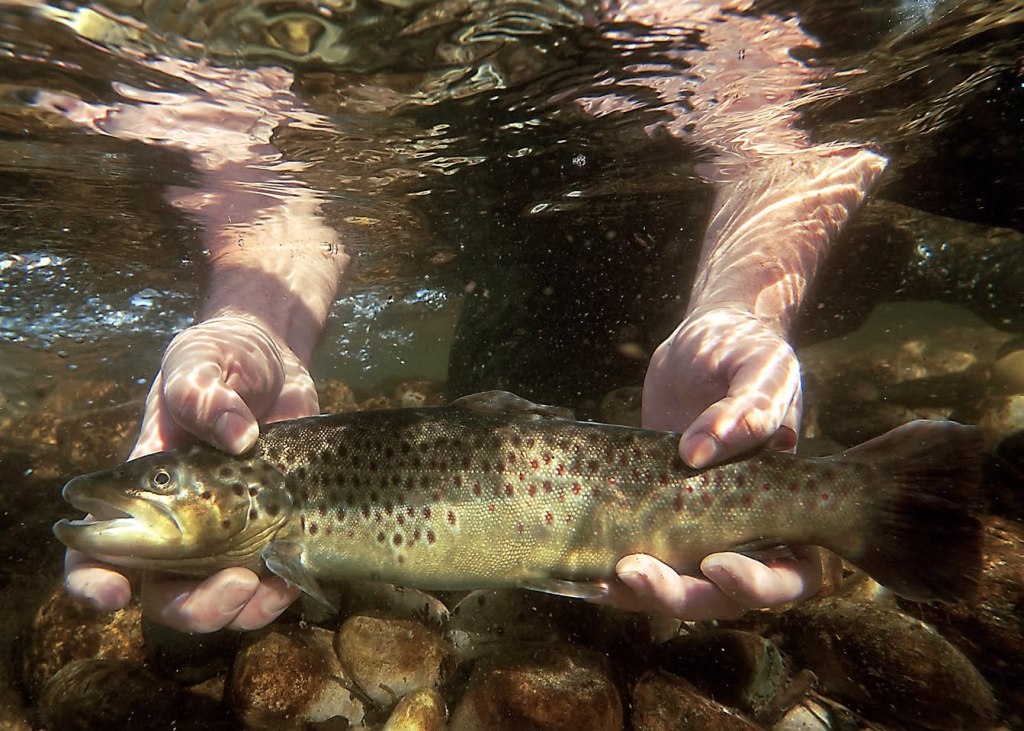
Brook Trout by Michigan DNR
Michigan’s state fish is the Brook Trout (Salvelinus fontinalis). The Michigan DNR says:
Brook trout have a long, streamlined body with a large mouth that extends past the eye. Color variations include olive, blue-gray, or black above with a silvery white belly and wormlike markings (vermiculations) along the back. They have red spots sometimes surrounded by bluish halos on their sides. The lower fins have a white front edge with black and the remainder being reddish orange. The tail fin is square or rarely slightly forked. During breeding time in the fall male brook trout can become very bright orange-red along the sides.
The brook trout is native to Michigan’s waters and is the state fish of Michigan. They can be found throughout most of the state in many creeks, streams, rivers, lakes, and in the Great Lakes. Brook trout require cool, clear, spring-fed streams and pools. They can be found under cover of rocks, logs, and undercut banks and have been described as stationary. Larger brook trout often inhabit deep pools moving to shallow water only to feed. They prefer temperatures from 57–60 degrees F.
…Brook trout have been described as voracious feeders with the potential to consume large numbers of zooplankton, crustaceans, worms, fish, terrestrial insects, and aquatic insects. Ephemeroptera, Trichoptera, and Diptera often make up a large component of their diet. However, they will often feed on whatever is most readily available. Brook trout are avidly sought after by sport anglers, for food as well as for the sport. They can be caught by using various bait and lures including worms, crickets, grasshoppers, wet and dry flies, spoons, and spinners.
Trout Unlimited’s Brook Trout Atlas adds: Brook trout are the only trout native to much of the eastern United States and serve as indicators of the health of the watersheds they inhabit. Strong wild brook trout populations demonstrate that stream or river ecosystem is healthy and that water quality is excellent. A decline in brook trout populations can serve as an early warning that the health of an entire aquatic system is at risk.
Choose your own adventure with more Michigan state symbols and more fish & fishing on Michigan in Pictures.

 Michigan in Pictures