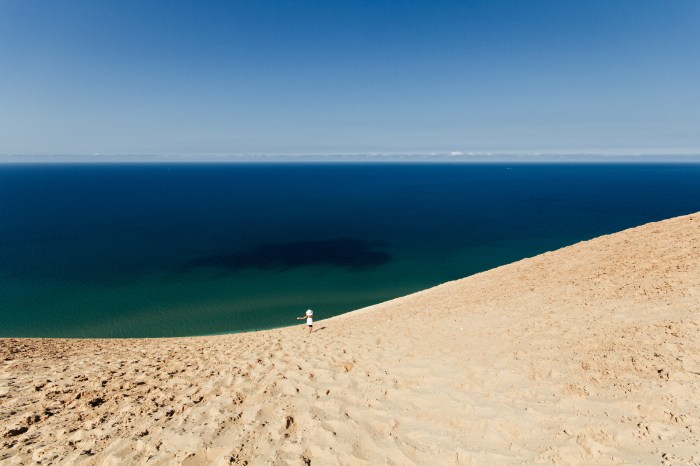
Few places in Michigan have the expansive view of the Lake Michigan overlook on Pierce Stocking Scenic Drive in the Sleeping Bear Dunes National Lakeshore. It’s 450′ feet down to the water, so remember that freedom comes at a price!
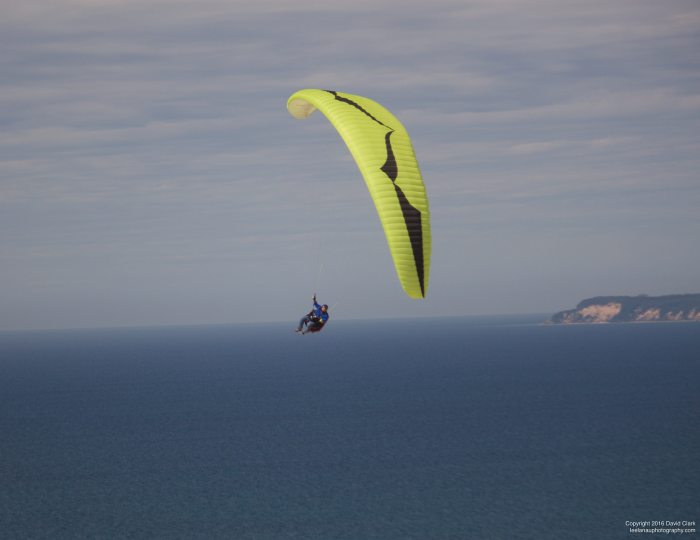
Most individuals will need lessons in hang gliding from a certified instructor prior to their first flight. Hang gliding schools provide instructions, gear, permits and safety equipment. The Draachen Fliegen Soaring Club is located in Cloud 9 Field between Detroit and Lansing, with instructors offering “tandem discovery” flights lasting from 15 minutes to one hour. Gliders drift in air space up to two miles high, in tandem with an instructor. Individuals with proven experience and certifications may rent gliders for solo flights. Traverse City Hang Gliders offers full programs of training and instruction in both traditional powerless hang gliding and “the Mosquito” powered hang gliding harness.
Hang gliding enthusiasts can enjoy practicing the sport at national parks within the state of Michigan, including Sleeping Bear Bear Dunes National Lakeshore. Several spots within the park are approved for powerless flight. Hang gliders can take off and land at Empire Bluff, Pyramid Point and Lake Michigan Overlook on the Pierce Stocking Scenic Drive, as well as Dune Climb in the months of November through March. Powerless flight permits are required and can be obtained free of charge at the Visitor Center Information Desk. Launch sites within the park require proficiency ratings established by the U.S. Hang Gliding Association. Gliders must also follow safety and federal regulations. Warren Dunes State Park also issues permits for hang gliding along the coastal dunes, about 14 miles from the state border with Indiana. Favorite launch and return sites within the park include Tower Hill and New Buffalo.
In the 1970s, Elberta Beach and the adjacent city of Frankfort, in Northern Michigan, were popular spots for what was then the new sport of hang gliding. Once referred to as the “Sail Plane Capital,” the area is still a magnet for gliders today. Just south of Frankfort, gliders can experience the thrill of soaring over sand dunes at Green Point Dunes. The Green Point Flyers Association, established in 1978, is a club for both hang gliders and parasailers, with a main flying site that is a sand dune stretching for three miles at a height of 370 feet. Licenses are required to fly at Green Point, and certified instructors are available. Pilots at Green Point also have access to hang gliding sites inside the Sleeping Bear Dunes National Lakeshore, as well as the bluffs of Elberta. Visitors can also team up for a ride with members of the Northwest Soaring Club, which is located in Cadillac, Michigan. Flights depart from the Wexford County Airport, then cruise over Lake Mitchell and Lake Cadillac.
I’ve shared this before, but Space.com has an interesting story about how the upcoming Perseid Meteor shower (peak August 11-13) came to be known as “The Tears of St. Lawrence” and also some of the science behind this annual August sky show:
Laurentius, a Christian deacon, is said to have been martyred by the Romans in 258 AD on an iron outdoor stove. It was in the midst of this torture that Laurentius cried out: “I am already roasted on one side and, if thou wouldst have me well cooked, it is time to turn me on the other.”
The saint’s death was commemorated on his feast day, Aug. 10. King Phillip II of Spain built his monastery place the “Escorial,” on the plan of the holy gridiron. And the abundance of shooting stars seen annually between approximately Aug. 8 and 14 have come to be known as St. Lawrence’s “fiery tears.”
…We know today that these meteors are actually the dross of the Swift-Tuttle comet. Discovered back in 1862, this comet takes approximately 130 years to circle the Sun. With each pass, it leaves fresh debris — mostly the size of sand grains with a few peas and marbles tossed in.
Every year during mid-August, when the Earth passes close to the orbit of Swift-Tuttle, the bits and pieces ram into our atmosphere at approximately 37 miles per second (60 kps) and create bright streaks of light.
Read on for more including diagrams and viewing tips.
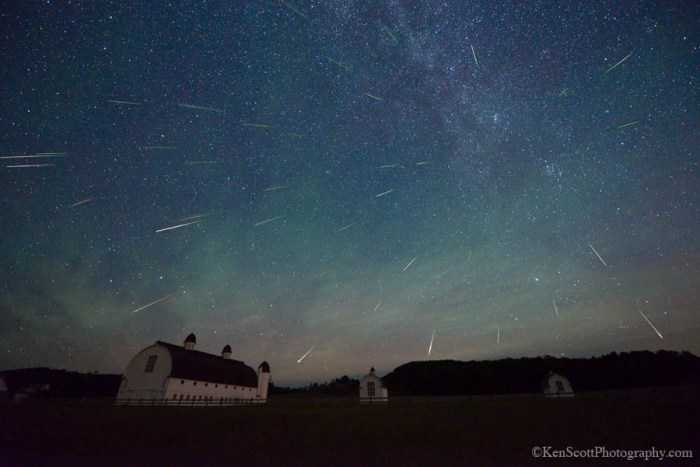
Ken Scott captured these Perseid meteors last August over a 2 1/2 hour period at the D.H. Day Farm in the Sleeping Bear Dunes National Lakeshore. He says that the barn is lit by rogue lightning and that this is a composite of many meteor images, where each photo is rotated around the north star so that the ‘point of origin’ of the shower can be seen better. He understands it visually but not scientifically – anyone have a simple explanation for him?
Leap years are added to the calendar to keep it working properly. The 365 days of the annual calendar are meant to match up with the solar year. A solar year is the time it takes the Earth to complete its orbit around the Sun — about one year. But the actual time it takes for the Earth to travel around the Sun is in fact a little longer than that—about 365 ¼ days (365 days, 5 hours, 48 minutes, and 46 seconds, to be precise). So the calendar and the solar year don’t completely match—the calendar year is a touch shorter than the solar year.
It may not seem like much of a difference, but after a few years those extra quarter days in the solar year begin to add up. After four years, for example, the four extra quarter days would make the calendar fall behind the solar year by about a day. Over the course of a century, the difference between the solar year and the calendar year would become 25 days! Instead of summer beginning in June, for example, it wouldn’t start until nearly a month later, in July. As every kid looking forward to summer vacation knows—calendar or no calendar—that’s way too late! So every four years a leap day is added to the calendar to allow it to catch up to the solar year.
Todd took this shot back in August of 2009 at one of my favorite spots for hiking (and jumping) – the Pyramid Point overlook in the Sleeping Bear Dunes National Lakeshore. Lake Michigan is hundreds of feet down a steep bluff from the point where she’s jumping, and many is the person who wished they didn’t run down that bluff after toiling up it!
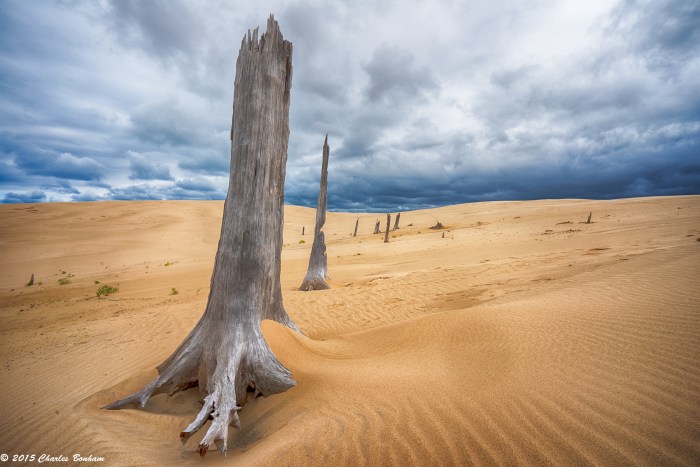
Not all of Michigan’s great hikes are trails. This trek is a journey through Silver Lake State Park’s trailless backcountry, a mile-wide strip of dunes between Silver Lake and Lake Michigan. There’s not another hike like this in Michigan or even the Midwest because no other stretch of dunes are so barren.
Perched on a plateau and rising more than 100 feet high above Silver Lake, the heart of these dunes are totally devoid of any vegetation, even dune grass. The only thing besides sand are the stumps and trunks of ghost forests, ancient trees that the migrating dunes had buried and killed. Almost half of the hike is in this Sahara Desert-like terrain, the other half is spent strolling a stretch of Lake Michigan that is free of cottages and frozen custard stands.
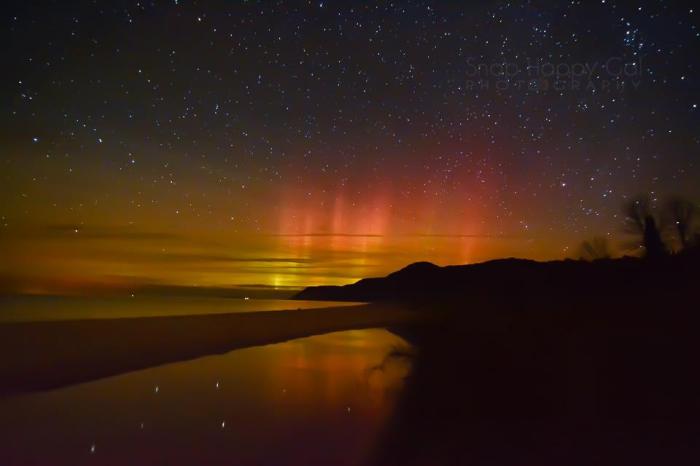
This is one shot from an incredible video that Heather made of the northern lights as seen from Esch Road Beach in the Sleeping Bear Dunes National Lakeshore. That’s Otter Creek in the foreground.
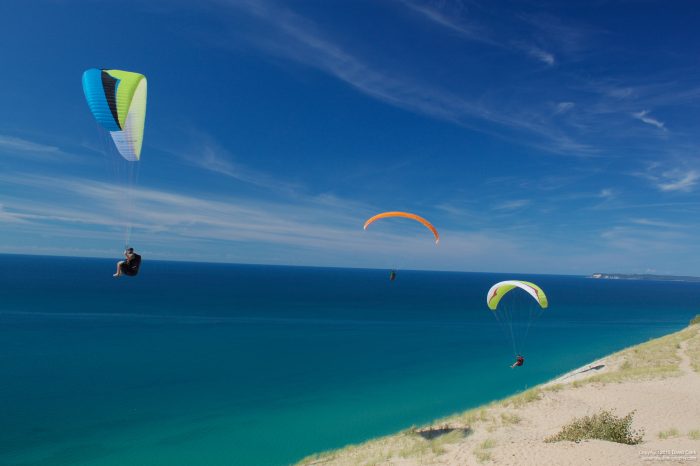
Here’s a pretty cool shot taken last weekend from high above the Sleeping Bear Dunes National Lakeshore and Lake Michigan. For reference, if he took this from where I think he did, those people are above a dune bluff that’s several hundred feet high.
Hard to believe that a raging storm tore through just hours after this idyllic morning in the dunes. But this is from the same day (Sunday) as the monster winds that uprooted and snapped countless large trees…
Who’s ready for a break from snow & ice? The Sleeping Bear Dunes National Lakeshore page on the North Bar Lake Overlook says (in part):
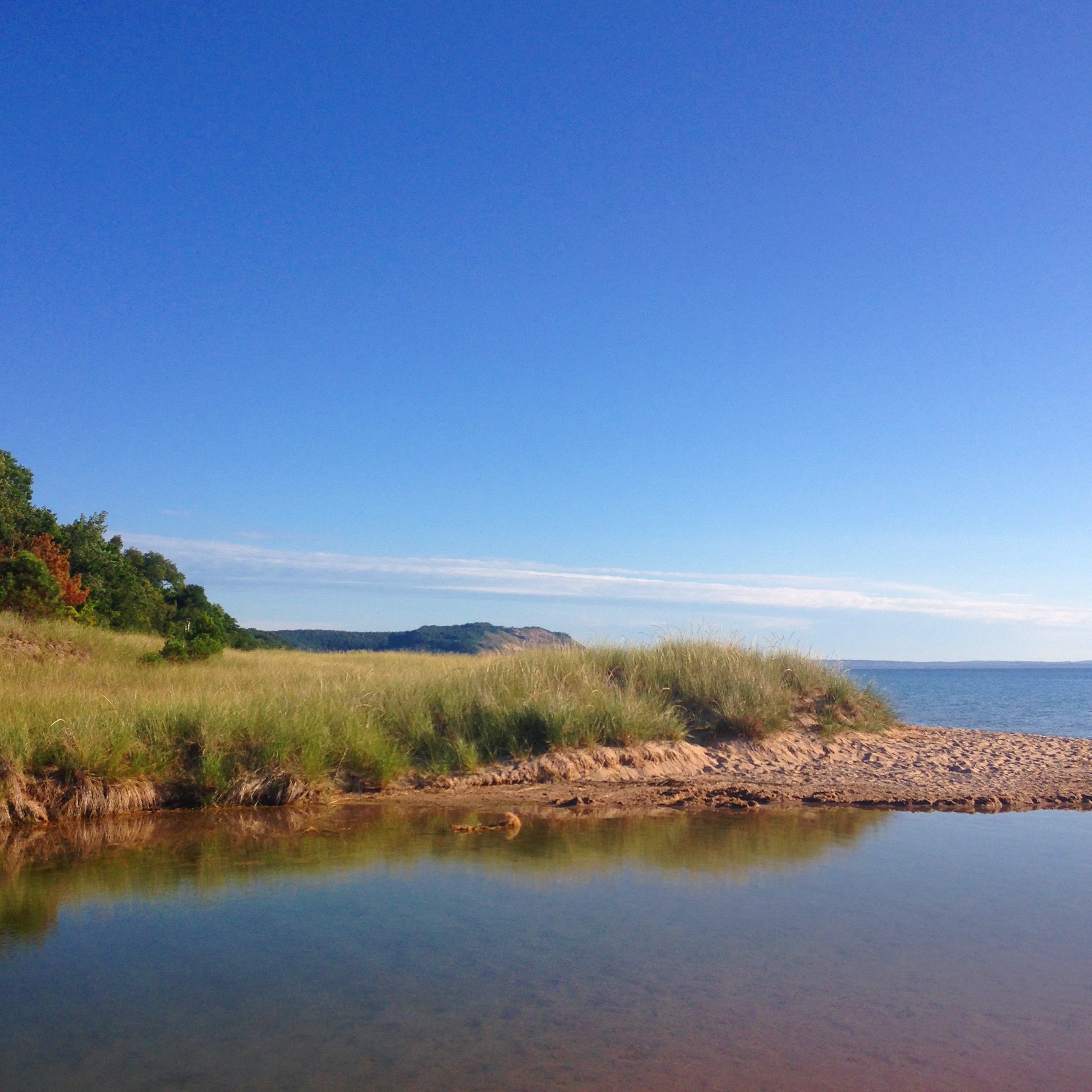
The name describes how the lake formed: it is ponded behind a sand bar. At times, the sand bar builds up and separates North Bar Lake from Lake Michigan. At other times, a small connecting channel exists between the two lakes. North Bar Lake occupies part of a former bay on Lake Michigan. This ancient bay was flanked by headlands on both sides: Empire Bluffs on the south and Sleeping Bear Bluffs on the north. Shorelines have a natural tendency to become straighter with time. Wave action focuses on the headlands and wears them back, while shoreline currents carry sediment to the quiet bays and fill them in. Deeper parts of the bay are often left as lakes when sand fills in the shallower parts.
The same process that formed North Bar Lake also formed many of the other lakes in northern Michigan: Glen, Crystal, Elk and Torch Lakes, for example.


 Michigan in Pictures