Fayette Historic State Park blends nature and history with a Historic Townsite, a representation of a once-bustling industrial community. Visitors can learn about the town through guided tours and information from the Visitor Center, or simply by walking through the townsite and exploring on their own. Walk through restored buildings like the town hotel and a cabin, built to replicate the homes in which residents of Fayette used to live. Interpretive panels provide information to transport visitors back in time and tell the story of the town.
On the second Saturday of August, the park is transformed back to its glory days with period displays, food and music at the annual Heritage Day.
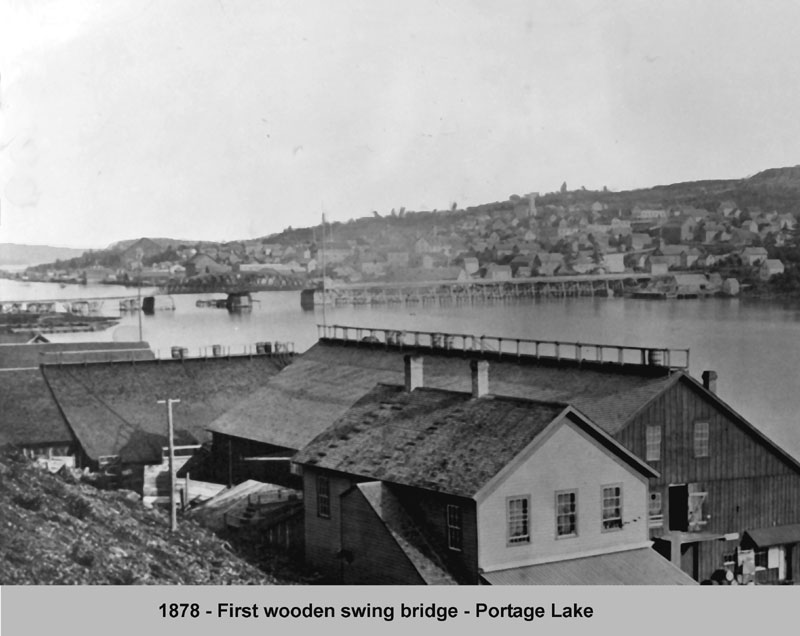
In 1897, the Mineral Range Railroad Company built a new iron swing type bridge, replacing the old wooden bridge. This bridge also featured a two lane roadway, with a railroad crossing underneath. New reconstructed support cribs were also sunk. But on August 15, 1905, disaster struck, when the steamer Northern Wave (Mutual Transit Lines), en route to the Quincy Smelter to pick up copper ingots, smashed into the center section, destroying much of it. The mishap was apparently caused by a mixup in signals.
Original Portage Wooden Swing Bridge Taken from the north side of Ruppe Dock and Warehouse in Hancock, 1878
The bridge would be replaced one year later, again with an iron bridge, and center swing section, and a control house above the roadway, over the center turnstile. This new bridge would have 118 ft. of clearance on the north maritime passage, and 108 ft. on the south side passage. (Newspaper accounts of the period, gave maritime traffic at 6,000 bridge openings per year, and up to 40 daily train crossings per day, both of which began to taper off by 1920). Although almost struck again in 1940 by the Steamer Maritana (Hutchenson Lines), it narrowly avoided the collision by dropping its anchors which caught the submarine telephone cables, stopping it just short of the bridge. (This would happen again 20 years later). Light signaling was added during WWII, to augment the steam whistles already in use. The bridge served the communities until 1960.
In the late 1950s, the Michigan Department of Transportation began studies on how best to replace the aging bridge, with a more modern one, that would accommodate the now much larger ships plying the waterway. It was decided to build what would be become the worlds heaviest aerial lift bridge, which was under construction by 1959, just to the West of the then current bridge. This new bridge, with 4 traffic lanes above, and a railroad crossing below, had its ribbon cutting on Saturday, June 25, 1960. But it almost didn’t happen. During the night before, the Steamer J.F. Schoelkoff (American Steamship Company), traveling westward, signaled for the bridge to open, but the signals were not acted on. Dropping all their anchors, they snagged the submarine telephone cables in an eerie repeat of 20 years previously. Onlookers for the ribbon cutting ceremonies were treated to the spectacle of a large freighter jammed crossways in the waterway, just a quarter mile from the Bridge. Area phone service was disrupted for nearly three days. Telephone service to the bridge, and marine radios were installed shortly. That incident not withstanding, the new Portage Lake Lift Bridge continues to well serve the area, as the possibility of adding yet another new bridge may be explored.
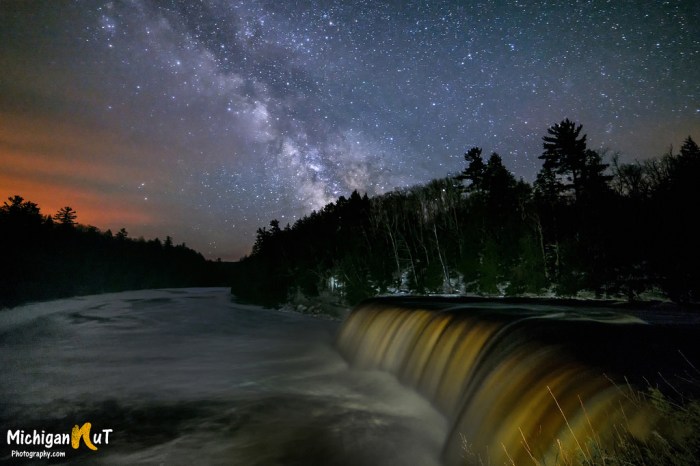
Tahquamenon Falls State Park encompasses close to 50,000 acres stretching over 13 miles. Most of this is undeveloped woodland without roads, buildings or power lines. The centerpiece of the park, and the very reason for its existence, is the Tahquamenon River with its waterfalls. The Upper Falls is one the largest waterfalls east of the Mississippi. It has a drop of nearly 50 feet and is more than 200 feet across. A maximum flow of more than 50,000 gallons of water per second has been recorded cascading over these falls.
…This is the land of Longfellow’s Hiawatha – “by the rushing Tahquamenaw” Hiawatha built his canoe. Long before the white man set eyes on the river, the abundance of fish in its waters and animals along its shores attracted the Ojibwa Indians, who camped, farmed, fished and trapped along its banks. In the late 1800’s came the lumber barons and the river carried their logs by the millions to the mills. Lumberjacks, who harvested the tall timber, were among the first permanent white settlers in the area.
Rising from springs north of McMillan, the Tahquamenon River drains the watershed of an area of more than 790 square miles. From its source, it meanders 94 miles before emptying into Whitefish Bay. The amber color of the water is caused by tannins leached from the Cedar, Spruce and Hemlock in the swamps drained by the river. The extremely soft water churned by the action of the falls causes the large amounts of foam, which has been the trademark of the Tahquamenon since the days of the voyager.
I was going to talk this morning about how I will continue to talk about what I want to talk about on Michigan in Pictures, but then I saw this awesome photo by Heather. I’m sure you get the idea.
On her Snap Happy Gal blog where you can view & purchase some great lighthouse photos, Heather writes:
I think of myself as a serendipitous shooter: I go out to scenes in all kinds of light – the good, the bad, even the ugly – and I take photos. Sometimes I walk away with artwork worth sharing, and sometimes I just walk away with happy memories. I don’t often stalk a scene for the best light, I don’t think of myself as having a favorite thing to photograph, and I don’t find that I’m predictable (even I don’t know when or where I’ll be heading out to shoot until I get the itch). But, lately, if you wanted to catch me out and about, you’d look at northern Michigan’s west coast lighthouses.
I’ve visited every one of them from Manistee up to Northport (though I didn’t take the camera out), and I’ve been there from sunrise to sunset, and well into the night.
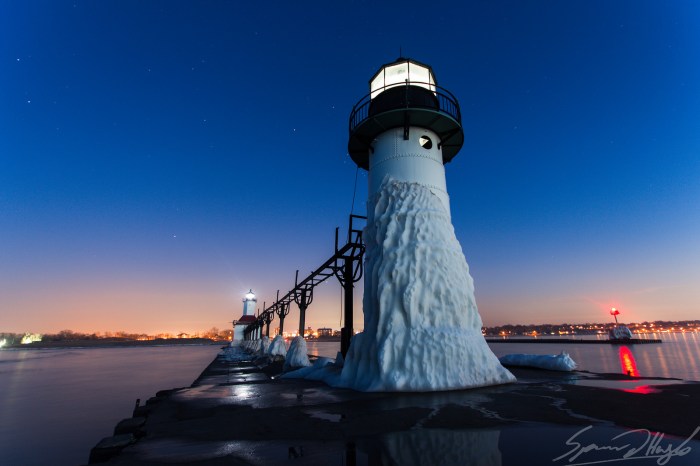
Last Wednesday, I checked the weather and saw something I hadn’t seen in what felt like eons: the possibility for clear night skies. I packed my gear, my cold weather clothes, and food and water, and headed for the coast. I missed the best light in an incredible sunset, but caught the afterglow and the first light of the moon on the lakeshore just south of Empire. While the skies were still cloudy, I headed south into Frankfort to see how the ice was shaping up along the beach. By this time, the winds had died down almost entirely. The water inside the breakwall was very still, the forming ice chattered, and tiny waves sloshed against the icebergs beached on the sand.
The steamer Ste. Claire represents the typical propeller-driven excursion steamer of the turn of the century, a type once found in many parts of the country. Excursion steamers are steamships built primarily for passengers for day trips. Ste. Claire and her running mate Columbia represent the “ocean-going” type of excursion vessel although they were used on lakes.
The steamer Columbia and Ste. Claire are the last two remaining classic excursion steamers in the country; and the last essentially unaltered passenger ships designed by Frank E. Kirby; and for their essentially unaltered propulsion machinery of a type becoming increasingly rare ; as the two last vessels of the Detroit and Windsor Ferry Co.; as two of the few surviving vessels built by the Detroit Dry Dock Company, and for their unaltered propulsion machinery, which is of a rare type. Columbia is the oldest passenger steamer in the United States, excepting vessels properly classed as ferries. Columbia and her running-mate Ste. Claire are the last two steamers of their type with integrity left in the United States. The pair shared their original run from Detroit to Bob-Lo Island for 81 years, a record of service on a single run unequalled in U. S. history
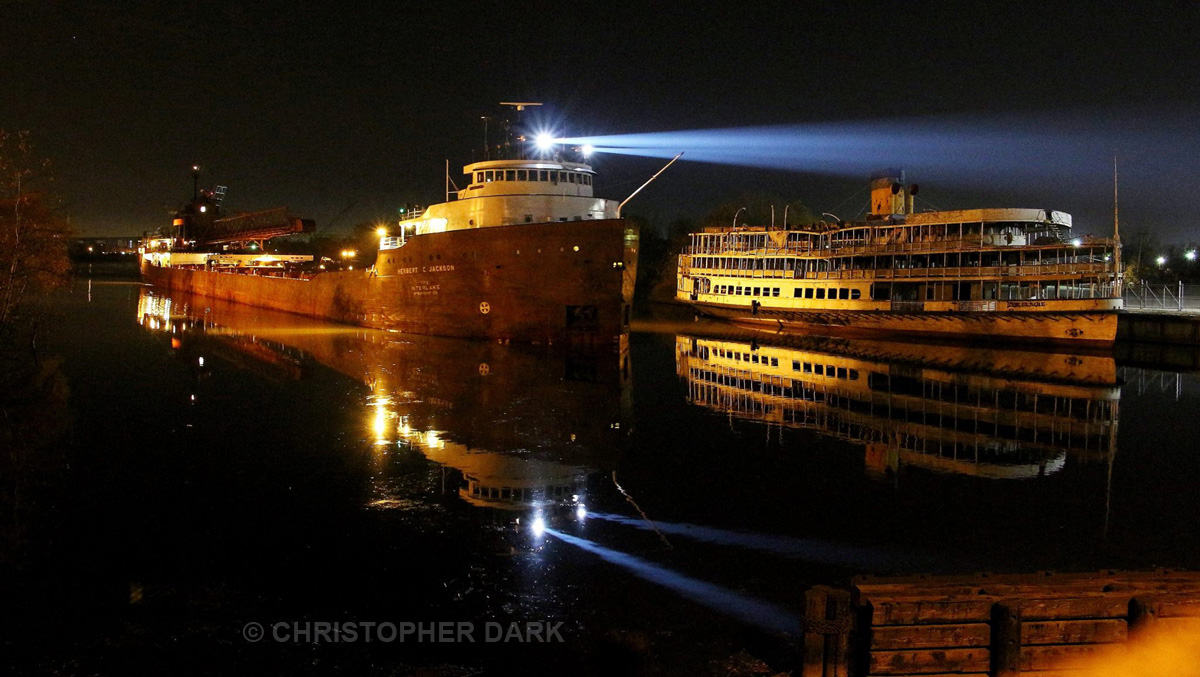
Christopher got this great shot of the Herbert C Jackson upbound on the Rouge River as she passed the Ste. Claire. Click to view it bigger and see more of his photos on Facebook.
Well, my farewell tour to Autumn lasted a whole day. What can you do with things to share like this though?
Yesterday NOAA’s Space Weather tipped us off that there was a chance of strong geomagnetic storms producing northern lights. Now NOAA forecasters are saying there’s a good chance of a strong, G3-class geomagnetic storm during the next 24 hours that could bring auroras as far south as southern Michigan and even into Illinois & Ohio! Top that off with clear skies in the forecast and that means EVERYONE in Michigan should make a point to get out to someplace dark tonight for better than average chance of seeing some killer aurora action!
It gets better though! EarthSky shares information about the South Taurid meteor shower that peaks on November 4th & 5th and is underway right now.
The meteoroid streams that feed the South (and North) Taurids are very spread out and diffuse. That means the Taurids are extremely long-lasting (September 25 to November 25) but usually don’t offer more than about 7 meteors per hour. That is true even on the South Taurids’ expected peak night. The Taurids are, however, well known for having a high percentage of fireballs, or exceptionally bright meteors. Plus, the other Taurid shower – the North Taurids – always adds a few more meteors to the mix during the South Taurids’ peak night. In 2015, the slim waning crescent moon coming up before dawn will not seriously obtrude on this year’s South Taurid meteor shower. The South Taurids should produce their greatest number of meteors in the wee hours – between midnight and dawn – on November 5. Remember, it’ll be possible to catch a fireball or two!
Late night November 12 until dawn November 13, 2015, the North Taurids
Like the South Taurids, the North Taurids meteor shower is long-lasting (October 12 – December 2) but modest, and the peak number is forecast at about 7 meteors per hour. The North and South Taurids combine, however, to provide a nice sprinkling of meteors throughout October and November. Typically, you see the maximum numbers at around midnight, when Taurus the Bull is highest in the sky.
Read on for info about where to look for the best chance – short answer is to the east between midnight and dawn!
Ken writes:
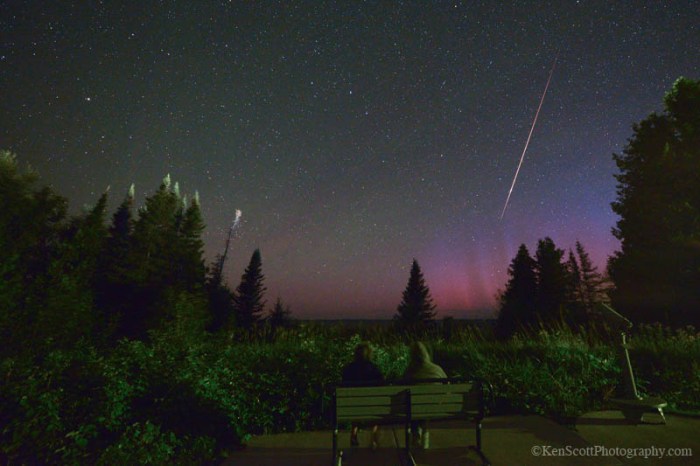
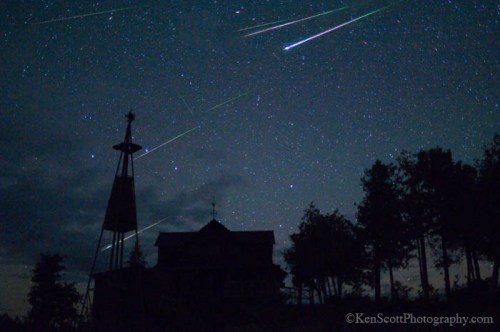
My friend Annette came up for a visit from Detroit and I wanted to show her some Perseid Meteors, so I got permission to work in the Grand Traverse Lighthouse Park after dark (thank you folks!) and well, we got more than we bargained for … a 4+ second fireball and unknown to us because they were hid by the trees and very dim … Aurora Borealis!!
and did I mention 2 ISS flybys!!
She paraphrased ‘we don’t see this in Detroit’ . . .
It was a good eve
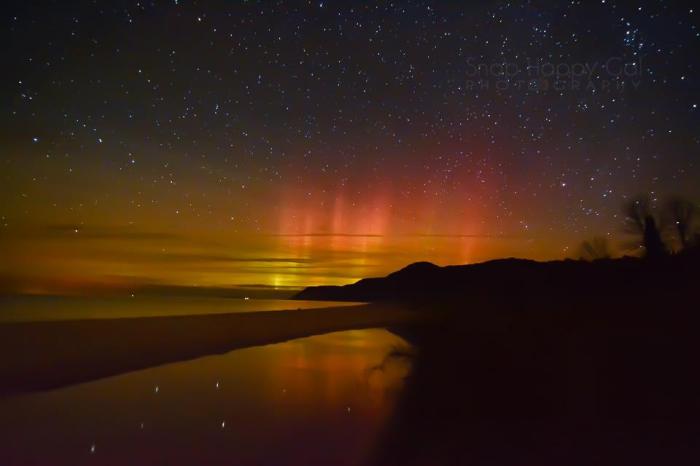
This is one shot from an incredible video that Heather made of the northern lights as seen from Esch Road Beach in the Sleeping Bear Dunes National Lakeshore. That’s Otter Creek in the foreground.
Keith’s Moon Names page says that the October full moon was known as the Hunter’s Moon by Colonial Americans, the Harvest Moon by the Cherokee and ancient Celts and the Blood Moon in Medieval England.
The Farmer’s Almanac says that October’s moon is full on the 27th at 8:05 AM and adds:
Many moons ago, Native Americans named this bright moon for obvious reasons. The leaves are falling from trees, the deer are fattened, and it’s time to begin storing up meat for the long winter ahead. Because the fields were traditionally reaped in late September or early October, hunters could easily see fox and other animals that come out to glean from the fallen grains. Probably because of the threat of winter looming close, the Hunter’s Moon is generally accorded with special honor, historically serving as an important feast day in both Western Europe and among many Native American tribes.
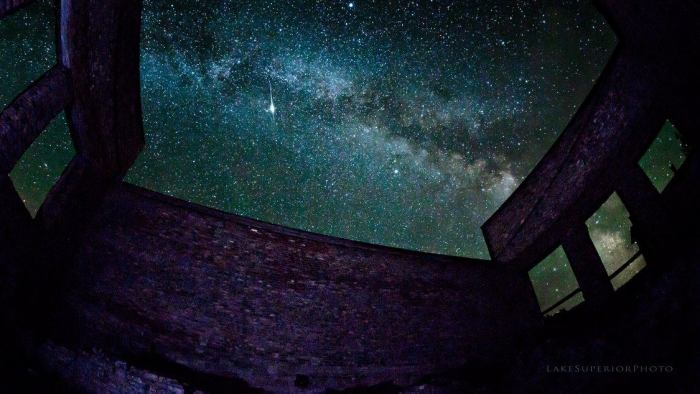
The annual Perseid Meteor Shower peaks August 11-13 and is the closest thing to a sure thing in when you’re talking meteor showers. The Perseids kick out 10+ meteors per hour at peak, and the darker your setting, the more you will see. EarthSky has detailed tips & diagrams about this summer favorite in Everything you need to know: Perseid meteor shower:
Start watching in the second week of August, when the Delta Aquarid meteor shower is rambling along steadily, reliably producing meteors each night. Then keep watching in the second week of August, when the Perseids are rising to a peak. The Perseid shower is known to rise gradually to a peak, then fall off rapidly afterwards. In early August (and even through the peak nights), you’ll see them combine with meteors from the Delta Aquarid shower. Overall, the meteors will be increasing in number from early August onward, and better yet, the moonlight will diminish until the new moon on August 14, 2015.
Don’t rule out early evenings. As a general rule, the Perseid meteors tend to be few and far between at nightfall and early evening. Yet, if fortune smiles upon you, you could catch an earthgrazer – a looooong, slow, colorful meteor traveling horizontally across the evening sky. Earthgrazer meteors are rare but most exciting and memorable, if you happen to spot one. Perseid earthgrazers can only appear at early to mid-evening, when the radiant point of the shower is close to the horizon.
As evening deepens into late night, and the meteor shower radiant climbs higher in the sky, more and more Perseid meteors streak the nighttime. The meteors don’t really start to pick up steam until after midnight, and usually don’t bombard the sky most abundantly until the wee hours before dawn. You may see 50 or so meteors per hour in a dark sky.
An open sky is essential because these meteors fly across the sky in many different directions and in front of numerous constellations. If you trace the paths of the Perseid meteors backward, you’d find they come from a point in front of the constellation Perseus. But once again, you don’t need to know Perseus or any other constellation to watch this or any meteor shower.
Read on at EarthSky for lots more and I hope you get a chance to enjoy Michigan after dark this week – it’s worth it!!
View Ken’s August 2012 composite of 8 meteors taken over an hour at the Grand Traverse Lighthouse on Cathead Bay bigger, see more in his massive Skies Above slideshow and head over to Ken Scott Photography on Facebook for a Perseids photo from last night!
PS: You can see a timelapse clip from this night on YouTube too!



 Michigan in Pictures