
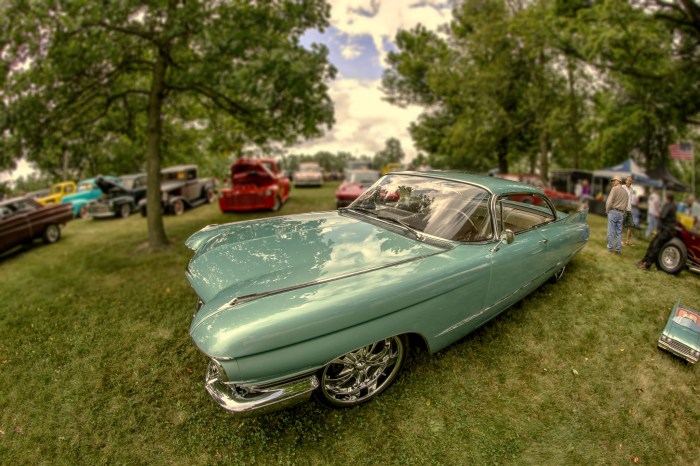
Cadillac, photo by Gregg Mulholland
View the photo background bigtacular and see more in Gregg’s seriously cool Crystal Car Show slideshow.
Cadillac, photo by Gregg Mulholland
View the photo background bigtacular and see more in Gregg’s seriously cool Crystal Car Show slideshow.
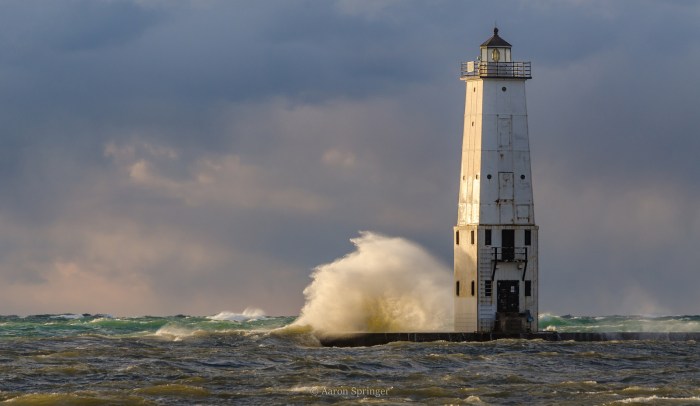
Mr. Brightside, photo by Aaron Springer
The Frankfort North Pier Head Light marks the entrance to Betsie Lake. It’s a popular fishing spot, but on Friday afternoon as UpNorthLive reports, a fisherman learned to pay a little more attention to his surroundings:
The Coast Guard says the man was fishing when the weather picked up. He then became stuck on the pier due to crashing waves over the break wall. The Coast Guard was notified by the Benzie County Central Dispatch around 9:25 p.m.
Coast Guard Station Frankfort then launched a 25-foot response boat, a small crew and a Coast Guard Air Station Traverse City MH-60 jayhawk helicopter crew. The response boat arrived on scene first and confirmed the man was on the wall. The boat could not help with the rescue due to the shallow water.
The Coast Guard says the MH-60 helicopter crew hovered over the lighthouse on the pier and lowered a rescue swimmer who then basket-hoisted the man to safety with no injuries before flying to Frankfort Dow Memorial Airport where local EMS were standing by.
Click through for more including a video of the man and the pier taken from the Coast Guard helicopter.
View the photo bigger and see more in Aaron’s slideshow.
More from the Frankfort Light on Michigan in Pictures.

Sunflowers Galore, photo by Shawn Jenks
If you’re a fan of sunflowers, it’s your season! I love seeing fields bursting with sunflowers as I’m out and about this time of year.
View the photo background bigilicious and see more in Shawn’s slideshow.
More summer wallpaper on Michigan in Pictures.
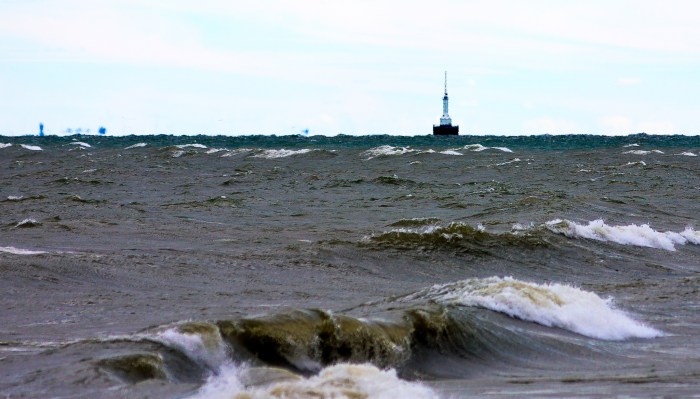
Gravelly Shoals offshore Light in Saginaw Bay, photo by George Thomas
The entry on Gravelly Shoal Light at Terry Pepper’s Seeing the Light begins:
Point Lookout juts from the shore on the western shore of Lake Huron, approximately half-way between the mouth of the Saginaw River and Tawas Point. With only five to eighteen feet above it, Gravelly Shoal extends some 3 miles southeasterly from Point Lookout towards Big Charity Island. To help guide down-bound vessels headed for Saginaw Bay through the deeper water lying between the southeast end of Gravelly Shoal and Big Charity Island, Congress appropriated $5,000 to construct a lighthouse on the northwestern shore of Big Charity on August 18, 1856. Work began at the site that year, but as a result of being started so late in the season, the station was not completed and lighted until the following year.
Perhaps as a result of its exposed location, or as a result of its keeper’s dwelling being one of the few of wooden frame construction on any of the Great Lakes, the station was a constant source of maintenance problems, and was not surprisingly one of the first to be automated through the installation of an acetylene illumination system in 1900. At this time an occulting white Pintsch gas buoy was also placed at the southeastern end of Gravelly Shoal to better mark the western edge of the passage between the shoal and Big Charity Island.
As a result of the combination of increasing vessel size, improvements in offshore light construction and the growing adoption of radio direction finding equipment, it became plain in the late 1930’s that the old Charity light and the gas buoy on Gravelly Shoal had outlived their usefulness, and consideration turned to the construction of a state-of-the-art offshore aid to navigation at the eastern end of Gravelly Shoal to better mark the deeper water of the passage.
View the photo background big and see more in George’s Lighthouses slideshow.
More Michigan lighthouses on Michigan in Pictures.
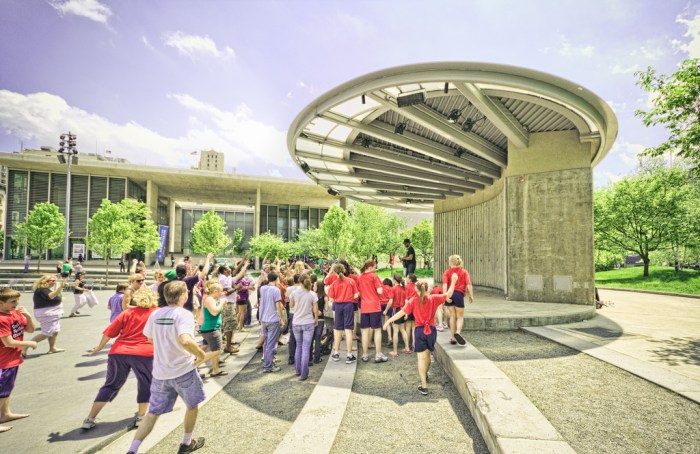
Grand Rapids Lip Dub – Rosa Parks Circle, photo by Gary Syrba
Tina Jones couldn’t believe I didn’t share the groundbreaking Grand Rapids Lip Dub of American Pie yesterday and neither could I! It was filmed in May of 2011 for Experience Grand Rapids by Scott Erickson Films and produced & directed by Rob Bliss. The YouTube page thanks a bunch of people involved and dedicates it to the late Roger Ebert, who loved movies and even named the GR LipDub “The Greatest Music Video Ever Made.” Rob (who is the musician on stage in the photo above) writes:
The Grand Rapids LipDub Video was filmed May 22nd, 2011 with 5,000 people, and involved a major shutdown of downtown Grand Rapids, which was filled with marching bands, parades, weddings, motorcades, bridges on fire, and helicopter take offs. It is the largest and longest LipDub video, to date.
This video was created as an official response to the Newsweek article calling Grand Rapids a “dying city.” We disagreed strongly, and wanted to create a video that encompasses the passion and energy we all feel is growing exponentially, in this great city. We felt Don McLean’s “American Pie,” a song about death, was in the end, triumphant and filled to the brim with life and hope.
If you know Grand Rapids and the people who were making it vibrant in 2011 – many who continue today – you’ll definitely see some friends. In any case – what fun!!
View the photo bigger and see more in Gary’s In the City (Grand Rapids) slideshow.

Doing it again this summer, photo by Kevin Povenz
If Asian carp ever get into the Great Lakes, fun in boats as shown above could well be a thing of the past. These invasive fish jump out of the water when disturbed by noise and vibrations. With an average weight of 30-40 pounds and some weighing in over 100 pounds, they can cause injury or death to boaters.
The Freep reports that a plan tentatively recommended by the Army Corps of Engineers to keep Asian carp from the Great Lakes would cost $275 million plus annual costs for maintaining and operating it of nearly $20 million a year:
Of all the options considered by the Army Corps for blocking the advance of Asian carp at the Brandon Road Lock and Dam in Joliet, Ill., the tentatively selected plan was the most expensive. It would use noise to block the fish, along with an electric dispersal barrier, water jets, a flushing navigation lock and more.
…The plan, however, doesn’t guarantee success: The Army Corps estimated the species known as Asian carp would still have a 10%-17% probability of becoming established in the Great Lakes, down from 22%-36% if no action was taken.
The Corps estimated that closing the navigation lock altogether would have the greatest likelihood of stopping bighead carp and silver carp — the two invasive species that are known as Asian carp — from reaching Lake Michigan, bringing the probability down to 1%-3%. But the cost to inland shippers and the companies they serve would be in the hundreds of millions of dollars with some shippers going out of business.
I hate to be a jerk, but PUT THOSE SHIPPERS OUT OF BUSINESS. Asian carp in the Great Lakes would be a disaster* and seriously impact BILLIONS OF DOLLARS in wages tied to the health and recreational value of the Great Lakes.
View the photo bigger and see more in Kevin’s slideshow.
*Don’t take my word for it. Jet skiing or pleasure boating anyone? Note that this video is 3 years old and also is PG-13 for language.
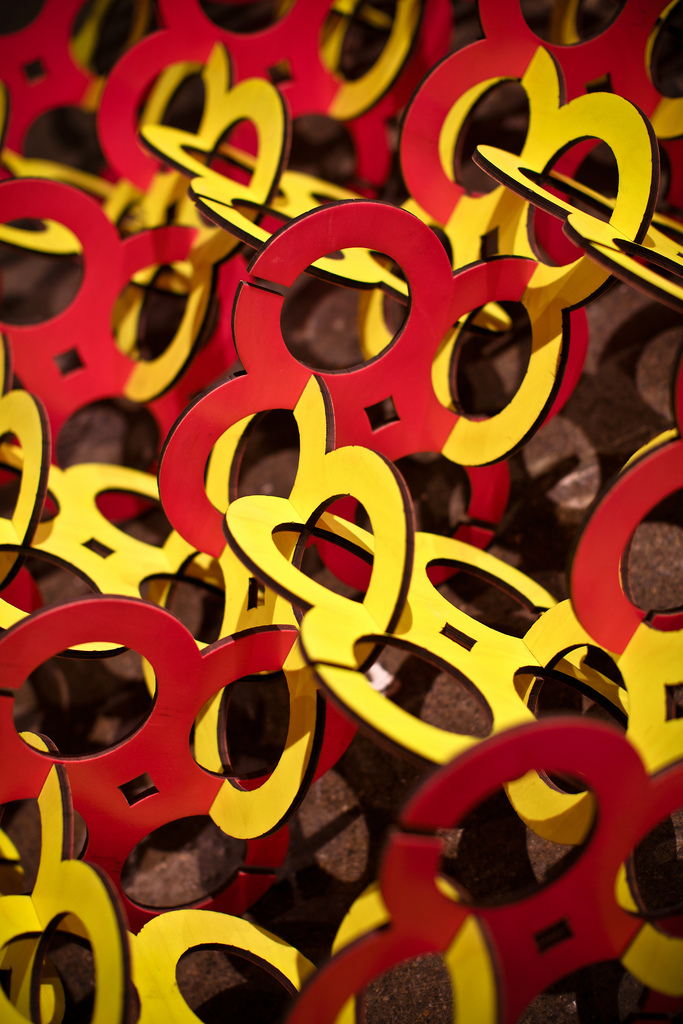
figure eights, photo by Terry Johnston
In the event that there aren’t enough 8s for you on this August 8th, here’s a whole bunch more from the Urban Institute for Contemporary Arts in Grand Rapids.
View the photo bigger and see more in Terry’s UICA slideshow.
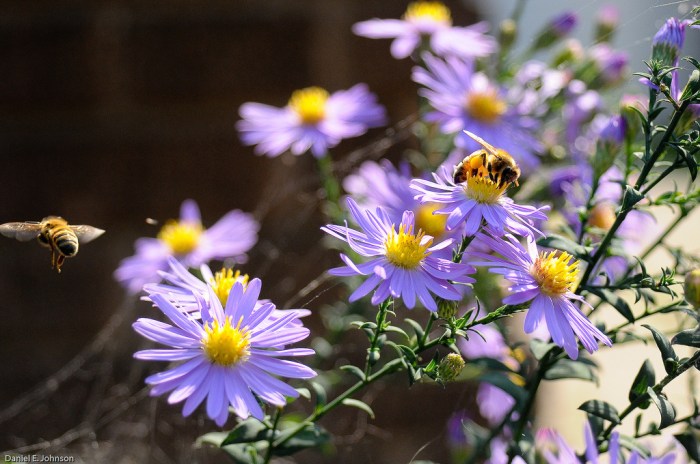
Around the Bend, photo by Daniel E. Johnson
The Traverse City Record-Eagle reports that the number of Michigan honey bee colonies is on the rise:
The number of honey bee colonies in Michigan rose about 16 percent over the last year. About 25,000 colonies existed at the beginning of 2016 in a census of operations with five or more colonies, according to the National Statistics Service of the United States Department of Agriculture. The comparable number on Jan. 1, 2017, was 29,000 colonies.
Varroa mites were the primary stressor of Michigan colonies over the last five quarters. They affected only 5.9 percent of the state’s bee colonies in the first quarter of 2016, but 64.1 percent of colonies in the third quarter of 2016. The Varroa mite is an external parasite that attaches to bees and weakens them.
The total number of bee colonies in the U.S. sank slightly during 2016, but held relatively steady at about 2.62 million colonies.
Colony Collapse Disorder symptoms were observed in more than 84,000 bee colonies in the U.S. from January through March 2017, a 27% increase from the same quarter of 2016.
View Daniel’s photo bigger and see more in his slideshow.
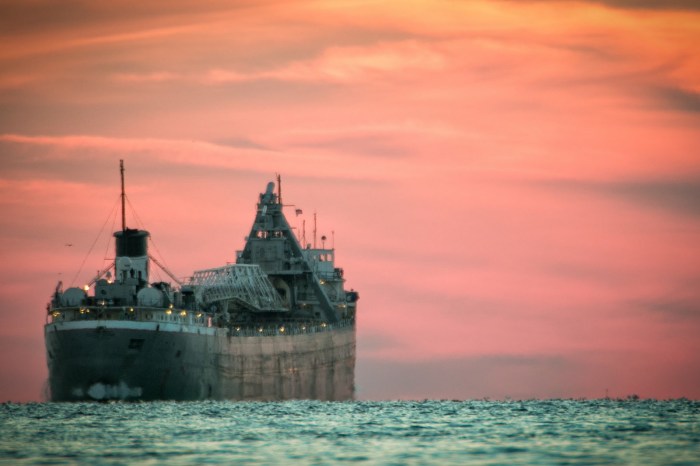
Into the Sunrise, photo by Tom Hughes
The sun rose on Lake St. Clair at about 6:30 AMthis morning. If you were there, maybe you were lucky enough to see something like Tom’s photo of the Cuyahoga headed into the sunrise. If not, at least we can be happy that there’s folks like him willing to get up and out for incredible shots like this.
Have a great weekend everyone!
View the photo bigger and see more in Tom’s slideshow.
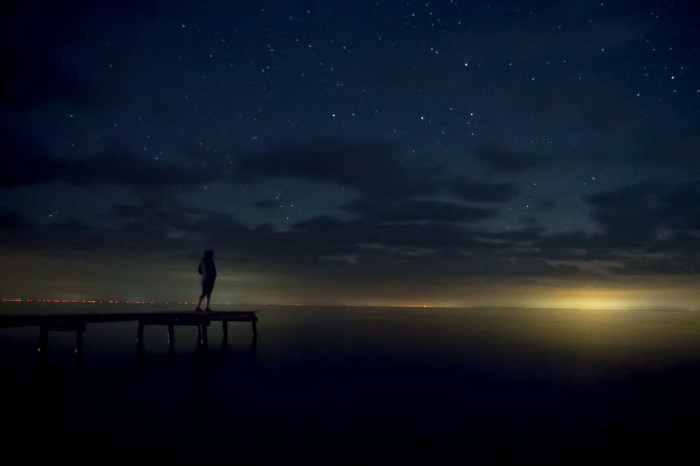
While the lights of distant Bay City across Saginaw Bay from Point Lookout make for a beautiful photo, I feel for the photographer who wishes they’d shut them off at night.
If you’re interested in making your community more “night friendly” check out How to Start a Local Dark Skies Group from the International Dark Sky Association. In addition to miles and miles in the UP, Michigan has six designated Dark Sky Preserves and the Headlands International Dark Sky Park.
View the photo background big and see more in kare hav’s Pt. Lookout/AuGres slideshow.
 Michigan in Pictures