Join the Golden Boy at the annual Marche du Nain Rouge

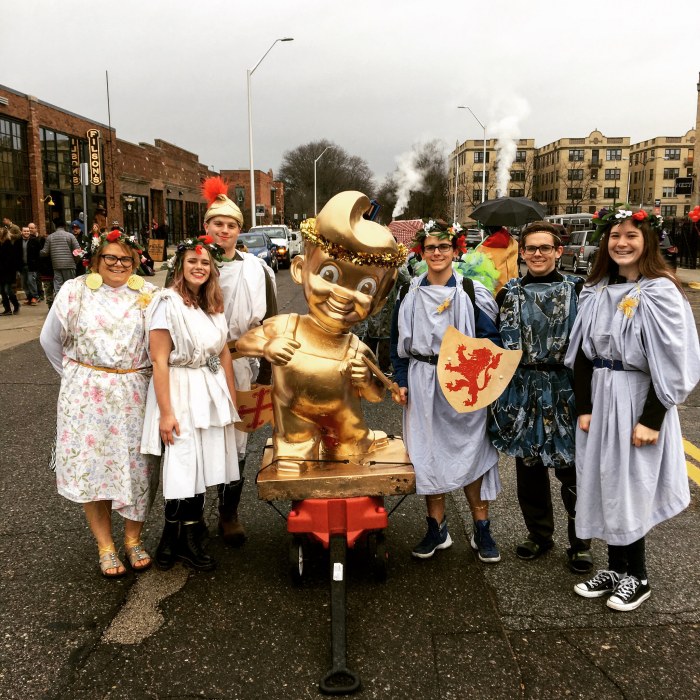
All Hail the Golden Boy!, photo by Andrew McFarlane

I’ve featured the annual Marche du Nain Rouge for years on Michigan in Pictures, but last year was the first time I ever attended. Even on a cold & rainy day, thousands of people turned out for what is unquestionably one of the coolest parades I’ve ever been a part of. My favorite parade group was certainly these folks, who would loudly intone “All hail the Golden Boy” as the walked.

The Marche du Nain Rouge takes place in two weeks – Sunday, March 25, 2018 along the Cass Corridor in Detroit. You can get all the details about the Marche du Nain Rouge on Facebook and read more about this incredible event & the chilling tales of the Red Dwarf of Detroit on Absolute Michigan.

I was more wandering with the parade than photographing, but you can see a lot more including videos in my 2017 Marche du Nain Rouge set on Flickr!

History of the Nain Rouge (courtesy the Marche du Nain Rouge)

In 1701, legendary founder of Detroit Antoine de la Mothe Cadillac met a fortune-teller, who warned him to beware of the Nain Rouge, the “Red Dwarf” who appeared to Cadillac in a dream. She warned Cadillac that the the little red imp is the embodiment of his ambition, anger, pride, envy — everything that held him back. The Nain Rouge, she told him, is the harbinger of doom. However, when Cadillac first saw the fiend in person, the Nain taunted him mercilessly and Cadillac chased the Nain away with a stick.

Unfortunately, the fortune turned out to be true and Cadillac died penniless after he left Detroit for France. The city he founded, however, fared better, endured and prospered (mostly), against the fiendish efforts of the Nain Rouge.

For 300 years, Detroiters memorialized Cadillac’s actions and willingness to persevere and hope for better things, combined with the determination to rise from the ashes. At Detroit’s worst moments, the Nain has been there, cackling or taunting the city’s residents. And so every year, Detroiters celebrate liberation from the Nain, a new beginning, and whatever is good and working in the city in a spring festival for the good and betterment of the city of Detroit.

March 3, 1875: Mackinac National Park

The National Parks Traveler has a great article by Bob Janiskee titled
Pruning the Parks: Mackinac National Park (1875-1895)
that says (in part):

Though few people seem to know or care, Michigan’s long-ago abolished Mackinac National Park was America’s second national park. Yellowstone got there first, but not by much.

On March 1, 1872 President Ulysses S. Grant signed a law establishing that Yellowstone would forever be “dedicated and set apart as a public park or pleasuring ground for the benefit and enjoyment of the people.” Yellowstone thus became the first true national park in America and the world. What few people seem to know is that Congress created a second national park just three years later. Michigan’s Mackinac National Park, which existed from 1875 to 1895, is the “forgotten” national park.

…Despite a location well removed from the main population centers of the Midwest, Mackinac Island was well served by Great Lakes steamers and became a significant summer resort after the Civil War. The island developed a tourism-based economy and a reputation for being a “healthy” place (though not a cheap one) in which to relax and reenergize in scenic surroundings. By the late 1800s the island had acquired several large hotels and a number of large Victorian homes (called “cottages”) built by wealthy summer residents. The resident population remained small due to the harsh winter climate of the place. There were still only about three dozen residences on the island in 1895.

Island-born U.S. Senator Thomas W. Ferry (1827-1896), whose parents ran the island’s mission school, was concerned that Mackinac Island would end up in private hands and be subjected to development that would ruin its scenic-historic character and slow paced lifestyle. Not long after Yellowstone National Park was established in 1872, Ferry began gathering political support for making a large part of Mackinac Island a national park as well.

It was tough going for several years, not least because Congress was loathe to spend money on parks and the island’s scenic and geologic attractions were not jaw-dropping wonders on a par with those of Yellowstone. Ferry finally prevailed, however, and Congress established Mackinac National Park with legislation that President Ulysses S. Grant signed into law on April 15, 1875. The enabling legislation was virtually identical to that used to create Yellowstone National Park in 1872.

This was a deal done on the cheap. Most of Mackinac Island was already federal property, and the park itself was small. Most importantly, Congress gave the park to the War Department to administer. That meant that soldiers from the Fort Mackinac garrison could be used for the requisite operation and policing of the park.

The arrangement actually worked quite well. The Fort Mackinac command gave serious attention to its park-related responsibilities, and although park superintendents irritated island business interests by nixing some inappropriate development proposals, islanders generally appreciated that their economic interests were best served by protecting the park’s scenery, geologic features, and historic landscape.

Mackinac National Park lasted just 20 years. In the 1890s the Army proposed to abandon Fort Mackinac, an action that would leave the park without a custodian. Alarmed at the prospect, Michigan governor John T. Rich petitioned Congress to turn the park over to the state of Michigan. This was done in 1895. Mackinac Island State Park, reportedly the first state-operated park in this country to be officially titled a “state park,” remains a Michigan state park to this day.

Read more at the National Parks Traveler and learn about this 1936 replica of Fort Holmes from Mackinac State Historic Parks.

The Michigan UFO Craze of March, 1966

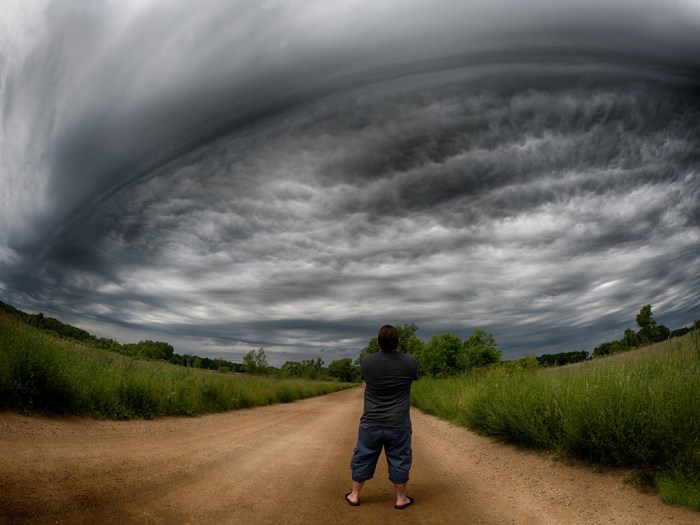
The UFO Show by Jamie MacDonald

The UFO Show by Jamie MacDonald

The UFO Show, by Jamie MacDonald

WDIV Local 4 / ClickOnDetroit shared a feature on the Michigan UFO Craze of 1966:

In 1966, a string of seemingly odd occurrences in Washtenaw County drew the attention of the entire country. The events centered on a sudden wave of UFO sightings, with reports by police and citizens in March 1966. The same lights were spotted by officers in Ohio, just across the Michigan border, and by observers at Selfridge Air Force Base. The sightings triggered investigations by the Civil Defense and U.S. Air Force.

A few days following the first reports, the lights were spotted again at various locations around Washtenaw County, with one deputy reporting something floating in the sky – described as looking like a “child’s top.”

On Sunday, March 20, 1966, the sheriff’s office received reports of a UFO landing in a wooded, swamp area of Dexter Township. Police spoke to Frank Mannor, a truck driver who had gone into the swamp with his son. Here’s what Mannor told police:

“We got to about 500 yards of the thing,” Mannor told interviewers. “It was sort of shaped like a pyramid, with a blue-green light on the right-hand side and on the left, a white light. I didn’t see no antenna or porthole. The body was like a yellowish coral rock and looked like it had holes in it—sort of like if you took a piece of cardboard box and split it open. You couldn’t see it too good because it was surrounded with heat waves, like you see on the desert. The white light turned to a blood red as we got close to it and Ron said, ‘Look at that horrible thing.’”

More from Click on Detroit.

More cool clouds from Jamie right here on Flickr and definitely follow MacDonald Photo on Facebook!

Here’s a part of one hour UFO special with Walter Cronkite from 1966:

Breaking up the band

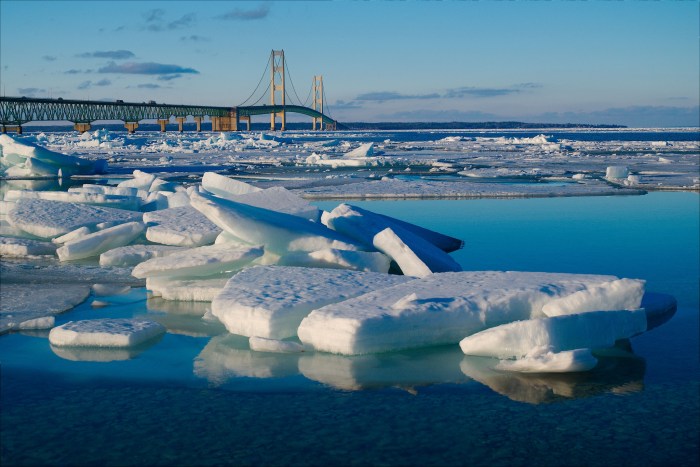
Ice at the Mackinac Bridge, photo by Kent Babb

Winter’s grip on Michigan is slipping early all over including at the Straits of Mackinac.

View Kent’s photo background bigilicious and see more in his photostream on Flickr.

Lots more from the Mackinac Bridge on Michigan in Pictures!


Walking on Water, Michigan Style

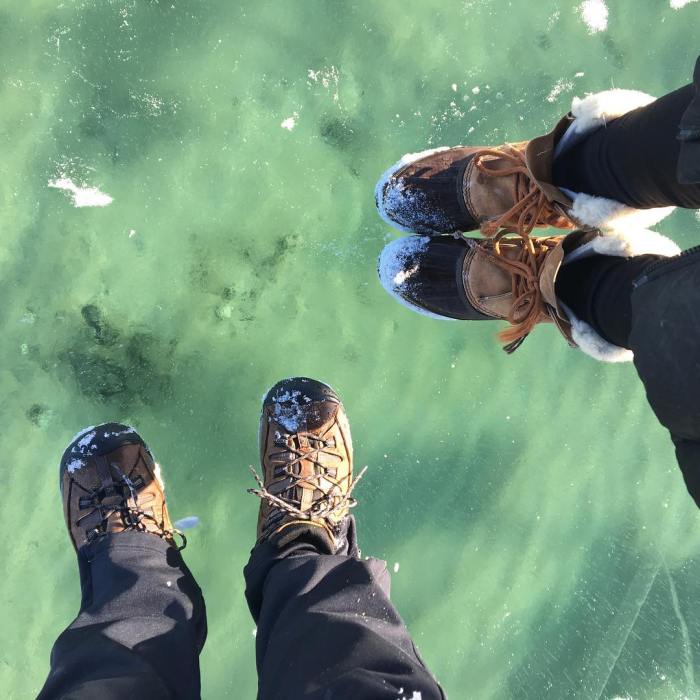
Walking on Water, Michigan Style by Andrew McFarlane

Here’s a shot I took while standing on the amazingly clear ice on Lake Michigan’s Suttons Bay on last Saturday with my sweetheart! mLive liked it enough to share in their article about Grand Traverse Bay freezing over (Suttons Bay is a “sub-bay” of GT Bay – here’s a map):

“Back in the early to mid-1900s the bay froze 80-90% of the time,” said Heather Smith, Grand Traverse baykeeper for the center. “Around 1990, ice cover dropped to 20-30%.”

This winter is the eighth time Grand Traverse Bay has frozen over since 1990.

The frozen conditions likely extend far beyond Power Island, at least close to shore. Last weekend, ice boaters, ice fishermen and people walking their dogs flocked to the frozen surface of Suttons Bay for some winter fun.

Grand Traverse Bay is divided neatly by Old Mission Peninsula into its East Arm and its West Arm. Its East Arm runs north of Elk Rapids, while its West Arm includes the popular Power Island and extends to Suttons Bay.  From there, the bay curves around the Leelanau Peninsula where it merges with Lake Michigan.

Happy Valentines Day everyone!!

#TBT: Beating the Winter Blues

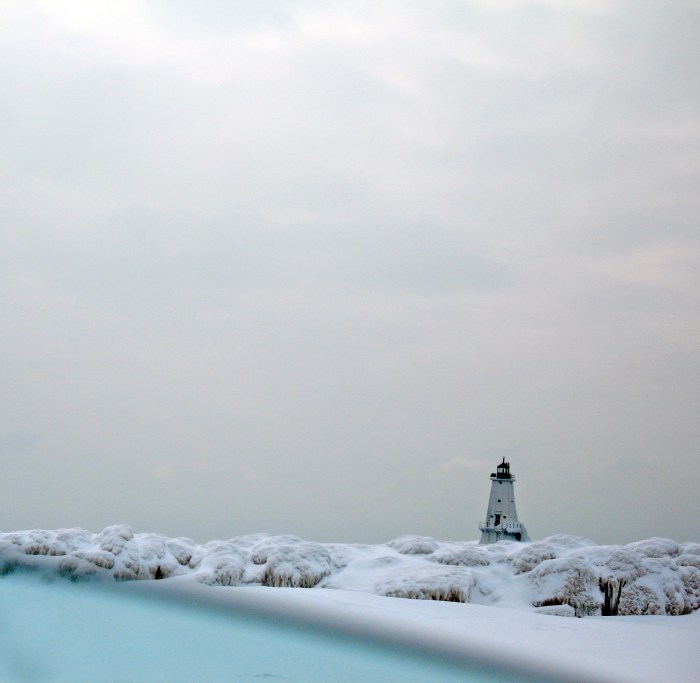
Winter Blues by simply, Diann.

If you’ve followed Michigan in Pictures for a long time, you’ll recognize this photo of the Ludington North Breakwater Light from 10 years ago. I love the photo so much that I thought I’d bring it back for an encore.

If you click the link above, you can read about the lighthouse, and if you head over to The Atlantic, you can learn about how Scandinavian countries are combatting seasonal affective disorder (SAD):

First described in the 1980s, the syndrome is characterized by recurrent depressions that occur annually at the same time each year. Most psychiatrists regard SAD as being a subclass of generalized depression or, in a smaller proportion of cases, bipolar disorder.

Seasonality is reported by approximately 10 to 20 percent of people with depression and 15 to 22 percent of those with bipolar disorder. “People often don’t realize that there is a continuum between the winter blues—which is a milder form of feeling down, [sleepier and less energetic]—and when this is combined with a major depression,” says Anna Wirz-Justice, an emeritus professor of psychiatric neurobiology at the Center for Chronobiology in Basel, Switzerland. Even healthy people who have no seasonal problems seem to experience this low-amplitude change over the year, with worse mood and energy during autumn and winter and an improvement in spring and summer, she says.

Why should darker months trigger this tiredness and low mood in so many people? There are several theories, none of them definitive, but most relate to the circadian clock—the roughly 24-hour oscillation in our behavior and biology that influences when we feel hungry, sleepy or active. This is no surprise given that the symptoms of the winter blues seem to be associated with shortening days and longer nights, and that bright light seems to have an anti-depressive effect. One idea is that some people’s eyes are less sensitive to light, so once light levels fall below a certain threshold, they struggle to synchronize their circadian clock with the outside world. Another is that some people produce more of a hormone called melatonin during winter than in summer—just like certain other mammals that show strong seasonal patterns in their behavior.

Read on for some of their solutions – maybe you’ll find some ideas if you suffer from SAD. I will say that I’ve found regular hikes and walks during the daylight hours in wintertime are key!!

Diann writes What I’m really wondering is whether or not its a good idea to edit out the blue shadows that often show up in winter shots when the sun is behind the camera. She offers this shot for comparison and discussion. She also has a bunch more photos of Ludington’s lighthouse.

Sunrise, Moonset

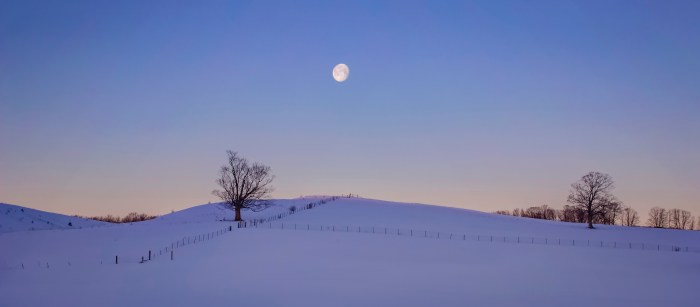
A Winter Morning and a Setting Moon, by TP Mann

He writes:

The moon was setting over this snowy hill on this cold crisp morning. Love the lines of the fences crossing and going up over the hill. A Pure Michigan​ winter scene found along the Breezeway.

Check out more from TP and The Breezeway​!

The Facebook Thing…

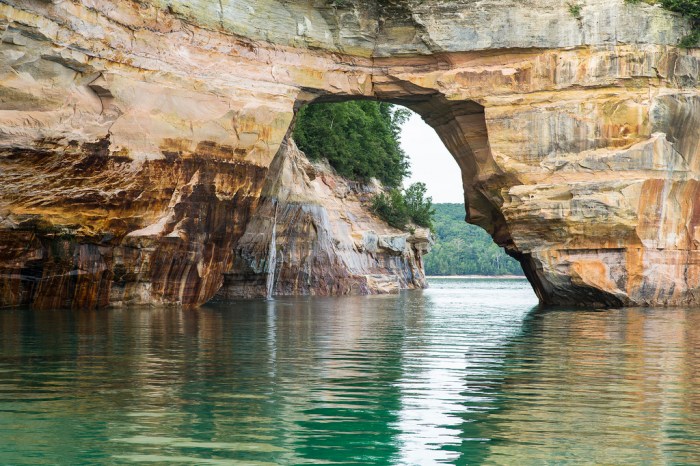
Pictured Rocks by Tudor ap Mac

I wanted to make sure everyone was aware that I’m making periodic updates on the Michigan in Pictures Facebook.

View Tudor’s photo of the Petit Portal in the Pictured Rocks National Lakeshore and a lot more including this stunning panorama in his Upper Peninsula album!

Waterfall Wednesday: Fall at Interstate Falls

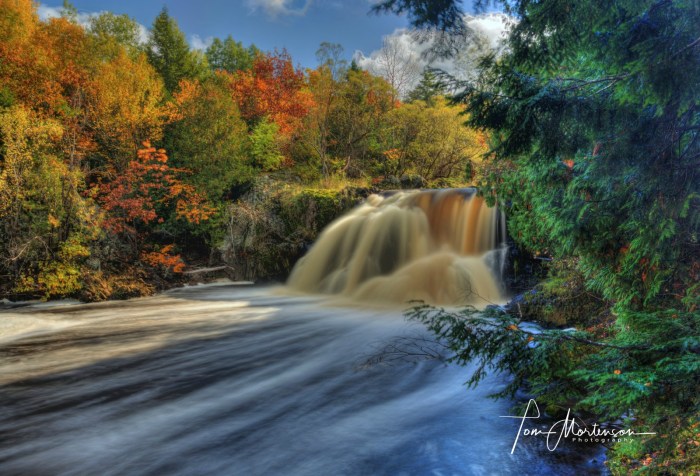
Interstate Falls, photo by Tom Mortenson

GoWaterfalling’s entry for Interstate Falls/Peterson Falls says (in part):

This waterfall is located on the Montreal River just a few miles upstream of Saxon Falls. The Montreal River forms part of the border between Michigan and Wisconsin so the falls is technically in both states, and can be visited from either state, but it is most easily visited from the Wisconsin side.

There seems to be some confusion about what this waterfall is named, or at least I am confused. Some sources refer to this as Peterson Falls, and the sign on the highway says “Peterson Falls”. However others say that this falls is Interstate Falls and that Peterson Falls is a smaller waterfall upstream of Interstate Falls. I have decided to go with Peterson Falls until I learn otherwise.

Read on for directions & more info.

View the photo background big and see more in Tom’s Upper Michigan slideshow.

More waterfalls on Michigan in Pictures and more Fall Wallpaper!

A wink from the Harvest Moon

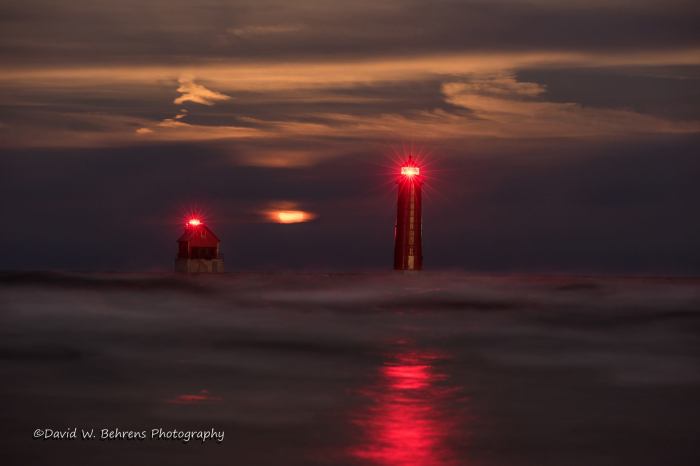
With A Wink The Full Moon Sets Over Grand Haven, photo by David W Behrens

I watched the full harvest moon set this morning over the Leland Harbor among some clouds, and then saw this photo that David of David W. Behrens Photography shared from Grand Haven, Michigan. Click through to see more pics from David!

The full harvest moon rises tonight at 7:21 PM, so I figured that I would share a bit about the Harvest Moon from a past post on Michigan in Pictures:

EarthSky.org has a nice article about the Harvest Moon that explains that for all its mystique, the Harvest Moon is just an ordinary full moon:

Still, you might think the Harvest Moon looks bigger or brighter or more orange. That’s because the Harvest Moon has such a powerful mystique. Many people look for it shortly after sunset around the time of full moon. After sunset around any full moon, the moon will always be near the horizon. It’ll just have risen. It’s the location of the moon near the horizon that causes the Harvest Moon – or any full moon – to look big and orange in color.

The orange color of a moon near the horizon is a true physical effect. It stems from the fact that – when you look toward the horizon – you are looking through a greater thickness of Earth’s atmosphere than when you gaze up and overhead. The atmosphere scatters blue light – that’s why the sky looks blue. The greater thickness of atmosphere in the direction of a horizon scatters blue light most effectively, but it lets red light pass through to your eyes. So a moon near the horizon takes on a yellow or orange or reddish hue.

…The shorter-than-usual time between moonrises around the full Harvest Moon means no long period of darkness between sunset and moonrise for days in succession. In the days before tractor lights, the lamp of the Harvest Moon helped farmers to gather their crops, despite the diminishing daylight hours. As the sun’s light faded in the west, the moon would soon rise in the east to illuminate the fields throughout the night.

You can read on for more.