Waterfall Wednesday: Michigan Mystery Waterfall Edition

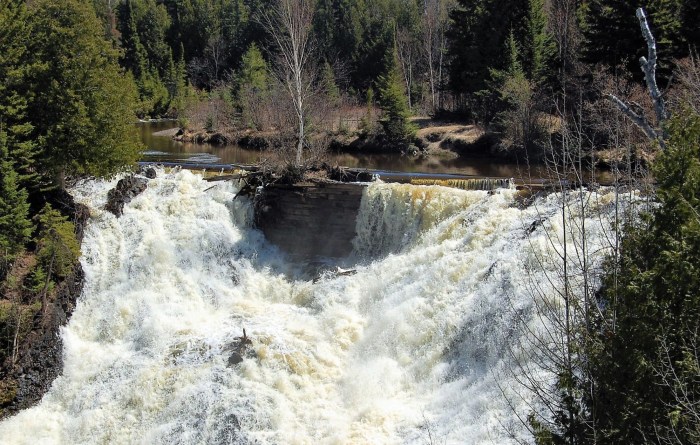
Keweenaw Waterfall

Keweenaw Waterfall, photo by Paula Liimatta

When I come across a waterfall photo that I can’t place, I have three places I turn:

  1. GoWaterfalling.com – hands down the best resource for waterfalls of Michigan and the Great Lakes region (with a few others scattered in for good effect). The author delivers concise descriptions, photos of the falls and accurate directions with maps and tips for hundreds of waterfalls.
  2. Waterfalls of the Keweenaw – this site was created by Jacob Emerick and has information, directions and beautiful photos for 200 Michigan waterfalls, in the Keweenaw and beyond. Sorry for getting  Jacob’s name wrong!!
  3. Waterfalls on Michigan in Pictures – there are over 100 Michigan waterfalls profiled on Michigan in Pictures.

I have my ideas as to which waterfall this is – any guesses? Post them in the comments!

Paula took this last April on the Keweenaw when spring snowmelt in the U.P. pumps the waterfalls up to incredible levels. View her photo background big and see more including some crazy ice-climbing shots in her slideshow.

Waterfall Wednesday: Quartzite Falls on the Slate River

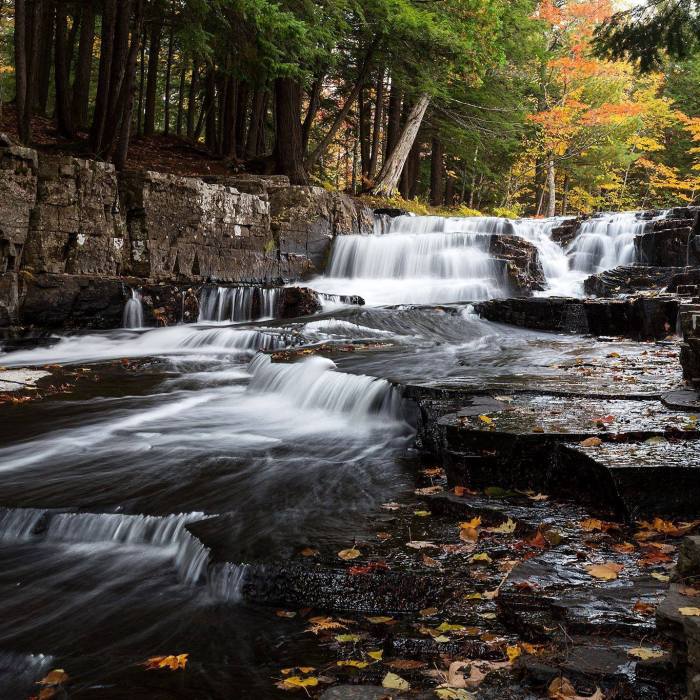
Quartzite Falls on the Slate River

Quartzite Falls on the Slate River, photo by Amie Lucas

Waterfalls of the Keewenaw’s page on Quartzite Falls says:

Quartzite Falls is a perfect little waterfall high above the rugged gorge on Slate River. The river drops in a sudden crescent onto a large, flat slide of slate before flowing into a deep pool surrounded by cedars. Quartzite Falls may be small, but it’s shape and scenic area makes for an amazing waterfall experience.

This waterfall is a short distance downstream of Black Slate Falls, easy walking distance from the road and about a mile from the slate quarries of Arvon. These three areas make for an excellent little adventure that is fairly accessible for all ages.

You can click through for directions and some pics. Amie took this back in October and writes:

The Slate River is magnificent. I spent an entire day traversing over rough, steep terrain & wading through cold water on slippery rocks to visit places that felt like no one had ever been before. Quartzite Falls, one of the many beauties on this river, is one of the easier waterfalls to access.

View her photo background bigilicious, follow her on Facebook and definitely check out her waterfall gallery and others at her photography website!

Many more Michigan waterfalls and (if you can’t let go of autumn) more fall wallpaper on Michigan in Pictures!

Waterfall Wednesday: Wyandotte Falls on the Misery River

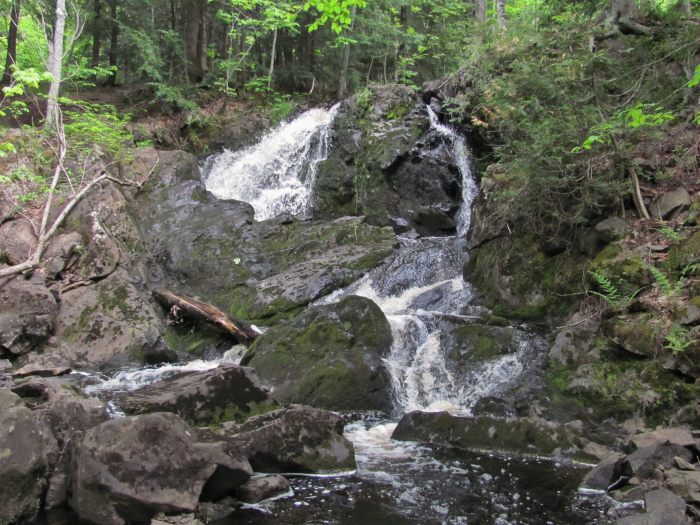
Wyandotte Falls Upper Peninsula

Wyandotte Falls, photo by David Hedquist

Waterfalls of the Keweenaw has this to say about Wyandotte Falls on the Misery River:

Misery River drains Lake Roland and Gerald (aka the Twin Lakes) westwards out to Lake Superior, passing over the small Wyandotte Falls along an otherwise twisted and swampy route. This waterfall is just downstream of a set of ponds next to a small set of cabins and the Wyandotte Hills Golf Course. Nestled in an older grouping of huge cedar trees and surrounded by smooth, moss-covered rocks, this waterfall seems ancient compared to the nearby golf course and state park. Also, due to the twin lakes upstream, Wyandotte Falls is susceptible to a rather large influx of spring melt.

You can click for more including photos and a map.

View David’s photo background big and see more in his Wyandotte Falls slideshow.

Many (many) more Michigan waterfalls on Michigan in Pictures.

The Anvil and the Pine

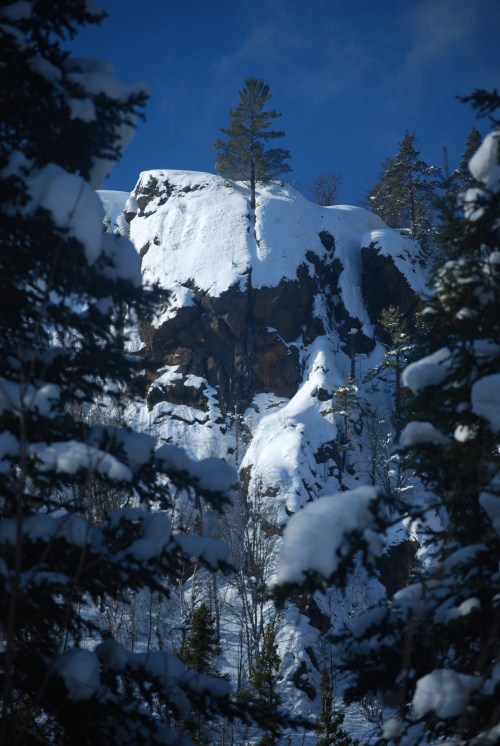
Cliffs from below

Cliffs from below, photo by David Clark

David writes that “The Anvil” is a high point where a white pine somehow makes a living growing out of a crack in the rock. On his blog, Cliffs and Ruins he writes:

This is one of my favorite places along the Cliff range: The Lookout. Apparently different people have different lookouts, but this is what I think of as the Cliff Lookout.

It’s a bit of a hike (no, you don’t have to go straight up the side of the cliffs… but you can if you want), but the view is 100% worth it. You can even see the silhouettes of the Huron Mountains in the distance. The most amazing thing, to me, is that tree — you can see it here. It’s a big old pine growing straight up out of the rock, over the edge of the cliffs.

There’s nothing quite like the solitude at the top of the lookout. When I snowshoed out to the lookout, there weren’t any tracks at all on the trail to the lookout — nor on the trail to the trail! It was one of those feelings which I love when I’m hiking up here — that I’m the first person in years to set foot here and see these sights. It might not be true, but this is still one of my favorite places to go whenever I really need some time alone.

View his photo background bigtacular and see more in his Winter slideshow. You can purchase David’s pics right here.

More winter wallpaper on Michigan in Pictures.

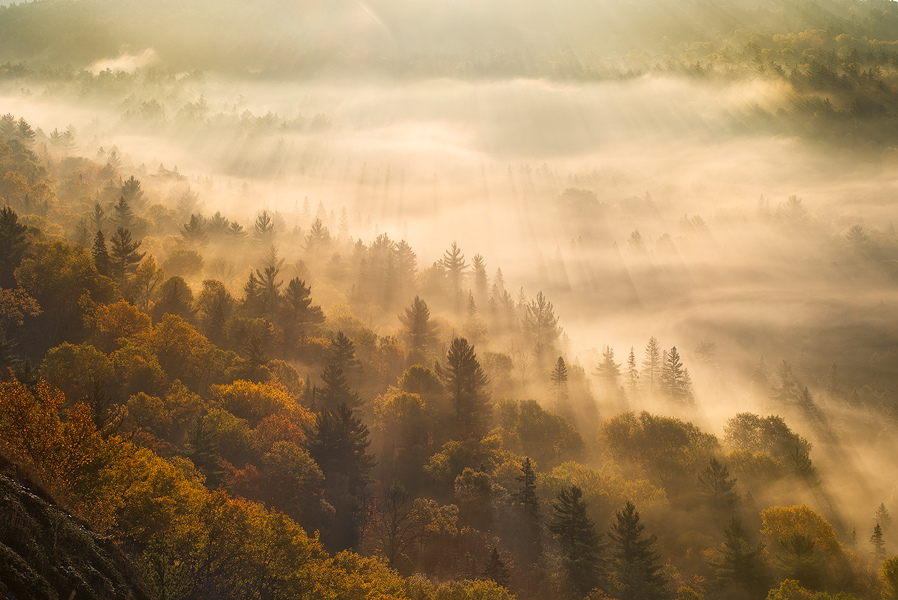
Foggy Morning on Portage Lake and the Tyndall Effect

Foggy morning, photo by Jiqing Fan

Wikipedia says that Portage Lake is part of the Keweenaw Waterway, a partly natural, partly artificial waterway that cuts across the Keweenaw Peninsula to provide access for shipping from Lake Superior. If you click the link you can get an aerial view.

View Jiqing Fan’s photo bigger and see more in his massive Houghton & UP MI slideshow. He writes:

Saw the fog on Lake Portage from my apartment window after I woke up today. I knew the potential this fog can bring so I darted down to the lake shore. But the fog was so heavy that the foliage on the other bank were completely blocked. Just when I was about to give up and head back for school, the fog started to break as the sun rises. And then the magic started to unfold before my eyes. Soon the fog lifted and fill the campus uphill, the entire campus was bathed in soft morning light and there were Tyndall effect everywhere! I can not think of a better way to start a day of work.

What’s the Tyndall effect you ask? The UC Davis ChemWiki explains that the Tyndall effect was identified by 19th Century Irish scientist John Tyndall.

Because a colloidal solution or substance (like fog) is made up of scattered particles (like dust and water in air), light cannot travel straight through. Rather, it collides with these micro-particles and scatters causing the effect of a visible light beam. This effect was observed and described by John Tyndall as the Tyndall Effect.

The Tyndall effect is an easy way of determining whether a mixture is colloidal or not. When light is shined through a true solution, the light passes cleanly through the solution, however when light is passed through a colloidal solution, the substance in the dispersed phases scatters the light in all directions, making it readily seen.

For example, light is not reflected when passing through water because it is not a colloid. It is however reflected in all directions when it passes through milk, which is colloidal. A second example is shining a flashlight into fog or smog; the beam of light can be easily seen because the fog is a colloid.

Yay science!

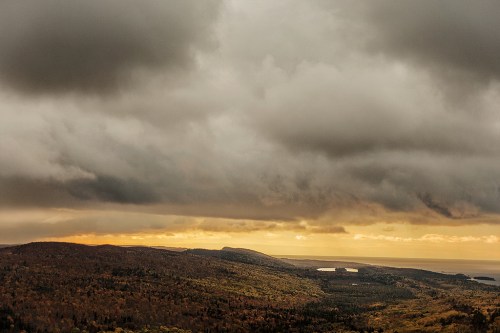
Sunset over the Keweenaw

Sunset over the Keweenaw

Sunset over the Keweenaw, photo by Ashley Williams

Here’s a beautiful shot from late October last year on the Keweenaw Peninsula in the U.P. With temps this cold, it won’t be long until the color returns! Hope you get a chance to get out and enjoy the outdoors this weekend.

View Ashley’s photo background bigtacular and see more in her slideshow. You can also follow her on Facebook or Instagram and visit her photography website.

More from the Keweenaw and more fall wallpaper on Michigan in Pictures.

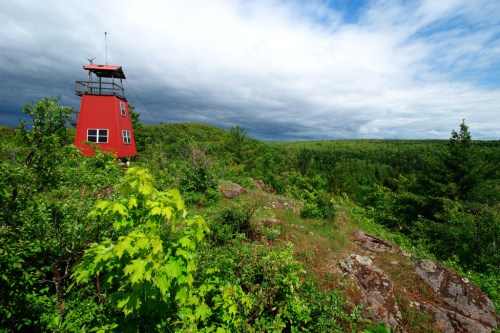
Elmo’s Tower

Elmo's Tower

Elmo’s Tower, photo by David Clark

The things I learn about through Michigan in Pictures! About Elmo’s Tower on the Keweenaw Peninsula David writes:

I was amazed to find that I’ve never posted a photo of Elmo’s Tower. This tower was built — by hand! — by the late Elmo Negro, at a beautiful rock outcrop along the Cliffs. It’s just above the Phoenix mine, and overlooks the Eagle River gap. The tower has no function other than to be a pleasant place to enjoy a day (and have a barbecue).

More about Elmo (who was apparently a great dancer too) at Pasty Central.

View David’s photo background bigtacular and see more in his Summer slideshow.

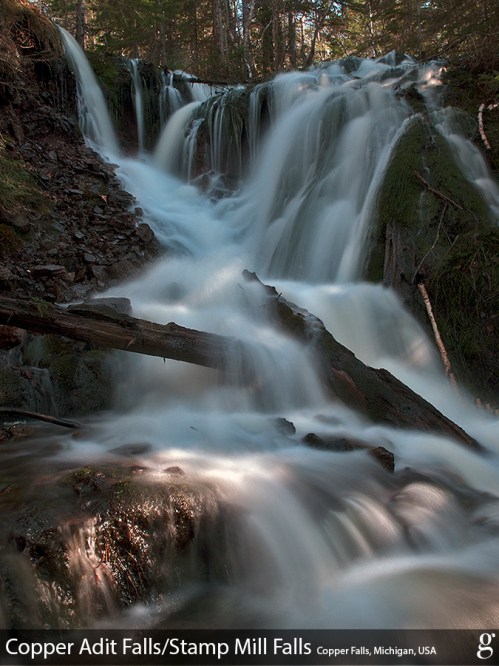
Copper Adit Falls, Stamp Mill Falls at Copper Falls Mine

n2c_113-4482

n2c_113-4482, photo by Gowtham

Gowtham writes:

Established in 1846, Copper Falls mine was a collection of several copper mine shafts and adits (definition below). Owl Creek — in what was once one of the richest fissure veins in the Keweenaw — seems to make a magical (and a seasonal) appearance out of a hillside draining the now closed Copper Falls mine to form this quite spectacular and scenic-looking Copper Adit Falls. With the nearby remnants of an old stamp mill, this waterfall is also known as Stamp Mill Falls.

Citing Wikipedia, an adit is an entrance to an underground mine which is horizontal or nearly horizontal, by which the mine can be entered, drained of water, ventilated, and minerals extracted at the lowest convenient level.

The Copper Country Explorer’s entry on Copper Falls begins:

Stamp Mills relied on two things in order to separate copper: water and gravity. Any stamp mill would be built near a source of water such as a river or lake. It also would be build along a hill, in order to make the greatest use of gravity. Because of this we started our search along the creek that had cut a path through the sands – Owl Creek.

Owl Creek was the lifeblood of the Copper Falls Mine. Steam stamps required water, and along the rugged ridges of the Copper Falls a natural source existed. Fed from atop the ridge by a lake of the same name, Owl Creek drops over 500 feet to the marshlands along Superior’s shore. This creek not only provided water to the mine and mill, but the potential energy stored in its banks could easily turn a water wheel for power (mechanical power, since electricity had yet to be invented). It was a perfect spot for a mill.

Read on for lots more and explore the Copper Falls Mill at with the Copper Country Explorer.

View Gowtham’s photo bigger and see more of his photos from the area on his website.

More waterfalls on Michigan in Pictures!

#michpics

Good Morning Brockway

Good Morning Brockway, photo by Jiqing Fan

Today’s post might win the 2013 Incomprehensible Garbledegook Award…

Almost all of the photos on Michigan in Pictures are those added to the Absolute Michigan pool on the excellent photo sharing site Flickr, with occasional photo posted to the Michigan in Pictures Facebook mixed in. While that’s very convenient for me, there’s a whole  lot of great photos on Twitter and Instagram too.

If you’re interested in sharing your photos and aren’t into Flickr, please feel free to use the “michpics” hash tag: #michpics on Twitter and #michpics on Instagram. If your photo is in some other place, you can tweet it with that hash tag.

Thanks everyone for sharing and I hope you get a chance to enjoy some of Michigan’s beauty this weekend!

Jiqing Fan took some amazing photos this fall. View his shot from Brockaway Mountain on the Keweenaw Peninsula bigger and see more in his slideshow. Past features of Jiqing Fan on Michigan in Pictures.

Support Michigan in Pictures with Patreon

Land of the Lost: Central Mine

land of the lost

land of the lost, photo by Marty Hogan

The Keweenaw Historical Society page on Central Mine and Village explains:

One of the most noteworthy historical sites in Keweenaw County is Central, or Central Mine, a village that once was the home for over 1,200 people, and the site of one Keweenaw’s most successful mines. The mine, opened in 1854, produced nearly 52 million pounds of copper by the time it closed in 1898.

Several miners’ homes and buildings still stand on the site. In 1996, the Keweenaw County Historical Society acquired 38 acres of the old Central site. Some of the residences are being restored, and a Visitors Center provides interpretive exhibits not only about the mine but also about the miners’ families, homes, schools and churches.

Click through for maps, photos and more information about Central and other sites.

Marty took this photo in Engine House No.2 at the Central Mining Company in Central, Michigan. He says that from 1875-1898, it housed the Steam Hoist for Shaft No.2. Check it out background bigtacular and see more in his Central, Michigan slideshow.

There’s a whole lot more from Marty and his travels to some of Michigan’s coolest places that once were on Michigan in Pictures!