Along the West Michigan Pike

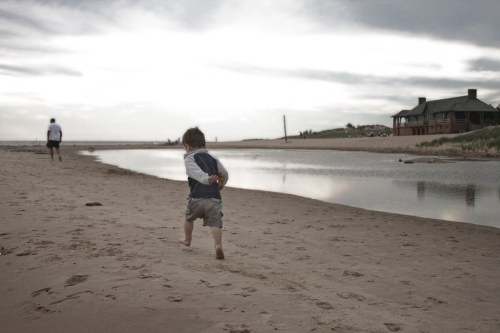
Beach House 2

Beach House 2, photo by Lori Hernandez

Amy Arnold has a cool feature on the West Michigan Pike called Highway to History at Seeking Michigan that says (in part):

You may know it as old M-11, old US 31, the Red Arrow Highway or the Blue Star Highway – all names for a road that was originally called the West Michigan Pike, the first continuous concrete highway in West Michigan. Begun in 1911 as part of a strategy to bring auto tourists from Chicago to Michigan, the road was completed in 1922 and ran from New Buffalo to Mackinaw City.

…In the 1920s, an effort to create a series of connected, safe places for auto travelers to stay resulted in the development of a series of parks along the route, including seven state parks between New Buffalo and Ludington. During the Depression, Ludington State Park was the first state park in Michigan to be constructed by the Civilian Conservation Corps (CCC) and was a showplace for the National Park Service program. The West Michigan Pike was also important in Michigan’s early conservation history. Much of Michigan’s land had been clear cut and abandoned by the lumber industry. The state incorporated highway beautification and reforestation as part of its work to create good roads in Michigan.

Read more at Seeking Michigan, and you can also check out Amy’s historical study of architectural resources along the West Michigan Pike at Michigan Beach Towns. If you’d like to retrace the route, here’s an old flyer with the West Michigan Pike route.

Also, they note that there’s an exhibit titled Yesterday on the West Michigan Pike: Photographs by Vincent J. Musi, that shows the noted National Geographic photographers photos taken along the Pike in 2008. View some right here.

View Lori’s photo background bigtacular and see more in her Ludington State Park slideshow.

More beach wallpaper on Michigan in Pictures!
Three Little Birds

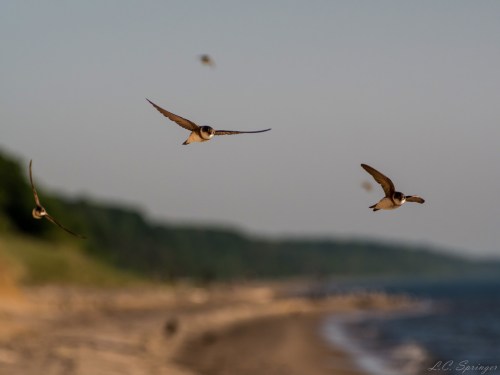
Little Birds

Little Birds, photo by Lance Springer

Want to have a good day? Consider starting it with one of the most upbeat songs I know: Three Little Birds by Bob Marley.

View Lance’s photo bigger and see more in his Great Lakes slideshow.

More Michigan birds on Michigan in Pictures.

Mirror Morning

Hasrot Beach

Haserot Beach, photo by lomeranger

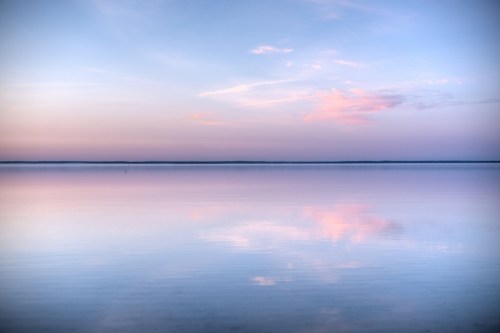
One of the things I love about Spring and early Summer is how calm the water can be.

Jason shot this at 6 AM on the Old Mission Peninsula near Traverse City. View his photo background bigtacular, see more in his Landscapes VII slideshow and purchase it if you wish at his photography website.

There’s more sunrises and more Spring wallpaper on Michigan in Pictures!
Meanwhile, on Miners Beach

Thankful for what we are blessed with here by oni_one

Thankful for what we are blessed with here…, photo by oni_one_

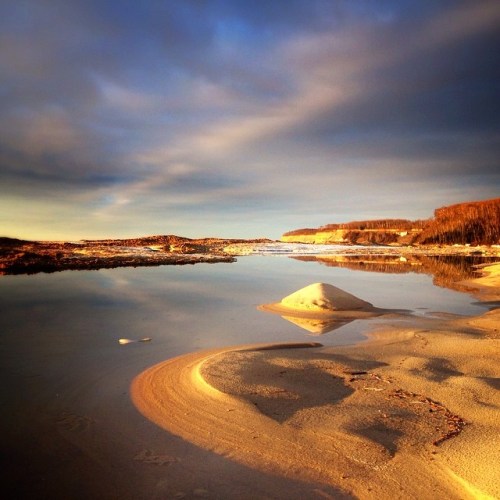
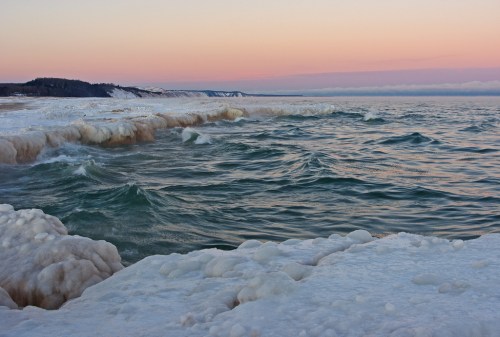
One of the neatest things for me about online photography and social media is how things come together in a synchronistic fashion sometimes. Yesterday, I posted a photo by Shawn Malone from above at Miners Castle of the frozen expanse of Lake Superior. For everyone who wondered what things were looking like at beach level, here you go!

Sarah took this pic yesterday at Miners Beach in the Pictured Rocks. View her photo bigger and see more on her Instagram.

Summer Dreams

Summer Dreams

Summer Dreams, photo by Miss Sydney Marie

Anyone else dreaming of summer?

View Sydney’s photo bigger and see more in her For Sale slideshow and on her website.

More from Michigan’s beaches.

Walking with the Icefoot on Great Lakes beaches

Winter morning on Agate Beach

Winter morning on Agate Beach, photo by Gary of the North(Footsore Fotography)

Ernest W. Marshall talks about a common winter feature along considerable stretches of Great Lakes shorelines, the Icefoot:

Air and water temperatures must be sufficiently low before an icefoot begins to form. The conditions favorable for icefoot formation are broad open shorelines gradually sloping below water level, and facing so that wind-blown spray is carried inland toward the shore to freeze. The character of growth of an icefoot differs during different periods of the winter. During the course of the winter the icefoot may suffer periods of denudation alternating with periods of accretion. The development of an icefoot can be held at one stage by the early freezing of fast ice offshore. An icefoot can be composed of any combination of frozen spray or lake water, snow accumulations, brash, stranded icefloes, and sand which is either thrown up on the icefoot by wave action or is blown out from the exposed beaches.

Observations of the icefoot along the shorelines of Lakes Superior and Erie indicated that the moderately steep portions of the shore were characterized by narrow terraces composed of frozen slush and brash thrown up by storm winds. The outer edge of this icefoot was often cusp-like in form, resulting from the mechanical and melting action of the waves. The inner portions of the cusps acted to concentrate the wave action, forming blowholes which threw spray back on the icefoot.

You can click to read more.

Gary took this photo at one of my favorite places in Michigan: Agate Beach on Lake Superior in Grand Marais, Michigan. In the distance is Grand Sable Dunes and the Pictured Rocks National Lakeshore. View his photo big as Lake Superior and see more in his Grand Marais Michigan slideshow including a shot of a staggeringly huge ice mound!

Lots more Grand Sable Dunes, Pictured Rocks National Lakeshore & winter wallpaper on Michigan in Pictures!
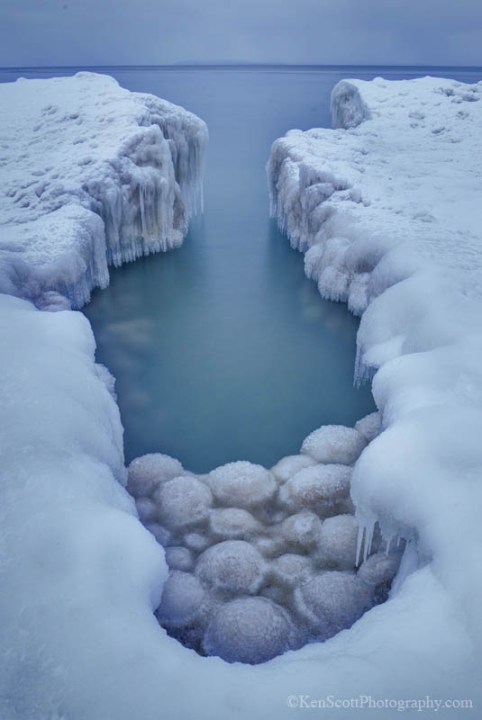
Ice Balls on the Sleeping Bear Lakeshore

Lake Michigan ... ice balls III

Lake Michigan … ice balls III, photo by Ken Scott

You may recall the Lake Michigan ice balls that were seen at the Sleeping Bear Dunes lakeshore last March.  Well, they’re baaaaack. You can see a great video of the ball ice at Accuweather. Here’s the explanation of how balls ice form that I  put together from AIR PHOTO INTERPRETATION OF GREAT LAKES ICE FEATURES by Ernest W. Marshal & Frazil ice at Wikipedia:

Ball ice consists of roughly spherical masses of slush and frazil ice that accrete in turbulent water. Frazil ice is a collection of loose, randomly oriented needle-shaped ice crystals that form in open, turbulent, supercooled water. Lumps that form in the less turbulent zones are typically flattened discs, while those formed in the extremely turbulent zone near the shoreline ice where wave action is strongest form into spheres.

The author explains that ball ice is a feature common to all of the Great Lakes and can occur at any time during the winter where water turbulence breaks up a slush layer. You can read more about this in Great Lakes Ice Features.

View Ken’s photo bigger, check them out in his ice balls slideshow and see this shot with Ken in it for a sense of the scale.

Earth Wind … and Snow

Earth Wind and Snow

Earth Wind and Snow, photo by Beth

One of the lesser known bands of the 70s…

View Beth’s photo from the beach at Holland background bigtacular and see more in her Winter slideshow.

More winter wallpaper on Michigan in Pictures!
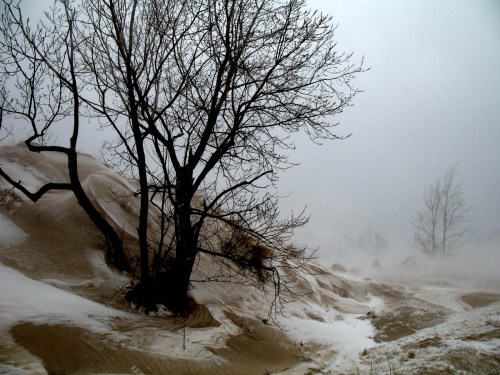
The Coves

The Coves Pictured Rocks

The Coves, photo by Gary of the North(Footsore Fotography)

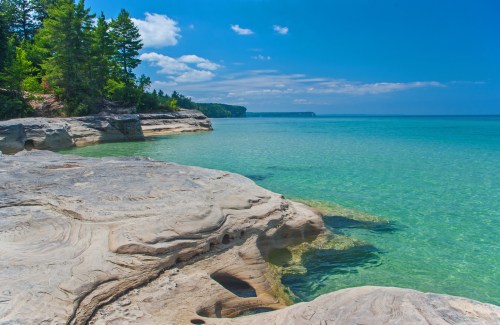
Today’s photo is the latest cover for the Michigan in Pictures Facebook. It was taken at a beach known as The Coves in the Pictured Rocks National Lakeshore and is one of those photos to show your friends who don’t know Michigan.

Check it out background bigtacular and see & purchase more in Gary’s Pictured Rocks gallery at Footsore Fotography.

More great beaches on Michigan in Pictures!

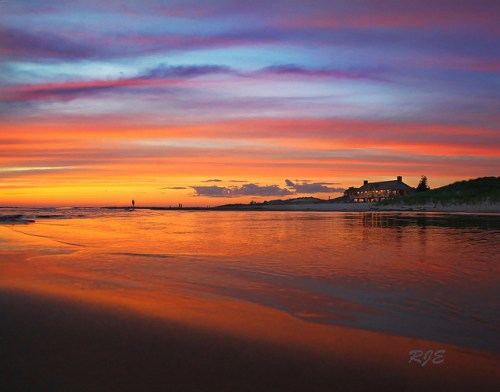
Ludington State Park Beach House

Ludington State Park beachhouse

Ludington State Park beachhouse, photo by R.J.E.

This page from the DNR has a vintage photo of the beachhouse.

Visit Ludington tells a little about the historic Beach House at Ludington State Park.

The Beach House has a long history of weathering the changing Michigan seasons within the Ludington State Park. This landmark has now received a makeover, and it’s a real showplace for the state park system. Built by the Civilian Conservation Corps in 1935, the Lake Michigan Beach at 116 ft. long and 35 ft. wide, has been a familiar sight for visitors to Lake Michigan within the State Park.

…The Lake Michigan Beach House is unique in nature due to the fact it is the only Arts-and-Craft inspired design bathhouse found on the shores of Lake Michigan. Also of significance is the role the CCC played in its construction–from architect Ralph B. Herrick to all the CCC workers who built the Beach House from recycled brick and pressed mortar. This style has not been found at any other state park in Michigan…and it is the largest and most intact of the CCC-built structures within the Ludington State Park.

Check it out background big and see more in R.J.E.’s Ludington, MI slideshow.

More from Ludington on Michigan in Pictures!