Blue Ice at Mackinac

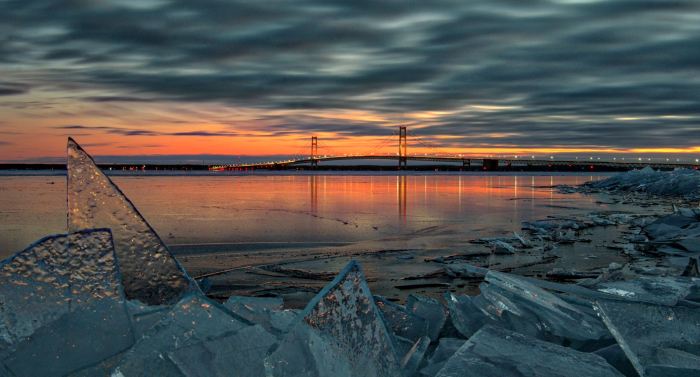
Blue Ice at Mackinac

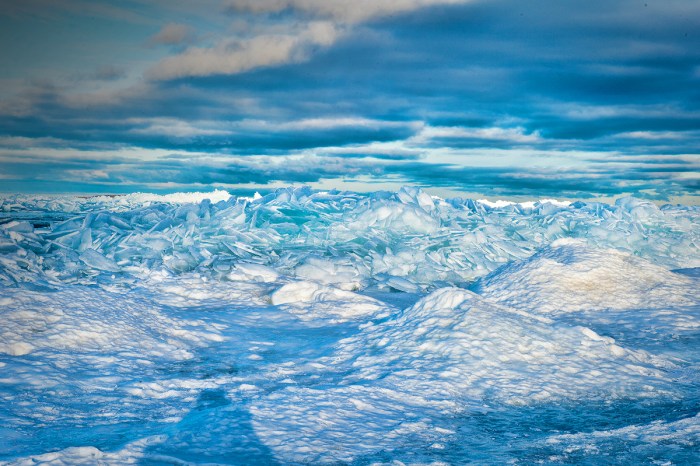
Michigan Winter, photo by Jeff Caverly

I featured this photo yesterday in Five Things you need to know about Michigan on Absolute Michigan. Check the link out for more interesting things including some new revelations about when Gov. Snyder’s senior staff raised concerns about Flint’s water (October 2014) and a look at an innovative approach to tackling urban blight. 

mLive recently reported on blue ice at the Mackinac Bridge. The other day’s post on Michigan in Pictures explained why ice is blue or green. In case you didn’t read it, here’s a bit of that:

As with water, this color is caused by the absorption of both red and yellow light (leaving light at the blue end of the visible light spectrum). The absorption spectrum of ice is similar to that of water, except that hydrogen bonding causes all peaks to shift to lower energy – making the color greener.

…In simplest of terms, think of the ice or snow layer as a filter. If it is only a centimeter thick, all the light makes it through; if it is a meter thick, mostly blue light makes it through. This is similar to the way coffee often appears light when poured, but much darker when it is in a cup.

You can view Jeff’s photo background bigilicious and see more photos of the ice at Mackinac & also Tahquamenon Falls in his slideshow.

More winter wallpaper on Michigan in Pictures.
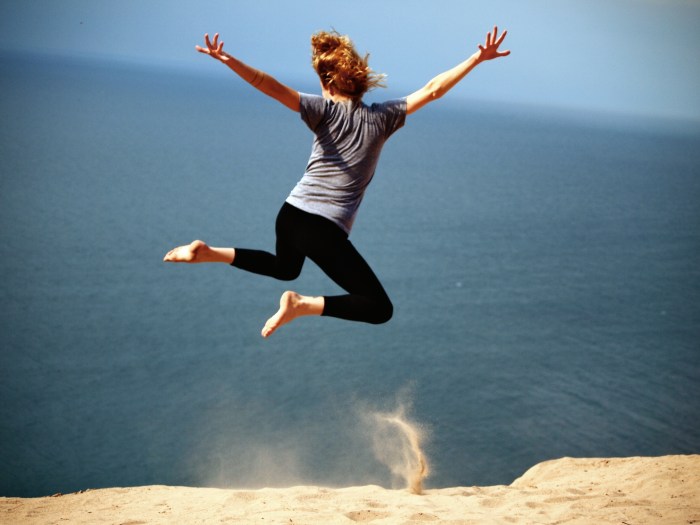
Making the Leap

Leaping off Pyramid Point

Untitled, photo by Todd Richter

Happy Leap Day everyone and here’s hoping that this quadrennial occurrence adds a little fun to your life! Borgna Brunner lays down Leap Year 101:

Leap years are added to the calendar to keep it working properly. The 365 days of the annual calendar are meant to match up with the solar year. A solar year is the time it takes the Earth to complete its orbit around the Sun — about one year. But the actual time it takes for the Earth to travel around the Sun is in fact a little longer than that—about 365 ¼ days (365 days, 5 hours, 48 minutes, and 46 seconds, to be precise). So the calendar and the solar year don’t completely match—the calendar year is a touch shorter than the solar year.

It may not seem like much of a difference, but after a few years those extra quarter days in the solar year begin to add up. After four years, for example, the four extra quarter days would make the calendar fall behind the solar year by about a day. Over the course of a century, the difference between the solar year and the calendar year would become 25 days! Instead of summer beginning in June, for example, it wouldn’t start until nearly a month later, in July. As every kid looking forward to summer vacation knows—calendar or no calendar—that’s way too late! So every four years a leap day is added to the calendar to allow it to catch up to the solar year.

Read on for more and enjoy your day.

Todd took this shot back in August of 2009 at one of my favorite spots for hiking (and jumping) – the Pyramid Point overlook in the Sleeping Bear Dunes National Lakeshore. Lake Michigan is hundreds of feet down a steep bluff from the point where she’s jumping, and many is the person who wished they didn’t run down that bluff after toiling up it!

View Todd’s photo background bigtacular and see more in his digital slideshow.

More dunes on Michigan in Pictures!

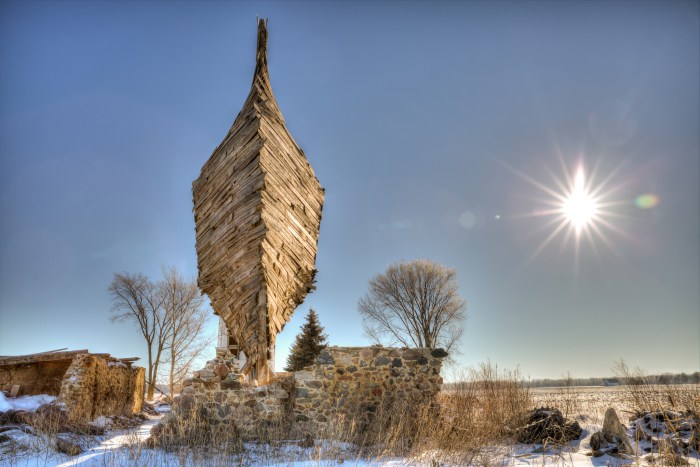
Emergency Ark: The Celestial Ship of the North

Emergency Ark

Emergency Ark, photo by Michael

The Celestial Ship of the North (Emergency Ark), aka the Barnboat, is a site-specific installation and permanent sculpture in Port Austin, Michigan created by Scott Hocking. He wrote to me:

I was asked by Detroiter Jim Boyle, whose family is still in Port Austin, if I’d ever had any ideas of working with old barns. He’s been trying to get a Detroit / Port Austin connection going by bringing artists up there to do projects. I basically told him I’d had some fleeting thoughts about how much certain barns look like overturned ship hulls, and that if I had an old barn to work with, I’d probably turn it into a boat.

So, that was the beginning.

Like all of my work, I try to let the materials and site dictate what I make, and as I worked on the barnboat the shape became what it is now – mostly influenced by the intense winds of Michigan’s thumb. It took about 3 months total, but I’m not quite done yet: I’m still planning to fill in the base with mounded sand this spring for a little extra stability, and so that it can once again overgrow like that ivy covered barn it was made from.

Awesome. Check out lots more of Scott’s engaging work on his website.

Enjoy Michael’s photo background bigtacular on Flickr and see more in his slideshow.

More art and more winter wallpaper on Michigan in Pictures.
Ice on the Straits of Mackinac

Ice in St Ignace

Last week in St. Ignace, photo by Thomas Nighswander

Doesn’t look like we’ll get an ice bridge for snowmobiles to Mackinac Island this winter.

Click to view the photo bigger and follow him on Facebook and at National Photography Workshops.

More ice on Michigan in Pictures.

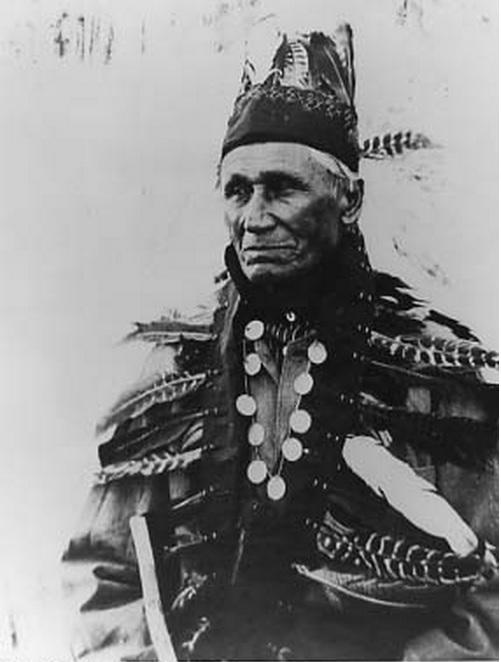
#TBT: Marquette’s Chief Kawbawgam

Chief Kawbawgam

Chief Kawbawgam, photo via Michigan’s Past & Superior View Gallery

Michigan’s Past shares all kinds of great old photos on Twitter. This one shows Chief Kawbawgam, a Chippewa who was reportedly over 100 years old when he died in Marquette in 1903.  According to the January 1903 edition of the The Lake Superior Journal:

Charley Kaw-baw-gam’s long life was brought to a close about 2 o’clock Sunday afternoon, when the old chief passed peacefully away at St. Mary’s hospital at Marquette, where he had been lying ill for the past couple of months.

Charley was one of the best known figures in Marquette, and he enjoyed this distinction from the first day when white men began to frequent the spot where the city was to grow. Charley’s reputation was not local alone. He was known throughout the upper peninsula and even below the straits his name and fame were familiar to many people.

He was an excellent type of the original owners of the soil, and an unusually creditable specimen. He was a full blooded Chippewa and a chief by blood. What is more he was a good Indian, and he lived a good life, according to his lights.

Kaw-baw-gam was also remarked upon time and again for his great age. It is believed that he was over 100 years old at the time of his death.

In 1849 when Peter White first landed on the shores of Iron bay it is well known that the first Indian to greet him and the party of which he was a member was the same chieftain. In the same year 1849, Mr. White, in carrying on a conversation in Chippewa with Charley asked him, for the sake of having something to say, “How old are you, Bawgam?” Charley replying said: “I am fifty. I spent twenty at the Soo; twenty years on the Tonquomenon bay and ten years on the Canadian side.” If Charley spoke the truth on that occasion he was about 103 years of age when he died, and there was no reason to doubt that this was the case. The Indians of his day were a notoriously long lived race and Charley was a find Indian physically, strong, tireless and healthy. Furthermore his countenance was that of a patriarch.

You can see Chief Kawbawgam’s grave in Marquette’s Presque Isle Park.

View the photo bigger and definitely follow @MichiganHist on Twitter for lots more great photos.

More Throwback Thursdays and more portraits on Michigan in Pictures.

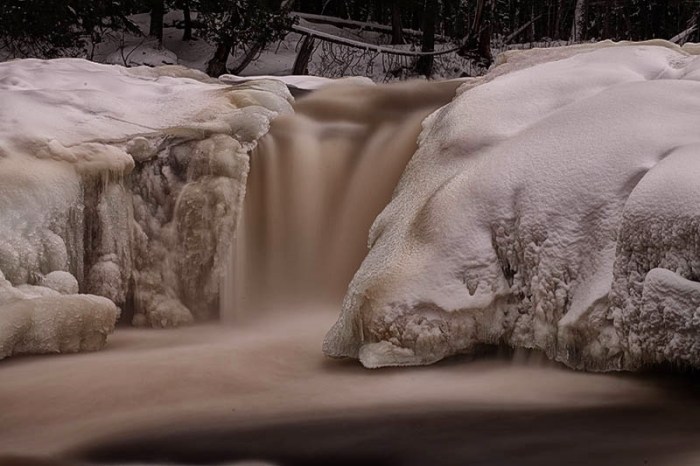
Waterfall Wednesday: Manido Falls in the Porcupine Mountains

Manido Falls Porcupine Mountains Wilderness

Manido Falls, Porcupine Mountains Wilderness, photo by Kirt E. Carter

The Waterfall Record’s page on Manido Falls has directions and some more photos and says:

Manido Falls did not impress me at first, at least not as much as the downstream Manabezho Falls. After seeing the pictures I had taken, though, I discovered what an amazingly beautiful waterfall Manido Falls is. It’s beauty comes from its complexity. The waterfall itself is not very tall at all. It is wide, though. As the Presque Isle River tumbles down toward Lake Superior, it comes to this set of rocks that create a beautifully cascading waterfall. I think what makes me like Manido Falls so much is that the water has taken such an interesting course here, erosion taking its effect in an oddly unique way.

Add to it that the just as spectacular Manabezho Falls is only hundreds of yards away, and Lake Superior not much more distant, this makes for one of the most beautiful waterfall stretches in the Upper Peninsula.

View Kirt’s photo bigger and check out his website for more.

More Michigan waterfalls on Michigan in Pictures!


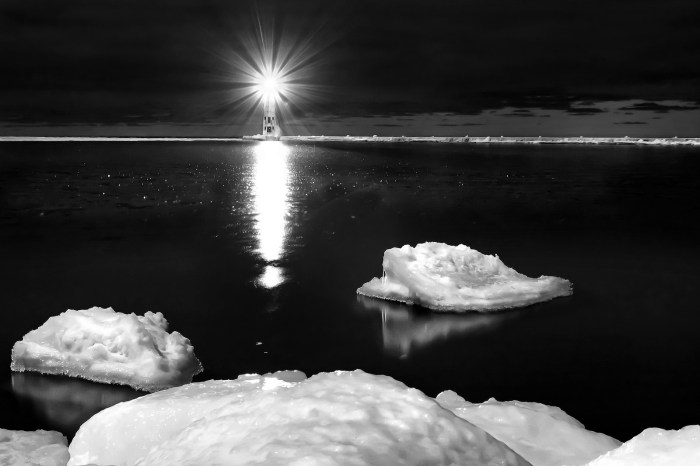
Quiet Night at Frankfort Lighthouse

Frankfort Lighthouse at Night

Quiet Night at Frankfort Lighthouse, photo by Snap Happy Gal Photography

I was going to talk this morning about how I will continue to talk about what I want to talk about on Michigan in Pictures, but then I saw this awesome photo by Heather. I’m sure you get the idea.

On her Snap Happy Gal blog where you can view & purchase some great lighthouse photos, Heather writes:

I think of myself as a serendipitous shooter: I go out to scenes in all kinds of light – the good, the bad, even the ugly – and I take photos. Sometimes I walk away with artwork worth sharing, and sometimes I just walk away with happy memories. I don’t often stalk a scene for the best light, I don’t think of myself as having a favorite thing to photograph, and I don’t find that I’m predictable (even I don’t know when or where I’ll be heading out to shoot until I get the itch). But, lately, if you wanted to catch me out and about, you’d look at northern Michigan’s west coast lighthouses.

I’ve visited every one of them from Manistee up to Northport (though I didn’t take the camera out), and I’ve been there from sunrise to sunset, and well into the night.

Last Wednesday, I checked the weather and saw something I hadn’t seen in what felt like eons: the possibility for clear night skies. I packed my gear, my cold weather clothes, and food and water, and headed for the coast. I missed the best light in an incredible sunset, but caught the afterglow and the first light of the moon on the lakeshore just south of Empire. While the skies were still cloudy, I headed south into Frankfort to see how the ice was shaping up along the beach. By this time, the winds had died down almost entirely. The water inside the breakwall was very still, the forming ice chattered, and tiny waves sloshed against the icebergs beached on the sand.

Read on for the rest, view & comment on her picture on Facebook, and definitely follow Snap Happy Gal for great pics of lighthouses and much more.

More about the Frankfort North Breakwater Light on Michigan in Pictures.

Another Day, Another Mass Shooting

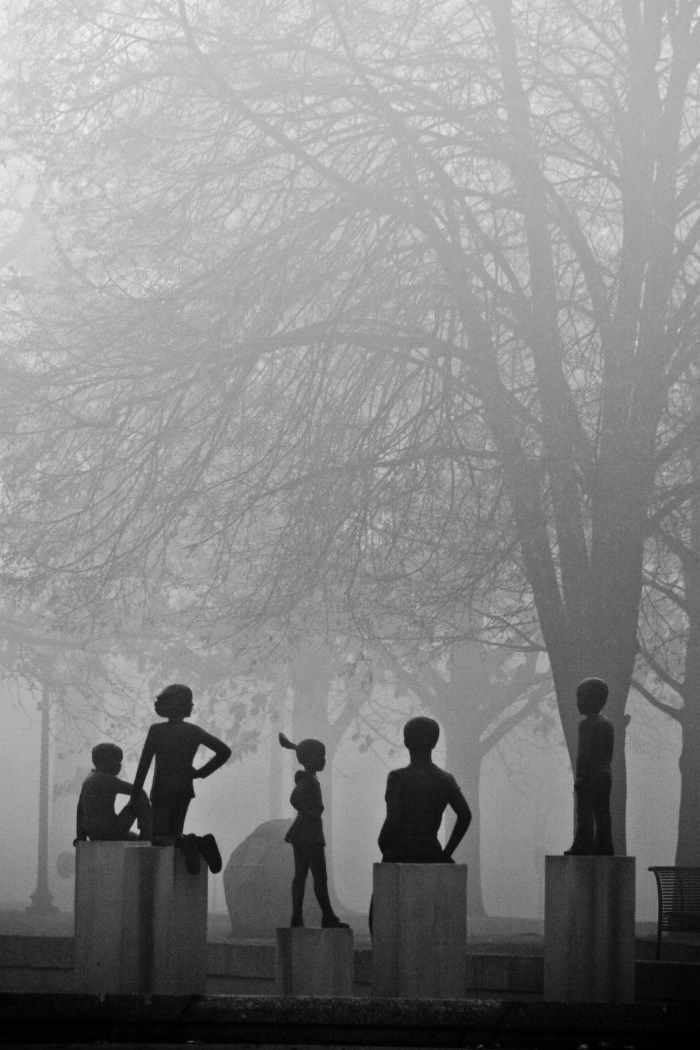
Something in the Air

Something in the Air, photo by Brian Wolfe

Another day, another mass shooting – this time in Kalamazoo, Michigan. Beyond right and left, can we all agree that we need to figure out why we’re the only nation in the world who has this tragic problem and work on actually addressing this problem?

I’m guessing bolstering our gutted mental health system is a great place to start.

View Brian’s photo from Kalamazoo’s Bronson Park background big and see more in his Black & White slideshow.

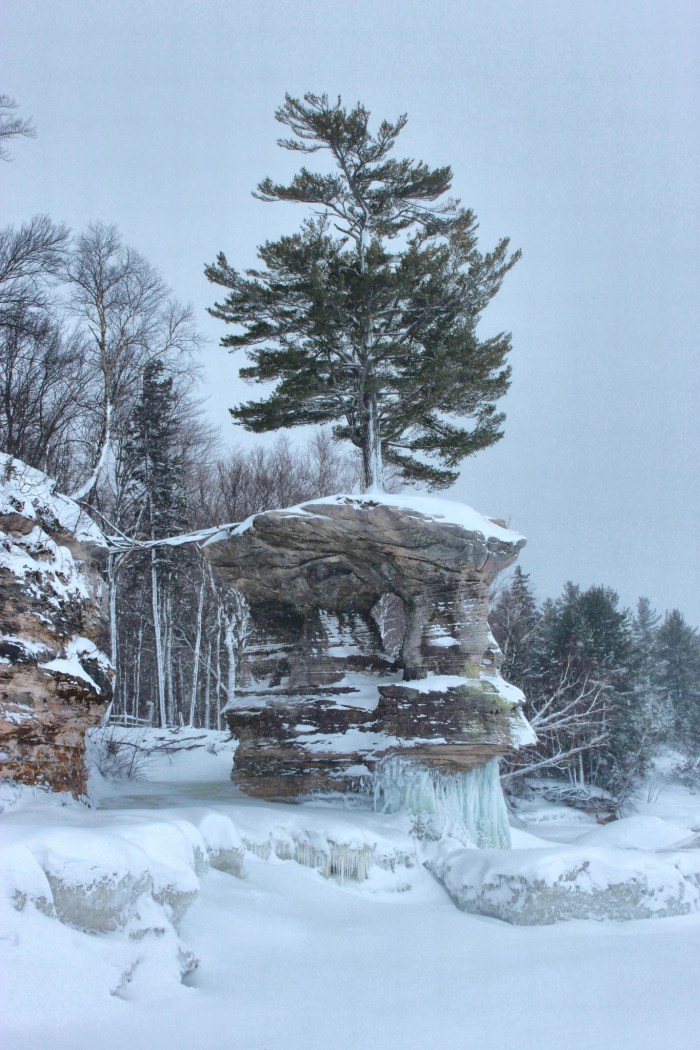
Chapel Rock in Winter

Chapel Rock in Winter

Live Anywhere, photo by Jay

When you think about it, it’s not only miraculous that the white pine on Chapel Rock in the Pictured Rocks National Lakeshore survives with barely any soil, but also that it endures winter after winter in the teeth of Lake Superior.

Jay took this shot on February 20th last year. View it background bigtacular and jump into his slideshow for some more spectacular winter photos from the Pictured Rocks.

Why is Ice Blue or Green?

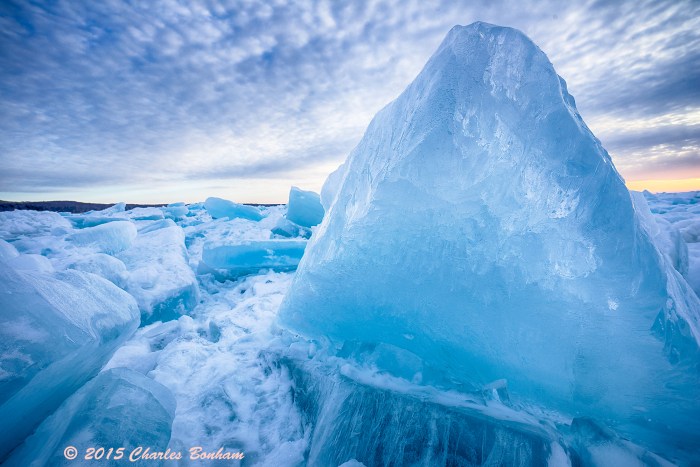
The Blue Ice

The Blue Ice, photo by Charles Bonham

The Causes of Color answers the question: What causes the blue color that sometimes appears in snow and ice?

As with water, this color is caused by the absorption of both red and yellow light (leaving light at the blue end of the visible light spectrum). The absorption spectrum of ice is similar to that of water, except that hydrogen bonding causes all peaks to shift to lower energy – making the color greener. This effect is augmented by scattering within snow, which causes the light to travel an indirect path, providing more opportunity for absorption. From the surface, snow and ice present a uniformly white face. This is because almost all of the visible light striking the snow or ice surface is reflected back, without any preference for a single color within the visible spectrum.

The situation is different for light that is not reflected, but penetrates or is transmitted into the snow. As this light travels into the snow or ice, the ice grains scatter a large amount of light. If the light is to travel over any distance it must survive many such scattering events. In other words, it must keep scattering and not be absorbed. We usually see the light coming back from the near surface layers (less than 1 cm) after it has been scattered or bounced off other snow grains only a few times, and it still appears white.

In simplest of terms, think of the ice or snow layer as a filter. If it is only a centimeter thick, all the light makes it through; if it is a meter thick, mostly blue light makes it through. This is similar to the way coffee often appears light when poured, but much darker when it is in a cup.

Click through for lots more about light & color!

Charles took this photo last March off Gills Pier on the Leelanau Peninsula when there was a whole lot more ice than there is this winter. View it background bigilicious and see more in his Leelanau Peninsula slideshow.

More winter wallpaper and more amazing ice on Michigan in Pictures.