As I shared a couple of weeks ago, the first-ever Fresh Coast Film Festival takes place next week (October 13-16) in Marquette. It’s a documentary film festival celebrating the outdoor lifestyle, water-rich environment and resilient spirit of the Great Lakes and Upper Midwest. In my article about the festival on Absolute Michigan I made a list of some of the films that were most exciting to me, including the one in the trailer below, Skips Stones for Fudge. It’s the story of competitive stone skippers Russ “Rock Bottom” Byars and Kurt “Mountain Man” Steiner that features the championships at Mackinac Island.
The film is just one of a diverse offering, and the festival will also make the outdoors a part the fun with guided outdoor activities to introduce visitors to the outdoor playground of the Marquette area. Rock climbing, fly fishing, sea kayaking, waterfall hikes and mountain bike rides will be offered as well!
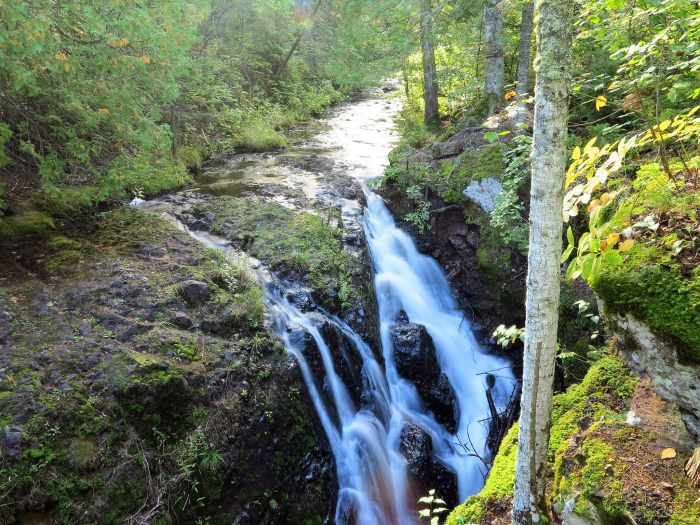
Manganese Falls is a steep cascade falling into a narrow gorge. The gorge is so narrow that it is actually hard to see the falls. There is a well marked overlook for the falls, but trees mostly obscure the falls. The overlook is perched on top of a sheer cliff, so do not even think about climbing over the fences for a better view.
It is easy to get to the top of the falls and you can look down the gorge. Even better views of parts of the falls can be had from the far side of the gorge. A large stretch of the main drop is visible. Getting a shot of the base of the falls would be very difficult. First there is a large pool at the base of the falls surrounded by steep walls, with apparently no dry places to stand. Second getting down there would be very difficult and dangerous.
Manganese Falls is located along Manganese Road just south of Copper Harbor. The road is paved, but steep in places. The falls are less than a mile from town.
Read on for more including some visiting tips and alternative viewing ideas.
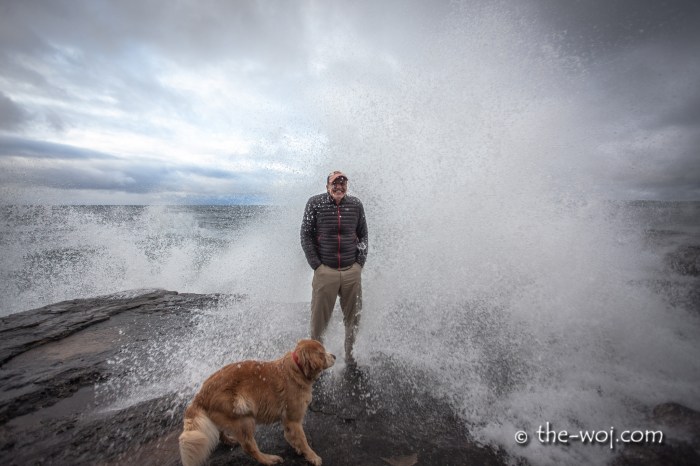
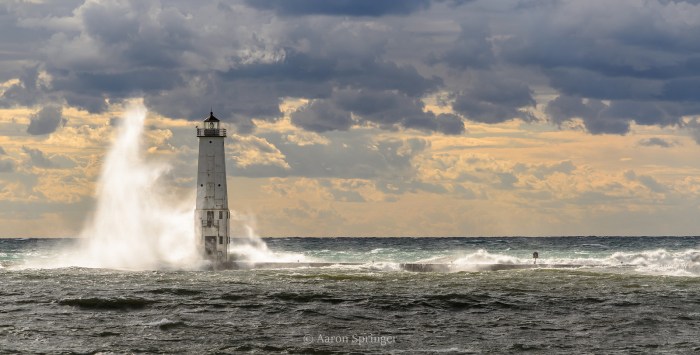
On a more serious note, as yesterday and today’s posts show, these big lakes have big and sometimes unexpected power, particularly as we head into fall and winter. Take a moment to see what’s going on, watch for a minute so you know what’s going on, be sure of your footing, and take a buddy or two if you can!
The Frankfort North Breakwater Lighthouse entry at Terry Pepper’s excellent Seeing the Light says the tip of the light is 72 feet off the water, making that spray over 80′ tall!! Click above for a ton more, but here’s something about the light tower:
1912 saw significant a significant change in the lighting of the Frankfort harbor entrance. A new square steel pyramidal tower was erected on the North Pier. Fully sheathed in steel plates, the white painted structure stood 44 feet from its base to the top of the ventilator ball. Outfitted with a fixed red Fourth Order Fresnel lens, the tower’s location on the north pier provided the new light with a focal plane of 46 feet, and a visible range of 12 miles in clear weather. The air siren from the South Pierhead light was relocated into this new structure, and set up to emit a characteristic isophase characteristic of alternating periods of 3 second blasts and 3 seconds of silence. An elevated walkway, similar to that installed on the south Pier, was erected from the new light to the shore.
…By 1924, the total car ferry tonnage through Frankfort Harbor was twenty five times greater than that prior to the establishment of the ferries. To better serve this vital commerce, the Army Corps of Engineers began construction of a pair of reinforced concrete arrowhead-type breakwaters at the harbor entrance in order to create a large stilling basin to protect the opening into the harbor. With the completion of these breakwaters in the early 1930’s, the twin piers at the entry into Lake Betsie no longer served any purpose. With plans in place to shorten them into short stub piers, the North Pierhead Light was lifted from the pier onto the deck of a barge and carried out to the end of the North Breakwater. A square steel base 25 feet in height had been erected on the end of the breakwater to receive it, and the tower was lifted onto the new base. After being bolted into position, the new tower stood 67 feet in height from the upper level of the pier to the top of the lantern ventilator ball. By virtue of its location on the concrete pier, the light stood at a focal plane of 72 feet, and the 17,000 candlepower incandescent electric light within the Fourth Order Fresnel was visible for a distance of 16 miles in clear weather.
Read on for lots more about the lighthouse including some great old photos.
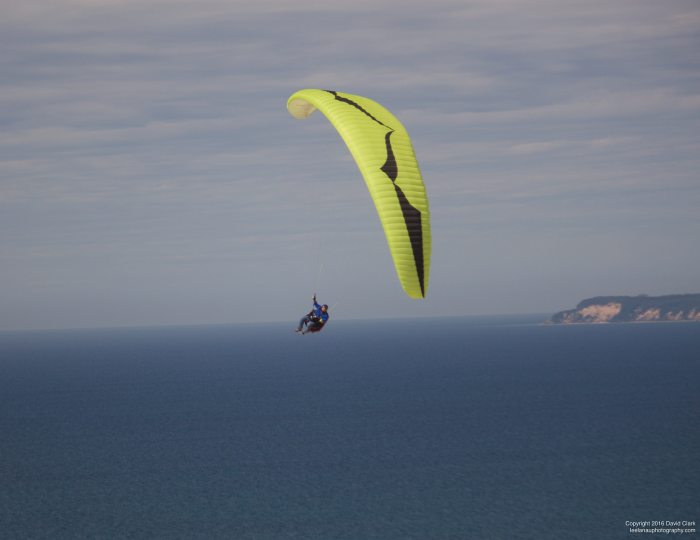
Most individuals will need lessons in hang gliding from a certified instructor prior to their first flight. Hang gliding schools provide instructions, gear, permits and safety equipment. The Draachen Fliegen Soaring Club is located in Cloud 9 Field between Detroit and Lansing, with instructors offering “tandem discovery” flights lasting from 15 minutes to one hour. Gliders drift in air space up to two miles high, in tandem with an instructor. Individuals with proven experience and certifications may rent gliders for solo flights. Traverse City Hang Gliders offers full programs of training and instruction in both traditional powerless hang gliding and “the Mosquito” powered hang gliding harness.
Hang gliding enthusiasts can enjoy practicing the sport at national parks within the state of Michigan, including Sleeping Bear Bear Dunes National Lakeshore. Several spots within the park are approved for powerless flight. Hang gliders can take off and land at Empire Bluff, Pyramid Point and Lake Michigan Overlook on the Pierce Stocking Scenic Drive, as well as Dune Climb in the months of November through March. Powerless flight permits are required and can be obtained free of charge at the Visitor Center Information Desk. Launch sites within the park require proficiency ratings established by the U.S. Hang Gliding Association. Gliders must also follow safety and federal regulations. Warren Dunes State Park also issues permits for hang gliding along the coastal dunes, about 14 miles from the state border with Indiana. Favorite launch and return sites within the park include Tower Hill and New Buffalo.
In the 1970s, Elberta Beach and the adjacent city of Frankfort, in Northern Michigan, were popular spots for what was then the new sport of hang gliding. Once referred to as the “Sail Plane Capital,” the area is still a magnet for gliders today. Just south of Frankfort, gliders can experience the thrill of soaring over sand dunes at Green Point Dunes. The Green Point Flyers Association, established in 1978, is a club for both hang gliders and parasailers, with a main flying site that is a sand dune stretching for three miles at a height of 370 feet. Licenses are required to fly at Green Point, and certified instructors are available. Pilots at Green Point also have access to hang gliding sites inside the Sleeping Bear Dunes National Lakeshore, as well as the bluffs of Elberta. Visitors can also team up for a ride with members of the Northwest Soaring Club, which is located in Cadillac, Michigan. Flights depart from the Wexford County Airport, then cruise over Lake Mitchell and Lake Cadillac.
TRUE CONFESSION: Page-at-a-time slideshows make me want to smash my screen, but I have to say that what mLive is doing with slideshows has been pretty cool. Their feature on the Most Famous Natives of Michigan has their pick for the most famous person from each of Michigan’s 83 counties. Definitely worth a read. Share your thoughts here on on the Michigan in Pictures Facebook!
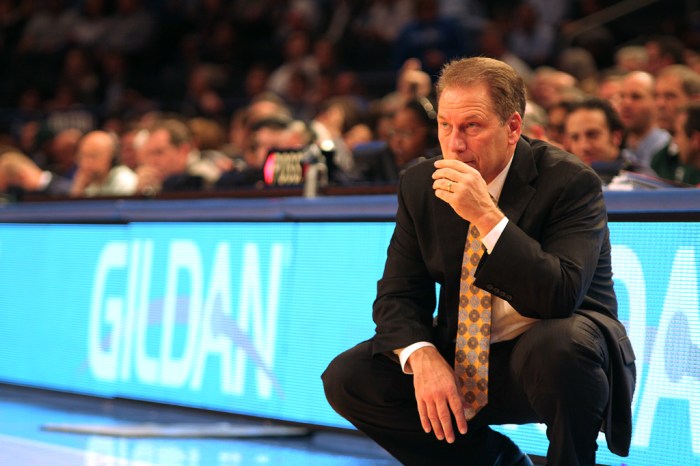
Since 1995, Tom Izzo has led the Michigan State men’s basketball team as head coach. Born Jan. 30, 1955, Izzo was recently inducted into the Naismith Memorial Basketball Hall of Fame. Under his watch, the Spartan team has made it to the Final Four seven times and taken home an NCAA Men’s Division I Championship.
You may know that Père Jacques Marquette founded Michigan’s oldest city Sault Sainte-Marie in 1668, but do you know Michigan’s second old city? If you can read titles, you know that’s St. Ignace, founded in 1671 and named in honor of Saint Ignatius of Loyola. Here’s some of the history of St. Ignace from the St. Ignace Visitor’s Bureau:
The natives of the St. Ignace region were migratory. In the spring, the Anishinabeg gathered maple sugar and fished sturgeon and smelt. Summer found them in settlements surrounded by crops of corn, potatoes and squash, and near the abundant supplies of wildlife, fish and berries. They developed efficient housing, watercraft, hunting and farming tools.
The heritage of the Straits evolved and changed over the centuries beginning with the arrival of Roman Catholic missionaries and then French and British explorers and fur traders … The natural waterway joining Lakes Michigan and Huron at the Straits of Mackinac generated extensive water traffic, and prompted the establishment of an outpost during the period of French occupation. The outpost – Fort de Buade – became the seat of King Louis XIV’s authority in the interior of North America. French notables including Rene-Robert Cavalier, Sieur de La Salle and Antoine Lamothe Cadillac spent time at the post. St. Ignace was among the largest settlements in New France from the last decade of the 15th century until the establishment of Detroit in 1701. The British arrived in the St. Ignace region with the defeat of the French during Seven Years War.
St. Ignace played a pivotal role in the fur trade until this industry began to wane. By the mid-1800’s the financial importance of commercial fishing to the economic well-being of the area eclipsed that of the fur trade. Ancillary industries including curing, packing and shipping augmented the fishery. It was during this period that the Mackinaw Boat became a familiar sight on the waters in and around the Straits. As the lumber industry in Michigan evolved, St. Ignace became a center for mill yards and its proximity to the shipping lanes added to its importance as a commercial hub in the northern Great Lakes area.

 Michigan in Pictures