22-Degree Radius Halo

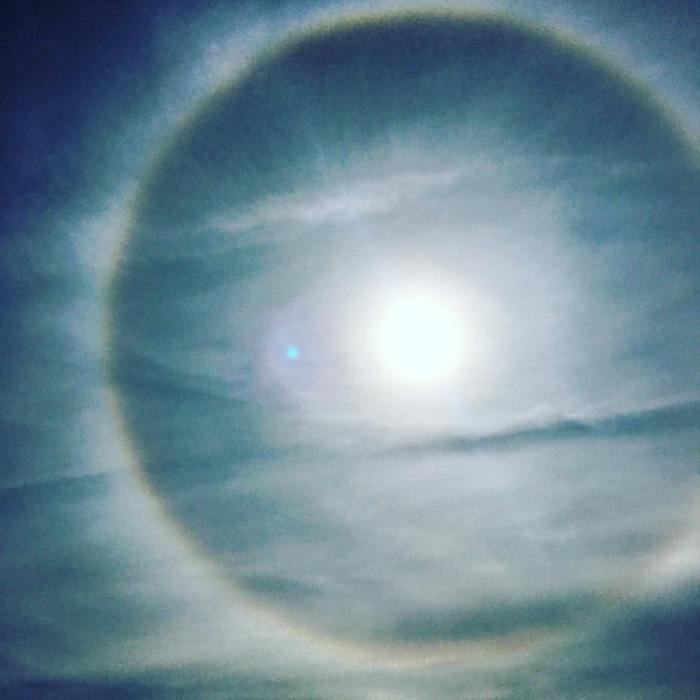
22 degrees at Van’s Beach, photo by Andrew McFarlane

Atmospheric Optics is an excellent resource for rainbows and similar phenomena. Their page on 22-degree halos says:

22º radius halos are visible all over the world and throughout the year. Look out for them (eye care!) whenever the sky is wisped or hazed with thin cirrus clouds. These clouds are cold and contain ice crystals in even the hottest climes.

The halo is large. Stretch out the fingers of your hand at arms length. The tips of the thumb and little finger then subtend roughly 20°. Place your thumb over the the sun and the halo will be near the little finger tip. The halo is always the same diameter regardless of its position in the sky. Sometimes only parts of the complete circle are visible.

Much smaller coloured rings around the sun or moon are a corona produced by water droplets rather than ice crystals.

Lots more at Atmospheric Optics!

See the photo bigger and view more on my Instagram.

More rainbows, sundogs, etc. on Michigan in Pictures – seriously cool stuff in here folks!

Dawn on the Vernal Equinox

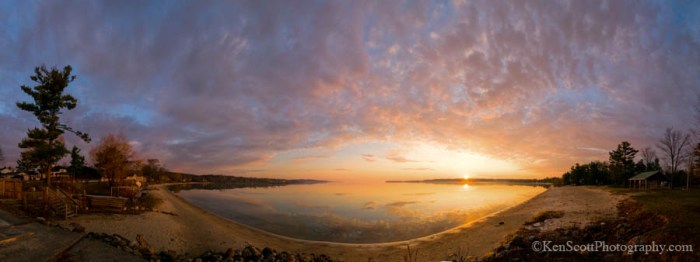
Suttons Bay … vernal equinox sunrise panorama, photo by Ken Scott Photography

Monday’s Michigan in Pictures is coming to you a little early so you have a chance to be aware of the vernal equinox tomorrow morning (Monday, March 20, 2017) at 6:29 AM EST. EarthSky editor Deborah Byrd’s article on the vernal equinox has a ton of great information, video, and illustrations and explains:

…there’s nothing official about it, it’s traditional to say the upcoming March or vernal equinox signals the beginning of spring in the Northern Hemisphere and autumn in the Southern Hemisphere. This equinox does provide a hallmark for the sun’s motion in our sky, marking that special moment when the sun crosses the celestial equator going from south to north … At the equinox, Earth’s two hemispheres are receiving the sun’s rays equally. Night and day are approximately equal in length. The word equinox comes from the Latin aequus (equal) and nox (night).

Read on for more including how you can mark due east and west from any location on the equinox!

View the photo bigger, get ready for the season with Ken’s Spring slideshow, and definitely join 25,000+ followers of Ken Scott Photography on Facebook!

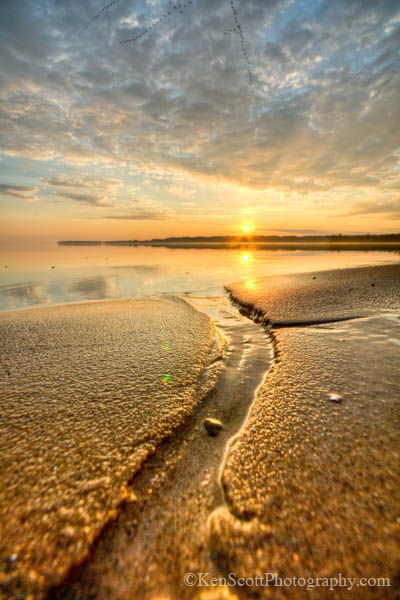
Below is another shot from the same morning – Suttons Bay Sunrise … morning findings  featuring a formation of geese at the very top!

A Little Light Changes Everything

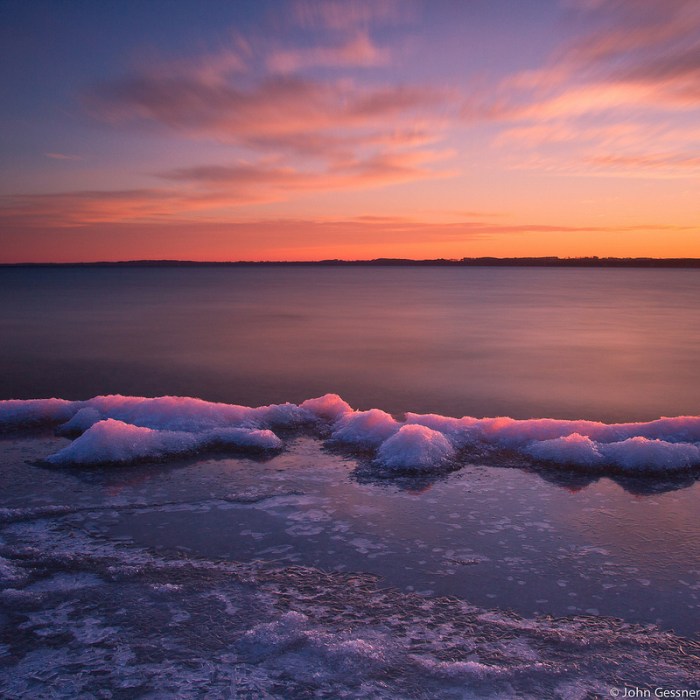
A Little Light Changes Everything, photo by John Gessner

I hope that you get a chance to get out there this weekend and let the sunlight in!

View John’s photo bigger and see more in his Michigan Water slideshow.

May you find your pot of gold on St Patrick’s Day

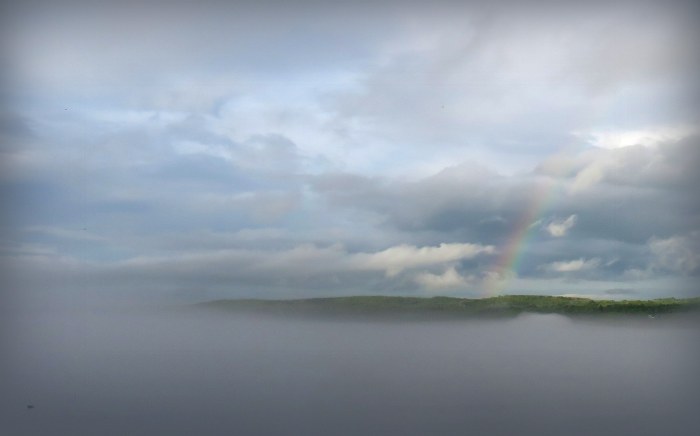
Rainbow and fog bank over the Pictured Rocks National Lakeshore, photo by Ann Fisher

May you have all the happiness
And luck that life can hold
And at the end of your rainbows
May you find a pot of gold.
~ Old Irish Blessing

A very happy St. Patrick’s Day and health & good fortune to you all!

View Ann’s photo background bigtacular and see more in her 2016 UP slideshow.

Lots more St. Patrick’s Day on Michigan in Pictures!

Michigan Tough: Daffodil Edition

Hopefully the daffodils are tougher than I am, photo by Bill Dolak

Bill took this shot yesterday at Celery Flats Park in Portage where it got down into the teens the night before.

View the photo background bigilicious and see more in his Portage, Michigan slideshow.

More spring wallpaper on Michigan in Pictures.

Mission: Possible

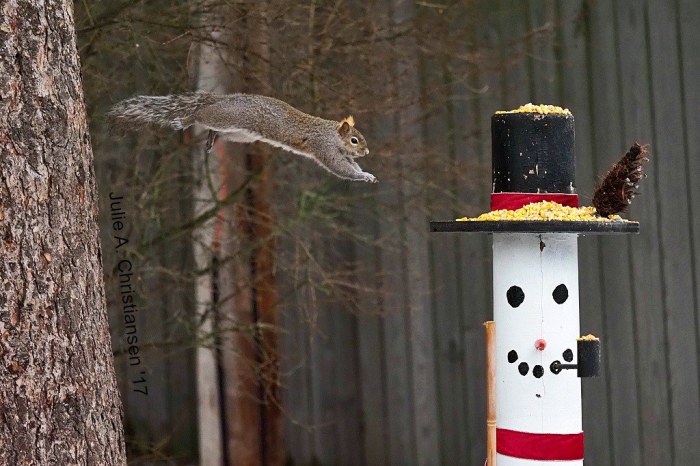
Will do ANYTHING for corn, photo by Julie A Christiansen

Dare to dream!

View Julie’s photo bigger on Facebook and see more including what looks to be a shot of the landing in her Wildlife slideshow.

Speed limits (and probably fatalities) going up in Michigan

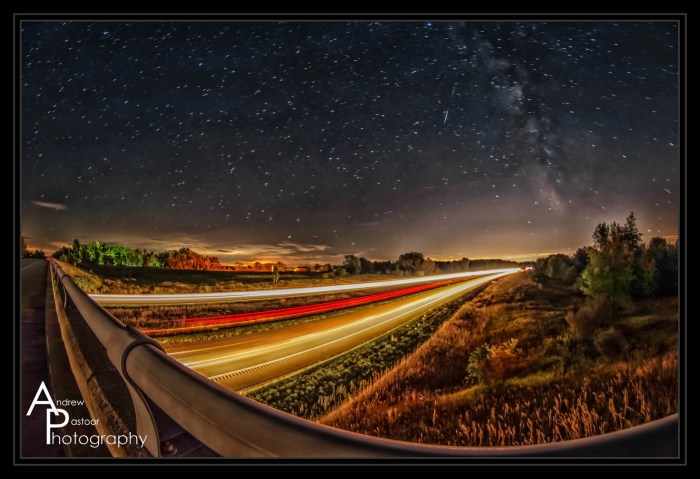
September 13 – Stars and Cars Part 4, photo by Andrew Pastoor

I was on the fence about posting this, but after I found this cool photo I just had to! Michigan Radio reports that a new law directing the Michigan Department of Transportation to increase speed limits to 75 miles an hour on up to 600 miles of rural highways in the state will have consequences:

Russ Rader of the Insurance Institute for Highway Safety says there’s decades of research proving that more people will die as a result. For every five miles’ increase in the speed limit on interstates and highways, says Rader, fatal crashes increase 8%.

He says Michigan is not alone; many other states are also raising speed limits. He says very high speeds cancel out the life-saving features on cars like seat belts and front air bags.

“In 2013 alone, speed limit increases resulted in about 1900 additional deaths,” says Rader. “That would essentially cancel out the number of lives saved that year from front air bags.”

Read on for more and get more about the law from mLive, It will go into effect following studies.

View the photo bigger and see more in Andrew’s Project 365 | 2014 slideshow,

Michigan House at SXSW

Flint Eastwood, photo by Joel Williams

A big thing that’s happening right now is the South By Southwest festival in Austin, Texas. SXSW celebrates the convergence of the interactive, film, and music industries and is ground zero for the future of media. I was gratified to learn through my friend Seth Bernard (who’s at SXSW) that a number of Michigan artists, organizations and companies have partnered for Michigan House, an effort spearheaded by Creative Many Michigan. Creative Many is a statewide organization focused on developing creative people, creative places and the creative economy for a competitive Michigan.

They have some cool things on the schedule including a Michigan music showcase featuring Flint Eastwood and the Go Rounds, so if you’re in Austin, definitely drop by and in any case, check out the folks who are taking Michigan messages to the world!

View Joel’s photo bigger and see more in his Favorites slideshow.


Detroit’s Immigrant Workers

Immigrant Workers, photo by Ryan Southen

3 out of 4 people in 1910 were immigrants or the children of immigrants. Wow. Ryan shared this photo on Facebook and wrote:

I stumbled upon this stone along the riverfront this afternoon. This region is what it is today because people came here seeking opportunity, or refuge and we are absolutely better for it. Something to ponder the next time you find yourself discussing immigration.

As the descendent of immigrants to the Detroit area, I completely agree. Crain’s Detroit Business has a nice feature by about how foreign-born workers have been an integral part of Detroit’s history, economy. It says in part:

Detroit once was the third-largest U.S. settlement for immigrants, said Kurt Metzger, the retired founder of Data Driven Detroit who spent nearly 40 years compiling information and statistical analysis locally.

“In 1930, the foreign-born accounted for almost 30 percent of Detroit’s population. The data show that more immigrants settled in Detroit between 1900 and 1920 than any other city but Chicago and New York,” Metzger said via email.

“The makeup of Detroit — European (Poles, Germans, Ukrainians, etc.) was heavily influenced by the national quota system that either forbid certain groups (Asians, for instance) or maintained extremely small quotas.”

The second, much broader and more diverse wave of immigration began around 1970 after Washington relaxed the quota system on a wide variety of groups, he said.

“We began to see large flows of Chaldeans from Iraq, Muslims from Lebanon and other areas of the Middle East, Asians from Taiwan, India, the Philippines, Albanians, Puerto Ricans and Mexicans,” he said. “Since that time, we have added, through war and displacement, Hmong, Cambodian and Vietnamese, Chaldeans, Syrians, Yemeni, and many more.

…Foreign-born workers and their families helped swell Detroit’s population to nearly 2 million people at its 1950 peak.

Ryan doesn’t have this pic on his Flickr, but you can see a lot of great shots from Detroit and elsewhere there and by following Ryan Southen Photography on Facebook.

Cruise to 32 Lighthouses including the Skillagalee Island Light!

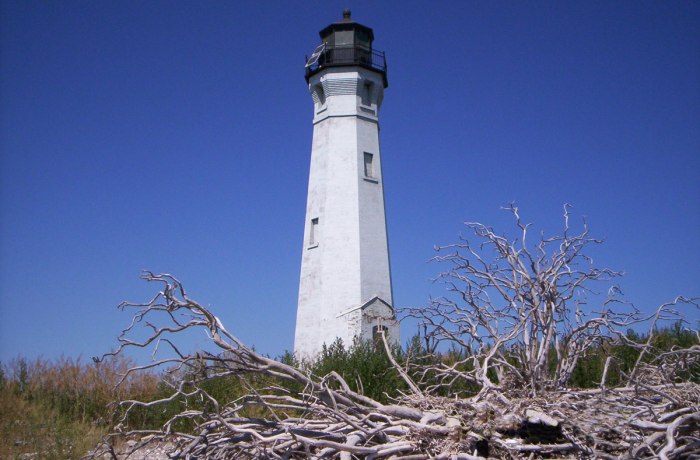
Ile aux Galets, courtesy Terry Pepper’s Seeing the Light

I just learned about a super-cool cruise for lighthouse lovers that also benefits the Great Lakes Lighthouse Keepers Association. mLive reports:

There are 80 spots available for the trip which takes place in the northern part of Lake Michigan June 5-9. It is presented by the Great Lakes Lighthouse Keepers Association, which oversees the care of two lighthouses in the region. Guests travel aboard the Shepler’s Ferry vessel HOPE and stay at different resorts along the way, including Weathervane Terrace Inn & Suites in Charlevoix and Stone Harbor Resort in Sturgeon Bay, Wisc.

“It’s an awesome thing to do,” said Terry Pepper, executive director. “Lighthouses were built for the mariners so by going out to see them the way they were designed for from the water is unique.”

Click above for more and make reservations at gllka.com. Speaking of Terry Pepper, let’s add another Michigan lighthouse! Via Terry’s excellent Seeing the Light website here’s the Skillagalee Island Light Station:

Skillagalee Island is located some 7.7 miles Southwest of Waugoshance Island on the East side of the approach to the Gray’s Reef Passage. The tiny island represents but a small exposed portion of a large gravel shoal that extends 1.8 miles to its East and a half a mile to the Northwest.

Being very low in elevation, the island is barely visible except from close by, and to exacerbate the problem, the size of its exposed surface fluctuates dramatically with the level of the surrounding water. The island was considered a navigational hazard during the earliest days when the French Voyageurs took the time to name the place “Ile aux Galets,” which translates as “Island of Pebbles.”

A is so often the case, the English speaking mariners and settlers found the French name difficult to pronounce, and “Ile aux Galets” soon unofficially mutated into “Skillagalee.” The anglicized version took hold, and by the mid 1800’s references to the original French name all but disappeared.

While Skillagalee laid claim to many wrecks over the years, the grounding of the A.D. PATCHIN was seminal in the call for the construction of an aid to navigation on the island. The PATCHIN was a 226 foot wood-hulled sidewheel steamer built in Trenton Michigan in 1846. Laden with general merchandise, she was making her way into Grays Reef Passage on September 27, 1850, when the currents pulled her out of line and onto shore at Skillagalee. While her crew managed to escape to safety and the initial damage to her hull was minimal, the weather turned evil and thwarted a number of attempts to pull her free. By late November she had been pounded to pieces, becoming yet another of Lake Michigan’s many victims.

To answer the need for a navigational aid to warn mariners of the shoal’s existence, Congress appropriated the necessary funds to construct a light on Skillagalee Island in 1851. As a result of the exposed location and fluctuating water tables, the tower was in constant need of repair, a cycle that would be repeated throughout the station’s history.

Read on for more and check ou tSeeing the Light for more Great Lakes Lighthouses!