
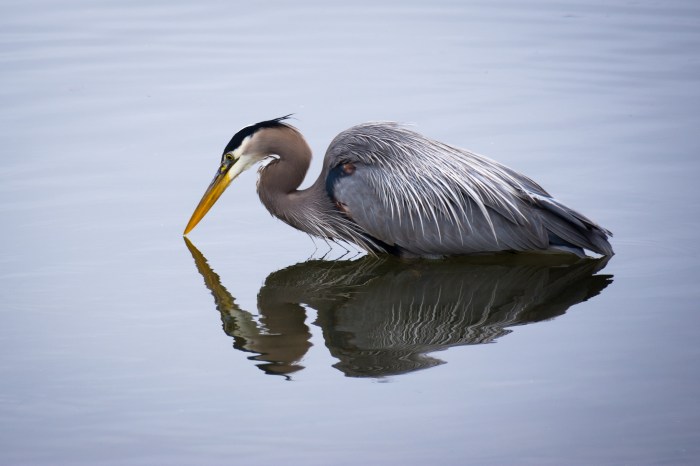
Reflections, photo by cncphotos
Here’s a sweet shot from May 1st last year of a Great Blue Heron patiently fishing.
View the photo background bigtacular and see more in cncphotos’ Birds slideshow.
More spring wallpaper on Michigan in Pictures.
Reflections, photo by cncphotos
Here’s a sweet shot from May 1st last year of a Great Blue Heron patiently fishing.
View the photo background bigtacular and see more in cncphotos’ Birds slideshow.
More spring wallpaper on Michigan in Pictures.
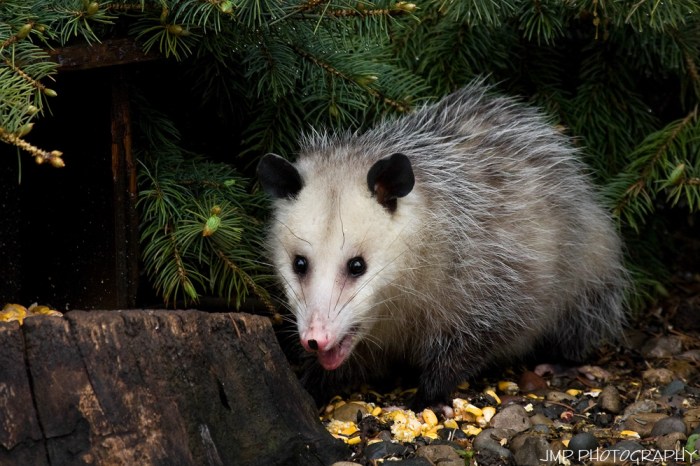
Caught In The Headlights, photo by James Marvin Phelps
Tick season is upon us, and with the added threat of Lyme disease, it’s serious business here in Michigan. My friend Tara with the Leelanau Conservation District shared some information about opossums from Opossum Awareness & Advocacy (opossum facts image below that you can share):
Did you know that opossums eat up to 5000 ticks per season thereby reducing our risk of contracting Lyme Disease and other tick-born diseases? They kill vermin, including mice, and garden pests. They are not dirty; they are very clean animals and groom and clean as much as cats. Better still, most opossums cannot contract or spread rabies. Opossums are the United States and Canada’s only marsupials.
They may look a little scary to the uninitiated, but they are actually timid and do so much good for humans compared to most other creatures. If you see an opossum consider yourself lucky, leave it alone and please do not harm it. They have a hard time surviving in cold climates because they don’t have very thick coats. Sometimes opossums play dead because they are afraid. Please don’t hit them with your car. Spread the word and please help protect opossums!
View the photo background big and see more in James’ massive Michigan slideshow, and follow James Marvin Phelps Photography on Facebook.

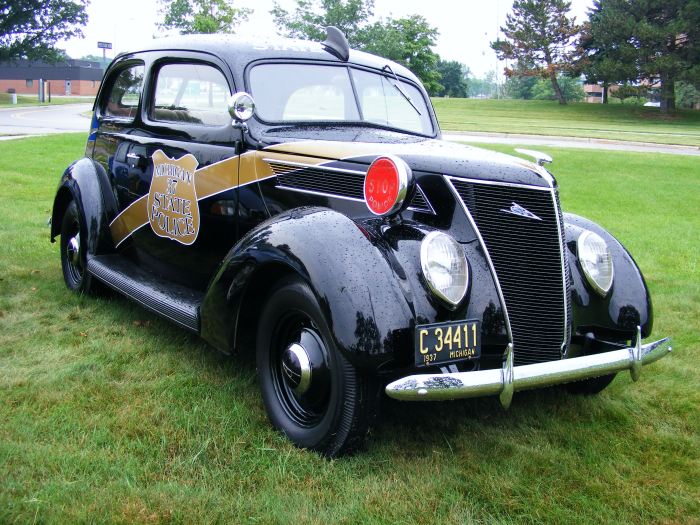
State of Michigan State Police, photo by glory be me
A belated happy 100th birthday to the Michigan State police, who are 100 years and a day old today:
Since April 19, 1917, the Michigan State Police has proudly served the citizens of Michigan. From a cavalry of 300 men to a full-service police agency of more than 2,900 members, the Michigan State Police has proven itself as a world-class leader in law enforcement.
The Michigan Department of State Police began as a temporary, wartime emergency force for the purpose of domestic security during World War I. On April 19, 1917, Governor Albert Sleeper created the Michigan State Troops Permanent Force, (also known as the Michigan State Constabulary). With Colonel Roy C. Vandercook as the first commanding officer, this new force consisted of five Troops of mounted, dismounted and motorized units, totaling 300 men. On March 26, 1919, Public Act 26 reorganized the Constabulary as the permanent, peace-time Michigan State Police.
Michigan adopted a new Constitution in 1963, authorizing up to 20 departments. Public Act 380 of 1965 reorganized the Michigan Department of State Police as one of these departments. The Director holds the rank of Colonel and is appointed by the Governor.
Today, the Michigan State Police consists of a modern-day force of law enforcement professionals, using the latest up-to-date training and technology to protect the citizens of Michigan. What was once a cavalry of 300 men now has evolved into one of the leading police agencies of the United States.
View the photo of what I believe is a 1937 Ford Model 74 patrol car background big and see more in glory be me’s Untitled Set slideshow.
More #TBT (Throwback Thursdays) on Michigan in Pictures.

Untitled, photo by Steve Nowakowski
It’s hard to convey the unique beauty of the Pictured Rocks National Lakeshore in a single photo, but the stunning green of this picture really triggered memories for me of some of my best and brightest days in one of Michigan’s crown jewels.
Steve took this on a boat tour in August of 2016 with nearly perfect conditions, likely with Pictured Rocks Cruises. View the photo background big and see more in his 2016 Pictured Rocks National Lake Shore slideshow.
There’s a whole lot more goodness from the Pictured Rocks on Michigan in Pictures.
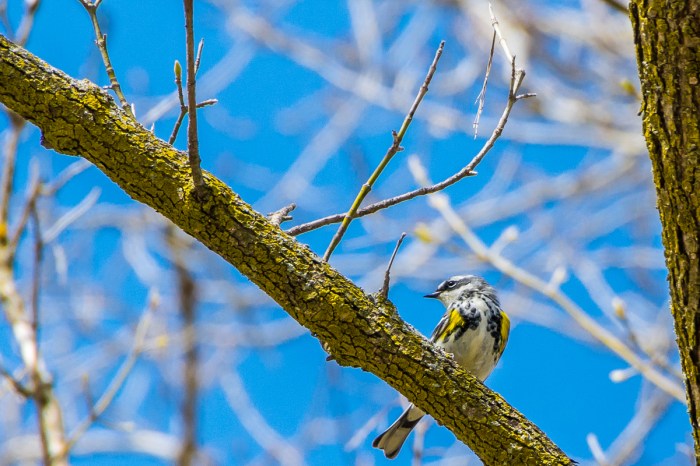
Yellow Rumped Warbler, photo by Jeff Dehmel
Jeff’s back with another bird everyone! I couldn’t resist – the colors on this are so perfectly April!! Here’s a couple of facts on the Yellow-rumped Warbler from All About Birds:
Yellow-rumped Warblers are impressive in the sheer numbers with which they flood the continent each fall. Shrubs and trees fill with the streaky brown-and-yellow birds and their distinctive, sharp chips. Though the color palette is subdued all winter, you owe it to yourself to seek these birds out on their spring migration or on their breeding grounds. Spring molt brings a transformation, leaving them a dazzling mix of bright yellow, charcoal gray and black, and bold white.
The Yellow-rumped Warbler is the only warbler able to digest the waxes found in bayberries and wax myrtles. Its ability to use these fruits allows it to winter farther north than other warblers, sometimes as far north as Newfoundland.
They’re the warbler you’re most likely to see fluttering out from a tree to catch a flying insect, and they’re also quick to switch over to eating berries in fall. Other places Yellow-rumped Warblers have been spotted foraging include picking at insects on washed-up seaweed at the beach, skimming insects from the surface of rivers and the ocean, picking them out of spiderwebs, and grabbing them off piles of manure.
The oldest recorded Yellow-rumped Warbler was at least 7 years old.
View the photo background big and see more in Jeff’s Holloway Reservoir slideshow (where you’ll see his photo of a bald eagle from not long ago).
More spring wallpaper and more birds on Michigan in Pictures.

Easter!, photo by Staci DeVries
Happy Easter, if that’s something you celebrate.
View the photo background bigilicious and see more in Staci’s slideshow.

Detail: Hand and Globe, “Spirit of Detroit”–Detroit MI, photo by pinehurst19475
The care of human life and happiness, and not their destruction, is the first and only object of good government.
-Thomas Jefferson
Happy 274th birthday to the principle author of our Constitution, Thomas Jefferson.
As we head into a recess where we all have a chance to speak with our elected officials, my personal hope is that many voices will be raised in support of this Jeffersonian ideal of good government that seeks to uplift and preserve our health and well-being, particularly in regards to our preserving & expanding access to health care, rebuilding our crumbling infrastructure, and ensuring that efforts to protect the Great Lakes aren’t defunded. You may want something different, so you probably should show up and share your thoughts as well! ;)
View the photo background bigtacular and see more in pinehurst19475’s massive Statues & Sculpture slideshow.
PS: This is the detail of the hand on the Spirit of Detroit by noted sculptor Marshall Fredericks and you can click that link for much more!
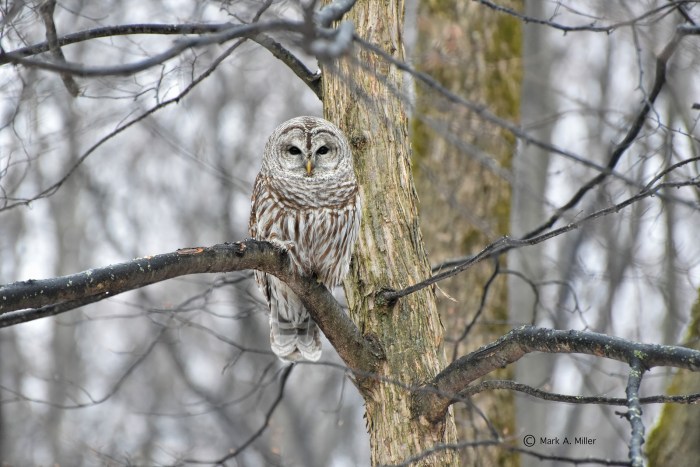
Barred Owl, photo by Mark Miller
Those cool names are from the Wikipedia for the Barred Owl (Strix varia). The All About Birds page on Bard Owls says in part:
The Barred Owl’s hooting call, “Who cooks for you? Who cooks for you-all?” (see video below) is a classic sound of old forests and treed swamps. But this attractive owl, with soulful brown eyes and brown-and-white-striped plumage, can also pass completely unnoticed as it flies noiselessly through the dense canopy or snoozes on a tree limb. Originally a bird of the east, during the twentieth century it spread through the Pacific Northwest and southward into California.
Barred Owls live year-round in mixed forests of large trees, often near water. They tend to occur in large, unfragmented blocks of mature forest, possibly because old woodlands support a higher diversity of prey and are more likely to have large cavities suitable for nesting. Their preferred habitats range from swamps to streamsides to uplands, and may contain hemlock, maple, oak, hickory, beech, aspen, white spruce, quaking aspen, balsam poplar, Douglas-fir, lodgepole pine, or western larch.
Barred Owls don’t migrate, and they don’t even move around very much. Of 158 birds that were banded and then found later, none had moved farther than 6 miles away. (In Michigan, the average range is about a mile)
View Mark’s photo bigger and see more in his In My Backyard slideshow.
More owls on Michigan in Pictures.

Shining in Cheyboygan, photo by Bill Johnson
Here’s a neat “Throwback Thursday” (TBT), a photo of the United States Coast Guard Cutter Mackinaw on May 25, 1993 when she was still in service. Bill writes:
This is the original Coast Guard Cutter Mackinaw, WAGB 83, wearing its silvery whitish colors, in its home port of Cheboygan, MI. This beauty was built in 1944 to aid the war effort by keeping the Great Lakes open during the winter. The cutter was intentionally built too wide to get through the Saint Lawrence Seaway in order to keep her in the Great Lakes. She was moved to Mackinaw in June of 2006, decommissioned, and turned into a museum at the Chief Wawatam docks. Today, she wears the red hull that she was retired in.
You can see the current look of the Icebreaker Mackinaw and get information about visiting on the Icebreaker Mackinaw Maritime Museum website.
View Bill’s photo background big and see more in his Boats, Ships, and Stuff That Floats slideshow.
More Throwback Thursdays on Michigan in Pictures.
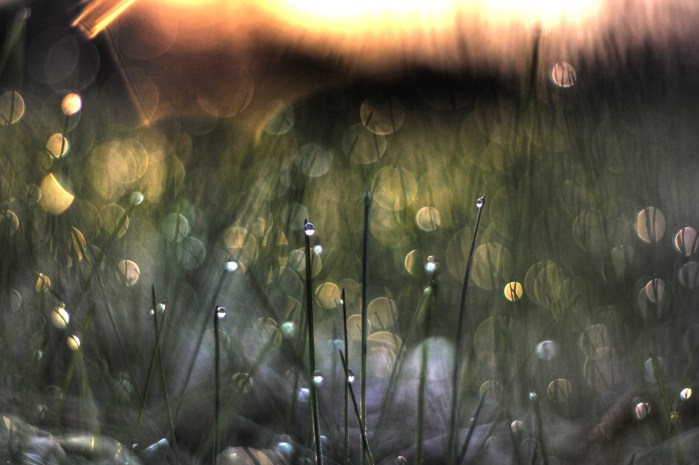
Say you will, photo by Brian Wolfe
Brian took this back in April of 2009 and shared some thoughts that I think all photographers (and people) would do well to consider:
This weekend I resolved to wake up for the dawn. With the days growing longer and the sun rising earlier, it will only get more difficult the longer I put it off. I was hoping for some brilliant cloud pattern to reflect amazing colors but like what happens so often, it was just (what I like to call) bland. This kind of killed my energy and I felt like I would rather have slept-in. Instead of turning for home, I expanded my perception of my surroundings, opened my eyes, and came up with some great stuff (I think so anyway).
View the photo background bigilicious, see more in Brian’s The Top Thirty slideshow, and definitely follow Brian on Instagram!
More Spring Wallpaper on Michigan in Pictures.
 Michigan in Pictures