Cheboygan Crib Light with Northern Lights

Cheboygan Crib Light

Cheboygan Crib Light, photo by yooper1949

Terry Pepper’s Seeing the Light says that the plan for the Cheboygan Crib Light that was drawn-up by the District Engineer called for a round crib with an octagonal cast iron pierhead beacon centered upon it.

Work began with the construction of a wooden crib onshore in Cheboygan, which was then lowered into the water and towed out to the specified location at the entrance to the dredged river channel. Sunk in place with the addition of crushed rock, an upper level consisting of oak timber framework was then constructed atop the crib, with a basement oil storage room beneath the location in which the tower was to be installed. The deck of this superstructure was then leveled at a height of eleven feet above the water, planked with timber and fitted with a circular oak ring centered over the oil storage room to serve as an anchoring foundation for the cast iron tower itself.

…One can only imagine the drudgery involved for the keepers who manned this station. Every afternoon he would have to leave the safety of the dwelling in Cheboygan and row the 1/4 mile out to the light in whatever weather the lake was dishing-up that day. On arrival at the crib, he would carefully secure his boat at the foot of the crib, and then gingerly step from the heaving boat onto the eleven foot ladder, climbing up to the deck while simultaneously carrying any supplies needed for the night. The lamp would illuminated at dusk, and the keeper would then sit in the solitude of the tower, huddled close to the stove to keep warm on cold nights during the late season, making frequent climbs to the lantern to adjust the light by trimming the wick, winding the occulting mechanism and adding fuel to the lamp. As dawn finally raised its head across the Straits of Mackinac, the lamp would be extinguished, and the illuminating apparatus, lens and lantern would be cleaned in preparation for illumination later that day. The keeper would then row the ¼ mile back to shore to get some sleep, knowing that he would have to back out on the crib to repeat the cycle a few short hours later.

Sounds like a wonderful job. Read lots more about the light from Terry Pepper.

If I were looking for northern lights, I might follow Carl around. He shot this on November 30th. See it background bigtacular and see more in Carl’s Northern Lights slideshow.

Want more lighthouses or northern lights? We have both on Michigan in Pictures…

Back into the Woods Day, 2012

Sandstone Creek Ravine

Sandstone Creek Ravine, photo by joeldinda

The hardest 15 days for the year for the non-hunting lover of the outdoors in Michigan are November 15-30th. I think of December 1st as a mini-holiday. Call it “Back into the Woods Day” and celebrate as you will.

Joel’s photo is from Fitzgerald Park aka “The Ledges”, an amazing park along the Grand River near the town of Grand Ledge. Check this out background bigtacular and see more in his Into the Woods slideshow.

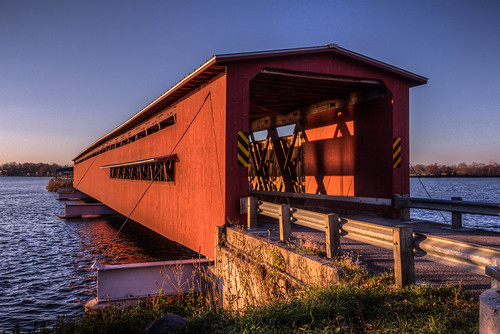
Langely Covered Bridge is Michigan’s longest

Langley Covered Bridge, Centreville, Michigan

Langley Covered Bridge, Centreville, Michigan, photo by bill.d

Bill writes this of the Langely Covered Bridge over the St. Joseph River, a Michigan Registered Historic Site:

This is the longest of Michigan’s few remaining covered bridges. It is 282 feet long with three, 94-foot spans of the Howe-truss construction. The bridge was built in 1887 by Pierce (?) Bodner of Parkville, using the best quality white pine for the frame timbers. The bridge’s name honors a pioneer Centreville family. When the Sturgis Dam was built in 1910, the Langley Bridge had to be raised eight feet. In 1950-51 extensive repairs and replacement of parts on the bridge were carried out by the St. Joseph County Road Commission to preserve for the future this historic link with a bygone era.

Personal note – the bridge is only one lane wide. Drivers take turns crossing the bridge, but this is a part of Michigan that doesn’t see much traffic anyway, so the wait is seldom long. The speed limit on the bridge is 15 mph.

Wikipedia’s entry on the Langley Covered Bridge adds that it was named for Thomas W. Langley and his family, the first settlers who helped establish the village of Centreville in St. Joseph County in the mid-19th century.

Check it out as big as a bridge and see more in Bill’s Michigan: Saint Joseph County slideshow.

More Michigan bridges on Michigan in Pictures!

The Iron River Meteorite and the Meteorites of Michigan

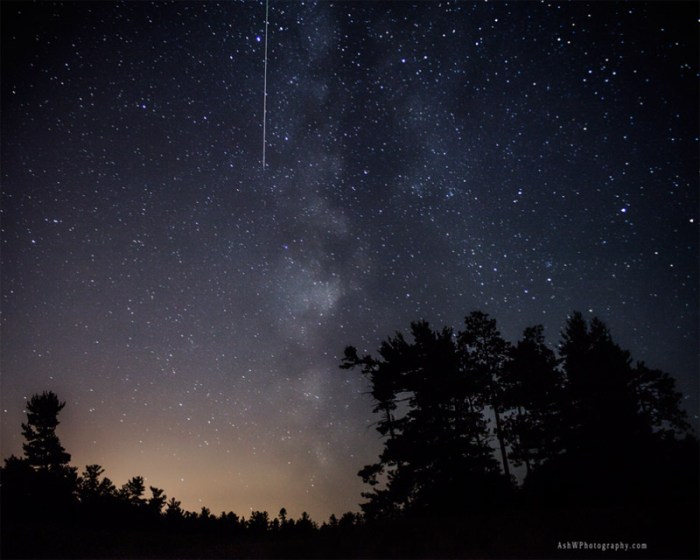
Meteor-Over-Marquette

Meteor over Marquette, photo by Ash W Photography

Recently in Peter Peterson and the Iron River Meteorite on Yooper Steez, Alice Rossignol remembered a day in 1889:

…when a six-year old boy named Peter Peterson (yes, this was actually his name) was helping his father clear rocks from a field near Iron River.

Things were proceeding as usual (I’m assuming) when little Peter noticed that one rock was much heavier than others of the same size. He showed the 3.13-pound whopper to his father who told him to toss it like the others.

But Peter, being a six-year old boy, kept it.

According to Von Del Chamberlain, a former MSU professor who recounts this story here, the rock was later identified as a meteorite, a fact which he later confirmed.

How rare are confirmed meteorites? There have only been 10 verified in Michigan, and this meteorite is currently the only verified meteorite in the Upper Peninsula. Read on for more about this story and some meteorwrongs (mis-identified meteorites) and dig into Prof. Del Chamberlain’s account for the scientific lowdown and how it ended up in Chamberlain’s hands almost 80 years later. You can also read the entirety of Chamberlain’s publication Meteorites of Michigan online.

Ashley took this photo in August 2012 during the Perseid meteor shower. Check it out big as the sky and in her Nature Gallery.

More meteors on Michigan in Pictures. If you’re wanting to see some, the Geminids are on tap for the night of December 13th!

New Destination

New destination

New destination, photo by Moobyluvsme

Gorgeous photo from last month. Check it out big as the sky, download it as a background and see more in Mike’s slideshow.

Safe travels this weekend everyone!

111 Years of over the river at Hines Park

Hines Park, Livonia, MI, November, 2012

Hines Park, Livonia, MI, September, 2012, photo by Norm Powell (napowell30d)

Nice shot from Hines Park in Livonia. Here’s hoping everyone and their guests have safe travels this holiday whether you’re headed over the river, through the woods or somewhere else.

Check this out background big and see more in Norm’s slideshow.

More bridges on Absolute Michigan.

Brad Keselowski poised to become Michigan’s first NASCAR champion

IMG_6536

IMG_6536, photo by PDA.PHOTO

In Michigan native Brad Keselowski on the verge of NASCAR glory, the Freep Mike Brudenell writes:

Keselowski, the tough-as-nails, unflinching NASCAR driver from Rochester Hills, is one race away from making sports history in this state.

Should the hard-charging 28-year-old driver survive a torrid 400-mile stock car race in south Florida on Sunday afternoon — against some of the most unforgiving drivers in the world — he will become the new NASCAR Sprint Cup champion for 2012, the first person born in Michigan to do so.

…Keselowski races for Penske, the legendary Birmingham team owner, and needs only to finish 15th or better at Homestead-Miami Speedway in the last race on the Cup schedule to capture the title.

More at Brad Keselowski Racing and while he probably won’t be tweeting from this race, you can also follow him on Twitter.

Check it out background bigtacular and see more in Parker’s NASCAR slideshow.

Deer Season in Michigan: 2012 Edition

IMG_9524

IMG_9524, photo by flickaway1

Today is Opening Day, a de facto holiday that will bring hundreds of thousands of deer hunters to the woods & swamps of the Great Lakes State. As almost all of the state is potentially open to hunting, you’re advised to take extreme care for the next two weeks during the November 15-30 Deer Hunting Season.

Read all about the 2012 Michigan Deer Season at Absolute Michigan.

Check this out big as a buck and see more deer shots in Brent’s slideshow.

Up Close at Hidden Lake Gardens

Detail

Detail, photo by corinne.schwarz

Corinne took this photo at Hidden Lake Gardens, a property just west of Tecumseh (map) that was donated to Michigan State University (then Michigan State College) in 1945 by Harry A. Fee, an Adrian businessman. They explain that:

He had always dreamed of owning a lake, and, upon his retirement in 1926, he purchased Hidden Lake along with 200 acres of land surrounding it. He repaired and refurbished the old farmhouse, built a greenhouse, and began farming. He soon realized that the land was not suitable to conventional farming or raising livestock and so he began to grow nursery stock. Not wanting to compete with local nurseries during the depression he planted the stock on his own land in an effort to create a “series of pictures,” a philosophy that we continue to strive for today. Mr. Fee described Hidden Lake Gardens as a “dream as you go development”…

“When the idea that I was making a series of beautiful scenic pictures available to the Public and just when I decided to dedicate the Gardens to public service I do not remember …. all subsequent work has been and should be continued with the prime object of its being for the Benefit of the Public…” Mr. Fee donated Hidden Lake Gardens to Michigan State University (then Michigan State College) in 1945 and his wish that the Gardens be for the benefit and education of the public has continued through the years. He was actively involved in decision making at the Gardens until his death in 1955.

With his generous endowment under the direction of MSU’s Horticulture Department, the Division of Campus Parks and Planning and presently Land Management, the Gardens has continued to develop with land acquisitions, construction of buildings, and the establishment of educational programs. The original 200 acres have grown to 755 acres! This includes a 120 acre arboretum that was begun in 1962 and consists of plant groups such as crabapples, lilacs, maples, evergreens, and shrubs.

Garden highlights include an extensive arboretum, a collection of dwarf trees and rare conifers, a Bonsai courtyard and a Conservatory featuring three distinct climates. They host weddings & events as well.

Check this out background big and see more in Corinne’s Hidden Lake Gardens slideshow and more of her photography on her Facebook page.

Tahquamenon Falls are pretty big

Tahquamenon Falls Panorama

Tahquamenon Falls Panorama, photo by Unified Photography

Wikipedia’s Tahquamenon Falls entry says that the upper Tahquamenon Falls in Tahquamenon Falls State Park are more than 200 feet across with a drop of approximately 48 feet. In the spring, the falls can push as much as 50,000 gallons of water per second. That makes it the third most voluminous vertical waterfall east of the Mississippi, after Niagara Falls and Cohoes Falls in New York.

As you can see, they are impressive even during times of lower flow. I thought this shot did a great job of conveying the size of these magnificent falls and really hope you get a chance to see them!

Check this out big as a waterfall and see more in Kenneth’s Pure Michigan slideshow.

Much more about Tahquamenon Falls on Michigan in Pictures!