It is hereby declared to be the policy of the United States that certain selected rivers of the Nation which, with their immediate environments, possess outstandingly remarkable scenic, recreational, geologic, fish and wildlife, historic, cultural or other similar values, shall be preserved in free-flowing condition, and that they and their immediate environments shall be protected for the benefit and enjoyment of present and future generations.
~Wild & Scenic Rivers Act, October 2, 1968
Visitors to the Pine River Corridor continue to enjoy a variety of recreation experiences in natural appearing settings. Visitors may encounter both non-motorized and motorized recreation on land within the Pine River corridor (such as hiking, mountain biking, hunting, and auto touring) while only non-motorized recreation is encountered in the river channel. High quality commercial services are available for recreation activities, particularly for boating and fishing.
Watercraft use, particularly canoeing, is an important recreation activity on the Pine River. The river character provides watercraft users with a moderate challenge in practicing boating and water safety skills and a high degree of interaction with the natural environment.
…Fishing on the Pine River is another popular recreation activity. The Pine River is considered a “blue ribbon” trout fishery and many anglers take advantage of the early morning and evening hours and weekdays to fish with some degree of solitude.
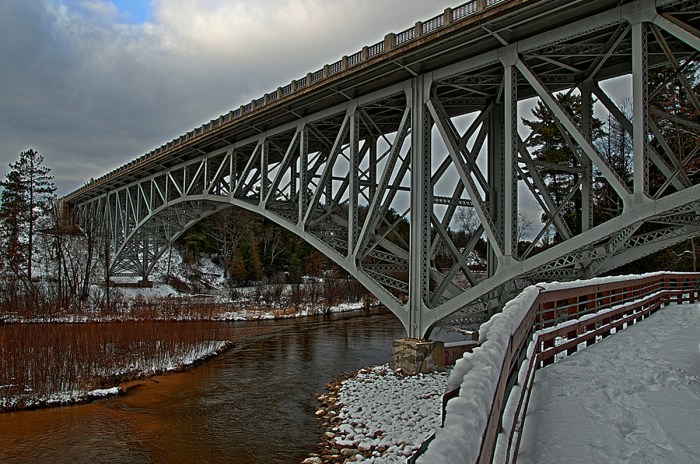
PS: Marilyn Wilkie shared that this is the Mortimer E Cooley Bridge on M-55. It’s a Metal Cantilever 12 Panel Rivet-Connected Pratt Deck Truss bridge built in 1935.
One Thanksgiving staple that Michigan is producing more of are cranberries, and you can get all kinds of information from the US Cranberry Marketing Committee. While it’s too late to get them this year, we have another cranberry that grows in Michigan you might not be aware of. Green Deane’s Eat the Weeds is a great blog, and his page on the High Bush Cranberry says (in part):
The High Bush Cranberry is actually a Viburnum (Viburnum trilobum) and a cousin of the elderberry. Both are in the greater Honeysuckle Family and have a characteristic musky odor. That family by the way straddles the edibility line, with some members edible and others not, some tasty and some not. As one might suspect by the name, the High Bush Cranberry has tart fruit. Bradford Angier, a well-known Canada-based forager along side Euell Gibbons, wrote they require a “conditioned palate” to appreciate.
In North America the High Bush Cranberry is found in Canada and the northern half of the United States plus, oddly, New Mexico. It is not as that friendly to wildlife as one might suspect. The fruit persists into the winter because they are not on the top of birds’ preferred food. Birds like the berries after they soften and ferment. White-Tailed deer also browse on the twigs and leaves. For humans the berries are high in Vitamin C, about 30 milligrams per 100 grams.
Viburnum trilobum has several disputed botanical names and several mistaken common names including Pimbina, Mooseberry, Cranberry Tree, Cranberry Bush, American Cranberry, and Squashberry.
Read on for lots more including identification tips. There’s much more Michigan Thanksgiving to feast on at Michigan in Pictures too!
Blondieyooper says she picked over 8 pounds of these gorgeous highbush cranberries in the UP back in October of 2011. View her photo background bigilicious and see more in her Fall 2011 slideshow.
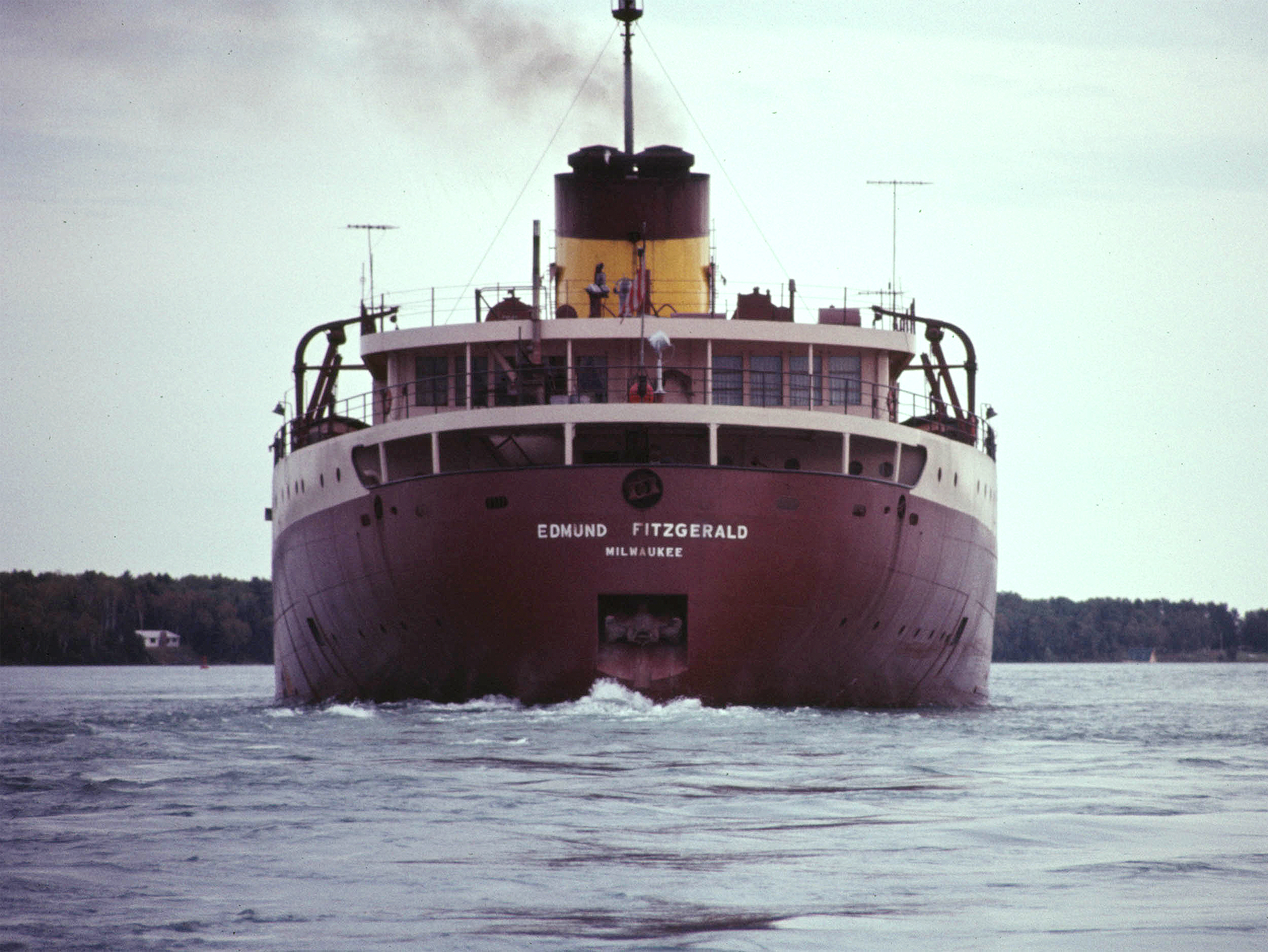
Every year, I revisit the story of the Edmund Fitzgerald on November 10th. I do this because I remember the ferocity of the winds on the day of the wreck vividly from my childhood, because as a Michigander Lightfoot’s song is probably coded in my DNA by now, and also because it’s very popular with readers. Nonetheless, the feature Should musicians decide the shipwrecks we know? from IPR News Radio by Peter Payette & Morgan Springer definitely struck a chord. There are thousands of ships that have gone down the world’s eighth sea, and so many families that have felt the loss when a sailor doesn’t return from one of the most dangerous jobs there is. We’d do well to remember some of the others as well!
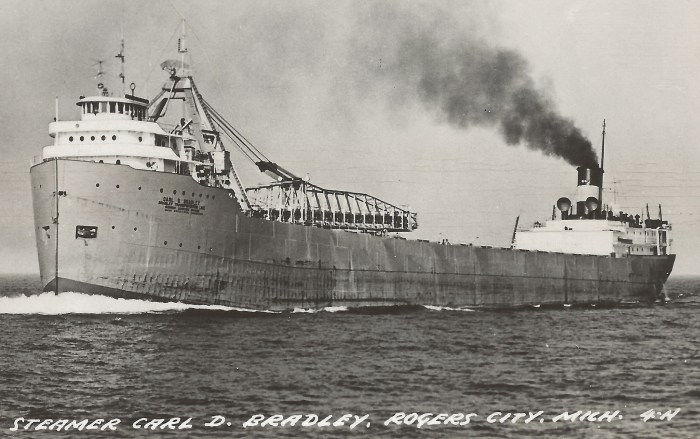
On this day in 1958, my vote for the most devastating Great Lakes shipwreck of the modern era took place. 33 of 35 crew members perished in the wreck, and 23 of them were from the town of Rogers City that boasted a population of less than 4000 people. The Presque Isle County Historical Museum’s website for the Steamer Carl D. Bradley tells the tale of the wreck of the Bradley:
The steamer was 638 feet long overall, with a 65-foot beam, a depth of 33 feet and a cargo capacity of 14,000 tons of crushed stone. The unloading boom was 160 feet long. The engineering and propulsion plant on the Carl D. Bradley was similar to that on the T.W. Robinson which was built two years before the Carl D. Bradley.
…The Carl D. Bradley, traveling light departed Buffington, Indiana around 9:30 pm, Monday, November 17, and headed up Lake Michigan bound for the Port of Calcite. Roland Bryan, a sailor since age fourteen, was the master. This trip was the last for the season and the steamer was going home. The Bradley never made it. In less than 24 hours the Carl D. Bradley was on the bottom of Lake Michigan and 33 of the 35-man crew were dead or missing.
When the vessel left Buffington, the winds were blowing up to 35 miles per hour from the south. The storm that was about to engulf the Bradley was developing over the plains when a cold front from the north met a warm front over the plains. The temperature in Chicago had dropped about 20 degrees that day. The forecast warned of gale winds. The crew prepared for severe weather by securing the unloading boom and the hatches. The steamer followed the route up the Wisconsin shore to Cana Island then changed course and cut across Lake Michigan toward Lansing Shoal. As the wind velocity increased, the crew filled the ballast tanks to maximum practical condition. By 4:00 pm of the next day, the 18th, the winds had reached 65 miles per hour. Even though the lake was rough and the winds high, the boat rode the heavy seas with no hint of the laboring.
Captain Bryan had asked the cooks to serve an early dinner. He knew the turn from Lake Michigan toward Lake Huron would put heavy weather broadside of the vessel. He wanted to give the mess crew the opportunity to clean up and secure before turning. The mess room was full of crewmembers anticipating going home.
About 5:30 pm First Mate Elmer Flemming radioed Calcite that the Bradley would arrive at 2:00 am. Then a “loud thud” was heard. In the pilothouse Captain Bryan and Flemming looked aft and saw the stern sag. Flemming immediately sent a distress signal over the radio. “Mayday! Mayday! This is the Carl D. Bradley. Our position is approximately twelve miles southwest of Gull Island. We are in serious trouble! We’re breaking up!” Captain Bryan sounded the general alarm, signaled the engine room to stop the ship, and blew the whistle to abandon ship. The power system failed and the lights in the bow section went out. The Bradley heaved upward near amidships and broke in two. The forward section rolled over and sank. The stern end plunged to the bottom. Within a few minutes the Carl D. Bradley was gone.
Read on for much more including theories of how the ship sank and the story of how deckhand Frank Mays & Elmer Flemming survived the wreck. At the website you’ll also find some cool old photos of the ship, newspaper clippings and photos of the crewmen lost at sea. The Wikipedia entry for the Carl D Bradley is particularly good as well with a lot more details!
This trailer for November Requiem, a DVD about the Carl D Bradley, the impact on Rogers City and the dive to the Bradley:
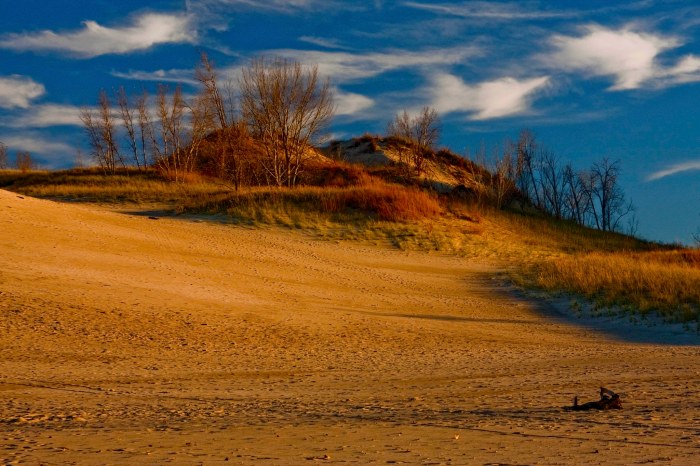
Edward K. Warren, of Three Oaks, was a pioneering conservationist. Long before he acquired his enormous wealth, Warren bought 300 acres of woodland in an effort to preserve a forest primeval. Wildlife abounds around the trails, which meander through Warren Woods that remains undisturbed and a natural treasure. Not surprisingly, Warren Woods can be found Warren Woods Road between Three Oaks and Lakeside. Warren Dunes State Park is a 1500-acre preserve located on Red Arrow Highway between Sawyer and Bridgman. Warren bought this land at the turn of the century again with conservation as his goal. Although most in the area saw the land as worthless, Warren wanted to preserve the majestic dunes that soar to more than 240 feet. The Park has a pristine two-mile beach as well as wildflowers and mature forests. Over a million people visit Warren Dunes annually [the state’s most popular park].
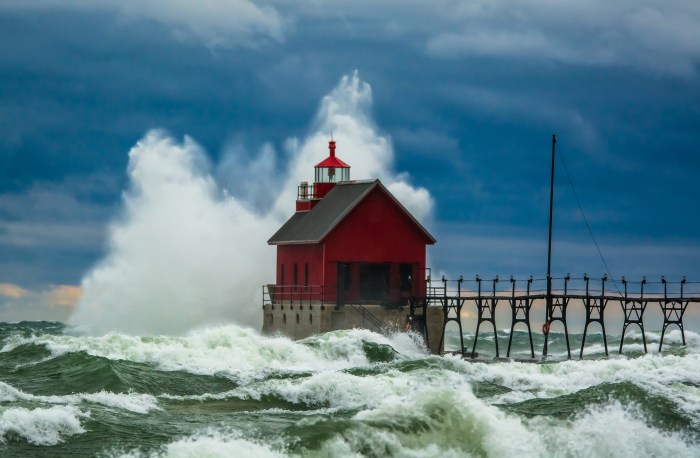
. . . Rita, . . . Sandy . . . Lake Michigan! Like the Weather Channel commercial, this lake which is only 60-80 miles across makes some of the best Gales of November! Grand Haven was busier than a summer’s day today, kind of disappointed I could not get a Pronto Pup or a Dairy Treat!
An intense low pressure system is still projected to slam into the western Great Lakes on Wednesday night.
The main hazard with this storm will be incredibly strong winds in excess to 45 m.p.h. at times. This will cause numerous issues, including downed trees and the potential for power outages.
In addition to impacts on land, Lake Michigan will also suffer the wrath of this strong fall storm, where waves could reach as high as 20 feet offshore. A gale watch has been issued by the National Weather Service in Grand Rapids for the Lakeshore and will be in effect from Wednesday evening through Friday afternoon.
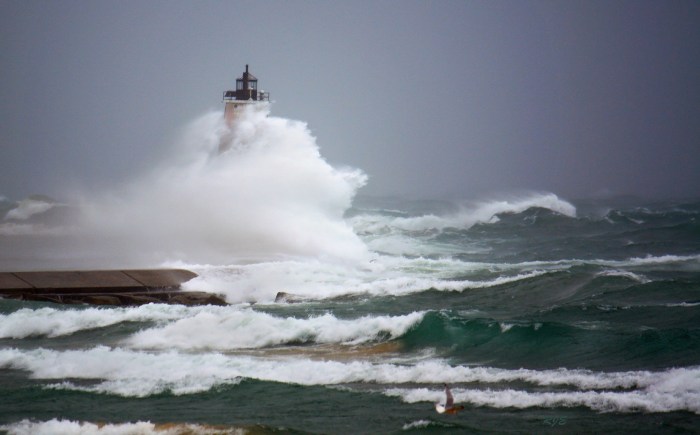
RJE caught this massive wave breaking against the Ludington lighthouse back in November of 2011. View the photo of big as Lake Michigan and see more of his great photos of Ludington on Flickr!
I went and bought all of the old newspapers, got everything in chronological order, and went ahead and did it because I already had a melody in my mind. It was from an old Irish dirge that I heard when I was about three and a half years old. I think it was one of the first pieces of music that registered to me as being a piece of music. That’s where the melody comes from, from an old Irish folk song. ~Gordon Lightfoot on The Wreck of the Edmund Fitzgerald
40 years ago today, Michigan’s most remembered shipwreck took place. A big part of this is certainly Gordon Lightfoot’s signature ballad The Wreck of the Edmund Fitzgerald. The song – familiar to almost every Michigander – seems to memorialize more than simply the 29 men who perished in that horrible storm. There is certainly no better video of this song than this one crafted by Joseph Fulton featuring footage of the Fitz that you’ve probably never seen. It starts out with Walter Cronkite’s Harry Reasoner’s news report from November 11, 1975 and just gets better from there – definitely worth your time!
mLive has an article about how & why Gordon Lightfoot wrote ‘The Wreck of the Edmund Fitzgerald’ that you should check out. It includes a nice little video where he shares how he’s edited the live lyrics to reflect what’s been learned about the sinking of the ship. They got Lightfoot’s account of the writing of the song from the songwriter’s Ask Me Anything on Reddit, an interesting look inside of the mind of a thoughtful and talented songwriter.
I woke up early this morning, and after seeing 5 meteors in just ten minutes, realized that the Taurid meteors were still kicking, how about an upcoming meteor shower update courtesy EarthSky’s 2015 meteor shower page:
Late night November 12 until dawn November 13, 2015, the North Taurids
Like the South Taurids, the North Taurids meteor shower is long-lasting (October 12 – December 2) but modest, and the peak number is forecast at about 7 meteors per hour. The North and South Taurids combine, however, to provide a nice sprinkling of meteors throughout October and November. Typically, you see the maximum numbers at around midnight, when Taurus the Bull is highest in the sky. Taurid meteors tend to be slow-moving, but sometimes very bright. In 2015, the new moon comes only one day before the predicted peak, providing a dark sky for the 2015 North Taurid shower.
Late night November 17 until dawn November 18, 2015, the Leonids
Radiating from the constellation Leo the Lion, the famous Leonid meteor shower has produced some of the greatest meteor storms in history – at least one in living memory, 1966 – with rates as high as thousands of meteors per minute during a span of 15 minutes on the morning of November 17, 1966. Indeed, on that beautiful night in 1966, the meteors did, briefly, fall like rain. Some who witnessed the 1966 Leonid meteor storm said they felt as if they needed to grip the ground, so strong was the impression of Earth plowing along through space, fording the meteoroid stream. The meteors, after all, were all streaming from a single point in the sky – the radiant point – in this case in the constellation Leo the Lion.
Leonid meteor storms sometimes recur in cycles of 33 to 34 years, but the Leonids around the turn of the century – while wonderful for many observers – did not match the shower of 1966. And, in most years, the Lion whimpers rather than roars, producing a maximum of perhaps 10-15 meteors per hour on a dark night. Like many meteor showers, the Leonids ordinarily pick up steam after midnight and display the greatest meteor numbers just before dawn. In 2015, the rather wide waxing crescent moon sets in the evening and won’t interfere with this year’s Leonid meteor shower. The peak morning will probably be November 18 – but try November 17, too.
Read on for viewing tips and definitely try and take a look up at night when you can as the northern lights have also been very strong lately!
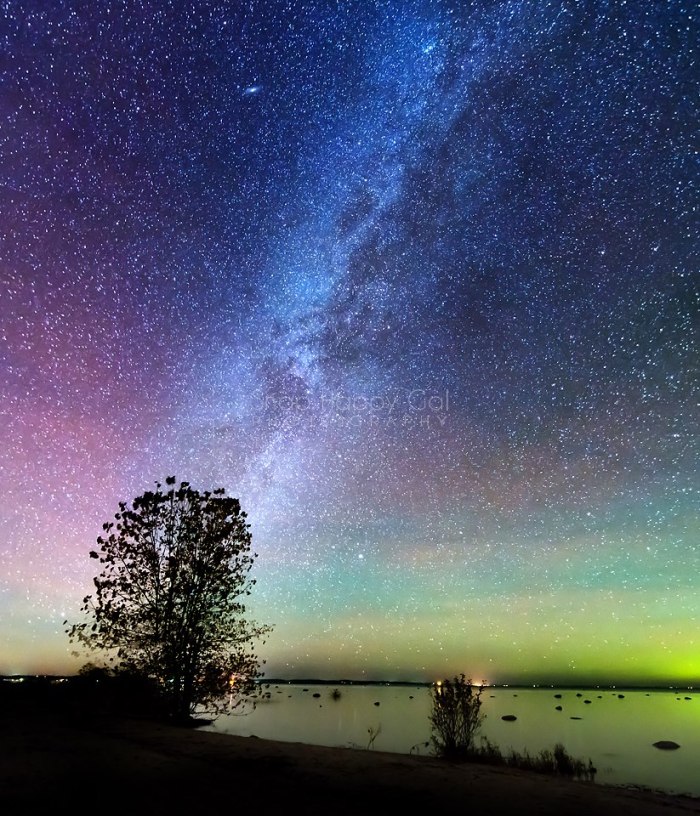
Heather writes that this image is a stitch of four 11mm frames with only minor adjustments to contrast – with no color saturation or vibrancy changes. It underscores what an incredible time for skywatching it is right now with low humidity making for extra-clear skies. View her photo background big and see more of her work at Snap Happy Gal Photography on Facebook!




#/media/File:Edmund_Fitzgerald,_1971,_4_of_4.JPG)
 Michigan in Pictures