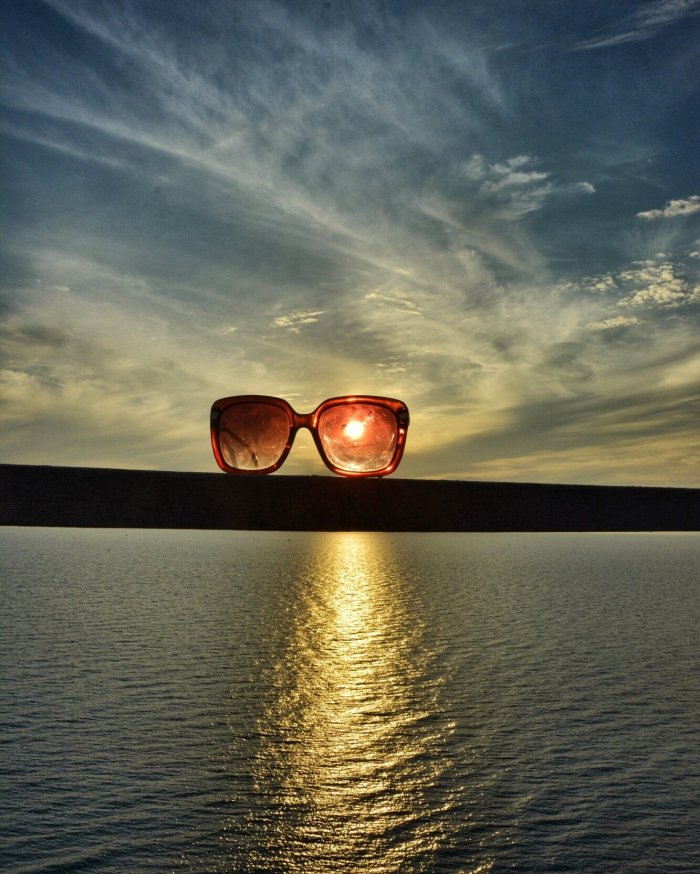
Since I shared something from the first day of fall, it seems only fitting that I share something from the last day of summer! Here’s a stunning sunrise over West Grand Traverse Bay in Traverse City by my friend John!
Click the pic to view it background bigilicious and get more from John, including professional portraits at jrwpix.com!
Mark took this back in July with Fuji Superia 400 color film. He says these blueberries have gone on to a better place … a blueberry pie to be precise.
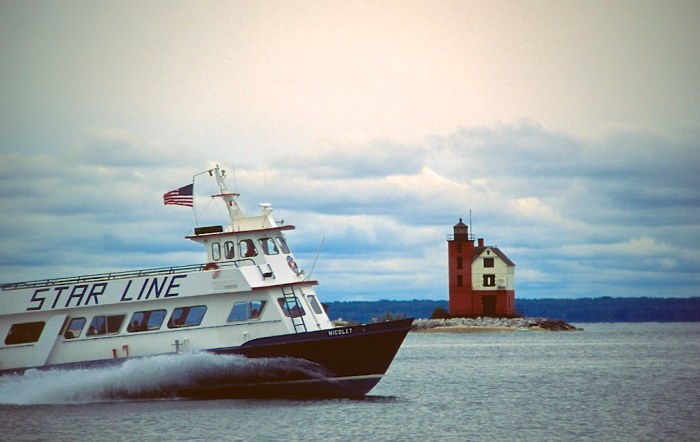
Bill took this photo 21 years ago on September 21, 1995! It shows the Star Line Ferry’sNicolet speeding past the Round Island Lighthouse. Star Line explains:
Star Line Ferry was started by Tom Pfeiffelmann, Sam McIntire, and others in the late 1970s. They purchased Argosy Boat Line. The company was then renamed Star Line after the 5 original stockholders making up a 5 pointed star. At that time they operated slower ferries including the Nicolet, Treasure Islander and Flamingo.
In 1979 Star Line bought their first fast ferry, Marquette. Over the next few years the old LaSalle and Nicolet were replaced with sisters to the Marquette. In 1987 Star Line decided to take it up a notch with Radisson, an 85-foot fast ferry which was modeled after a luxury yacht.
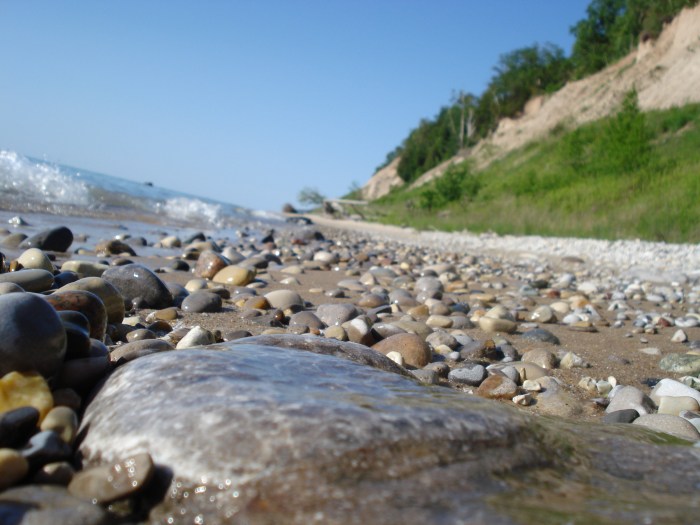
This is one of my photos that I dug up for another project that I wanted to share. Apparently this was taken during in my “tilty” phase. ;)
Here’s something beautiful that a young woman I know named Rose Petoskey wrote about Petoskey stones several years ago.
My name is Noozeen (Rose) Nimkiins (Little Thunder) Petoskey (Rising Sun) and I am Anishinaabek.
Many people would associate the word Petoskey with the souvenir stone found on the northern Lake Michigan shorelines. However, to my family, the word Petoskey represents much more than a souvenir.
In the Odawa language, the word Petoskey (Bii-daa-si-ga) means the rising sun, the day’s first light, or the sun’s first rays moving across the water. The Petoskey stone is a fossilized coral created by impressions made in limestone during the last Michigan ice age. These stones were named “Petoskey” because the impressions resembled the rising sun coming up over the water. Just as the image of the rising sun is implanted within the Petoskey stone, the archaeology of a person’s names is implanted within. All names within our Anishinaabek culture reflect an individual’s personal history. Rocks go deep, but names go much deeper to reveal the stories of the past.
PS: The other project was for a stone path that a friend is building this year at the Earthwork Harvest Gathering held next weekend near Lake City (September 16-18). It’s a wonderful festival packed with Michigan musicians!
Well, football season is almost here and Detroit Lions’ fans are probably feeling optimistic, so it’s probably time to explain The Curse of Bobby Layne:
In 1958, after leading the Lions to 3 NFL Championships and providing Detroit nearly decade of Hall of Fame play, the Lions traded Bobby Layne. Bobby was injured during the last championship season and the Lions thought he was through and wanted to get what they could for him. According to Legend, as he was leaving for Pittsburgh Bobby said that Detroit “would not win for 50 years”. In the pages that follow we present evidence that supports and confirms the existence of this curse which has been plaguing this team for nearly half a century.
Well, I hope that you had a wonderful weekend, and that if you traveled you are either still on vacation or had as enjoyable a return trip as this fellow.
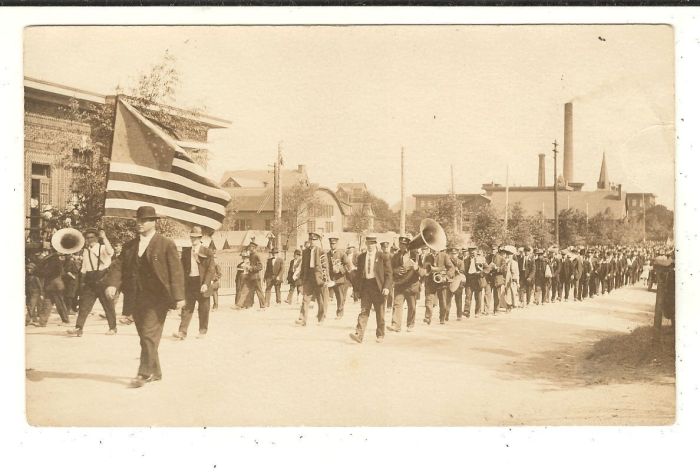
Labor Day has become little more than a three day weekend, and labor and labor unions are often frowned upon. Before you go out and enjoy that extra day off, you might take a moment to reflect that the 5-day week of 8-hour days that we take for granted was won with the sweat and tears and blood of dedicated men and women who put it all on the line. Many of these were from Michigan, like these Keweenaw copper miners who risked everything from the loss of their livelihood to outright murder.
As a friend said, as we honor the sacrifice of soldiers on Memorial Day, let us also honor all the hard-working people of today and days gone by who have fought for a better life.
View Wystan’s photo background big and dive into his slideshow for many more great old photos from Michigan!
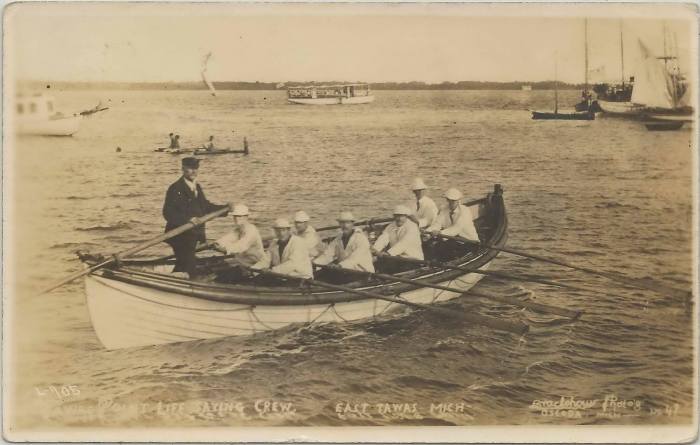
In 1878 the growing network of lifesaving stations was finally organized as a separate agency of the Treasury Department and named the U.S. Life-Saving Service. Sumner I. Kimball was chosen as the General Superintendent of the Service. Kimball held tight reign over the Service and, in fact, remained the only General Superintendent of the organization. The law which created the U.S. Coast Guard in 1915, also provided for the retirement of Kimball. The Service’s reputation for honest, efficient, and non-partisan administration, plus performance of duty, can be largely attributed to the efforts of this one man.
The stations of the Service fell into three broad categories: lifesaving, lifeboat, and houses of refuge. Lifesaving stations were manned by full-time crews during the period when wrecks were most likely to occur. On the East Coast this was usually from November to April, and was called the “active season.” By the turn of the century, the active season was year-round. Most stations were in isolated areas and crewmen had to be able to perform open beach launchings. That is, they were required to launch their boats from the beach into the surf. Before the turn of the century, there were very few recreational boaters and most assistance cases came from ships engaged in commerce.
Lifeboat stations were located at or near port cities. Here, deep water, combined with piers and other waterfront structures, allowed the launching of heavy lifeboats directly into the water by marine railways on inclined ramps. In general, lifeboat stations were located on the Great Lakes, but some lifesaving stations were situated in the more isolated areas of the lakes. The active season on the Great Lakes stretched from April to December.
…The U.S. Life-Saving Service had two means of rescuing people on board ships stranded near shore: by boat and by a strong line stretched from the beach to the wrecked vessel. The Service’s boats were either a 700 to 1,000 pound, self-bailing, self-righting surfboat pulled by six surfmen with twelve to eighteen foot oars, or a two to four ton lifeboat. The surfboat could be pulled on a cart by crewmen, or horses, to a site near a wreck and then launched into the surf. The lifeboat, following a design originated in England, could be fitted with sails for work further offshore and was used in very heavy weather. Some crews, at first, viewed the lifeboat with skepticism because of its great weight and bulk. The skepticism soon changed and crews began to regard it as “something almost supernatural,” for it enabled them to provide assistance “when the most powerful tugs and steam-craft refused to go out of the harbor. …”
Terry Pepper’s Seeing the Light has a bunch of information and photos of the Tawas Point Lighthouse.
“The heat is rising and only getting hotter, ready to blow I think I’ll pour myself a glass of water, let it flow She’ll show you what she’s made of Yeah she’s comin’ for ya She’s gonna try to break ya Yeah she’s comin’ for ya No, she don’t mess around” -Cage The Elephant, Mess Around
You know that when I pull out Cage the Elephant lyrics, I’m probably going to say something that will anger a slice of Michigan in Pictures readers, so be warned! Longtime readers will also know that I am pretty committed to saying what I want to say, so it’s probably good keep that in mind as well.
The planet is warming at a pace not experienced within the past 1,000 years, at least, making it “very unlikely” that the world will stay within a crucial temperature limit agreed by nations just last year, according to Nasa’s top climate scientist.
This year has already seen scorching heat around the world, with the average global temperature peaking at 1.38C above levels experienced in the 19th century, perilously close to the 1.5C limit agreed in the landmark Paris climate accord. July was the warmest month since modern record keeping began in 1880, with each month since October 2015 setting a new high mark for heat.
But Nasa said that records of temperature that go back far further, taken via analysis of ice cores and sediments, suggest that the warming of recent decades is out of step with any period over the past millennium.
“In the last 30 years we’ve really moved into exceptional territory,” Gavin Schmidt, director of Nasa’s Goddard Institute for Space Studies, said. “It’s unprecedented in 1,000 years. There’s no period that has the trend seen in the 20th century in terms of the inclination (of temperatures).”
Read on for more. I’d like to go on record as a parent and member of the human race that I’m really alarmed by this, and also the fact that what appears to be a serious emergency is being ignored.
I would really like to share the video of Mess Around from Cage the Elephant because I really like the band. In the interests of responsibility however, here’s a 30-second video showing the temperature rise of the last 145 years:





 Michigan in Pictures