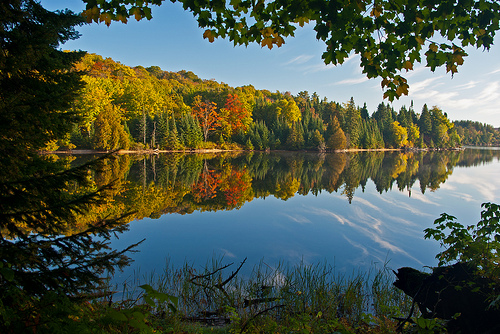
Grand Sable Lake in the Pictured Rocks National Lakeshore

Grand Sable Lake

Grand Sable Lake, photo by Gary of the North

The Michigan DNR says (in part from this PDF) that Grand Sable Lake:

…is a scenic undeveloped lake located in Alger County, about 6 miles southwest of Grand Marais. The 630 acre lake lies within the boundaries of the Pictured Rocks National Lakeshore (PRNL). The shoreline is mostly wooded with mixed hardwoods, conifers, and cedar species. Most of the surrounding soils are sandy. Sand dunes 200 ft high are located on the north end. Grand Sable Lake has a maximum depth of 85 feet, but averages around 35-40 feet. The banks drop off quite rapidly. Even so, the shoreline at the public access site on the northeast shoreline remains shallow for over 200 feet, dropping quickly into deep water…

Access to the lake before the area became part of the PRNL was from the small park on the north end. At that time, the park was managed by the village of Grand Marais. A 1949 fisheries survey documented the presence of rock bass, northern pike, yellow perch, smallmouth bass, white suckers, and minnow species. Past stocking efforts included rainbow trout, splake, smelt, smallmouth, largemouth, pike, bluegills, and lake trout.

It’s apparently 50% white suckers now – click through to read more. Also see the Grand Sable Loop at DW Hikes.

Check this out background big and check out some other views here and here. More in Gary’s Pictured Rocks National Lakeshore slideshow.

Much (much) more from the awesomely amazing Pictured Rocks National Lakeshore on Michigan in Pictures!
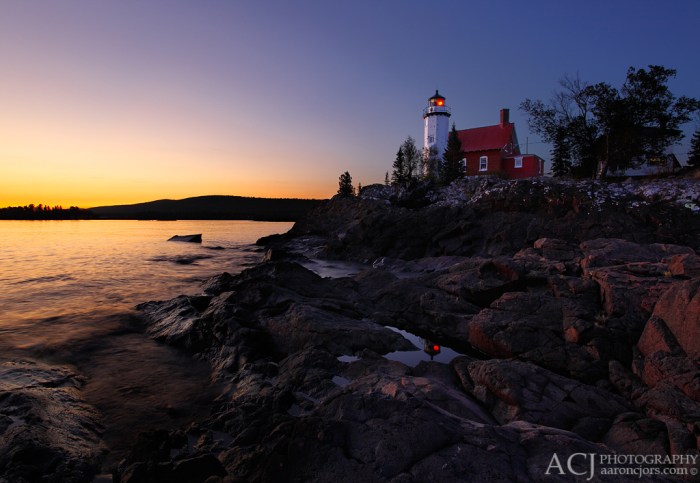
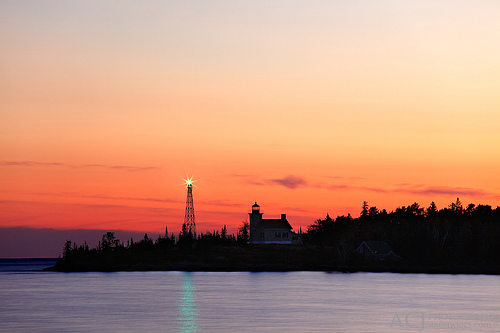
Eagle Harbor Lighthouse

Eagle Harbor Lighthouse Sunset

Reflecting Light – Eagle Harbor Lighthouse (Eagle Harbor, MI), photo by Aaron C. Jors.

Our tour of the lighthouses of the Keweenaw Peninsula with Aaron Jors continues with the light at Eagle Harbor.

The Eagle Harbor Lighthouse from Terry Pepper’s Seeing the Light tells of the first light built in 1850 at the western point of Eagle Harbor built in 1850 and the rubble stone keeper’s dwelling with a square white-painted wooden tower integrated into one end of the roof. As with many lights built during the penny-pinching Pleasonton administration, the light was judged to be “laid together in the rudest manner” and targeted for replacement.

Rather than creating a unique set of plans for the new station, Eleventh District Engineer Brevet Brigadier General Orlando M. Poe resurrected a plan which had been previously used on Chambers Island in 1867 and at Eagle Bluff in 1868. After blasting out a hole for the cellar, the masons crafted a two-story dwelling red brick dwelling, 29-foot by 25-foot in plan, with an integrated 44-foot tall tower oriented diagonally into its northeastern corner. The exterior of the first and second stories of the tower were approximately ten feet square with buttressed corners, while the tower’s upper portion consisted of a ten-foot octagon. The tower was double-walled, with a circular inner wall approximately four inches thick and eight feet in diameter. This cylindrical inner wall supported a cast iron spiral staircase which wound from the oil storage room in the cellar to a hatch in the lantern floor. Since these spiral stairs also served as the only means of moving between floors in the dwelling, steel doors provided access to landings on both the first and second floors to prevent the spread of any fire in either the dwelling or tower.

Read on for much more and get information of visiting the lighthouse from the Keweenaw Historical Society.

Check this out bigger and in Aaron’s Lighthouses slideshow.

Many (many) more Michigan Lighthouses from Michigan in Pictures.

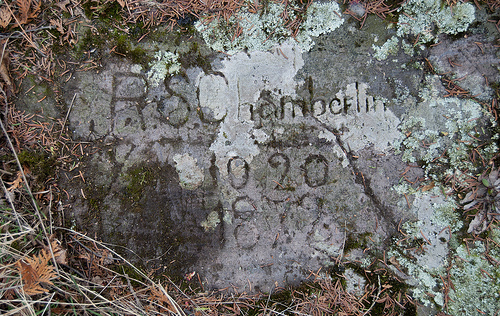
Mystery Monday: Who Was R.S. Chamberlin?

Mystery!

Mystery!, photo by I am Jacques Strappe.

Yesterday Marjorie went hiking on a mountain near Marquette where she came across this carving that reads R.S. Chamberlin 10 20 1872. She writes:

Near the highest point of the mountain was a small outcrop of rock. This was carved into it — though it had been hidden by grass and pine needles until one in our party found it by chance and cleared it all away.

Check it out bigger, see more photos from the day in her slideshow and if you have ideas as to the identity of R.S. Chamberlin, post them here!

PS: Lots more (including a great profile) from Marjorie on Michigan in Pictures!

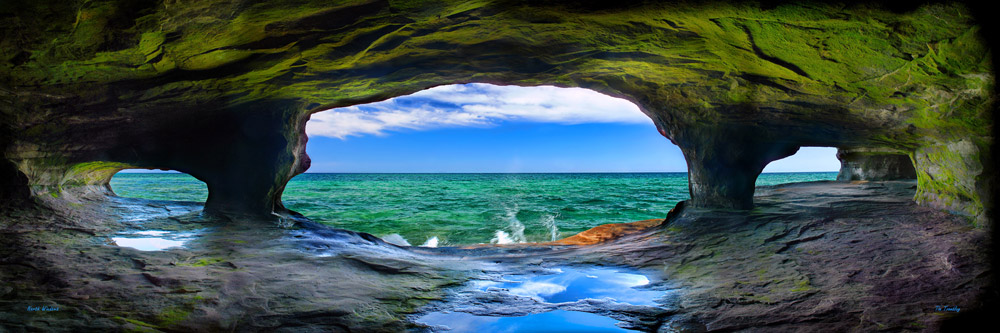
North Windows

North Windows, photo by Tim Trombley

One of my favorite web sites is the Great Lakes Echo, a fantastic news source for Michigan and the Great Lakes. Recently they asked Great Lakes photographers to send their favorite and toughest Great Lakes shots, and UP photographer Tim Trombley responded with this one, explaining:

This cave was only accessible by kayak. I had to land way down the shoreline and got wet feet making my way inside. Once there, the shot required me to crouch and back into the sandstone recesses allowing sand to drop down my collar. Scrunched with wet knees, I panned the camera for three shots that were later merged into this panorama. The clarity of Lake Superior and the reflection of the blue sky give this image a “tropical” look.

Click through for another great shot from Tim of a Lake Superior iceberg.

You have to check this photo out bigger – it’s hard to fully appreciate if you don’t! Be sure to view his photo gallery at GreatLakesPhotography.net for many more works and ordering. You can also call Tim at (906)439-1551 or email.

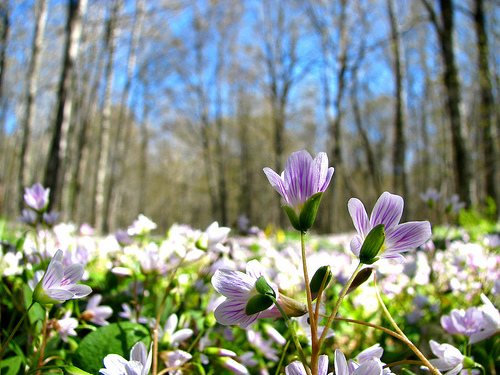
Spring Beauties say welcome spring!

tinyflowers_vista

tinyflowers_vista, photo by CreateWithKim

Wikipedia’s entry for the season of Spring says that the  vernal equinox, the point when the earth is straight on its axis and the sun passes directly over the equator. That put the official start of spring at 1:14 AM EST this morning. As the northern hemisphere tilts sunward, temperatures begin to warm and all kinds of good stuff starts growing and popping. A few of my personal favorites are daffodils, crocuses and yes, spring beauties. Yours?

According to the University of Michigan Herbarium, Michigan is home to two native species of ClaytoniaClaytonia caroliniana and Claytonia virginica:

The two native species of Claytonia only rarely grow side by side in the same forests in Michigan. When they do, C. virginica reaches the peak of its flowering later by at most a few days than C. caroliniana. The vegetative parts of both turn yellowish after a short flowering and fruiting season in the spring, and soon the plants are no longer seen above ground in forests which may have been carpeted with them a month previously. Both native species are extremely variable in leaf shape and size as well as in other characters, such as the aberrant presence of extra leaves on the stem. The petals are usually pale pink with deeper colored veins, but the ground color ranges from white to very deep pink; the corolla may be as much as 27 mm broad.

The photo above looks like virginica, but Kim shot this on the Pictured Rocks National Lakeshore and the Herbarium doesn’t list Alger as one of the counties it is found in.

Check this photo out bigger and in her Mostly Wildflowers slideshow.

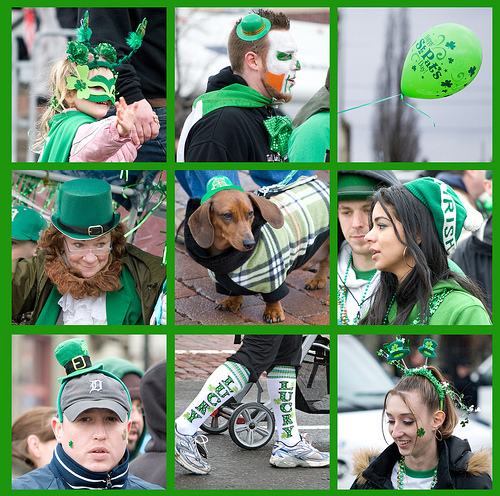
Corktown, the Irish and St. Patrick’s Day in Michigan

Saint Patrick's Day Parade

Saint Patrick’s Day Parade, photo by *Alysa*.

May your blessings outnumber the shamrocks that grow,
And may trouble avoid you wherever you go.
~Irish Blessing

Happy St. Patrick’s Day everyone! Detroit had their parade last weekend but there are events on tap today and tomorrow in Bay City, Clare, Flint, Kalamazoo, Grand Ledge,  Saugatuck, Traverse City and Muskegon.

Ground zero for the Irish in Michigan is Corktown. Wikipedia notes that it is Detroit’s oldest neighborhood explaining:

The roots of Corktown lie in the Great Irish Potato Famine of the 1840s. The Irish immigrated to the United States in droves, and by the middle of the 19th century, they were the largest ethnic group settling in Detroit. Many of these newcomers settled on the west side of the city; they were primarily from County Cork, and thus the neighborhood came to be known as Corktown. By the early 1850’s, half of the population of the 8th Ward (which contained Corktown) were of Irish descent

The Corktown Historical Society has a cool slideshow of historic photos and brochure images and you might want to check out the Corktown Explorer blog.

The Irish in Michigan from Seeking Michigan has some information about Corktown but adds that:

Irish immigrants to Michigan certainly did not limit themselves to settling in the urban hub of Detroit, with many of them making their way up north. In the 1830s, Irish immigrants settled in fishing camps on Mackinac and Beaver Islands. Today, a large portion of Beaver Island’s year-round residents are of Irish descent. Wexford, Clare, Emmet and Antrim counties in the northern Lower Peninsula are all named after counties in Ireland. Irish immigrants were also instrumental to the copper mining boom in the Upper Peninsula. Nearly one-third of the area’s foreign-born population was from Ireland in 1870, though the Irish population would decline by 1920. Many small Irish communities could also be found scattered throughout the Lower Peninsula in the 1800s and early 1900s.

Wherever you are and whoever your ancestors were, here’s hoping you have a fun and safe St. Patrick’s Day holiday!

Check this out bigger and in Ann Lysa’s slideshow.

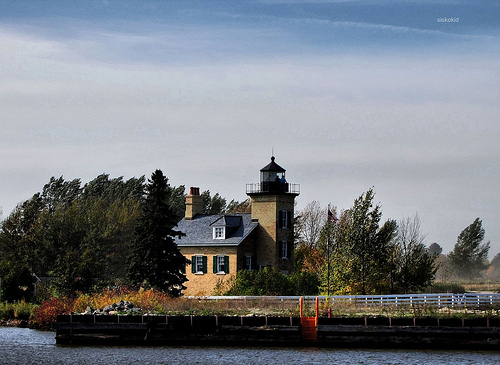
Ontonagon Lighthouse: Gateway to Copper Country

Ontonagon Lighthouse

Ontonagon Lighthouse, photo by siskokid

The Ontonagon Lighthouse is part of the Ontonagon Museum. Their page on the lighthouse explains that:

America’s first mineral rush began in earnest with the opening of the Copper District in Michigan’s Upper Peninsula to the prospectors and mining developers following the Treaty of 1842 with the Ojibwe nation. Suddenly there was a great need for navigational aids. Among the first five lighthouses established on Lake Superior was the one at the mouth of the Ontonagon River, the largest river that flows into Lake Superior from the south shore. In 1851, a wooden lighthouse was constructed on the west side of the river’s mouth to guide ships to the port from which copper was being shipped from the mines upriver. In 1857, the Winslow Lewis light was replaced with a 5th order Fresnel lens, the latest thing in lighting technology.

At that time, there was a sand bar across the river’s mouth, so only smaller craft could enter the bowl-shaped harbor (the name Ontonagon is a corrupted Ojibwe word that infers a bowl or bowl shape). With the opening of the first Soo Lock in 1855, shipping volume increased dramatically. Permanent breakwaters were constructed at Ontonagon, the sandbar was dredged out, and Ontonagon became the busiest port on Lake Superior.

You can get lots more information and photos about the Ontonagon Lighthouse and the copper boom in the region from Terry Pepper’s Seeing the Light.

Jim adds that the light was deactivated in 1963 after an automatic foghorn was installed on the west pier and a battery light was located at the end of the east pier at the  entrance into the Ontonagon harbor and marina. See his photo bigger and see more in his Lake Superior Lighthouses slideshow.


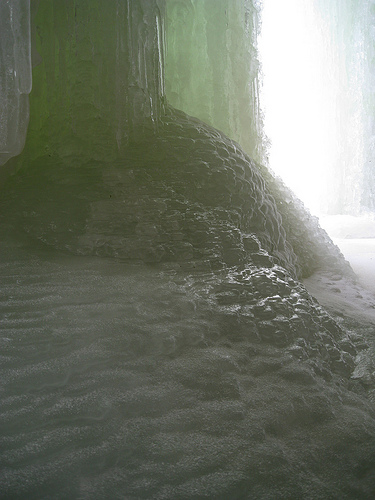
Build-up: Inside the Eben Ice Caves

Build-up

Build-up, photo by nasunto.

“The drips of water falling from above created wonderful echoes and added to the cave atmosphere. There is much variation of color and texture to the ice in different parts of the cave. Some formations were smooth and clear, others were bumpy and hollow-sounding, and there were some columns that looked like dripping candle wax.”
~Nina Asunto on being inside the Eben Ice Caves

This may be the latest I have ever posted a Michigan in Pictures. Busy, busy I guess.

Nina took this photo at the Eben Ice Caves, which are a very popular subject on Michigan in Pictures. In Monday’s Daily Michigan email (which I think you might enjoy as it is Not Too Terribly Long and also Filled With Michigan Stuff & Giveaways) we featured Nina’s video from these seasonally forming caves in the Rock River Canyon Wilderness Area.

Nona has a great blog called Black Coffee at Sunrise with writing and photos from some of Michigan’s coolest places, and her Eben Ice Caves feature is a must-read. View her photo as big as you like and see her other shots and the video in her Eben Ice Caves 2012 slideshow.

PS: Separated at birth?

Sunrise at Copper Harbor Lighthouse

Bounded Light - Copper Harbor Lighthouse (Copper Harbor, MI)

Bounded Light – Copper Harbor Lighthouse (Copper Harbor, MI), photo by Aaron C. Jors.

The Freep had a feature on the most romantic places to visit in Michigan. I was happy to see that two of their 5 sunset spots were in my native Leelanau Peninsula. There’s bunches of Leelanau on Michigan in Pictures, so I figured I’d pick another. Since there are also a whole lot of sunsets, how about a romantic sunrise over the Copper Harbor Lighthouse on the Keweenaw Peninsula?

Terry Pepper’s Seeing the Light says that the discovery of copper in the Keweenaw drew so many immigrant Cornish and Finnish miners seeking their fortunes that one pioneer observed that “the shores of the Keweenaw became whitened with tents.” Terry’s entry on the Copper Harbor Lighthouse says that the original light from 1849 was exemplary of the poor planning and tight budgets of the administration of Stephen Pleasonton. Pleasonton was also the man who saved the original copy of the Declaration of Independence, so you win some and lose some I guess. In any case:

By the early 1850’s a cry arose in the maritime community, voicing concern over Pleasonton’s tight-fisted administration of the nation’s aids to navigation. A clerical administrator, Pleasonton had no maritime experience, and it showed-up in the sub standard workmanship and poorly chosen locations of many of the lighthouses erected under his administration. A study commissioned by Congress recommended the establishment of a nine-member Board to oversee the administration of aids to navigation. Staffed with Navy officers and Engineers from the Army Corps of Engineers, the Lighthouse Board was established in 1852, relieving Pleasonton from any further involvement. One of the Board’s first orders of priority was the upgrading of illumination systems from the dim and poorly performing Argand lamps to the far more efficient and powerful Fresnel lenses manufactured in Paris. However, with the Copper Harbor Light not being of major importance in the greater scheme of things, it would be some time before its lens would be upgraded, and thus the Argand lamps continued to light the way into the harbor.

…In 1856, a work crew finally arrived in at the station and removed the Argand lamps from the lantern, and replaced them with a single fixed white Sixth Order Fresnel lens, thus increasing the station’s range of visibility to ten miles at sea. Three years later, the Light was upgraded further through the replacement of the Sixth Order lens with a more powerful fixed white lens of the Fourth Order.
As was the case with virtually all of the lighthouses built on the Great Lakes during the Pleasonton administration, the true costs of inferior materials and shoddy workmanship began to show. After his 1864 visit to the station, the Eleventh District Inspector remarked that the Copper Harbor lighthouse required “extensive repairs.” On subsequent investigation, the condition of the tower was determined to be beyond repair, and the following year the decision was made to raze the old tower and erect a completely new structure.

Read on for more on the construction of the new light and to see some great old photos. Also see Terry Pepper’s explanation of Argand and Fresnel lamps.

Check this out on black and in Aaron’s Great Lakes Lighthouses slideshow.

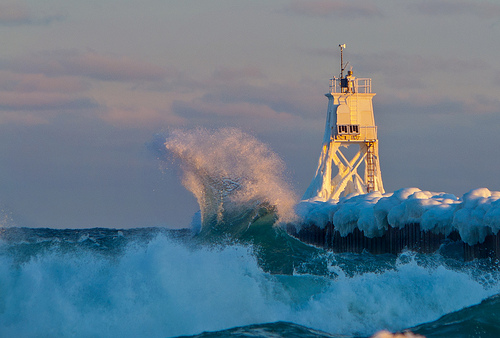
Break Wall Sunrise

Break Wall Sunrise

Break Wall Sunrise, photo by Gary of the North.

Here’s yesterday’s sunrise in Grand Marais, Michigan … it’s pretty clear that Lake Superior was wide awake.

Check it out background bigtacular and see a lot more photos from the area on Gary’s map.

More winter wallpaper from Michigan in Pictures!