Photographic Proof of the Michigan Cougar!

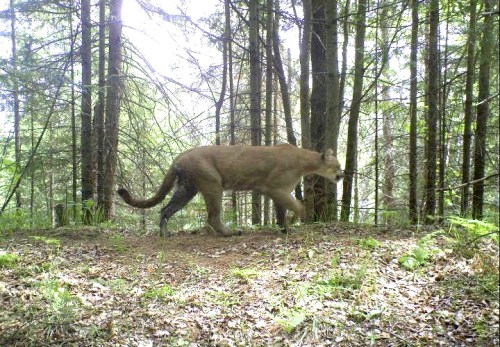
Marquette County Cougar, photo by Michigan Wildlife Conservancy

A trail cam in southern Marquette County operated by the Michigan Wildlife Conservancy (MWC) recently captured the above photo of a cougar. Dr. Patrick Rusz, Director of Wildlife Programs for the MWC and retired DNR forester Michael Zuidema verified the trail camera’s location on a well-worn wildlife trail atop a wooded ridge. The camera has also photographed wolves, coyotes, fishers and numerous other species at the same site over a four year period.

The MWC is publicizing this photograph because it may be the best, clearest photograph of a wild Michigan cougar ever taken. It is also unusually interesting because Mr. Zuidema has recorded over twenty credible cougar sightings in the same vicinity since the 1970s. These include several sightings within a few miles of the trail camera location.

Dr. Rusz stated that “the long history of sighting reports in the area indicates the cougar photographed on June 1 may be part of a resident population rather than a wandering cat from a western state.” Dr. Rusz has studied cougars for the Conservancy for 14 years and is co-author of a peer-reviewed study that confirmed cougars in both peninsulas of Michigan by analyses of DNA in droppings. He has also identified a long list of additional physical evidence dating back to 1966, and notes that Michigan State College zoologist Richard Manville documented several cougar sightings or incidents when he inventoried the fauna of Marquette County’s Huron Mountains from 1939 to 1942.

“The MDNR cougar team should now look at the very good evidence of a remnant cougar population collected before 2008,” said Bill Taylor, President of the Conservancy. “They could still easily verify cougar photos taken in the 1990’s in Alcona and Oscoda Counties in the Lower Peninsula and some others. The vegetation and other landmarks needed to confirm the photos are still there.”

You can compare the photograph above with photos of a wolf, coyote, raccoon, and porcupine taken by the same camera in the same location at the MWC website at www.miwildlife.org.

The Michigan Wildlife Conservancy is a non-profit citizens group established to restore Michigan’s wildlife legacy. They have restored more than 8,200 acres of wetlands, 2,500 acres of prairies and grasslands, and hundreds of miles of trout streams, and helped with several rare species recoveries and the creation of many backyard habitats.

More about cougars in Michigan on Michigan in Pictures and weigh in with your comments below or on the Absolute Michigan Facebook!
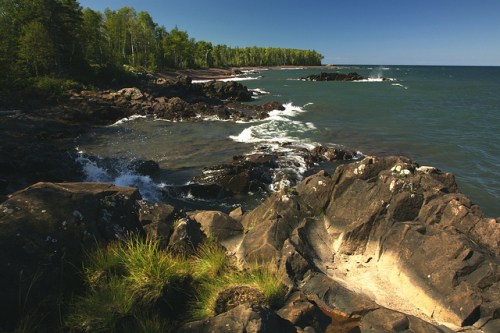
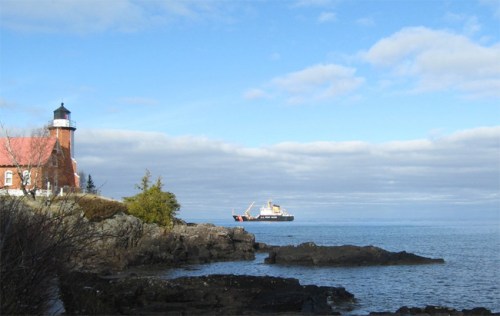
Seven Mile Point on the Keweenaw Peninsula

Untitled

Untitled, photo by North Woods Conservancy

When someone with the commitment to jump into the icy waters of Lake Superior in February asks you to take a look at something she thinks is important, my feeling is that you darn well do it.

Kate shared news that the Keweenaw-based North Woods Conservancy owns a piece of property called Seven Mile Point. It’s 32 acres with 1,854’ of sand, basaltic bedrock and volcanic cobble beach located on Lake Superior about 5 miles from Eagle River. The Michigan Natural Features Inventory listed it for high-priority protection due to the unique plant and animal communities associated with the 1.1 billion-year-old basaltic lava flow lakeshore.

While they were able to get going with the purchase, they haven’t been able to raise enough funds to make the payments. They’re seeking folks to help with one-time or monthly donations. Click for more information and photos of this gorgeous spot and also follow them on Facebook!


You can get this photo background big and in their Seven Mile Point slideshow.

More of Lake Superior on Michigan in Pictures.

Dragonfly in the Northern Sky

Dragonfly

Dragonfly, photo by Xavist on the colorful way

Sorry failing to post the last two days – I hope these stunning northern lights shots make up for it a little. Xavist took them last night on the Keweenaw, but I saw them all the way down in Frankfort!

Check this out bigger and see many more in his slideshow.

Many (many) more Michigan northern lights shots on Michigan in Pictures!

George’s Eagle Harbor Web

November 11 2008 Walkabout, photo by George Hite

“To Serve”, that’s the whole idea. Other Web sites set forth the natural, cultural and historic wonders of this special place for all to see. This site is designed to respond to more basic needs of those who live here — like what’s going on and, more importantly, the desire we all have for the delight and support of “neighborhood”.
~George Hite, November 1996

Last November 1, George Hite of Eagle Harbor passed away at his home at the age of 80. His memorial service is planned forJuly 28, 2012 and I thought it would be good to post one of his photos to remember one of the early pioneers of blogging in Michigan.

I first became aware of George’s Eagle Harbor Web in 1997 when looking for information about Eagle Harbor and the Keweenaw Peninsula. Over the years and along with many others, I followed life in the small town of Eagle Harbor through his photos and updates about longtime residents, new arrivals and the changing seasons. I hope you get a chance to take a moment to shuffle through his photos and writing and reflect upon a man who spent a lot of his life in service to his neighbors.

Farewell George.

Sunset over Copper Harbor

Sunset over Copper Harbor

Sunset over Copper Harbor, photo by Xavist on the colorful way

You may remember Xavist from his sweet northern lights shots in April. (he shot some at Yellowstone last week)

Check this out big as the sky or on his map.

The U.P. is open for business!

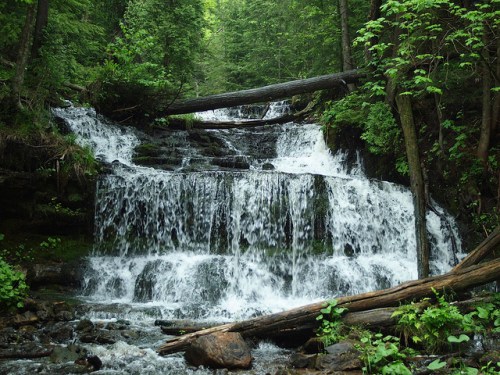
Wagner Falls

Wagner Falls, photo by karstenphoto

The Michigan DNR reports that fire crews are making good progress on the Duck Lake Fire in Luce County and that campgrounds, state parks, resorts and other businesses throughout the region and the Upper Peninsula are ready & waiting to deliver Pure Michigan fun! Tahquamenon Falls State Park was completely untouched and the Upper Falls viewing area and Lower Falls campground and visitor center are open. The fire itself isn’t putting up a smoke plume, it’s in a remote area and there hasn’t been significant activity since Monday.

One of the main businesses of the Upper Peninsula is tourism, and waterfalls like this are one of the draws. GoWaterfalling says that Wagner Falls is located south of Munising. It has its own state scenic site and after a short & pleasant boardwalk, you get to see this pretty waterfall!

Check this out background bigtacular and see more in Steven’s falls slideshow.

Michigan’s State Tree: White Pine (Pinus strobus)

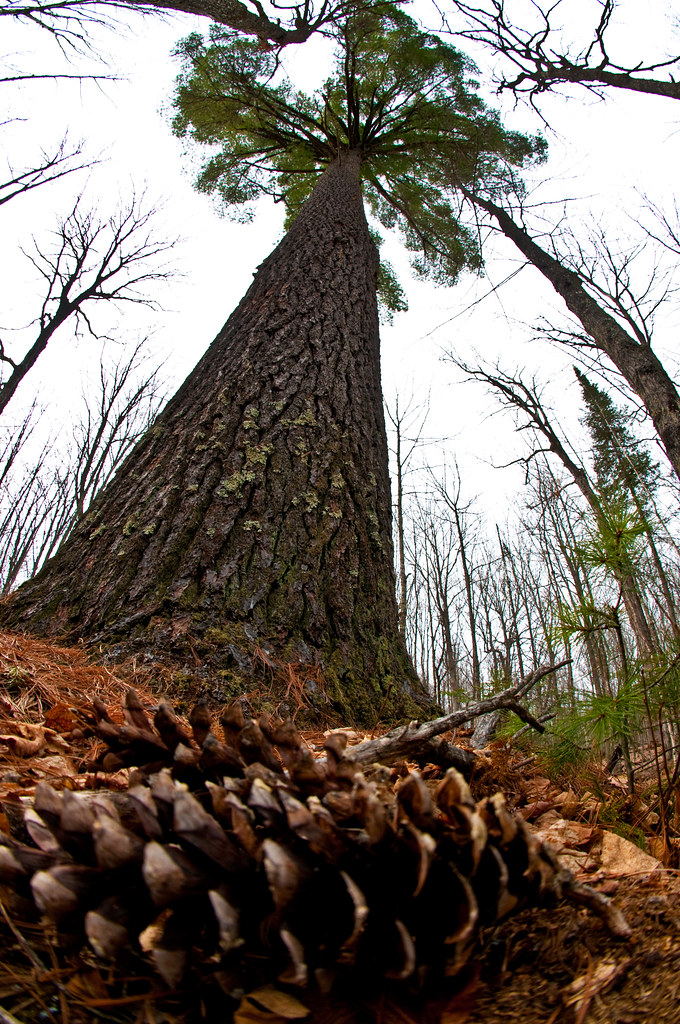
Michigan Wite Pine by Sven

13/52 by Sven

This week is Arbor Week, a week dedicated to celebrating and planting trees. One tree for Michiganders to celebrate is the eastern White Pine (Pinus strobus), which was adopted as our official State Tree by Act 7 on March 4, 1955. Here’s an edited summary of what I’ve learned about white pines.

The eastern white pine, is also known as “soft pine.” It was called the Tree of Peace by the Iroquois and in Ojibway, Zhingwaak. Mature white pines can easily live 200+ years of age, with some Michigan trees that have approached 500 years in age. The eastern white pine has the distinction of being the tallest tree in eastern North America, and pre-colonial stands were reported over 200′ in height.

It was said that when settlers arrived, a squirrel could travel in the forest canopy from one side of the state to the other. With this amazing resource, Michigan led the nation in lumber production in the 1880s and 1890s, and by the early 1900s, over 100 million of Michigan pine trees worth more than all the gold mined in California had been felled in the Lower Peninsula. Most of that value was in white pine, an when the forest was depleted, timber companies moved to the UP.

Small white pines are popular as Christmas trees due to their ability to hold needles, while large white pines were prized as ship masts and known as mast pines by the British navy. These trees were marked with a broad arrow by agents of the crown, a very controversial action that was one of the factors leading to the Revolutionary War. The original masts on the USS Constitution (aka Old Ironsides) were single trees before they realized that laminated trees were better about to withstand cannon fire.

More about the White Pine in Michigan

Scott writes that this mighty 200+ year old White Pine was spared the lumberjack’s axe, but he’s glad to have this remnant of the forest that once covered Upper Michigan standing sentinel in the forest surrounding his cabin. Check it out bigger and in his Fisheye slideshow. More of Scott’s work on his Facebook.

More of Michigan’s tallest things and more Michigan state symbols on Michigan in Pictures.

Support Michigan in Pictures with Patreon

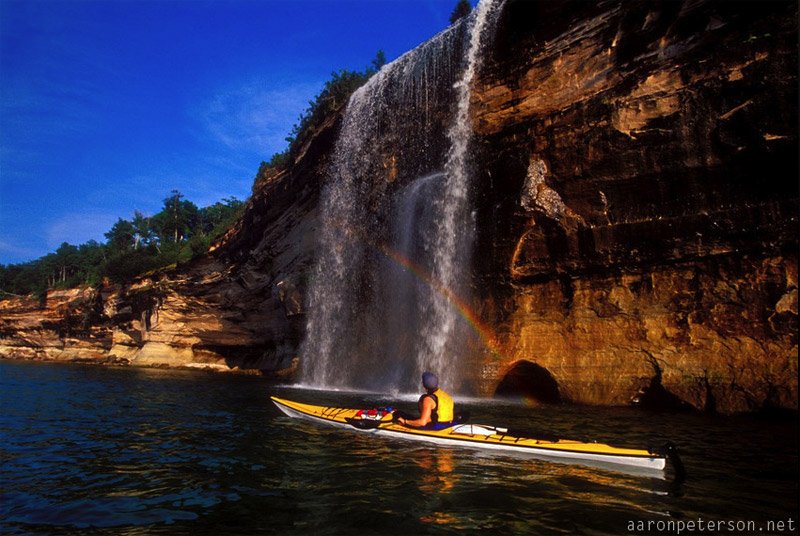
Kayaking at Spray Falls in the Pictured Rocks National Lakeshore

Kayaking at Spray Falls, photo by Aaron Peterson

In Wednesday Waterfall: Spray Falls on his blog Aaron writes:

Remote Spray Creek bubbles up somewhere in the middle of Pictured Rocks National Lakeshore, meanders through miles of maple and beech forest—then flies foam-first over a 50-foot cliff into Lake Superior. Seeing the creek upstream, you’d never guess the little guy had it in him to become one of the most dramatic waterfalls in the region.

Due to its remote location and precipitous drop, visitors to Spray Falls will have to decide ahead of time how they’d like to view it: from land, or from water. Each gives an amazing perspective and a good workout (3 miles by foot, 12 miles by float). Either way, you can contemplate gravity and the world’s largest lake in peace, because the park’s tour boats usually turn around a couple miles short of this fascinating feature. Scan the water at the base of the falls for the rusting remnants of a boiler from an 1856 shipwreck.

Read on for directions and another stunning shot of this amazing waterfall. Click to see this photo bigger and check out some more shots by Aaron of Spray Falls and view a lot more of his photography of the Upper Peninsula and the Lake Superior region on his website.

Many more Pictured Rocks photos on Michigan in Pictures.

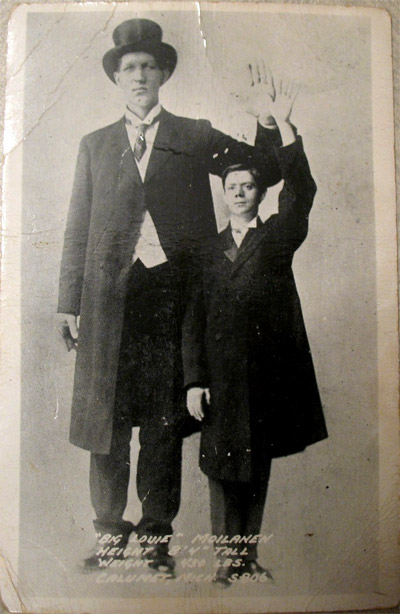
Michigan’s Tallest Man: Louis “Big Louie” Moilanen

Louis “Big Louie” Moilanen

Our impromptu “Michigan’s Tallest” series continues with the tale of Louis “Big Louie” Moilanen. The entry on Louis Moilanen at thetallestman.com explains:

Louis Moilanen (also known as Lauri Moilanen and Louie Moilanen) came to the Keweenaw at the age of four in 1889, the son of Louis and Annie Moilanen. The family arrived from Finland and homesteaded just north of Hancock in the Salo district. Little Louie thrived in the new environment overlooking Lake Superior and at nine years old he was the height of an average man. Ten years later he was declared to be the tallest man in the world. Big Louie was seven foot nine inch tall, even though his parents were just five foot. When young Louie came to town in his horse drawn buck board it was quite a sight. Buying clothes was difficult, so the Ed Haas Men’s Store in Houghton tailored clothes for Louie and special ordered size 19 shoes and size nine Stetson hats. Louie lived not too far from the Boston mine where he got his first non-farming job as a timber man in the Franklin Junior. Setting and shimming large timbers with block and tackle in the small stopes and drifts was hard work, but fellow miners said he could do the work of two men. Louie’s size was a handicap and he soon found out that the mines were designed for five foot men.

Read on for more about Big Louie (including photos) and his career with Ringling Brothers, as a tavern owner in Hancock and as Justice of the Peace. There’s a little more information at Yooper Steez including Louie’s hometown of Boston, now a ghost town. The comments are especially great, with many memories of Louis and his family. While Louis Moilanen’s height was never verified, he would have ranked between 4th (at 8’4″) and 9th (at 8’4″) among the tallest people in the world. Curiously enough, the tallest person ever recorded, 8’11” tall Robert Wadlow of Alton Illinois, died in Michigan on July 15, 1940. The Daily Mining Gazette adds that:

Although exactly how tall Moilanen was is a matter of debate, with descriptions ranging from 8 feet, 1 inch to 8 feet, 4 inches, Richter said the death certificate he found in the Houghton County Court House indicates he was 8 feet, 1 inch at the time of his death on Sept. 16, 1913. The certificate lists his age as 27 years, 7 months and 12 days.

There’s also information about the Big Louie Monument Project. Donations can be sent to the Houghton County Historical Society P.O. Box 127 Lake Linden, MI 49945.

Mt Arvon: Michigan’s Highest Point

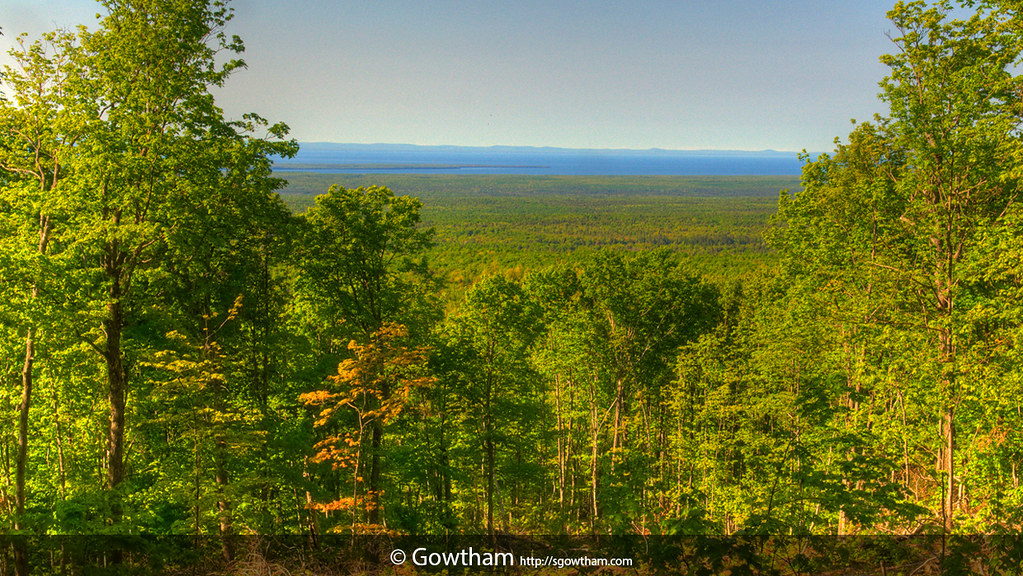
Mt Arvon - Michigan's Highest Point by Gowtham

Mt Arvon – Michigan’s Highest Point by Gowtham

Yesterday we featured Mark Chamerberlin’s photo of Michigan’s tallest building (the Renaissance Center) in our Daily Michigan email along with some more of Michigan’s tallest things. Seemed like a good theme to continue…

You can view Gowtham’s photo bigger and in his Michigan slideshow. About Mount Arvon, which is part of the ancient Huron Mountains, he writes:

Mt. Arvon is Michigan’s highest point standing at 1,979.238 ft above sea level. It is located in the rugged backwoods of Michigan’s Upper Peninsula, about 25 [driving] miles from L’Anse. Getting to Mt. Arvon is no easy feat if one doesn’t know her/his way around. Due to logging operations, the roads in the area change frequently. In the winter, the roads become impassable due to the heavy snow the area receives. During the rainy season, the roads become muddy and are often unfit for passenger cars. As if that weren’t sufficient, the peak is not prominent as it is located in a heavily wooded area.

He adds that the blue waters in the distance are Lake Superior and:

…the edge of tiny strip of land [Copper Country State Forest] marks Point Abbaye. The piece of land lining up with horizon is the Keweenaw Peninsula. For many years, Mt. Curwood, located a few miles south of Mt. Arvon, was recognized as the highest point in Michigan. However, in 1982, the U.S. Department of Interior’s Geological Survey team gathered new measurements and found Mt. Curwood to be slightly lower in elevation than Mt. Arvon measuring in at 1,978.24 ft above sea level.

Slightly is an understatement – Wikipedia’s Mount Arvon entry explains that the surveyors found Arvon to be a whopping ONE FOOT taller than Curwood.

Check out both peaks on Google Maps and get a little more info in Summit Post’s entry for Mt. Arvon.