Election Day: Sometimes the light shines on you

Rainstorm and Sunlight on Pictured Rocks

Rainstorm and Sunlight on Pictured Rocks, photo by ShelNf

I wondered a lot about what to post on Election Day, but when I saw this photo, I knew I didn’t have to look any more.

In the end, I suspect it doesn’t matter as much about what your vote is as the simple fact that you do vote. A lot of sacrifices have been made to give you this moment when you can make some statements about the future you want, and there’s way to much to be done to sit on the sidelines. Here’s an easy way to see your ballot courtesy of Absolute Michigan.

That light is shining today. Does it shine for you?

ShelNf writes that while walking out on Miner’s Beach in the Pictured Rocks National Lakeshore on a rainy day, he noticed a patch of sunlight that had broken through the clouds, illuminating part of the cliff face. Check this photo out on black and see more in his really awesome slideshow.

Lots more Pictured Rocks and more elections too on Michigan in Pictures.

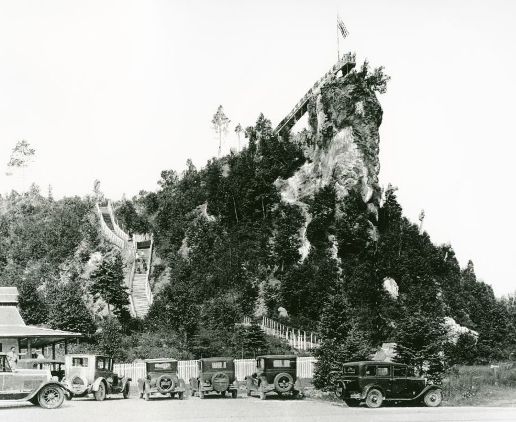
Castle Rock, a Natural Lookout

Castle Rock, circa late 1920s or early 1930s, photo courtesy Seeking Michigan

This morning I saw a photo of Castle Rock in the Absolute Michigan group on Flickr that made me wonder about the history of this iconic UP tourist stop. Bob Garrett of the Archives of Michigan has the story in A Natural Lookout at Seeking Michigan:

The Upper Peninsula contains a wealth of great scenery. One might wish to climb to a high point and “take it all in.” Fortunately, nature sometimes provides a natural lookout. One such lookout is Castle Rock.

Castle Rock is located near St. Ignace, on the Upper Peninsula side of the Straits of Mackinac. The Rock is a natural limestone tower, standing nearly two hundred feet above lake level. Wind and water erosion have shaped it into a sort of “castle.” Visitors who climb the 170 steps to the top will receive a stunning view. Looking left to right, one can see St. Martin Island, Marquette Island in Les Cherneaux (on a clear day), the town of St. Ignace, ferries coming to and from Mackinac Island and the top of the Mackinac Bridge.

Castle Rock had been an ancient lookout of the Ojibway tribe, who often called it “Pontiac’s Lookout.” A company named Norton and Lund purchased the site around 1927. Norton and Lund built a stairway to the top of the Rock, opened a souvenir stand and made cabins available for tourists.

Shortly thereafter (Sources differ on the date.), a St. Ignace photographer and businessman named Charles Clarence Eby (1890-1961) bought the property. Eby hoped to increase tourism, and he used his photography skills toward that end. He launched a high volume postcard business, and his postcards and other promotional material drew people to the Upper Peninsula and the St. Ignace area.

Around 1958, statues of the mythical lumberjack Paul Bunyan and his blue ox, Babe, were built at the foot of the stairs. These were handcrafted by Calvin Tamlyn, who was Eby’s son in law. They still greet visitors today.

Castle Rock can be found north of St. Ignace, along I-75. Take exit 348, and you’ll be there. For more information, see the Castle Rock Web site.

You can head over to Seeking Michigan for more including some books in Michigan libraries, a photo of Paul & Babe and also a stereoscopic pic from the 20s. There’s a little more info on Wikipedia, including a panorama of the view from the top of the rock.

Seeking Michigan is the web site of the Archives of Michigan and it’s packed full of articles like this in their Look section and also an extensive & searchable Michigan photo archive.

More roadside attractions on Michigan in Pictures.

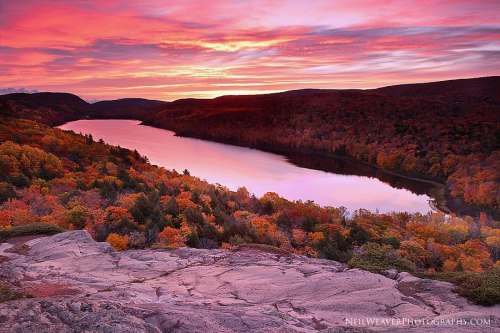
Sunrise at Lake of the Clouds

Sunrise at Lake of the Clouds, Porcupine Mountains, photo by Neil Weaver Photography

Lake of the Clouds is a favorite here on Michigan in Pictures, so it was a happy morning when I found Neil’s great shot of sunrise over the lake.

Head over to Facebook to see it bigger and see more from the UP and elsewhere in Neil’s Landscapes & Lakescapes album.


Fall Color in the Mitten

Fall Colors-HDR

Fall Colors-HDR by Mi Bob, photo by Mi Bob

Fall color is really kicking in around the state. It’s looking like this weekend may be the optimal time for your color tour, as Michigan’s summer drought might cause an earlier leaf drop.

The Freep has a nice aerial from the UP and reports that Upper Peninsula color is at 60-80%. If you head over to the Marquette Country Facebook, you can see a lot of photos from all across the UP. The West Michigan color report shows 40-50% coverage and they have photos from across the region on their West Michigan Weekly blog. Of course you can also search for “autumn” in the Absolute Michigan pool on Flickr to see the latest as well!

If you’re looking for some ideas on where to go, Pure Michigan fall color tours for everywhere in the state and other ideas for fall travel. This photo was taken near Muskegon, and while Pure Michigan doesn’t have a tour there among their 20+ tours, the West Michigan Tourist Association has a whole bunch of color tours including one that goes along the lakeshore near Muskegon.

Check this out on black and see more in Mi Bob’s Fall in West Michigan slideshow.

There’s lots more barns and fall color on Michigan in Pictures.

Waterfall Wednesday: A Fall Morning at Bond Falls

Morning fog

Morning fog, photo by adonyvan

Bond Falls is is one of Michigan’s most beautiful waterfalls and a frequent guest on this blog. Click for more Bond Falls photos from Michigan in Pictures including a great one from a month ago of Bond Falls under the stars by the same photographer!

Check this out on black and see much more in Jiqing Fan’s Houghton & UP MI slideshow.

There’s more Michigan waterfalls and more Michigan sunrises on Michigan in Pictures.

Northern Lights Tonight?

Surprise Northern Light

Surprise Northern Light, photo by Xavist on the colorful way

NOAA’s Space Weather Prediction Center (a great resource for alerts on the aurora borealis) reports that the Earth remains under the influence of a September 27 coronal mass ejection (CME)  that has reached the G3 (Strong) level. They say that auroral activity is possible through tonight, and they were seen last night at least as far south as Cadillac!

Last night Xavist Zhao caught these amazing northern lights over the Michigan Tech’s Amjoch Observatory. Check them out on black and see more including a couple more from last night in his Space & Astronomy slideshow.

Much more in our northern lights category on Michigan in Pictures!

Thursday Morning Face-off: Michigan Moose Edition

Foggy Morning Face-off

Foggy Morning Face-off, photo by yooper1949

In their History of Moose in Michigan, the DNR notes that moose are native to Michigan and were present throughout the state except for the southwestern Lower Peninsula prior to European settlement. Due to extensive logging of their habitat, hunting and likely a parasitic brainworm, they disappeared from the Lower Peninsula in the 1890s, with only a few hanging on in the UP. You can click the link above for the story of the recovery to the current level of around 500 and see Moose in Michigan for more.

Nature Works page on Moose – Alces alces tells us that:

The moose is the largest member of the deer family and the tallest mammal in North America. It stands six feet tall from shoulders to feet. Females weigh between 800 to 1,300 pounds and males weigh 1,200 to 1,600 pounds. The moose has long, thick, light brown to dark brown fur. Moose hair is hollow, which helps keep the moose warm. The moose has long legs. Its front legs are longer than its rear legs. This helps it jump over fallen trees and other forest debris…

The male or bull moose has huge broad and flat antlers that can stretch 4 to 5 feet across. Antlers start to grow in the early summer. When antlers first start to grow, they are covered with a soft fuzzy skin called velvet. The velvet has blood vessels in it that deliver nutrients that help the antlers grow. By late summer, when the antlers reach full size, the blood supply dries up and the velvet starts to drop off.

Moose mate in early fall. During mating season, females attract males with their deep calls and strong scent. Bull moose use their antlers in threat displays when they are fighting over females. Sometimes they will get into a pushing fight with their antlers. These fights rarely get too serious because the antlers could catch together and both moose could die.

The UM Animal Diversity Web entry for Alces alces Eurasian elk aka Moose has a lot of great information and photos as well and they add that:

The word “moose” comes from the Native American tribe, the Algonquins, which means “twig eater” in their language. It is an appropriate name because moose primarily browse upon the stems and twigs of woody plants in the winter and the leaves and shoots of deciduous plants in the summer.

If you happen to come across moose and want to help Michigan out with moose management, consider filing a moose observation report.

Carl says that the two young moose locked horns and pushed each other around for a while, but no real battle ensued. Check this out big as a moose, see a close-up of the confrontation and in his slideshow.

More Michigan animals on Michigan in Pictures.

Gabbro Falls and the Black River Scenic Byway

From Above - Gabbro Falls (Black River - Upper Michigan)

From Above – Gabbro Falls (Black River – Upper Michigan), photo by Aaron C. Jors

Gabbro Falls is one of several very nice waterfalls on the Black River. Others are Great Conglomerate Falls, Gorge Falls, Potawatomi Falls, Sandstone Falls and Rainbow Falls – click that link for more info from GoWaterfalling.com.

The Black River Scenic Byway:

…is in the western corner of Michigan’s Upper Peninsula, near the Wisconsin state line. The byway begins in Bessemer and travels north to the road’s end on the shores of Lake Superior. Black River is 15 miles long and follows North Moore Street, Saint Johns Road, and Black River Road (CR 513). All are two-lane paved roads suitable for all types of vehicles. The byway is open year-round.

The Black River scenic byway crosses the Ottawa National Forest alongside the meandering Black River through areas of old growth hemlock and hardwoods of the Black River Valley. The byway offers scenic views of the distant Porcupine Mountains. In autumn, the byway is bathed in colors of red, orange, and gold.

Aaron’s photo from early October of 2010 certainly bears that out. See it on black and view more in his awesome Waterfalls slideshow.

More waterfalls on Michigan in Pictures.

Channel Currents & Longshore Currents at Picnic Rocks

Storm Clouds over Picnic Rocks in Marquette, MI Labor Day 2012

Storm Clouds over Picnic Rocks in Marquette, MI Labor Day 2012, photo by Superior Seasons

Picnic Rocks is a popular beach area in Marquette. I thought that I’d come up with a good story for the name, but instead, I learned about the formation and dangers of what are known as channel & longshore currents. The Marquette National Weather Service explains:

A channel current is caused when water is squeezed between the shore and an offshore structure or feature (such as an island). When water is squeezed it speeds up, thus causing the current. This is like putting a smaller nozzle on a garden hose. When the smaller nozzle is on, the water comes out faster.

This current can be enhanced by what is known as a longshore current, a current that is generated by waves breaking onshore. As waves move onshore, they break in the direction they are moving in order to dissipate their energy. This causes the longshore current. Overtime, the current spans the entire width of the surf zone (the place where you swim). In the case of a channel current, the longshore current can speed up the channeling effect between the shore and the rocks, causing dangerous conditions to develop for those who are walking along the sandbar. The longshore current is maximized during times of higher waves that come in at a 45 degree angle to the shore.

…One could escape a channel current by swimming back to towards the shore. Many people make the mistake of swimming against the current as they are trying to get back to the sandbar. Think of the current as an underwater treadmill. In order to get off the treadmill, one needs to step off to the side of it. The channel current will be moving parallel to shore, so in order to escape, swim perpendicular to the shore.

Read on for more including a diagram demonstrating the best way to escape if you’re caught in these currents. A swimmer recently drowned here and this summer has been a deadly one – please use your knowledge to help others stay safe!

So we don’t end on a down note, let me say that in good weather, Picnic Rocks is a fantastic, natural playground for folks of all ages!!

Check this out background big and in Superior Season’s Marquette slideshow.

More from Marquette on Michigan in Pictures.

The Quincy Copper Smelter

Abandoned Quincy Copper Smelter Pano / See the set.

Abandoned Quincy Copper Smelter Pano, photo by Whitney Lake

The Quincy Smelter Association says:

The Quincy Smelter is the only remaining copper smelter in the Lake Superior Region. Built by the Quincy Mining Company, the smelter used heat and chemical processes to turn copper ore into ingots. The ingots were then sold and shipped to factories where they were turned into products such as copper wire or tubing.

From 1898 to 1967 the Quincy Mining Company Smelter at Ripley processed copper, first from its mines and then later from its reclamation plant. The smelter complex is built on the stamp sand of the Pewabic mines’ mill. It continued to melt scrap copper until 1971.

Among the buildings remaining on the site are the three-story blast furnace, built in 1898, with additions in 1904 and again in 1910. The sandstone faced mineral warehouse built in 1904 is reached by a 460-foot trestle. The site also includes three rectangular warehouses, a concrete block briquetting plant built in 1906, a powerhouse, a casting house, carpenter and cooper shop for making barrels, as well as a machine shop, and laboratory.

The Copper Country Explorer has an incredible, multi-part tour of the Quincy Smelter that is rich with history and photography new & old. I can’t recommend that link enough! You can get some interesting stories of life at the smelter and the machines they used from the Quincy Smelter blog. The Keweenaw National Historical Park continues the story in Quincy Smelter Stabilization and Rehabilitation, saying that the smelter is now owned by Franklin Township:

The smelter complex is unique in the country and, perhaps, the world in the number and types of 19th and early 20th century buildings and landscape features that survive.

The continued survival of these structures is tenuous. Preservation of the complex is proving challenging. Since the final shutdown of the smelter in 1971, little has been done to maintain it. Severe winters and neglect have taken a sizeable toll; some buildings have collapsed, others are nearly so. Franklin Township took on the property as a preservation-friendly owner, and has endeavored to find new uses for the historic complex, including simply opening it as a heritage attraction as part of Keweenaw National Historical Park.

They also have a report on conditions at the site and plans for the future (includes a nice map of the site). If you’re interested in Michigan’s mining heritage, the Keweenaw National Historical Park (established 1992) is a relatively new and interesting project of the NPS.

Definitely check this photo out on black and see more in Whitney Lake’s Quincy Smelter / Michigan slideshow.

More from the Keweenaw National Historic Park on Michigan in Pictures.