Slice of Wonder

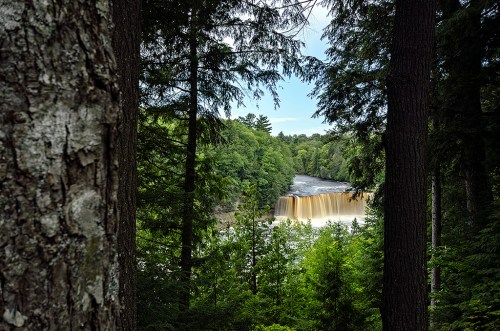
Upper Tahquamenon

Upper Tahquamenon, photo by Jasondoubleuel

Jason shared this shot of one of my favorite views in Michigan, the Upper Tahquamenon Falls, in the Michigan Cover Photos Group. It’s the new cover photo for the Michigan in Pictures Facebook page and (in my opinion) looks just about perfect.

View his photo bigger and see more in his Summer slideshow!

Much more about the Tahquamenon Falls on Michigan in Pictures.

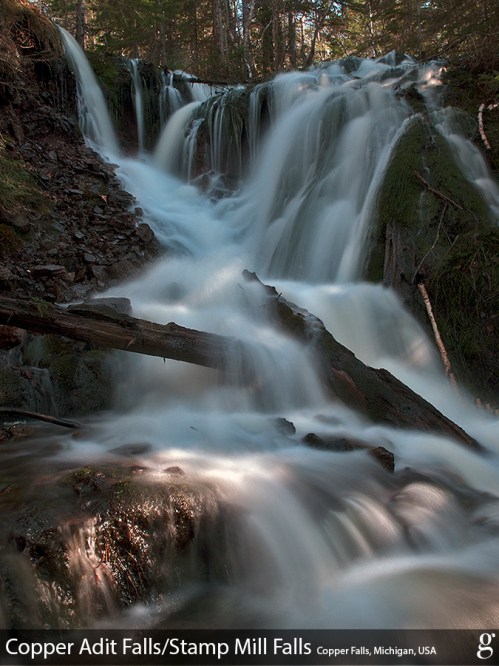
Copper Adit Falls, Stamp Mill Falls at Copper Falls Mine

n2c_113-4482

n2c_113-4482, photo by Gowtham

Gowtham writes:

Established in 1846, Copper Falls mine was a collection of several copper mine shafts and adits (definition below). Owl Creek — in what was once one of the richest fissure veins in the Keweenaw — seems to make a magical (and a seasonal) appearance out of a hillside draining the now closed Copper Falls mine to form this quite spectacular and scenic-looking Copper Adit Falls. With the nearby remnants of an old stamp mill, this waterfall is also known as Stamp Mill Falls.

Citing Wikipedia, an adit is an entrance to an underground mine which is horizontal or nearly horizontal, by which the mine can be entered, drained of water, ventilated, and minerals extracted at the lowest convenient level.

The Copper Country Explorer’s entry on Copper Falls begins:

Stamp Mills relied on two things in order to separate copper: water and gravity. Any stamp mill would be built near a source of water such as a river or lake. It also would be build along a hill, in order to make the greatest use of gravity. Because of this we started our search along the creek that had cut a path through the sands – Owl Creek.

Owl Creek was the lifeblood of the Copper Falls Mine. Steam stamps required water, and along the rugged ridges of the Copper Falls a natural source existed. Fed from atop the ridge by a lake of the same name, Owl Creek drops over 500 feet to the marshlands along Superior’s shore. This creek not only provided water to the mine and mill, but the potential energy stored in its banks could easily turn a water wheel for power (mechanical power, since electricity had yet to be invented). It was a perfect spot for a mill.

Read on for lots more and explore the Copper Falls Mill at with the Copper Country Explorer.

View Gowtham’s photo bigger and see more of his photos from the area on his website.

More waterfalls on Michigan in Pictures!

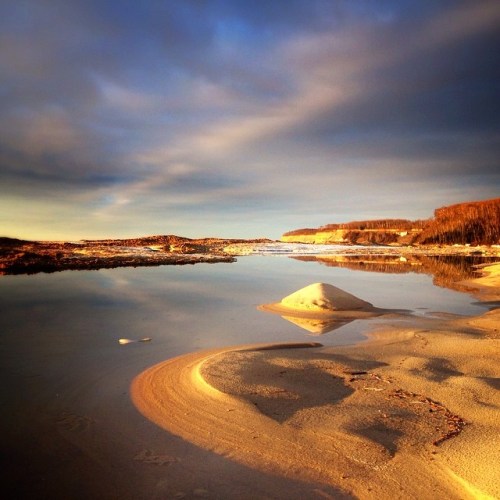
Meanwhile, on Miners Beach

Thankful for what we are blessed with here by oni_one

Thankful for what we are blessed with here…, photo by oni_one_

One of the neatest things for me about online photography and social media is how things come together in a synchronistic fashion sometimes. Yesterday, I posted a photo by Shawn Malone from above at Miners Castle of the frozen expanse of Lake Superior. For everyone who wondered what things were looking like at beach level, here you go!

Sarah took this pic yesterday at Miners Beach in the Pictured Rocks. View her photo bigger and see more on her Instagram.

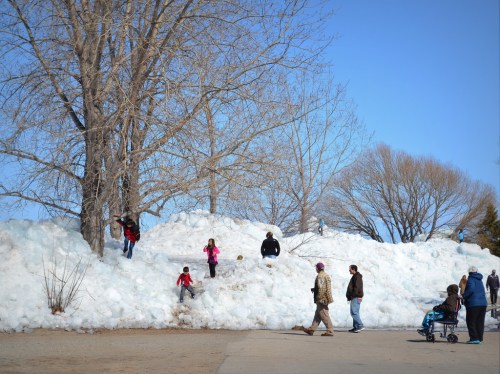
Menominee Ice Shoves

Everyone came out to see the ice shoves

Everyone came out to see the ice shoves, photo by Ann Fisher

While much of the state is enjoying springlike weather, folks in northern Michigan and the UP are still going toe to toe with a winter that will not quit. In solidarity, here’s one more wintry shot.

It comes from Ann Fisher in Menominee and shows the large “ice shoves” or “ice push” that came off Lake Michigan last Sunday. In Ice Shove: Giant Ice Slabs Invade Great Lakes Shorelines, Jon Erdman of the Weather Channel explains:

An ice shove is a rapid push of free-floating lake or sea ice onshore by wind. Strong winds from the same direction over, say, a 12 to 24 hour period, are enough to drive large chunks and plates of ice ashore.

The initial slabs or blocks of ice will slow down momentarily when reaching land, creating a traffic jam of ice piling behind and on top. The result is a massive ice pile often over 10 feet high, surging ashore in a matter of minutes, surrounding and damaging everything in their path, including trees, sod, fences, and homes.

Read on at Weather.com for more including the much bigger ice shoves in Oshkosh, Wisconsin and a look at the most widespread ice coverage on record for mid-April – over 39% of the Great Lakes! You can see some more photos from Fox6 in Menominee and if you head over to Absolute Michigan, you can look back to March of 2009 and some a CNN video of the crazy massive ice shoves on Saginaw Bay.

View Ann’s photo background big and see more in her Ice slideshow.

More ice on Michigan in Pictures.

Snowshoe on out of here, Winter!

Snowshoeing the U.P.

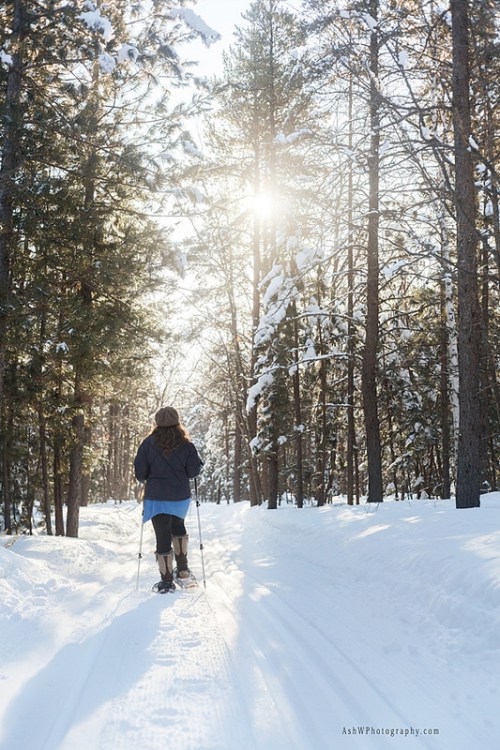
Snowshoeing the U.P., photo by Ashley Williams

Ashley took this shot in February in the Upper Peninsula, and by “February” I mean “this Monday”. It’s a beautiful scene for sure, but I think I speak for most of us when I say, “You’re drunk, Winter. Go home.”

View her photo bigger and see more in her Nature slideshow.

Frozen Adventures in Pictured Rocks

Ice Column / Pictured Rocks National Lakeshore.

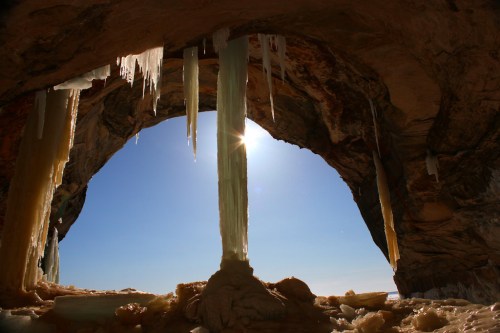
Ice Column / Pictured Rocks National Lakeshore, photo by DIsnowshoe

Jay writes:

Many have cursed the cold of this winter that is almost over now though spring seems a long way off. It has caused hardships and pain but has also given rare opportunities to many who have been willing to bundle up and seek the wonders the cold has brought about.

A few weeks ago a friend asked me on somewhat short notice if I’d join him for a walk along the Pictured Rocks National Lakeshore. I’d walked the cliffs above the Lake before but the extreme cold of this wonderful winter granted us the opportunity to walk on even the Greatest of Lakes. We had two nights out with no fire to warm us but it was well worth it and a most amazing hike.

View his photo background bigtacular and definitely check out more stunning photos from his Pictured Rocks adventure.

Much more from the Pictured Rocks National Lakeshore and more winter wallpaper on Michigan in Pictures!

Heavy Space Weather Ahead?

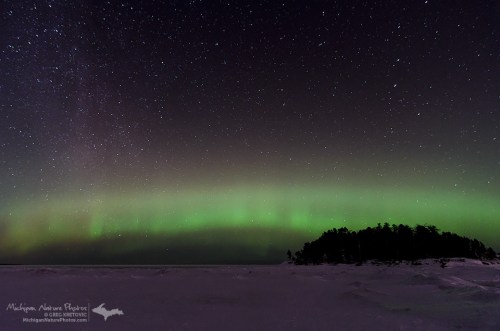
Frigid Auroras Over Superior

Frigid Auroras Over Superior, photo by Michigan Nature Photog

NOAA’s current space weather forecast reports an M Class (moderate) solar flare from solar region AR2002. Spaceweather.com adds that AR2002 has destabilized its magnetic field, making it more likely to erupt, and that NOAA forecasters are estimating a 60% chance of M-class flares and a 10% chance of X-class flares during the next 24 hours. X-class flares are major solar events that can spawn incredible auroras visible far to the south of us, planet-wide radio blackouts and long-lasting radiation storms. Click to Space Weather for a video of AR2002 development.

While there’s not much chance of a major event, I thought it was interesting that 25 years ago this week,  one of the most significant solar storms in memory created a spectacle in the skies as it demonstrated the power and danger of solar weather to modern society. A Conflagration of Storms begins:

On Thursday, March 9, 1989 astronomers at the Kitt Peak Solar Observatory spotted a major solar flare in progress. Eight minutes later, the Earth’s outer atmosphere was struck by a wave of powerful ultraviolet and X-ray radiation. Then the next day, an even more powerful eruption launched a cloud of gas 36 times the size of the from Active Region 5395 nearly dead center on the Sun. The storm cloud rushed out from the Sun at a million miles an hour, and on the evening of Monday, March 13 it struck the Earth. Alaskan and Scandinavian observers were treated to a spectacular auroral display that night. Intense colors from the rare Great Aurora painted the skies around the world in vivid shapes that moved like legendary dragons. Ghostly celestial armies battled from sunset to midnight. Newspapers that reported this event considered the aurora, itself, to be the most newsworthy aspect of the storm. Seen as far south as Florida and Cuba, the vast majority of people in the Northern Hemisphere had never seen such a spectacle. Some even worried that a nuclear first-strike might be in progress.

…Millions marveled at the beautiful celestial spectacle, and solar physicists delighted in the new data it brought to them, but many more were not so happy about it.

Silently, the storm had impacted the magnetic field of the Earth and caused a powerful jet stream of current to flow 1000 miles above the ground. Like a drunken serpent, its coils gyrated and swooped downwards in latitude, deep into North America. As midnight came and went, invisible electromagnetic forces were staging their own pitched battle in a vast arena bounded by the sky above and the rocky subterranean reaches of the Earth. A river of charged particles and electrons in the ionosphere flowed from west to east, inducing powerful electrical currents in the ground that surged into many natural nooks and crannies. There, beneath the surface, natural rock resistance murdered them quietly in the night. Nature has its own effective defenses for these currents, but human technology was not so fortunate on this particular night. The currents eventually found harbor in the electrical systems of Great Britain, the United States and Canada.

You can read on for more about how the storm spawned a power outage in Quebec and pushed US systems to the brink of collapse. If you want to totally geek out on auroral science, check this article out about how the Earth’s magnetosphere actually extends itself to block solar storms.

Greg took this shot in late February in Marquette in -17 temps! View his photo bigger and see more in his northern lights slideshow. You can purchase Greg’s pics at MichiganNaturePhotos.com.

There’s more science and much (much) more about the Northern Lights and Michigan on Michigan in Pictures.

Pictured Blue: Miner’s Castle in the Pictured Rocks National Lakeshore

Pictured Blue

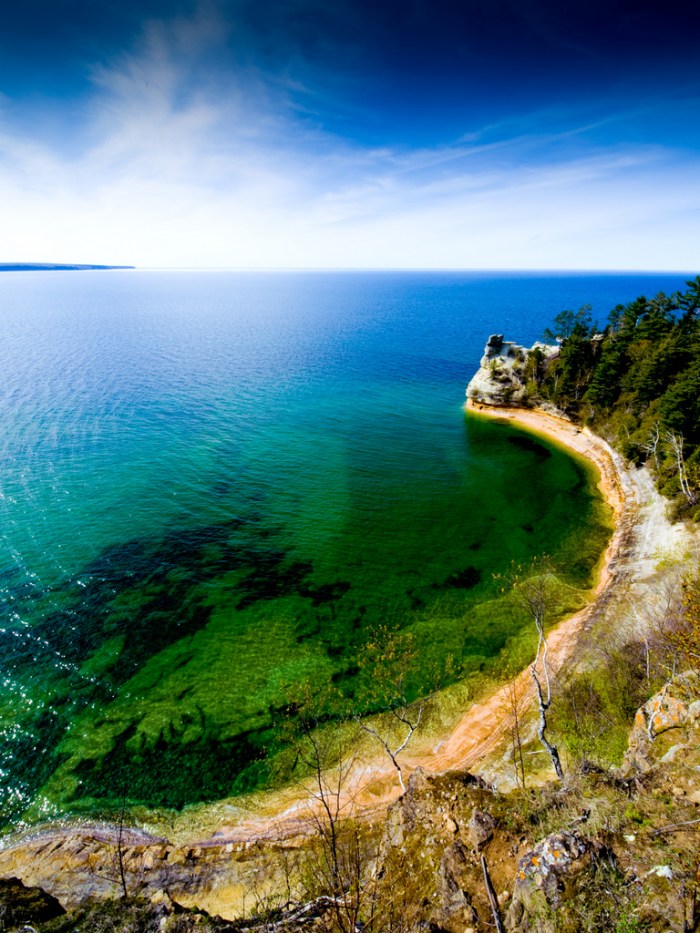
Pictured Blue, photo by Kiiraaan

View this jaw-dropping photo of Miner’s Castle bigger and see more in Kiran’s Landscape slideshow.

The Pictured Rocks National Lakeshore’s Geology Field Notes page has this barely comprehensible stuff to say about Miner’s Castle:

The Miners Castle Member is a soft, crumbly, quartz sandstone (with abundant garnet content) about 140 feet thick; its complete section is exposed in the Pictured Rocks Cliffs between Sand Point and Miners Castle. Sediments of this member are generally poorly sorted.

Capping the easily eroded Miners Castle Member of the Munising Formation in the western half of Pictured Rocks, is the resistant Early Ordovician (480-500 million years old) Au Train formation. The Au Train Formation is a light brown to white dolomitic sandstone that forms the resistant cap to the underlying softer sandstones. The numerous falls in Pictured Rocks National Lakeshore are the result of this caprock.

Read on for much more about the geology of Pictured Rocks. Erosion is indeed a factor with one of the most visible instances being April 13, 2006, when one of the pillars of Miner’s Castle collapsed.

You can see more of Pictured Rocks from Absolute Michigan and at the Pictured Rocks National Lakeshore web site.

Early One February Morning at Little Girl’s Point

Early One February Morning (2)

Early One February Morning (2), photo by siskokid

Jim caught a gorgeous sunrise last February on the shore of Lake Superior at Little Girl’s Point. The article Legendary Little Girl’s Point from the Ironwood Daily Globe says it is located about 21 miles north of Ironwood and was used by the Chippewas for fishing, hunting and a camping place during trips to the Porcupine Mountains. As to the name:

According to Burnham, Mary Amoose (Little Bee), an unusually intelligent Chippewa woman of Bad River, told Burnham the story of the lost girl of Little Girl’s Point as she had often heard it told by her grandmother more than a half century ago.

She told Burham how a party of hunters returning from a trip to the Crouching Porcupine rounding the point of land now known as Little Girl’s Point, thought they saw the form of a girl among the trees. She was clad in green. The hunters, thinking that it was some girl that had become lost, beached their canoes, but on climbing the steep shore, only caught one or two glimpses of the green girl, who glided further back among the stately pines, and vanished.

Burham said he was interested in this story for it gave the name to Little Girl’s Point, and it was told to him by this Chippewa woman, much as it had been told to Henry R. Schoolcraft, the historian, and discoverer of the source of the Mississippi River. Burnham said the story was told to Schoolcraft by his half-breed wife, Julia (Jane) Johnson, granddaughter of the great chief Waubojeeg, who lived on the mainland near where Bayfield now stands.

I can’t tell if the “unusually intelligent” is sexist or racist, but there is a lot of interesting historical information to be found if you read on. The article is housed on the Gogebic Range City Directories which looks to be a treasure trove of historical information about the region that includes Michigan’s northwestern corner and Wisconsin’s northeastern.

Check it out bigger and see more in Jim’s Little Girl’s Point slideshow.

There’s more history (and more ice) on Michigan in Pictures.

Black Slate Falls

Black Slate Falls, Baraga County, MI, April, 2010

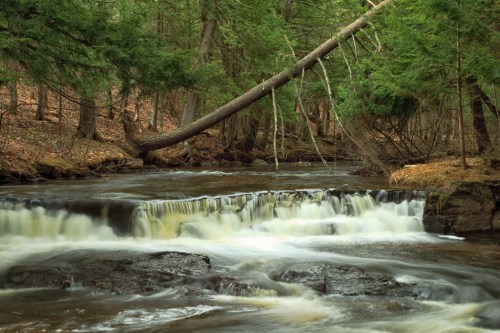
Black Slate Falls, Baraga County, MI, April, 2010, photo by Norm Powell (napowell30d)

On Scenic USA, Ken Reese has some info about Black Slate Falls:

Gathering momentum on the slopes of Mount Arvon, Michigan’s highest peak, the Slate River drops northward into Lake Superior. At one time when slate was a predominant roofing material, Arvon Road led to the small town of Arvon and a slate quarry. Today the town has all but disappeared, and piles of waste slate mark the quarry site.

West of the Slate River, Arvon Road leads to this beautiful setting of Black Slate Falls. Here, tucked in the woods is a picturesque little falls as it drops over slate ledges. Quartzite and Black Slate falls are found at the end of Arvon Road. For those seeking more woodland waterfalls, this wild river leads down to Slate (the largest drop), Slide and Ecstasy falls, just three miles downriver. Hiker’s notes indicate it’s a lot easier to reach Slate Falls from Skanee Road, where Arvon Road gets its start.

GoWaterfalling adds that Black Slate Falls are one of several waterfalls on the Slate River.

View Norm’s photo bigger and see more of his waterfall photos on Flickr!

Many more waterfalls on Michigan in Pictures.