A Peaceful Moment on Lake Superior

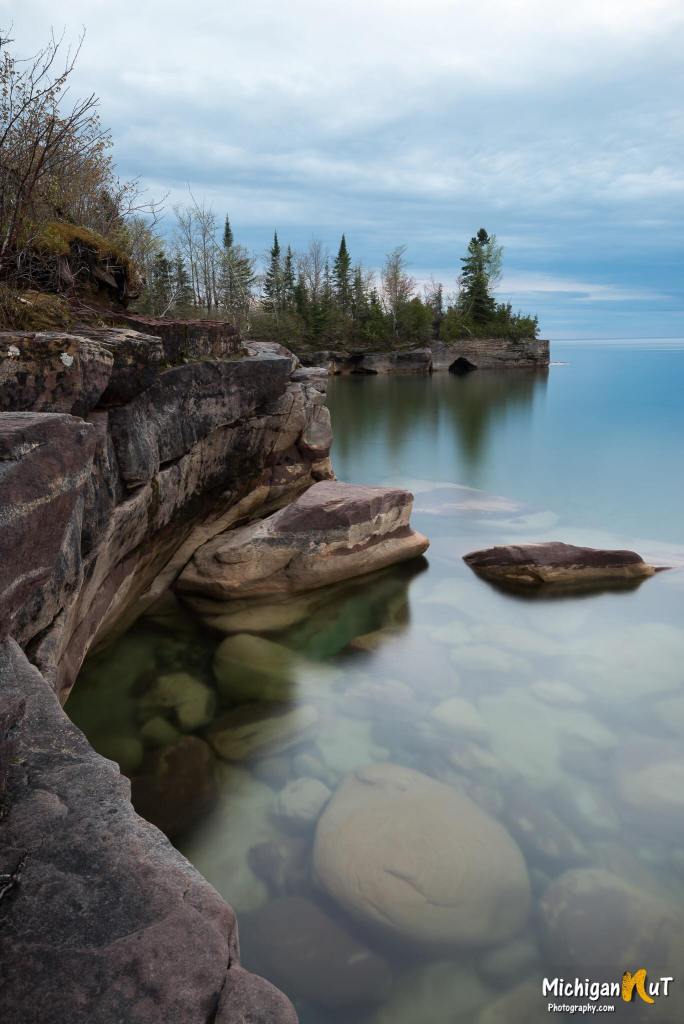
Peaceful Moment at Lake Superior near Munising by Michigan Nut Photography

Peaceful Moment at Lake Superior by Michigan Nut Photography

One of my favorite photographers on Michigan in Pictures is John McCormick aka Michigan Nut. He caught this peaceful moment at Lake Superior near Munising the other day, remarking that “you don’t often see the big lake this calm.

Prints of this photo and a whole lot more Michigan beauty are available at michigannutphotography.com.

Support Michigan in Pictures with Patreon

The Corgi & the Cataract

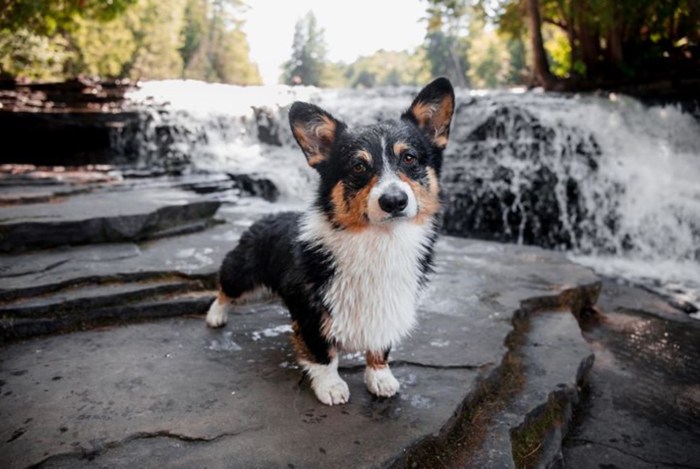
The Corgi & the Cataract by Taylor Nicole Featherstone

This photo from one of the many waterfalls in the Upper Peninsula was sent in by a fan last March. I’m hoping that those of you with furry friends are finding ways to keep them (and yourself!) happy & fit.

You can check out more at Featherstone Fotography on Facebook & keep up with the Adventures of Darwin + Charles on Facebook. And definitely follow her on Instagram @oureveolvingadventure!

TBT: Columns of Ice at the Eben Ice Cave

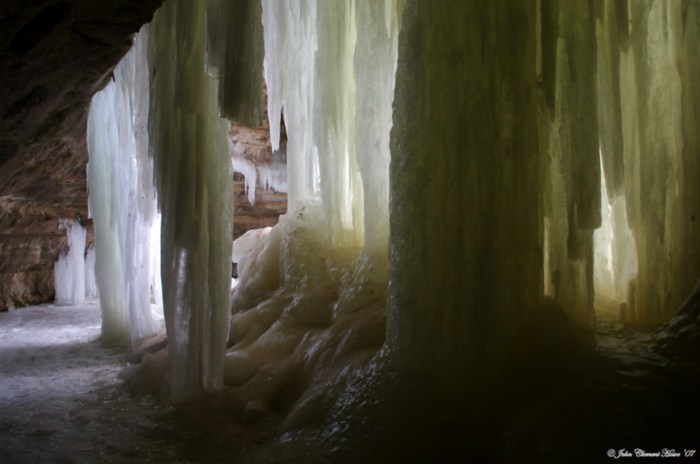
Eben Ice Caves March 19, 2007

Columns of Ice, Eben Ice Cave, photo by John Clement Howe.

EDITOR’S NOTE: With the rise of coronavirus, it seems to me that we could all use a little reconnection with our lovely state of Michigan, so I’m going to try to dig out some old photos and share some new ones to help keep you close to Mama Michigan as you socially distance!

This photo originally appeared March 20, 2007 and is one of a nice set titled At the Ice Cave of Eben taken in March of 2007 at the Eben Ice Caves in the Upper Peninsula near Munising. My friend Dr. John Anderton of the Northern Michigan University Department of Geography who has since passed away explained their formation:

The Eben Ices Caves are located just a few miles north of the little town of Eben, within the Rock River Canyon Wilderness Area (RRCW). The RRCW, which became a Wilderness in 1987 as a part of the Michigan Wilderness Act, is located approximately 15 miles west of the town of Munising, MI, within the Munising Ranger District of the Hiawatha National Forest. It comprises 4,460 acres and contains outstanding natural features including Rock River, Silver Creek and Ginpole Lake. Within its interior there are two short user-developed trails (totaling about 1.75 miles) leading to Rock River Falls and the Eben Ice Caves. An estimated 1,700 people visit the area annually (USFS records) …

The Ice Caves are not true caves at all. They consist of walls or vertical sheets of ice that form across the face of overhanging rock outcrops. In the summer, small unimpressive waterfalls and groundwater seeps may found along the overhangs. In the winter, however, the water hits the cold air, drips downward under the influence of gravity and freezes, creating spectacular ice caves. Each winter they look a little different, but typically there are openings in the ice that allow you to walk behind the ice walls.

The rock overhangs, where the ice caves form, consist of outcrops of Munising Formation (Cambrian) with a capstone of AuTrain Formation (Ordovician). The outcrops are found along the south side of the valley of Silver Creek, which is part of a network of secondary glacial drainage channels that formed during the Marquette Advance (about 10,000 years ago). Theses secondary drainage channels flowed easterly into the AuTrain-Whitefish Channel, a primary glacial meltwater channel that flowed south to the Lake Michigan basin. Groundwater naturally seeps from these rocks, providing the water necessary to form the ice caves in the winter.

For directions and more info, check out  Munising Ice Climbing from Travel Marquette!

The Colors of Cold

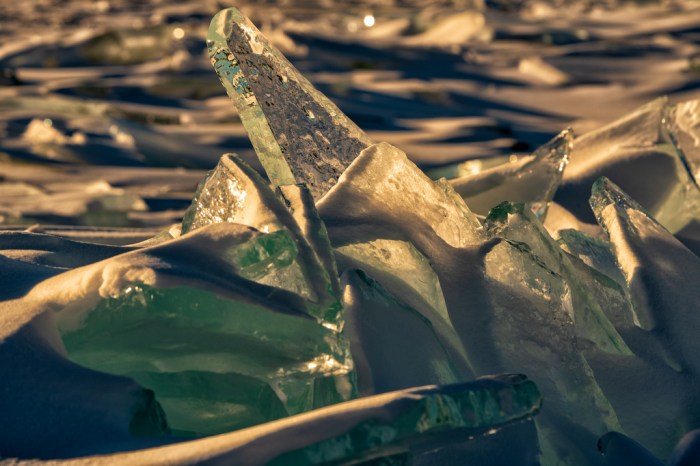
Green Blue Ice, photo by Charles Bonham

Apparently Charles is my go-to photographer for ice colors as his picture was used for my post about what makes ice blue or green a couple years ago on Michigan in Pictures. Then as now, I went to The Causes of Color to answer the question: What causes the blue color that sometimes appears in snow and ice?

As with water, this color is caused by the absorption of both red and yellow light (leaving light at the blue end of the visible light spectrum). The absorption spectrum of ice is similar to that of water, except that hydrogen bonding causes all peaks to shift to lower energy – making the color greener. This effect is augmented by scattering within snow, which causes the light to travel an indirect path, providing more opportunity for absorption. From the surface, snow and ice present a uniformly white face. This is because almost all of the visible light striking the snow or ice surface is reflected back, without any preference for a single color within the visible spectrum.

The situation is different for light that is not reflected, but penetrates or is transmitted into the snow. As this light travels into the snow or ice, the ice grains scatter a large amount of light. If the light is to travel over any distance it must survive many such scattering events. In other words, it must keep scattering and not be absorbed. We usually see the light coming back from the near surface layers (less than 1 cm) after it has been scattered or bounced off other snow grains only a few times, and it still appears white.

In simplest of terms, think of the ice or snow layer as a filter. If it is only a centimeter thick, all the light makes it through; if it is a meter thick, mostly blue light makes it through. This is similar to the way coffee often appears light when poured, but much darker when it is in a cup.

Click through for lots more about light & color!

Charles took this photo last week on Sand Point near Munising. Check it out bigger and head over to his Flickr page for a bunch more great shots of winter in the Upper Peninsula!

More winter wallpaper and more amazing ice on Michigan in Pictures.

Last Blast of Summer!

Last Blast of Summer, photo by paula liimatta

Did you get all your summertime fun in? If not, get on that before it’s gone!

Paula took this a year ago at Blackrocks in Marquette’s Presque Isle Park. View it background bigtacular and see more in her Summer 2017 album on Flickr.

More Summer Wallpaper on Michigan in Pictures!

#TBT Spring Storm on Superior

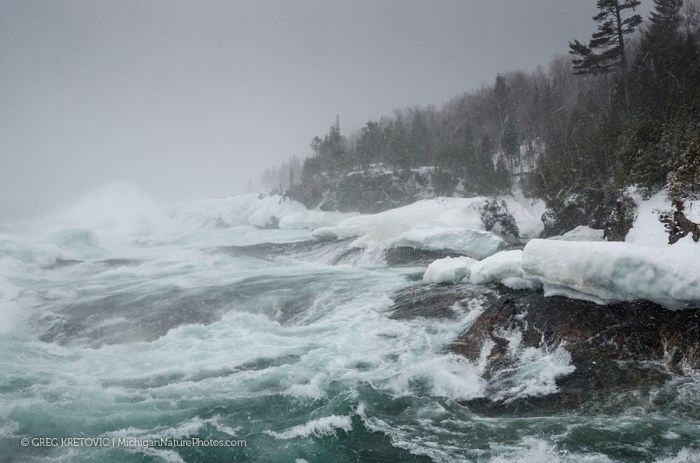
Spring Storm on Superior, photo by Greg Kretovic

Here’s a great Throwback Thursday of big waves on Lake Superior back on Friday, April 19 of 2013 at the Black Rocks in Marquette’s Presque Isle Park.

Lots more of Greg’s Lake Superior photos right here and more Lake Superior pics on Michigan in Pictures too!

Waterfall Wednesday: Fall at Interstate Falls

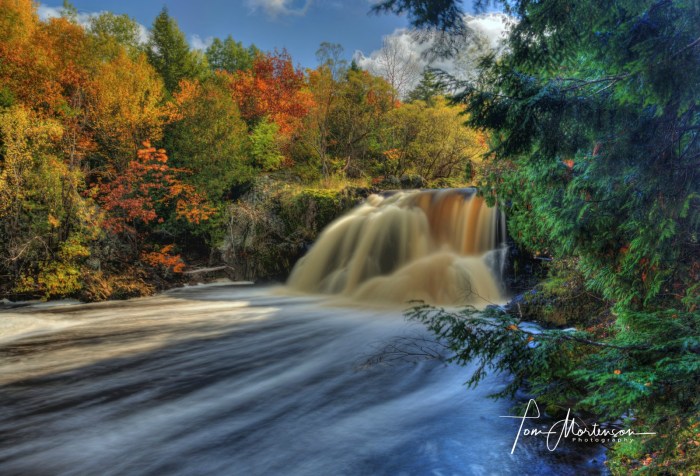
Interstate Falls, photo by Tom Mortenson

GoWaterfalling’s entry for Interstate Falls/Peterson Falls says (in part):

This waterfall is located on the Montreal River just a few miles upstream of Saxon Falls. The Montreal River forms part of the border between Michigan and Wisconsin so the falls is technically in both states, and can be visited from either state, but it is most easily visited from the Wisconsin side.

There seems to be some confusion about what this waterfall is named, or at least I am confused. Some sources refer to this as Peterson Falls, and the sign on the highway says “Peterson Falls”. However others say that this falls is Interstate Falls and that Peterson Falls is a smaller waterfall upstream of Interstate Falls. I have decided to go with Peterson Falls until I learn otherwise.

Read on for directions & more info.

View the photo background big and see more in Tom’s Upper Michigan slideshow.

More waterfalls on Michigan in Pictures and more Fall Wallpaper!

Calm Before the Storm

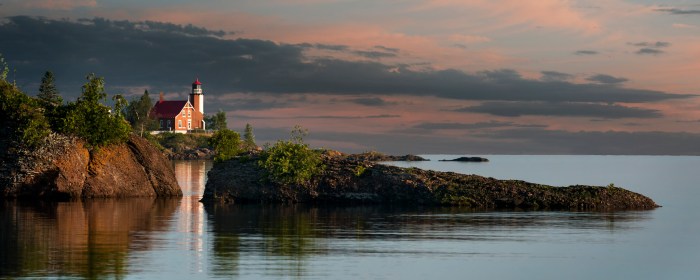
Eagle Harbor Lighthouse, photo by Peter Tinetti

What a September. Even without the daily political chaos, we’ve got the West in flames, our fourth largest city devastated by flooding from the current most costly storm in US history, and what could very well be the new most costly storm barreling towards Florida.

Hopefully, we’ll get a breather soon.

View the photo of the Eagle Harbor Lighthouse background big and see more in Peter’s slideshow. He’s originally from the UP but lives in California, so many of the pics are from there … and gorgeous!

More about the Eagle Harbor Light on Michigan in Pictures.

The Calumet Children’s March and the Keweenaw Miners Strike

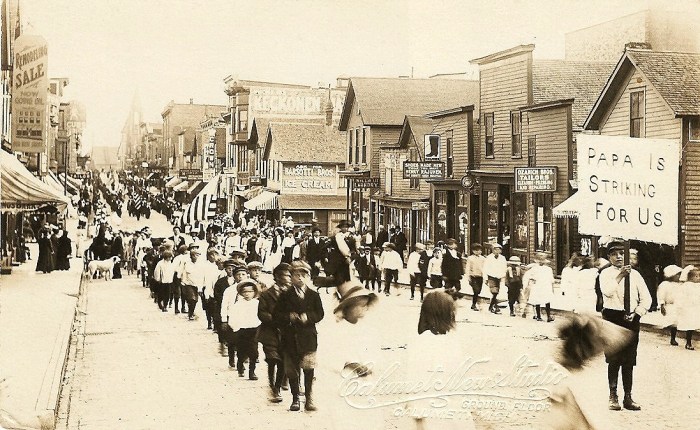
Children’s Parade, Calumet Copper Miners Strike — RPPC by Calumet New Studio, Calumet, Michigan, photo by Wystan

Here’s a throw back Monday for you – a photo from July 23, 1913 of children marching in Calumet during the tumultuous miners’ strikes of 1913. It’s an interesting case study for our modern world given that the driver was the same driver that’s beginning to impact our labor market – automation. The excellent article Labor unions, strikes and violence in the Keweenaw: The Copper Miner Strike of 1913 – this is seriously great work by Frank Zawada’s descendent(s) – the says that there  had been strikes in the Keweenaw in 1872, 1874, 1890 and 1893, but they hadn’t turned deadly. And then:

Around 1910, the mining companies sought to cut back the expenses of mining, and they started to consider lighter machinery such as the J. George Leyner rock drills. Leyners drills were 154-pounds heavy, compared to the 293-pound drills then in use at the mines. Not only that, but the smaller drills could drill just as much as the larger drills but with only one person to man it, instead of two.

The mining companies tried these drills out with the miners, and it was pretty unanimous; the miners didn’t like the new drills. First of all, the men complained that the drills were still too heavy for one man to carry, set up and operate. Secondly, losing a drilling partner opened up safety concerns – who would watch out for the guy alone on the drill if something should happen to him in the loud, darkened mine? Third, but related to number two, was worker concern of being displaced to a lower-paying job or of losing one’s job altogether when the one-man drills became the standard.

Discontent brewed amongst the workers in the mines, and some miners refused to use the drills. Some got into fights with the management about the drills. And some miners walked off the job or were told to leave for disobeying the new rules. Before things could get too crazy, winter set in and so the miners calmed the labor unrest. By early 1913, tensions were running at maximum capacity between workers and the mining companies on the Keweenaw Peninsula.

Read on for more about this strike that turned into one of Michigan’s most deadly labor struggles, including the Italian Hall Massacre of Christmas 1913 in which dozens and dozens of of these children lost their lives.

View the photo background big and see more in Wystan’s slideshow.

Michpics Monday Message

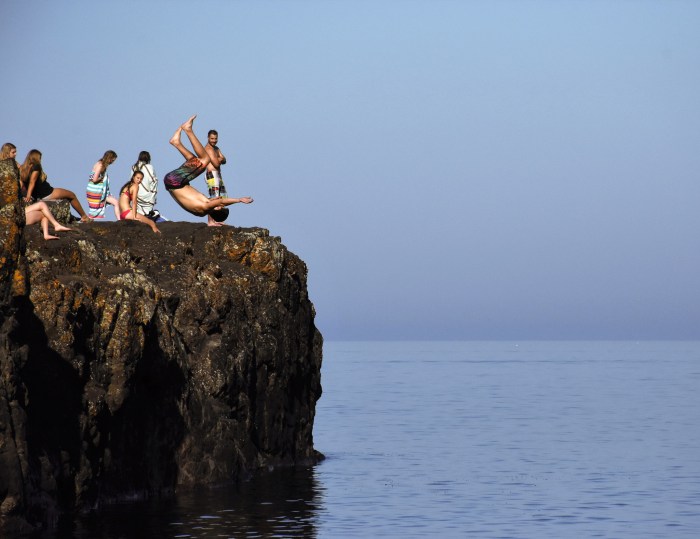
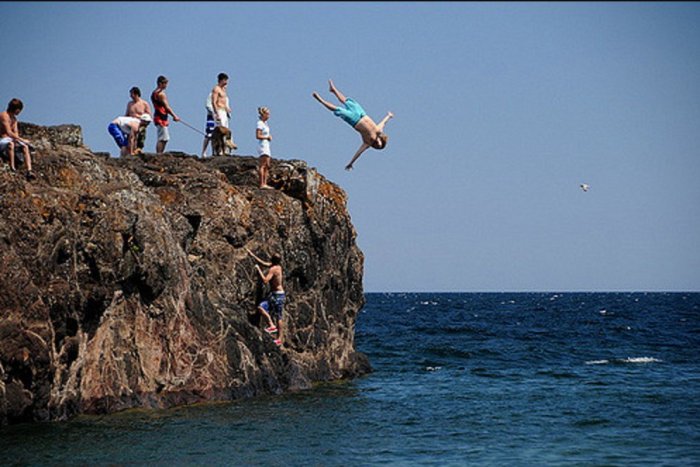
Cliff Jumpers, photo by Julie

“A ship is safe in harbor, but that’s not what ships are for.”
~William G. T. Shedd

Hi folks, this is Andy McFarlane, curator of Michigan in Pictures with a message so we’re all clear on what this blog is, and what it isn’t.

A little background: On Saturday I was not going to be a computer so I pre-scheduled a photo on Thursday, something I do fairly often. The photo was of some people jumping off the South Haven Pier, and coincidentally, someone fell (or jumped) off the pier late Friday night. They weren’t found, and the search has been called off as there’s no report of a missing person and it appears they may have gotten out of the water undetected.

While I did Saturday things not involving a computer, quite a large discussion unfolded on the Michigan in Pictures Facebook page, centering on the illegality of jumping off that pier (something I didn’t know about) and the irresponsibility of sharing photos of people doing dangerous things. After a quick scan of the comments and messages I’d received, I decided to delete the entire post from Facebook and Michigan in Pictures because I was told that people were still processing grief and that I was being insensitive. That appears to not be the case, and I’m sorry that I didn’t have more time to figure out the whole story.

I guess we can have some of the discussion here (and on the Facebook post). You may recall a couple of years ago when there was a minor uproar over a photo my girlfriend took on the ice. I think that what I wrote then is still applicable, and I hope that all my readers can accept my policy for this blog because at the end of the day, it’s how it’s going to be:

I post pictures all the time where the photographers have taken calculated risks to see, photograph and experience things that you cannot see and photograph without an element of risk. I allow my son to surf in conditions that can be very dangerous, let my daughter climb trees high enough to probably kill her if she fell, and have hiked on trails where one slip meant death.

I suppose I should post disclaimers of “don’t be an idiot” with all photos of risky environments, but I think I will continue to assume that my readers will assess risks on their own, and I will continue to experience and share Michigan as I choose.

…Please understand that Michigan in Pictures is a place where I share amazing pictures that are shared with me. I’m not doing this as a public service to educate people on how to stay alive and safe. I do it for love of Michigan and to share the cool experiences it offers. I trust that my readers will exercise appropriate caution as they enjoy Michigan, and I’m 1000% sure that if folks get out and wisely play a little closer to the edge, they’ll have a happier and longer life.

Caveat emptor!

Caveat emptor will remain the policy of Michigan in Pictures, which I will again remind readers is my personal blog, not paid for by anyone and offered with the sole hope that you can find pictures and places that help you enjoy and appreciate Michigan more.

View Julie’s photo of a maniac kid jumping off the 15-foot high Black Rocks in Marquette bigger and see more in her UP of Michigan slideshow.

Note: Lake Superior is SUPER COLD. You might die from cold water drowning. Also note that 15′ is pretty high. That could hurt or even kill you if you dive off the wrong rock somewhere else. Also note that if it’s wavy you could be hurt by the waves.