The science behind the magic: Fall color explained

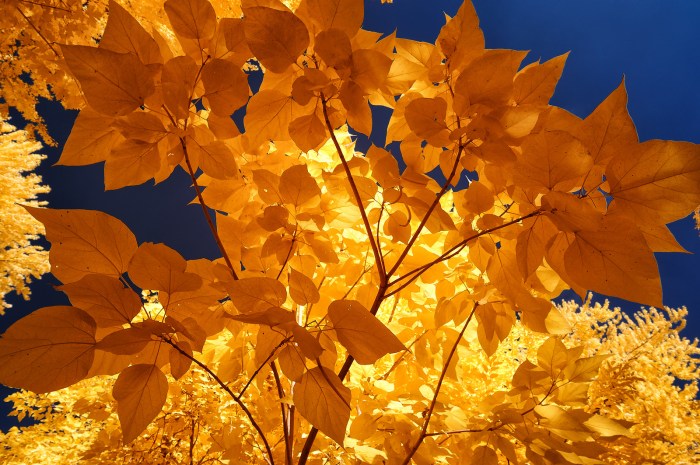
yellow-glory-by-scottie

Untitled, photo by Scottie

The Science of Color in Autumn Leaves from the United States National Arboretum is such an excellent explanation of the science behind the magic of Michigan’s fall color show that I try and share it every year:

The process that starts the cascade of events that result in fall color is actually a growth process. In late summer or early autumn, the days begin to get shorter, and nights are longer. Like most plants, deciduous trees and shrubs are rather sensitive to length of the dark period each day. When nights reach a threshold value and are long enough, the cells near the juncture of the leaf and the stem divide rapidly, but they do not expand. This abscission layer is a corky layer of cells that slowly begins to block transport of materials such as carbohydrates from the leaf to the branch. It also blocks the flow of minerals from the roots into the leaves. Because the starting time of the whole process is dependent on night length, fall colors appear at about the same time each year in a given location, whether temperatures are cooler or warmer than normal.

During the growing season, chlorophyll is replaced constantly in the leaves. Chlorophyll breaks down with exposure to light in the same way that colored paper fades in sunlight. The leaves must manufacture new chlorophyll to replace chlorophyll that is lost in this way. In autumn, when the connection between the leaf and the rest of the plant begins to be blocked off, the production of chlorophyll slows and then stops. In a relatively short time period, the chlorophyll disappears completely.

This is when autumn colors are revealed. Chlorophyll normally masks the yellow pigments known as xanthophylls and the orange pigments called carotenoids — both then become visible when the green chlorophyll is gone. These colors are present in the leaf throughout the growing season. Red and purple pigments come from anthocyanins. In the fall anthocyanins are manufactured from the sugars that are trapped in the leaf. In most plants anthocyanins are typically not present during the growing season.

As autumn progresses, the cells in the abscission layer become more dry and corky. The connections between cells become weakened, and the leaves break off with time. Many trees and shrubs lose their leaves when they are still very colorful. Some plants retain a great deal of their foliage through much of the winter, but the leaves do not retain their color for long. Like chlorophyll, the other pigments eventually break down in light or when they are frozen. The only pigments that remain are tannins, which are brown.

The explain that because the starting time of the whole process is dependent on night length, fall colors appear at more or less the same time every year and are not overly dependent on temperature, rainfall or other factors, other than the fact that weather can shorten or prolong the show by stripping leaves from trees.

Click through to the US Arboretum for more and also see Fall & Fuit from the Science of Color!

View Scotties’ photo bigger and see more in his Infrared slideshow.

Tons more fall photos on Michigan in Pictures!
Red Mohawk: At Home with Michigan’s Pileated Woodpecker

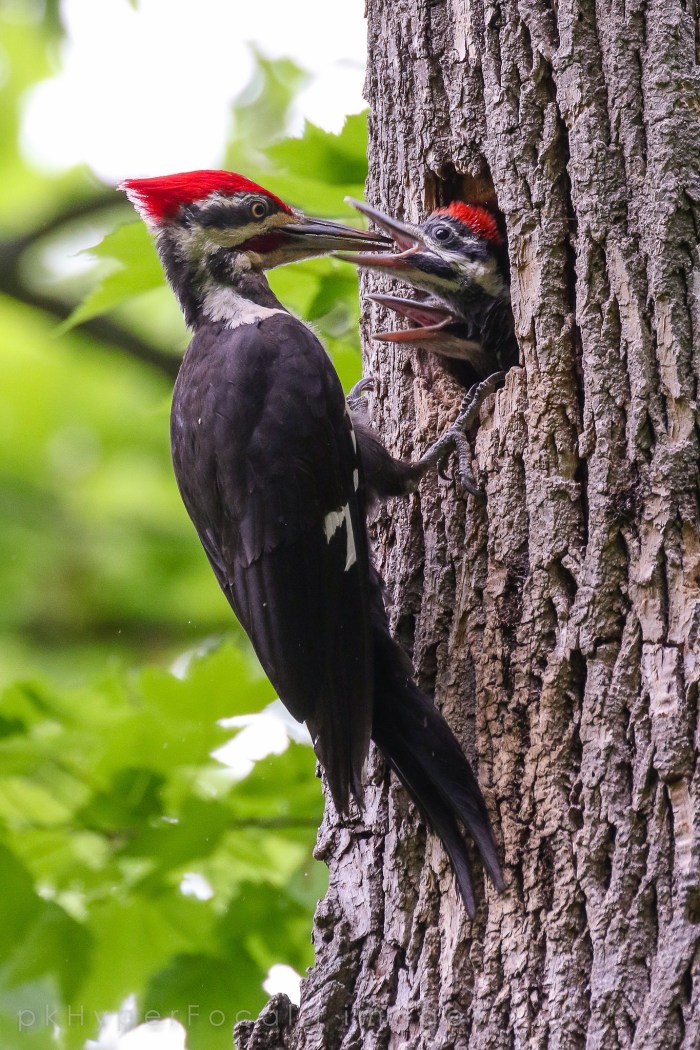
Red Mohawk

Red Mohawk, photo by PK HyperFocal

The All About Birds entry for the Pileated Woodpecker (Dryocopus pileatus) says in part:

The Pileated Woodpecker is one of the biggest, most striking forest birds on the continent. It’s nearly the size of a crow, black with bold white stripes down the neck and a flaming-red crest. Look (and listen) for Pileated Woodpeckers whacking at dead trees and fallen logs in search of their main prey, carpenter ants, leaving unique rectangular holes in the wood. The nest holes these birds make offer crucial shelter to many species including swifts, owls, ducks, bats, and pine martens.

…The male begins excavating then nest cavity and does most of the work, but the female contributes, particularly as the hole nears completion. The entrance hole is oblong rather than the circular shape of most woodpecker holes. For the finishing touches, the bird climbs all the way into the hole and chips away at it from the inside. Periodically the adult picks up several chips at a time in its bill and tosses them from the cavity entrance. Pileated Woodpeckers don’t line their nests with any material except for leftover wood chips. The nest construction usually takes 3-6 weeks, and nests are rarely reused in later years. Cavity depth can range from 10-24 inches.

Nest trees are typically dead and within a mature or old stand of coniferous or deciduous trees, but may also be in dead trees in younger forests or even in cities. Dead trees are a valuable resource as nest sites or shelter for birds and other animals, and Pileated Woodpeckers battle for ownership with Wood Ducks, European Starlings, Red-bellied Woodpeckers, Red-headed Woodpeckers, Eastern Bluebirds, and Great Crested Flycatchers. Occasionally bats and swifts share roost cavities with Pileated Woodpeckers.

Click through for lots more including calls, Pileated facts, and video.

PK HyperFocal’s photo background big and see more in his Feathers slideshow.

Lots more Michigan birds on Michigan in Pictures.

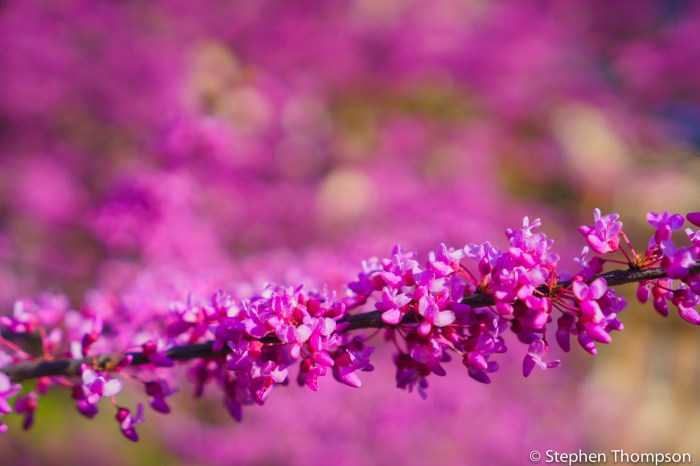
Eastern Redbud (Cercis canadensis)

Redbud

Redbud, photo by Stephen Thompson

The magenta flash of Eastern Redbud (Cercis canadensis) is one of my favorite sights in springtime. I used to think it was an exotic tree, but as Rick Meader of the Ann Arbor News shares, Redbud trees are native to southern Michigan:

…as a member of the Pea family (Fabaceae) it’s a cousin to the previous pod-producers we’ve learned about, Honeylocust (Gleditsia triacanthos) and Kentucky Coffeetree (Gymnocladus dioica). Let’s learn more about this colorful little native.

As mentioned before, Eastern redbud is native to southern Michigan, occurring naturally up to a line across the lower peninsula from Kent County to Genesee County. Nationally, it occurs naturally in an area extending from Maryland and the Carolinas west to eastern Kansas through Texas, including all of the southern states and northern Florida. Of course, because it’s a pretty little thing, it has been planted in areas beyond its native range.

If you want to use it in your landscape, it is fairly flexible in terms of where it will grow. It naturally occurs in rich soil along stream and river banks but is tolerant of a wider range of conditions. It likes sun or partial shade and can do well in most soils except waterlogged soils and dry, sandy soils.

Read on for more.

View Stephen’s photo bigger and jump into his slideshow for more great pics!

Beautiful Blossoms

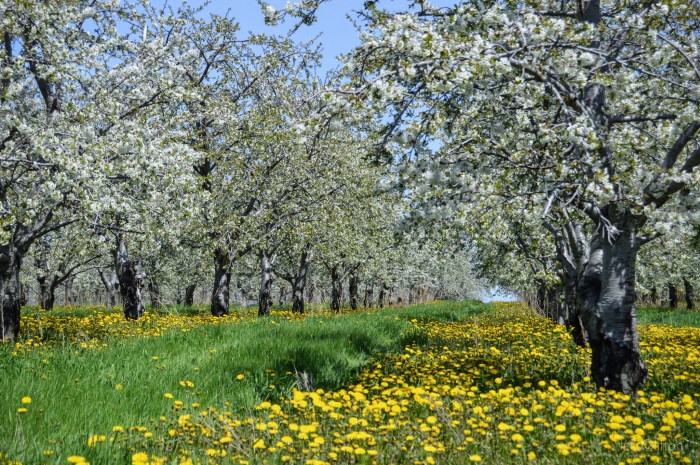
Cherry Orchard Aisles & Blossoms

Cherry Orchard Aisles & Blossoms, photo by Jess Clifton

mLive meteorologist Mark Torregrossa writes that the upcoming weather is looking normal, which is also fantastic for an extended time period of blooming here in Michigan:

Tulip Time runs from Saturday, May 7, to May 14 in downtown Holland. The Traverse City area cherry blossoms are also about to erupt with color.

Cool nights and near normal temperature days are just what we want for a long display of color from these two spring performers.

Gwen Auwerda, Executive Director of Tulip Time in Holland, MI says tulip blossoms can last up to 21 days if high heat is avoided. Auwerda says most of the tulips in Holland, MI are at peak right now, with some of the late bloomers expected to peak next week.

The cooler weather has slowed down the cherry blossoms in northwest Lower Michigan. Nikki Rothwell, MSU Extension educator, says now the cherries are right on track to blossom at the typical time.

Rothwell says sweet cherries are only days away from blooming, with peak bloom in northwest Lower Michigan possibly on Mother’s Day. Tart cherries, which make up most of northwest Lower Michigan’s cherry crop, should start blooming May 11 or May 12, and peak around May 14.

Jess took this back in May of 2014 near Traverse City. View it background bigilicious, enjoy her Mother Nature in Michigan slideshow, and check out more of her work at jesscliftonphotography.com.

More spring wallpaper on Michigan in Pictures!

Michigan’s Bird of Fire: Saving the Kirtland’s Warbler

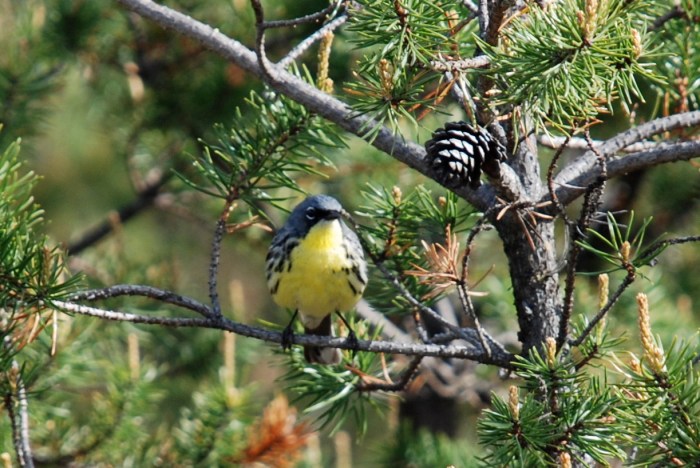
Michigan Bird of Fire Kirtlands Warbler

Kirtland’s Warbler, photo by James Fox

On June 3-4, northeast Michigan will celebrate a Michigan conservation success story with the annual Kirtland’s Warbler Weekend that includes an Au Sable River Kayak Tour. You can also lend a hand this Saturday with the annual jack pine planting day through the Kirtland’s Warbler Initiative!

The Detroit News has a nice editorial by Michael Bean, Principal Deputy Assistant Secretary for Fish and Wildlife and Parks at the U.S. Department of the Interior about how determination saved Michigan’s “Bird of Fire”, the Kirtland’s Warbler:

More than 60 years ago, scientists realized that the Kirtland’s warbler was in trouble. A 1951 census found fewer than 500 breeding pairs. The bird was among the first species ever listed as endangered and was the first species to ever have a “recovery team.”

Kirtland’s warblers will only nest in young jack pine forest. Jack pine requires fire to open its cones and spread its seeds — hence the nickname, “bird of fire.” Fire suppression policies last century led to the decline of the Kirtland’s warbler, as did parasitism from brown-headed cowbirds. The recovery team had to figure out a way to overcome these challenges to save the species.

Since 1974, the Kirtland’s Warbler Recovery Team has worked to save the species, even when the outlook for recovery was bleak. The recovery team brought together federal, state, academic, nonprofit, and even international partners.

Today, scientists estimate there are more than 4,000 Kirtland’s warblers in Michigan. The population has more than doubled its recovery goal, so the recovery team is no longer needed. Through years of hard work the partners figured out how to provide the conditions necessary for the warblers to survive, and the birds have flourished.

View James’ photo background big and see more in his Grayling 2009 slideshow.

Tragic Tree Tuesday: Beech Scale & Beech Bark Disease

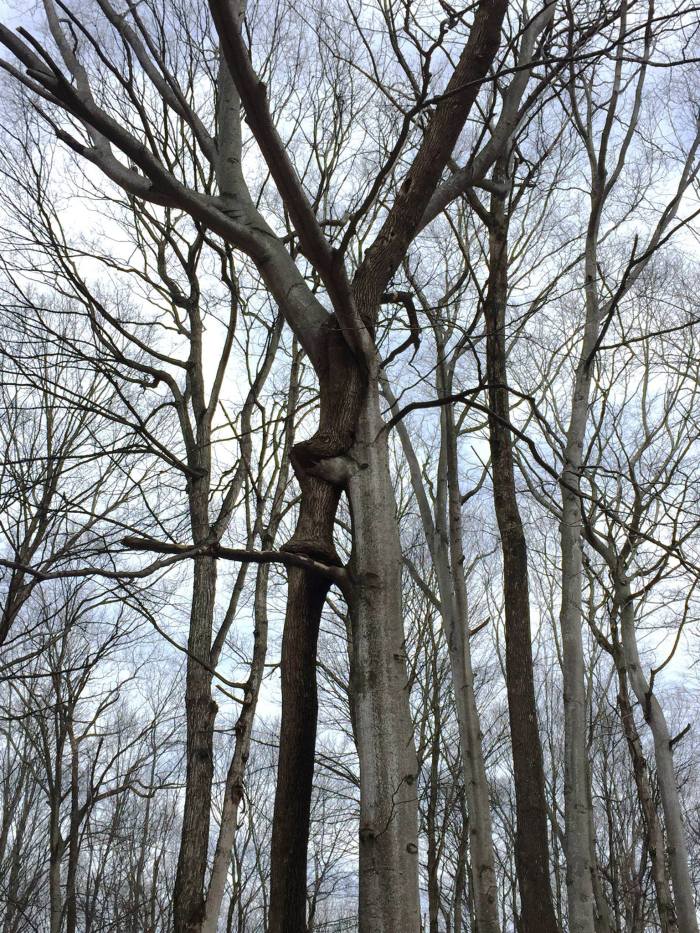
Twined Trees at Treat Farm

Twined Trees at Treat Farm, photo by Sleeping Bear Dunes National Lakeshore

“A glooming peace this morning with it brings;
The sun, for sorrow, will not show his head:
Go hence, to have more talk of these sad things;
Some shall be pardon’d, and some punished:
For never was a story of more woe
Than this of Juliet and her Romeo.”
~William Shakespeare

The Sleeping Bear Dunes National Lakeshore shared this photo from their Tweddle/Treat Farm property saying:

The two hugging trees on the trail to Treat Farm share a similar fate to the star crossed lovers, Romeo and Juliet. The beech scale brings a fungus that is deadly like a poison, and kills off the American beech trees. The Emerald Ash Borers pierce the hearts of the ash trees to take the nutrients.

Invasive species have made their way to the fair Lakeshore of Sleeping Bear Dunes. You can help prevent the spread by purchasing local firewood, and burning it within the local area.

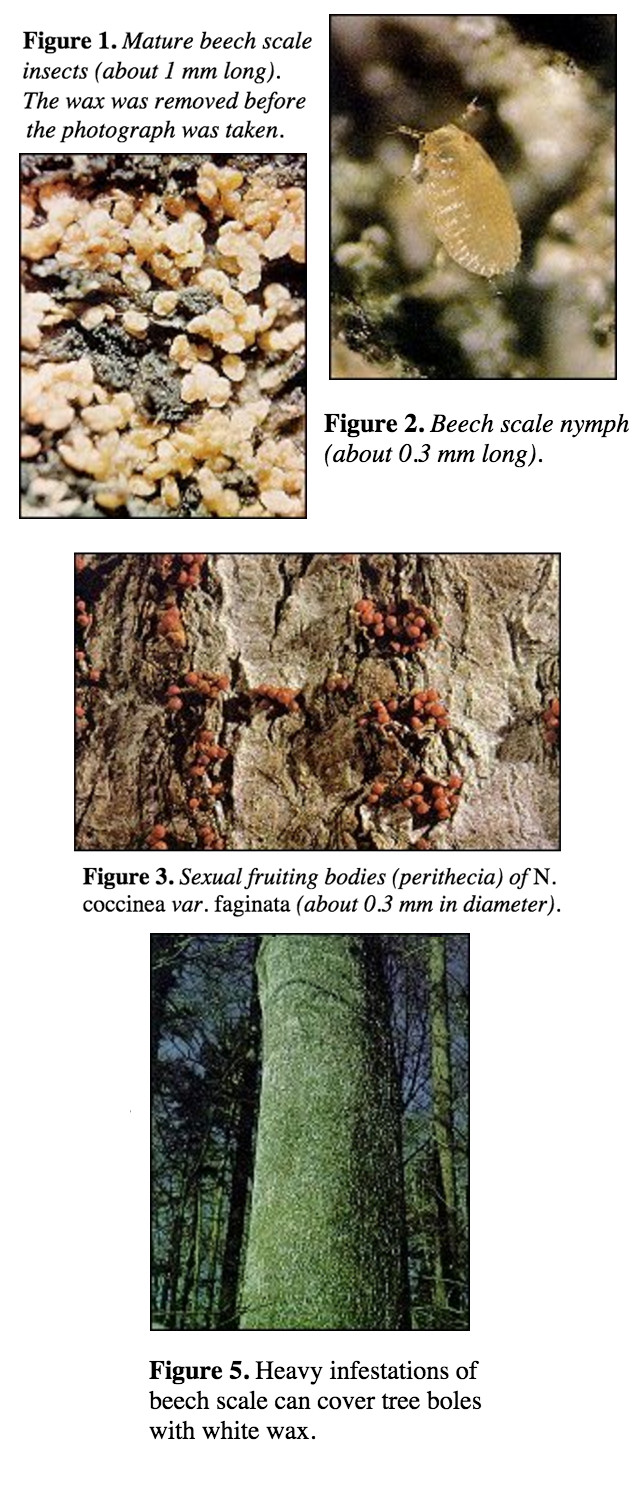
Beech Scale and Beech Bark DiseaseI’ve written about the Emerald Ash Borer on Michigan in Pictures, so here’s a bit about beech scale & beech bark disease from MSU:

Beech bark disease is one of the latest exotic pest problems to plague Michigan forests. Beech bark disease refers to a complex that consists of a sap-feeding scale insect and at least two species of Nectria fungi. Beech bark disease begins when American beech (Fagus grandifolia) becomes infested with beech scale (Cryptococcus fagisuga Lind) (=Cryptococcus fagi Baer.). The tiny scale insects, found on the tree trunk and branches, feed on sap in the inner bark. White wax covers the bodies of the scales.

When trees are heavily infested, they appear to be covered by white wool. Minute wounds and injuries caused by the scale insects eventually enable the Nectria fungus to enter the tree. Nectria kills areas of woody tissue, sometimes creating cankers on the tree stem and large branches. If enough tissue is killed, the tree will be girdled and die. Other trees may linger for several years, eventually succumbing to Nectria or other pathogens. Some infected trees will break off in heavy winds — a condition called “beech snap.” Dense thickets of root sprouts are common after trees die or break.

Read on for lots and also see Beech Bark Disease from the National Forest Service where I got these photos.

View the photo bigger on their Facebook page and learn all about the Lakeshore from their website.

The Ghost Forest in Silver Lake Dunes

Ghost Forest

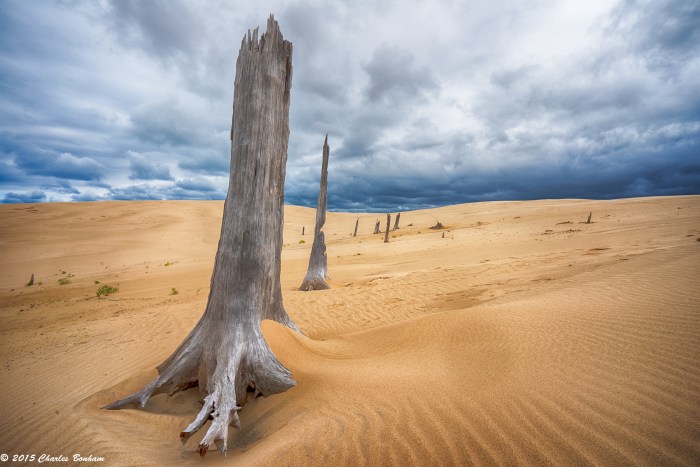
Ghost Forest, photo by Charles Bohnam

The Silver Lake State Park page at Michigan Trail Maps says in part:

Not all of Michigan’s great hikes are trails. This trek is a journey through Silver Lake State Park’s trailless backcountry, a mile-wide strip of dunes between Silver Lake and Lake Michigan. There’s not another hike like this in Michigan or even the Midwest because no other stretch of dunes are so barren.

Perched on a plateau and rising more than 100 feet high above Silver Lake, the heart of these dunes are totally devoid of any vegetation, even dune grass. The only thing besides sand are the stumps and trunks of ghost forests, ancient trees that the migrating dunes had buried and killed. Almost half of the hike is in this Sahara Desert-like terrain, the other half is spent strolling a stretch of Lake Michigan that is free of cottages and frozen custard stands.

A rare hike indeed.

View Charles’ photo background bigilicious and see more in his slideshow.

More dunes and more summer wallpaper on Michigan in Pictures.

O Tree, Live Forever

Kalamazoo Tree

O, tree, live forever, photo by Bill Dolak

Bill writes:

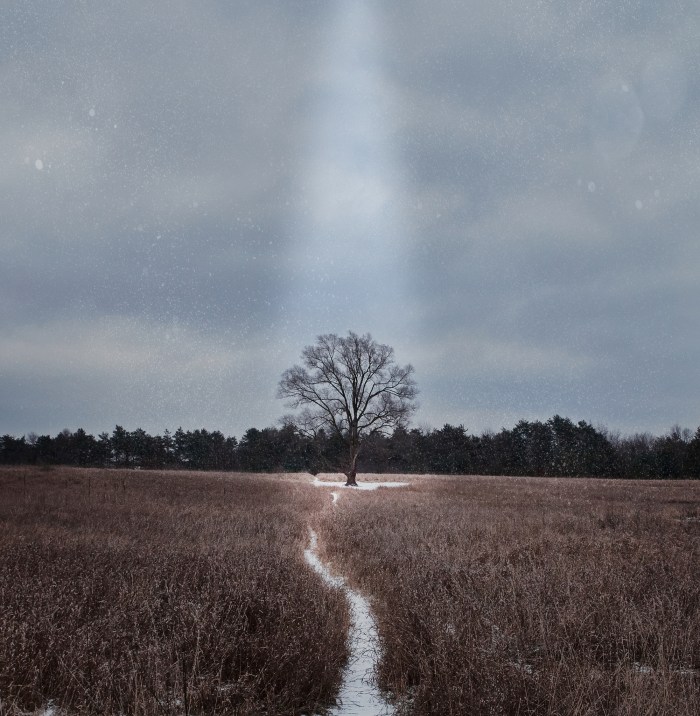
This tree in the Al Sabo Preserve in Kalamazoo County is a frequent subject and accessory for local photographers. I have images of it from the days I was still putting film into my SLR.

Regarding the Al Sabo Preserve, the Texas Charter Township Parks & Rec page says:

The Al Sabo Land Preserve was established in the early 1970’s in order to protect the groundwater supply of the Atwater wellfield. The 741 acres were purchased in the late 1960’s and a master plan was developed for its use as a passive recreation nature preserve. The City of Kalamazoo passed an ordinance that would ensure its protection as a water resource. The wetlands and sandy soils serve as a recharge area for the area’s groundwater.

View Bill’s photo background big and see more in his Al Sabo, Michigan slideshow.

Christmas Memories

Christmas Memories

Christmas Memories, photo by Richard Deming Photography

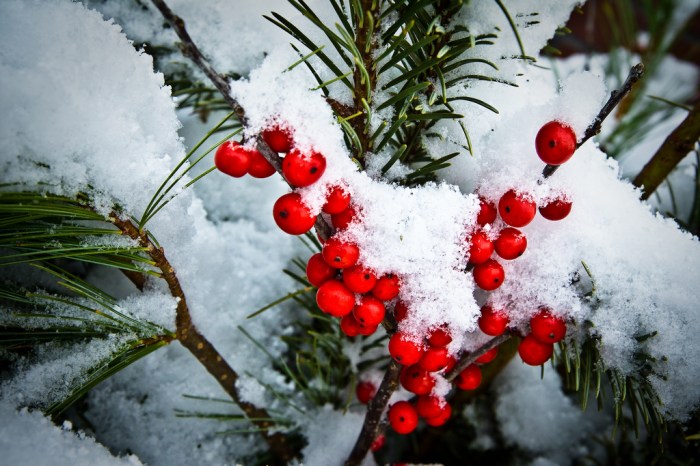
Here’s hoping that whatever holiday you are celebrating this season is wonderful. Thanks everyone for being a part of Michigan in Pictures!

View Richard’s photo bigger and see more in his Christmas Time 2010 slideshow.

Forecasting sunsets through Sunset WX

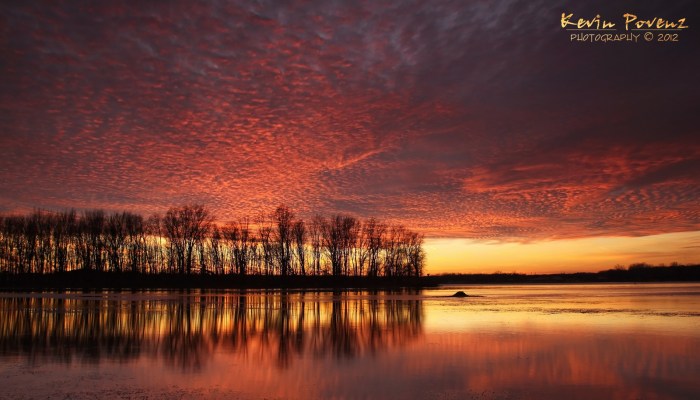
Sunset at the Bend Area

Sunset, photo by Kevin Povenz

If you’re looking to get the perfect sunset, you might want to check out the sunset forecast from Sunset WX. They explain (in part) their model for sunset forecasts:

…we understand there are numerous definitions for the criteria: Vivid, average, and poor. However, as a landscape photographer, there are certain variables I look for each evening before making the decision to take time out of my day and photograph the sunset. The most important factor I look for is sky cover, and more specifically, the existence of high clouds over the area. High clouds not only provide moisture to refract the sunlight, their ‘wispy’ formation also provides “texture” to the sky and are high enough in the atmosphere for the sun to scatter light below. Think of these as a movie theatre screen, in which light can be projected upon.

Because of this, we weighted high clouds the most as stated before, and consider this necessary for a “Vivid” sunset. In general, regions that are displayed “Poor” in the model, are areas of near 100% of total cloud cover, and also areas that are projected to experience precipitation around sunset time. The ‘hard to define’ area comes in between the two. To some, a clear sky at the time of sunset may be the definition of a great one. In this model, it is our intent to weight a clear sky sunset as average, and therefore it would show up as green or light yellow. The oranges and reds are really the areas where we are trying to show that the sunset will be one of those that makes you go ‘Wow’.

Click through to check out the live sunset forecast map – it’s pretty cool!

Kevin took this photo back in December of 2012 at “The Bend Area” in Ottawa County on the Grand River near Jenison. View it bigger and see lots more in his Sunrise/Sunset slideshow.

Lots more great Michigan sunsets on Michigan in Pictures!