Knockout storm packs 100 MPH winds & huge hail

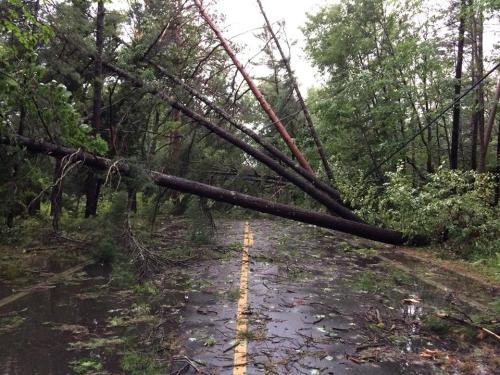
Road Closed in Glen Arbor

Road Closed in Glen Arbor, photo via the Glen Arbor Sun

One more day of storm reporting from my neck of the woods…

In Glen Arbor Hit By Knockout Storm, Jacob Wheeler of the Glen Arbor Sun lays out a diary of the destruction of the storm and wrote:

In the storm’s wake yesterday, Glen Arbor residents immediately recognized that the destruction they witnessed was unprecedented for our town. This was worse than the 1987 storm, people said. In fact, it was far worse. The storm was more powerful and more destructive than any other Glen Arbor storm ever recorded. And now we have stats to prove it.

I spoke late this afternoon to Jeff Lutz, meteorologist with the National Weather Service (NWS) in Gaylord. While Lutz clarified that yesterday’s storm was not a tornado (you can blame some of the hyperbole on this newspaper) he did confirm that the straight-line winds which accompanied the sudden thunderstorm reached speeds of 100 miles per hour. That’s strong enough to be called a tornado. More significantly, it blows away the previous wind velocity record for Leelanau County. According to the NWS, on Sept. 13, 2005, a barrage of wind traveling at 63 miles per hour hit Leland and Empire, but not Glen Arbor. But 63 is not 100. Not even close. Nope, yesterday’s storm was the strongest to ever hit Leelanau County, since records were kept starting in 1950.

You can click through to the Sun for more pics and storm coverage and get even more on their Facebook. Jacob also shared the National Weather Service’s Aug. 2 severe weather recap:

  • Multiple rounds of severe weather impacted northern Michigan on August 2nd, 2015. The first severe thunderstorm warning was issued 10:34 am with an additional 27 warnings being issued before the last warning of the day expired at 8:00 pm.
  • The largest hail reported was 4.25″, or the size of a softball, seven miles north of West Branch at 4:55 pm. The large hail was reported by trained spotters and members of the public. There were several reports of damage to vehicles and other property. At the time of the event, a Severe Thunderstorm Warning was in effect for all of Ogemaw County, issued at 4:33 pm. Additional reports of 1.00″ to 2.00″ hail were received from law enforcement, emergency managers, trained spotters and the public across multiple locations in northern Michigan.
  • The 4.25″ hail observed seven miles north of West Branch was the largest documented hail stone ever to impact northern Michigan since records began in 1950 and the largest since 1998 when a 3.50″ hail stone was recorded in Arenac County.
  • Hundreds of downed trees and power lines were reported on Sunday as 60-80 mph (locally 90-100 mph) straight-line winds accompanied the severe thunderstorms.

Lots more at that link including some pics of that hail.
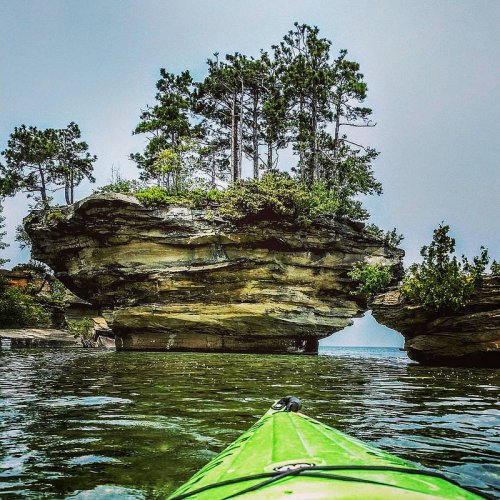
Kayaking to Turnip Rock

Kayak at Turnip Rock

Turnip Rock, Port Austin, MI, photo by Seasons Photography

The second in our series of “Cool Places Your Kayak Can Take You” features this cool rock formation in Lake Huron. Port Austin Kayak’s page on kayaking to Turnip Rock says:

A trip to Turnip Rock in Port Austin is unmistakably one of the best activities for kayakers on Lake Huron. The trip consists of a 7 mile out-and-back trip via the Point aux Barques trail. The shallow waters surrounding Turnip Rock allow you to get out and enjoy the area as well as snap a few photos while you are there. Be sure to wear suitable footwear if you are going to exit the kayak as the rocks are slippery. For an account of what it’s like kayaking out to Turnip Rock, read this adventurer’s great story. While this story also goes out to the lighthouse, that leg of the trip is for experienced kayakers only and is reserved for the calmest weather days, as you will be kayaking two miles out into Lake Huron.

Please note that the property surrounding Turnip Rock is privately owned, which is why kayaking is the premier way to access the rock. The owners of the surrounding properties take great care of the land and we ask that you respect their space by not trespassing or littering.

If you don’t have a kayak, they can certainly rent you one. That link goes to one of my favorite photographer’s trips: Lars Jensen and his Turnip Rock expedition.

View the photo bigger and see more in Seasons Photography’s Michigan slideshow.

More kayaks & kayaking and more about Turnip Rock on Michigan in Pictures.

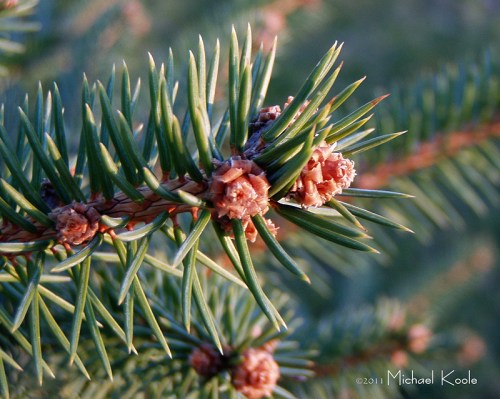
Requiem for a Spruce: Spruce Budworm in Michigan

April 11, photo by Michael Koole

April 11, photo by Michael Koole

Garret Ellison of the Grand Rapids Press & mLive writes that the Michigan Department of Natural Resources expects spruce budworm to inflict heavy damage on white spruce and balsam fir trees across the Upper and northern Lower Peninsulas this year:

The budworm is “one of the most destructive native insects” in the northern spruce and fir forests of the eastern U.S. and Canada. The worms drop as caterpillars from treetops on webs and feed on tree growth in the spring.

Repeated budworm defoliation can cause top-kill and death in older and stressed trees. Balsam fir older than 60 and spruce over 70 years are prime targets. Younger trees infested with budworms lose much new growth but generally survive.

Read on for more, including how to protect your trees. The U.S. Forest Service has more about the spruce budworm:

The spruce budworm Choristoneura fumiferana (Clemens) is one of the most destructive native insects in the northern spruce and fir forests of the Eastern United States and Canada. Periodic outbreaks of the spruce budworm are a part of the natural cycle of events associated with the maturing of balsam fir.

The first recorded outbreak of the spruce budworm in the United States occurred in Maine about 1807. Another outbreak followed in 1878. Since 1909 there have been waves of budworm out breaks throughout the Eastern United States and Canada. The States most often affected are Maine, New Hampshire, New York, Michigan, Minnesota, and Wisconsin. These outbreaks have resulted in the loss of millions of cords of spruce and fir.

Balsam fir is the species most severely damaged by the bud-worm in the Eastern United States. White, red, and black spruce are suitable host trees and some feeding may occur on tamarack, pine, and hemlock. Spruce mixed with balsam fir is more likely to suffer budworm damage than spruce in pure stands.

If you’re intrigued by the “natural cycle” as I was, head over to Wikipedia’s entry on Choristoneura fumiferana, the Eastern Spruce Budworm for an explanation and some pics of these (for a change) native pests.

View Michael’s photo bigger and see more (including lots of tasty macro) in his Around the Yard slideshow.

PS: Sorry about the Monday morning novel … sometimes I over share. ;)

Foxy Friday

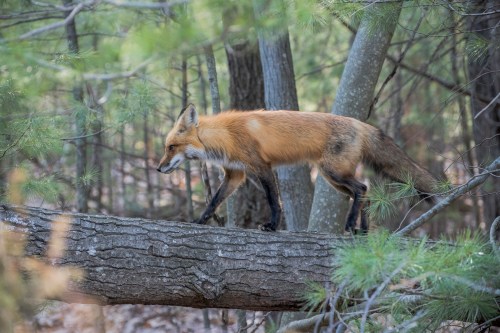
Fox Crossing

Fox Crossing, photo by Mark Miller

What an incredible catch by Mark!

View his photo bigger and see more of this little lady in his slideshow.

PS: More about red fox in Michigan from Michigan in Pictures.

Old Mission Orchard in Bloom

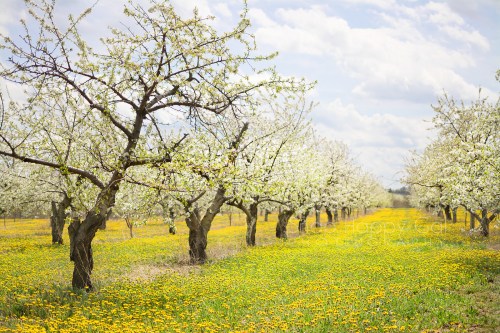
Old Mission Orchard

Old Mission Orchard, photo by Heather Higham

The cherry blossoms are out on northwest Michigan’s Old Mission Peninsula. A little over 100 years ago, this annual occurrence gave birth to Traverse City’s National Cherry Festival. The Cherry Festival’s history page shares that sometime around 1910, cherry growers in the Grand Traverse area began to hold informal “blessing of the blossoms” ceremonies each year at blossom time in May. The TC Record-Eagle picks up the story:

Something had to be done to attract tourists to the Grand Traverse area, local resident and community leader Jay P. Smith declared in 1925.

Henry Ford had introduced a new automobile that allowed people to travel long distances with ease, and Hannah, Lay & Co. spurred a growing business atmosphere here, but tourism still lagged. So Smith created the Blessing of the Blossoms festival.

For one day in May area residents and visitors traveled out to the Old Mission Peninsula to view fields of cherry blossoms from the vantage point of two towers, then flocked to a downtown parade that moved east on Front Street from Elmwood Avenue to Railroad Avenue.

“This was kind of a big deal,” said Gary Kaberle, a former National Cherry Festival president. “People really liked this.”

But Smith and his committee quickly realized that a May festival meant children weren’t out of school and tourists were less likely to have time off work, so they moved the festival to July to coincide with the cherry harvest.

You can read on for more about the evolution of the Cherry Festival and if you want to attend, the dates are July 4-11, 2015 and you can get all the details at cherryfestival.org.

Heather writes that she was looking into an orchard from the edges, surrounded by flowers and bees when she took this picture. View her photo bigger on Flickr, see more in her Old Mission Peninsula slideshow and definitely follow her at Snap Happy Gal Photography on Facebook.

PS: If you want to learn about the early days of the Old Mission Peninsula, check out Rev. Peter Dougherty House on Old Mission having one heck of a yard sale from May 2007 on Michigan in Pictures.

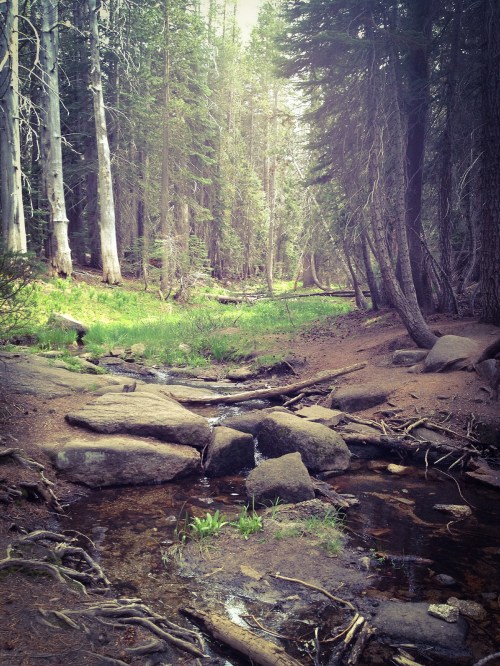
Spring at Tahquamenon Falls

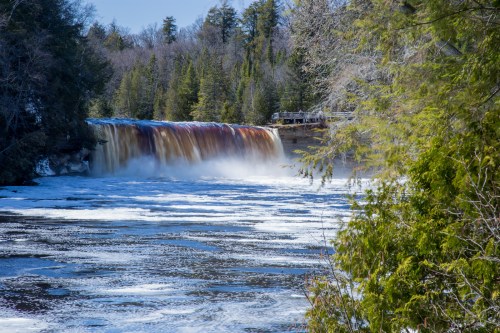
Tahquamenon Falls

Tahquamenon Falls, photo by ptrefftz

Hey beautiful!

View the photo background bigtacular and see more including some beautiful night sky photos in ptrefftz’s slideshow.

More Spring wallpaper on Michigan in Pictures.

Welcome to May

Untitled

Untitled, photo by Amy Holley

Hope your May brings you promise and new growth.

Amy took this photo on May 1st last year. View it background big and see more wide-ranging goodness in her Outdoors slideshow.

Get growing.

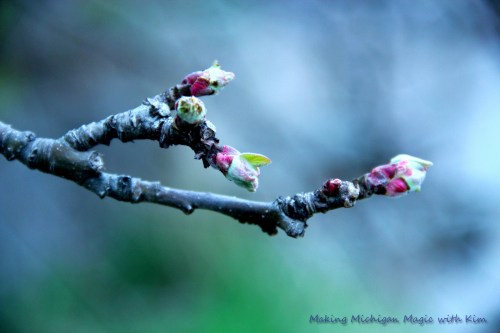
Apple Tree Budding by Kim Nixon

Apple Tree Budding, photo by Kim Nixon

Kim took this on April 1, 2012. View it bigger on Flickr and see more in her April 2012 slideshow that includes photos from the Yellow Dog River and some of the coolest clouds ever!

Polling for Parks: Porcupine Mountain Wilderness State Park

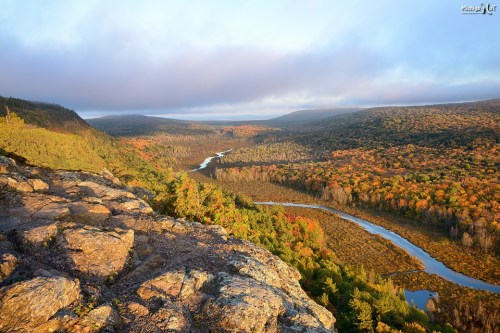
Sunset over Lake of the Clouds, Porcupine Mountains

Sunset over Lake of the Clouds, Porcupine Mountains, photo by John McCormick

USA Today is polling their readers to see what they think the 10 best state parks in the nation are. The entry page for the Porcupine Mountain Wilderness State Park says:

The Porcupine Mountains Wilderness State Park, or the “Porkies” as its known to frequent visitors, encompasses 60,000 acres of lakes, rivers and virgin forest. The park offers camping on the shores of Lake Superior, 90 miles of hiking trails, kayak rentals, mountain biking and, in the winter, access to the Porcupine Mountains Ski Area.

Porcupine Mountains Wilderness State Park – Mich. is currently ranked #2 of 20.

You can click here to vote if you’re so inclined.

John took this evening shot in October 2014 near the east end off the Lake of the Clouds. View it bigger on Flickr, see more staggering photos in his Autumn in Michigan slideshow, and definitely follow him on Facebook at Michigan Nut Photography.

You can click to visit the Porcupine Mountains Wilderness State Park website and get all kinds of Porcupine Mountains rivers, falls and views on Michigan in Pictures.

Northern Lights: Ancient Aliens Edition

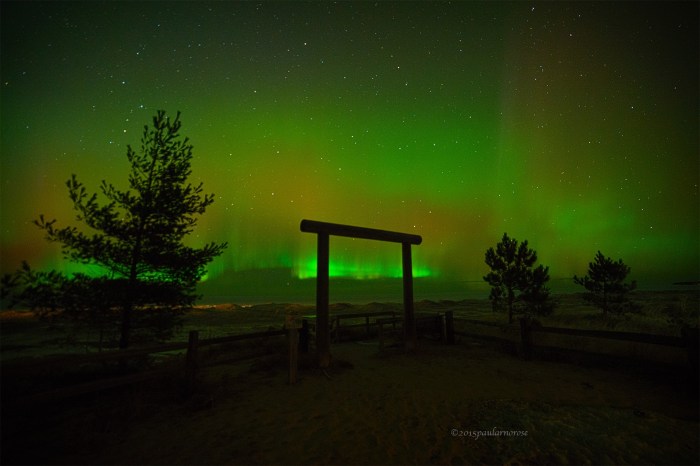
Northern Lights Ancient Aliens Edition

Northern Lights over Lake Lake Superior, photo by Paul Arno Rose

NOAA’s Space Weather Prediction Center is THE place to go for forecasting of likely northern lights activity. Yesterday they held a press conference regarding the G4 storm (on a scale of 1-5) that was caused by two magnetic eruptions on March 15 that combined to form a single wave producing the biggest storm so far of Cycle 24.

Their page on Geomagnetic Storms explains:

A geomagnetic storm is a major disturbance of Earth’s magnetosphere that occurs when there is a very efficient exchange of energy from the solar wind into the space environment surrounding Earth. These storms result from variations in the solar wind that produces major changes in the currents, plasmas, and fields in Earth’s magnetosphere. The solar wind conditions that are effective for creating geomagnetic storms are sustained (for several to many hours) periods of high-speed solar wind, and most importantly, a southward directed solar wind magnetic field (opposite the direction of Earth’s field) at the dayside of the magnetosphere. This condition is effective for transferring energy from the solar wind into Earth’s magnetosphere.

The largest storms that result from these conditions are associated with solar coronal mass ejections (CMEs) where a billion tons or so of plasma from the sun, with its embedded magnetic field, arrives at Earth. CMEs typically take several days to arrive at Earth, but have been observed, for some of the most intense storms, to arrive in as short as 18 hours. Another solar wind disturbance that creates conditions favorable to geomagnetic storms is a high-speed solar wind stream (HSS). HSSs plow into the slower solar wind in front and create co-rotating interaction regions, or CIRs. These regions are often related to geomagnetic storms that while less intense than CME storms, often can deposit more energy in Earth’s magnetosphere over a longer interval.

Storms also result in intense currents in the magnetosphere, changes in the radiation belts, and changes in the ionosphere, including heating the ionosphere and upper atmosphere region called the thermosphere. In space, a ring of westward current around Earth produces magnetic disturbances on the ground. A measure of this current, the disturbance storm time (Dst) index, has been used historically to characterize the size of a geomagnetic storm. In addition, there are currents produced in the magnetosphere that follow the magnetic field, called field-aligned currents, and these connect to intense currents in the auroral ionosphere. These auroral currents, called the auroral electrojets, also produce large magnetic disturbances. Together, all of these currents, and the magnetic deviations they produce on the ground, are used to generate a planetary geomagnetic disturbance index called Kp. This index is the basis for one of the three NOAA Space Weather Scales, the Geomagnetic Storm, or G-Scale, that is used to describe space weather that can disrupt systems on Earth.

During storms, the currents in the ionosphere, as well as the energetic particles that precipitate into the ionosphere add energy in the form of heat that can increase the density and distribution of density in the upper atmosphere, causing extra drag on satellites in low-earth orbit. The local heating also creates strong horizontal variations in the in the ionospheric density that can modify the path of radio signals and create errors in the positioning information provided by GPS. While the storms create beautiful aurora, they also can disrupt navigation systems such as the Global Navigation Satellite System (GNSS) and create harmful geomagnetic induced currents (GICs) in the power grid and pipelines.

Lots more including the ability to sign up for space weather alerts at www.swpc.noaa.gov. Also head over to the NOAA Auroras group on Flickr to share your photos.

View Paul’s photo background bigtacular and check out more of his photography on his Facebook page.

More northern lights photos & info on Michigan in Pictures.