That’s a job creation engine out there…

Layers of Michigan Winter

Layers of Michigan Winter, photo by nasunto.

The Wall Street Journal reports:

An analysis by Michigan Sea Grant at the University of Michigan says more than 1.5 million U.S. jobs and $62 billion in annual wages are linked directly to the Great Lakes.

The study was released Thursday. It says Michigan has 525,886 jobs connected to the Great Lakes, more than any other state. Illinois ranks second with 380,786, followed by Ohio with 178,621.

Most of the jobs are in manufacturing. Others are in tourism and recreation, shipping, agriculture and other sectors of the economy.

Jim Diana, director of Michigan Sea Grant, says the study illustrates that protecting the lakes is crucial to attracting and retaining businesses and jobs.

That’s a lot of jobs … and at an estimated $62 billion in wages, it’s a very compelling argument for Michigan to take a leadership role in protecting the Great Lakes. Here’s the news release from Sea Grant and the PDF of the Great Lakes Jobs Report.

About the photo Nina writes On the shore of Lake Michigan: Cold sand and a layer of ice. In the distance, snow, ice, whitecaps on the beautiful and temperamental lake, and a cloud-filled sky. Check it out background big and in her Lake Michigan slideshow.

Complete Streets could change the look of Michigan cities

SCW bike lane Front St

SCW bike lane Front St, photo by TART Trails.

Today’s post comes courtesy of the Grand Vision in northwest Michigan

The Detroit Free Press has a report on a law passed this year that could have a big impact on the future design of Michigan’s cities. The Complete Streets act directs transportation planners in the state to plan for streets that accommodate pedestrians and bicyclists along with cars and trucks.

It means that Michigan is now on the record acknowledging that it is a mistake to build roadways just to move high volumes of vehicle traffic as fast as possible. Designing healthy cities means considering all potential users of a street, regardless of their age or ability.

Ultimately, complete streets could produce road designs that accommodate sidewalk restaurants and the like, and intersection designs that allow pedestrians to cross in safety, not in fear of their lives.

A complete street, in other words, would be designed to handle pedestrians, people in wheelchairs, families pushing strollers and bicyclists. It also would meet the needs of retail and commercial users for wider sidewalks or slower traffic speeds.

See this photo by John Robert Williams bigger in the Smart Commute Week set.

A little trip up north… and Thomas Story Kirkbride

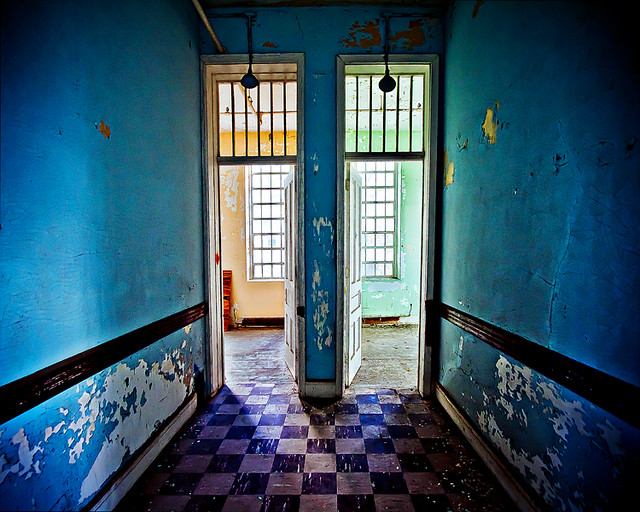
2 Doors Down by Carolyn Gallo

Last weekend, I had the good fortune to lead a photo walk for a group of Michigan photographers at the place where I work, the The Village at Grand Traverse Commons in Traverse City. We were touring the as yet un-renovated parts of what was known as Building 50 when it was the Traverse City State Hospital. Also known as the Northern Michigan Asylum for the Insane and the Traverse City Regional Psychiatric Hospital, the building was a Kirkbride Institution, designed by Dr. Thomas Story Kirkbride.

Kirkbride was a Pennsylvania Quaker and founding member of the Association of Medical Superintendents of American Institutions for the Insane who developed a concept of treatment known as the Kirkbride Plan. This plan proposed a particular way of housing patients that included segregating by severity of mental illness and fresh air and natural light where possible:

It was believed crucial to place patients in a more natural environment away from the pollutants and hectic energy of urban centers. Abundant fresh air and natural light not only contributed to a healthy environment, but also served to promote a more cheerful atmosphere. Extensive grounds with cultivated parks and farmland were also beneficial to the success of an asylum. Landscaped parks served to both stimulate and calm patients’ minds with natural beauty (enhanced by rational order) while improving the overall aspect of the asylum. Farmland served to make the asylum more self-sufficient by providing readily available food and other farm products at a minimal cost to the state.

Patients were encouraged to help work the farms and keep the grounds, as well as participate in other chores. Such structured occupation was meant to provide a sense of purpose and responsibility which, it was believed, would help regulate the mind as well as improve physical fitness. Patients were also encouraged to take part in recreations, games, and entertainments which would also engage their minds, make their stay more pleasant, and perhaps help foster and maintain social skills.

There’s lots more from Kirkbride Buildings where the author has done some spectacular scholarship and created an excellent resource for these amazing structures. The Kirkbride System produced a photographic environment of uncommon richness that is evident in the slideshow from the group A little trip up north…, the Flick slideshow for the “atripupnorth2010” tag and in the streams of the photographers in the group. They also visited some wineries and other spots in the area.

As an added bonus, and unlike many of Michigan’s ruins, the Village at Grand Traverse Commons is actively being redeveloped. In fact, this week a crew began work to restore much of the North Wing where we toured!

See this photo bigger in Carolyn’s Photogs Up North slideshow.

Search Kirkbride on Michigan in Pictures for more about the history of this remarkable place.

The Art of Michigan Wine

-55

-55, photo by Emery Co Photo.

In the month of August, Absolute Michigan is featuring everything about Michigan’s booming wine industry.

Today there’s a feature on the Traverse City Wine & Art Festival that clues you into this great event and also offers you some chances to win tickets!

Stay tuned to absolutemichigan.com/Wine for much more information!

Jesamin has a great slideshow of photos from the inaugural Traverse City Wine & Art Festival and we also encourage you to add YOUR Michigan wine photos to the Absolute Michigan pool!

2010 Traverse City Film Festival

2009-7-31 TCFF 0065 copy

2009-7-31 TCFF 0065 copy, photo by tcfilmfest.

All week long I’m going to be on location with Absolute Michigan, working for the Traverse City Film Festival.

Tune in to Absolute Michigan’s Traverse City Film Festival coverage where we’ll try and take you up close and personal with one of Michigan’s most dynamic festivals!

Many more photos are posted daily during the festival to the Traverse City Film Festival Flickr. You can see some of the best in the Traverse City Film Festival Flickriver and the Traverse City Film Festival group on Flickr.

M is for Michigan (and Memorial Day Weekend)

M is for Michigan

M is for Michigan, photo by David Belo.

Absolute Michigan reports that 1.1 million Michiganians will hit the roads over Memorial Day Weekend 2010. I hope a good number of them get to hold hands and take in one of our stunning make that magical sunsets, and that some of them are you!!

David writes that this shot (and sunset) from the last stop of a wonderful 4th of July weekend getaway through Northern Michigan was most definitely worth the 3 am arrival back home in Ann Arbor. Be sure to check it out bigger in his Interesting slideshow and have and awesome make that marvelous weekend!

Let’s Talk About Tent Worms: Eastern Tent Caterpillars & Forest Tent Caterpillars

Tent Worm

Tent Worm, photo by sisterKRS10.

This year tent worms aka Eastern Tent Caterpillars seem to be a little thicker than normal in northern Michigan. I think the pictured caterpillar is actually a forest tent caterpillar. Both are tent caterpillars, about which Wikipedia says:

Tent caterpillars are readily recognized because they are social, colorful, diurnal and build conspicuous silk tents in the branches of host trees. Some species, such as the eastern tent caterpillar, Malacosoma americanum, build a single large tent which is typically occupied through the whole of the larval stage while others build a series of small tents that are sequentially abandoned. The forest tent caterpillar, Malacosoma disstrium, is exceptional in that the larvae build no tent at all, aggregating instead on silken mats that they spin on the leaves or bark of trees. Tents facilitate aggregation and serve as focal sites of thermal regulatory behavior. They also serve as communication centers where caterpillars are alerted to the discovery of new food finds…

The MSU Horticultural Research Station in Leelanau County has a really cool look at the Forest tent caterpillar in Northern Michigan that explained something I saw this weekend – tent worms leaving a tree on strands of web.

Here’s a PDF that looks at Gypsy Moth Caterpillars, Forest Tent Caterpillars and Eastern Tent Caterpillars and here’s more about Forest Tent Caterpillars and Eastern Tent Caterpillars. Most of what I read says that tent worm infestations are typically not life-threatening for trees. However, if you’re creeped out by these crawlies, eHow has advice for how to get rid of tent caterpillars.

Check this out bigger and in Kristin’s Mother Nature Up Close set (slideshow).

Pirates of the Caribbean 4 … in Traverse City?

Schooner Morning

Schooner Morning, photo by ETCphoto.

Under the “Is that Johnny Depp behind that moonbeam” heading comes the rumor making the rounds that Pirates Of The Caribbean 4: On Stranger Tides will film part of the movie in Traverse City, Michigan. Before the Trailer says that they have heard from several sources that the new Pirates of the Caribbean movie will be filming parts in the Traverse City area:

Before dismissing it, for those that have been to Lake Michigan shores in Traverse City, the water and the beaches are as beautiful and crystal clear as any you will find in the Caribbean. It could easily double for any tropical paradise. With Michigan having the best incentives in the country for filming, it would also make sense that producers and filming scouts would consider Traverse City as an ideal location to film parts of Pirates of the Caribbean 4.

While /Film notes that word on the street is that Jerry Bruckheimer is scaling back Pirates 4 to accommodate a smaller budget, /Film’s own Russ Fischer says:

They’ve pretty loudly talked up the deal that has them shooting in Hawaii, where they’ll take advantage of big tax breaks. I know Michigan has its own advantage systems in effect, and the lake there is amazing, but I’d guess it’s a hopeful rumor.

Whatever ends up happening, you have to wonder how long the beautiful Great Lakes of Michigan will go without a starring role in a major Hollywood film.

Terry took this photo of a marina full of schooners at the inaugural Michigan Schooner Festival last September. See it bigger or in his Michigan Schooner Festival slideshow. For many more photos showcasing the beauty of wild Lake Michigan, check out the Sailing Lake Michigan pool.

Worlds (3rd) Largest Cherry Pie

Worlds (3rd) Largest Cherry Pie

Worlds (3rd) Largest Cherry Pie, photo by Allen Gathman.

February is National Cherry Month and there’s nothing more cherry than the cherry pie. The folks at Roadside America (who keep track of stuff like this) have this to say about the titanic battle for the World’s Largest Cherry Pie:

Charlevoix was the first into the mix. In 1976 a man named Dave Phillips, in a burst of bicentennial fervor, convinced local businesses in Charlevoix to bake the World’s Largest Cherry Pie as part of the town’s annual cherry festival. A giant pan was built, along with an equally titanic oven. Local farmers supplied the ingredients. The result: a cherry pie weighing 17,420 pounds. It was a world record.

Further south, the town of Traverse City had its own cherry festival. It had perhaps heard one too many boasts from Charlevoix, and in 1987 it decided to do something about it…

The Chef Pierre Bakeries went to work, and on July 25 it baked a cherry pie that put Charlevoix to shame: 28,350 pounds; 17 feet, 6 inches in diameter. As an added snub, the town had Guinness Book of World’s Records certify its pie as the largest ever. Charlevoix’s days in the spotlight were ended after only 11 years.

But time has a way of humbling the proud. The Chef Pierre Bakeries were bought out by Sara Lee. The cherry farms around Traverse City were turned into golf courses. Yuppies from downstate began invading the town, as they were invading Charlevoix. And in 1992, after only five years, Traverse City’s cherry pie crown was knocked clear into Canada when the tiny town of Oliver, British Columbia, baked a cherry pie for the ages — 39,683 pounds.

For some reason Oliver failed to save its pan, so you can still see the largest cherry pie pan in Traverse City here and get a sense of the scale right here.

Check Allen’s photo out bigger.

Theft of the Traverse City State Hospital Gate

Light of Day Falls on the Asylum

Light of Day Falls on the Asylum, photo by sunliner500.

We’ve been working all week on the first ever Traverse City Wine & Art Festival which takes place tonight. In a normal world, I’d be posting today only about how excited I am at how amazing this event will be.

The festival takes place at The Village at Grand Traverse Commons and the Minervini Group who owns and manages the of the former Traverse City State Hospital was gracious enough to let us use an office in their main headquarters. Yesterday morning, I was shocked to learn that someone had stolen the iconic gate from the back of Building 50. It’s likely that this metal gate was packed on a truck for Chicago or elsewhere. Check out some of the photos linked below to see the details, and if you ever come across it on a walk, know that there are a lot of people who would appreciate you letting the Minervinis know by email or calling 231.941.1900!

Have a look at Nick’s photo bigger and also check out Traverse City State Hospital set (slideshow). There’s more photos at traverse city state hospital gate on Flickr.

There’s also great information about the Traverse City State Hospital from Kirkbride Buildings and some cool old photos on this Building 50 page that might contain some shots of the gate.