Chasing the Perseid meteor shower

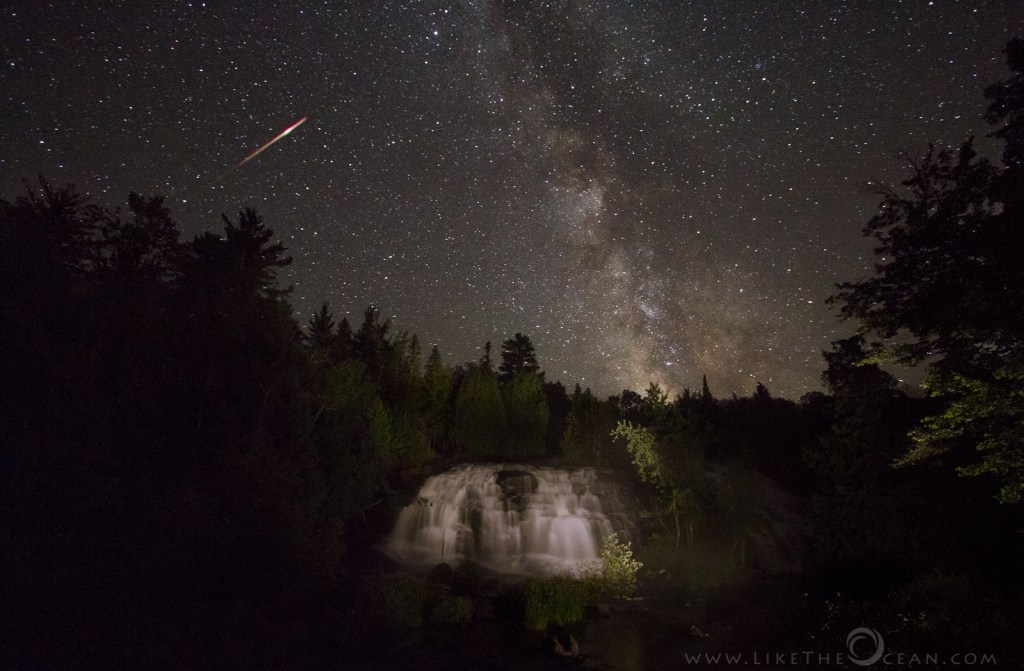
Milky Way over Milky Bond Falls with a dash of Perseids by Sathya

The Perseid meteor shower is a summer staple & fast approaching the peak!! Our friends at EarthSky say that the early mornings of August 11-13, 2024 are your best bet for meteor action, but you can usually see them between midnight – 6am. That’s perfect because there’s an excellent chance of Northern Lights for the next couple of days & they are usually strongest between midnight – 3am.

EarthSky writes that the August Perseid meteor shower is rich and steady, from early August through the peak. The meteors are colorful. And they frequently leave persistent trains. All of these factors make the Perseid shower perhaps the most beloved meteor shower for the Northern Hemisphere.

Head over to EarthSky for everything you need to know about the Perseids, our most reliable meteor shower!

This photo of a Perseid meteor over Bond Falls that I shared back in 2013 remains one of my favorite michpics ever! Sathya wrote on their blog:

The deafening sound of 500 gallons of water / second from 50 feet
The tranquil silence of the dark night
Milky way adorning the skies
A (Perseids) meteor fireball streaking across the horizon
Definitely a moment of serenity and one I would cherish!

For sure check out Like the Ocean to view & purchase prints and a whole lot of amazing photos & amazing thoughts about some of the most beautiful places on this planet.

Support Michigan in Pictures with Patreon

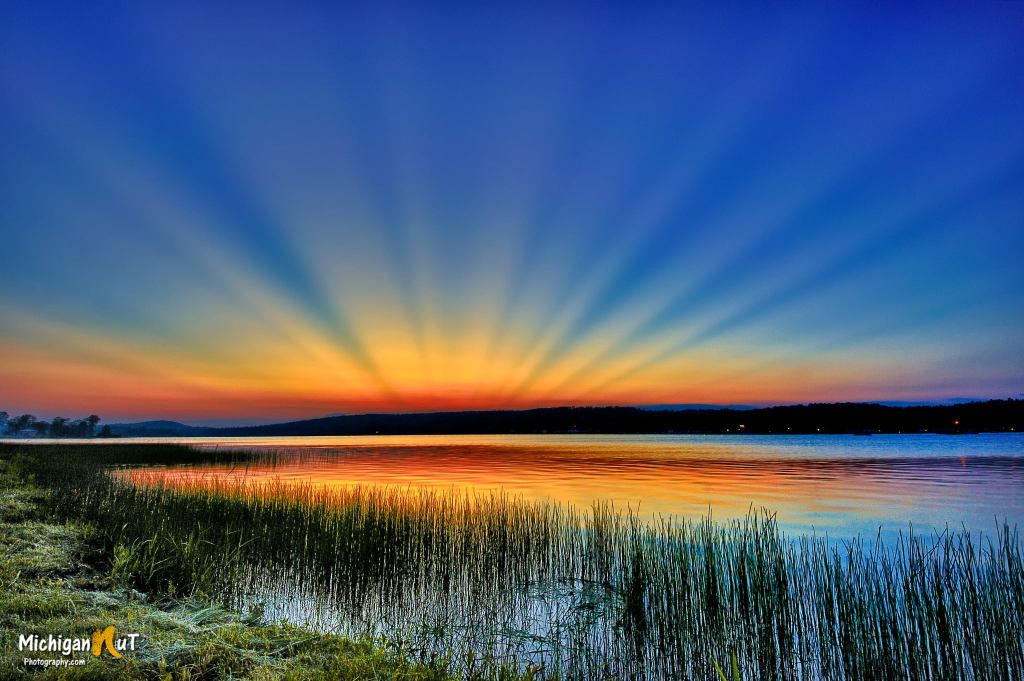
Muscular crepuscular rays

Crepuscular rays over Sunday Lake by Michigan Nut Photography

Crepuscular rays over Sunday Lake by Michigan Nut Photography

Atmospheric Optics shares that crepuscular rays:

also known as sun rays, are a mesmerizing atmospheric optics phenomenon that captivates the imagination. These ethereal beams of light, streaming through gaps in clouds, create a breathtaking display of nature’s beauty. The parallel columns of sunlit air, separated by darker cloud-shadowed regions, give the impression of diverging rays, much like the parallel furrows of freshly ploughed fields or a road that appears to narrow with distance.

The visibility of crepuscular rays is made possible by the scattering of sunlight by various atmospheric components. Airborne dust, inorganic salts, organic aerosols, small water droplets, and even the air molecules themselves all play a role in scattering the sunlight and making the rays visible.

I shared this photo several years ago and I’m not gonna say I won’t share it again! 😅 John took the pic at Sunday Lake in Wakefield. For more, follow him on Facebook & view and purchase his work at michigannutphotography.com.

Support Michigan in Pictures with Patreon

2024 West Michigan Photo Contest

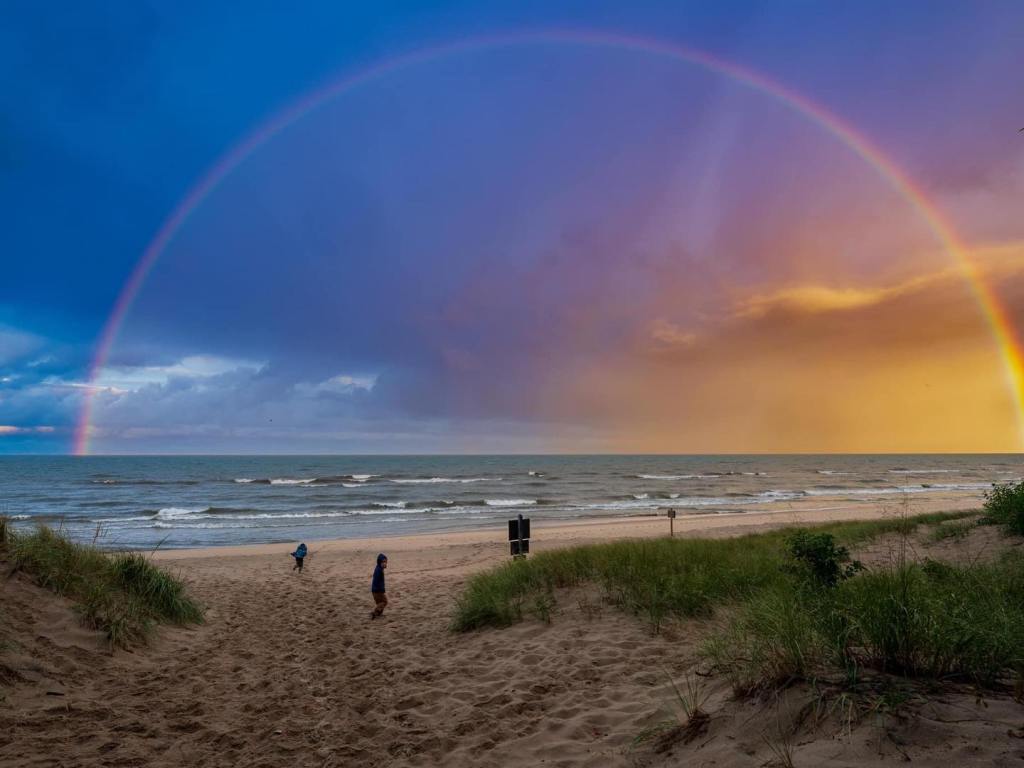
Hoffmaster State Park Rainbow by Lillian Dotzlaf

The West Michigan Tourist Association invites you to participate in their 2024 West Michigan Photo Contest. Prizes include packages from some great businesses & they are looking for traveler photo submissions from the entire west half of Michigan – all the way from the Indiana border to Mackinac Island and into the Upper Peninsula.

“We love getting to see all of the amazing photos from all throughout West Michigan – it’s a highlight of the summer!” said Kaylie Pomper, Marketing Manager. “We love seeing so many different perspectives from the photos shared with us. It’s a great way to see involvement from the communities that make up our beautiful state.”

Pomper also noted that photos do not need to be taken this month in order to submit them to the photo contest. “If you have West Michigan photos from your past visits to the area, we encourage you to enter those as well! West Michigan is photogenic all seasons of the year, so don’t feel that you’re only limited to submitting summer photos.”

All photo entries must be received by July 29th, 2024. Judges will be awarding prizes in the categories of “Beach/Lake Photo; Travelers Exploring Iconic West Michigan Destinations; Downtown Photo; Fairs & Festivals Photo” with an additional prize awarded via public voting by WMTA’s Facebook audience.

Lillian won the public vote last year & shared “I am elated I won the public vote category with the rainbow photo I took just after my Dad passed away. I am so blessed to call this place home. Thank you WMTA for giving me the opportunity and to Mackinac Island for the phenomenal prize package. I know I’ve got an extra angel looking out for me.”

Indeed!! Check out Lillian’s work on Instagram and at Little Lill’s Photography on Facebook!

Support Michigan in Pictures with Patreon

Shelf cloud over the Mackinac Bridge

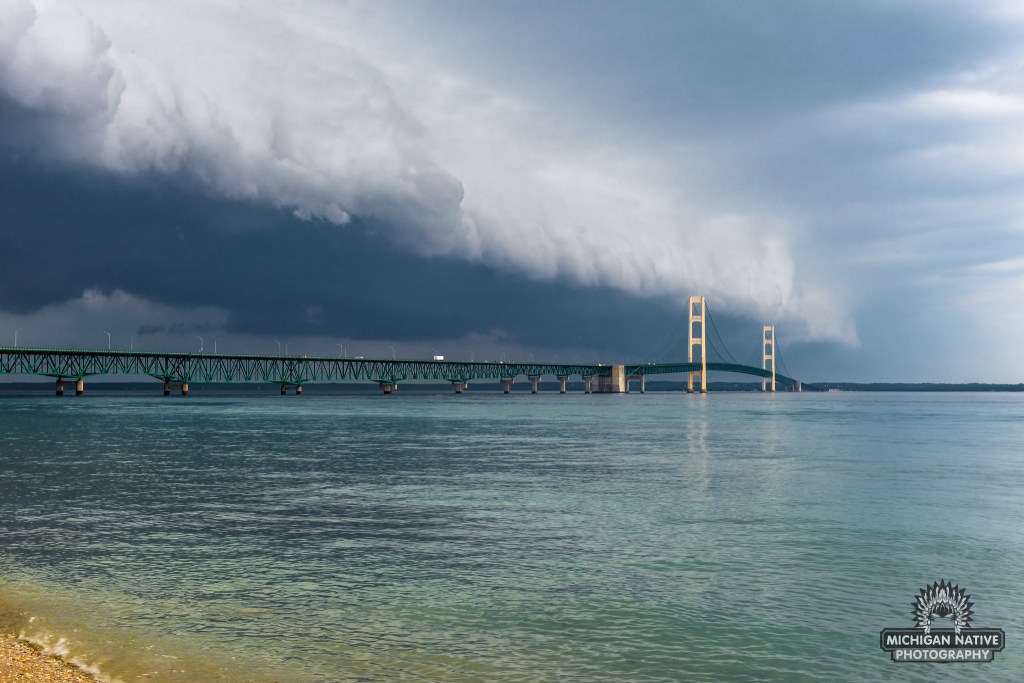
Shelf Cloud Over Mackinac Bridge by Michigan Native Photography

Shelf Cloud Over Mackinac Bridge by Michigan Native Photography

I saw a couple other photos of this cloud as it rolled across the Straits of Mackinac & northeast Michigan the other day but wowzas – the Mighty Mac takes it!! Our friends at the Earth Science Picture of the Day have an excellent post on the difference between roll clouds & shelf clouds:

Roll clouds and shelf clouds are found near the leading edge of thunderstorms and form when relatively cool air, from the storm’s downdraft, forges ahead into the warm, moist air that’s feeding the storm. The main difference between roll clouds and shelf clouds (both are called arcus clouds) is that a roll cloud is detached from the parent thunderstorm, whereas a shelf cloud (right) is affixed to the base of a cumulonimbus cloud.

NOTE: Just learned that this picture is from 2018 – still love it! (buy it here)

You can follow Michigan Native Photography on Facebook or Instagram and view & purchase more work on their website.

There’s more weird, wild Michigan weather on Michpics including a monster roll cloud over Lake Michigan from June of 2016.

Support Michigan in Pictures with Patreon

Get ready for the 2024 Lyrid Meteor Shower!

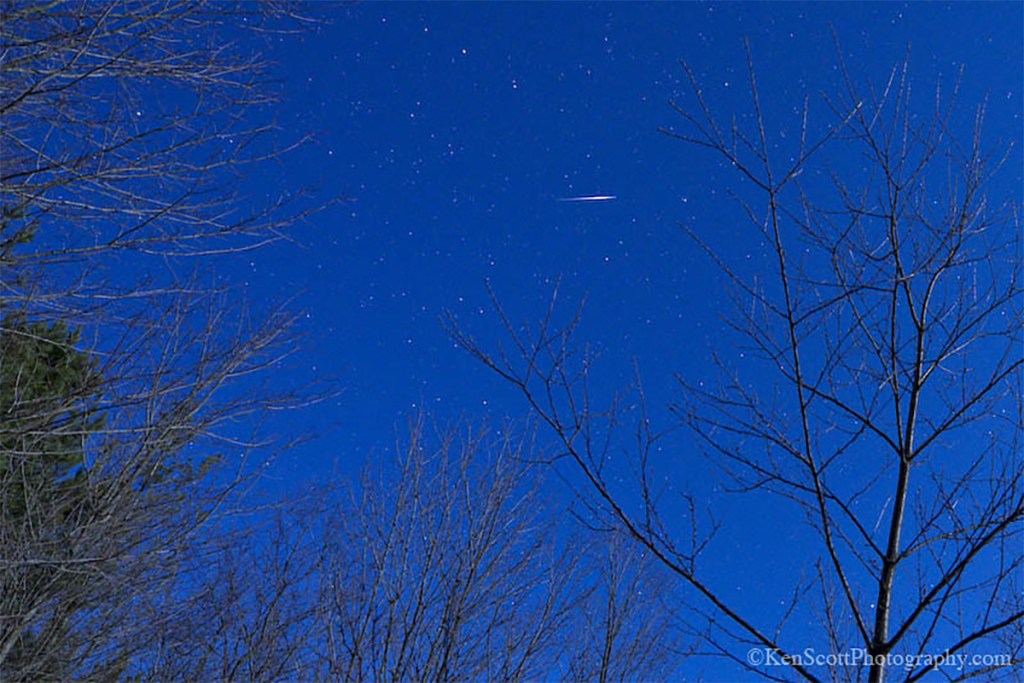
Lyrid Meteor … sprinkle by Ken Scott Photography

Longtime skywatchers know that April’s Lyrid meteor shower is the kickoff to meteor season. Earthsky shares the best time to see the Lyrids:

Late evening April 21 until dawn April 22 is the shower’s likely peak. The predicted** peak is 9:23 UTC on April 22. The peak of the Lyrids is narrow (no weeks-long stretches of meteor-watching, as with some showers). And, in 2024, the full moon will fall at 23:49 UTC on April 23. So your Lyrid meteor watching will be in moonlight this year. Tip: Go to a country location where the skies are as dark and clear as possible. Observe under a wide-open sky. But try to place yourself in a moon shadow. If you can block out the sight of the moon, yet still have some sky left for seeing meteors, you might see some of the brightest Lyrids blaze past in the bright moonlight. Remember, even one bright meteor can make your night!

I’ve shared this photo that Ken shot back in April of 2016 before, and I’ll probably share it again! He shared that he shot over a 3 hour period in hopes to catch the meteor ‘shower’ and only caught this one streaker. See more in his Skies Above album on Flickr and for sure visit Ken Scott Photography to view & purchase his work!

Support Michigan in Pictures with Patreon!

Comet P12 Pons-Brooks Visits Eagle Harbor!

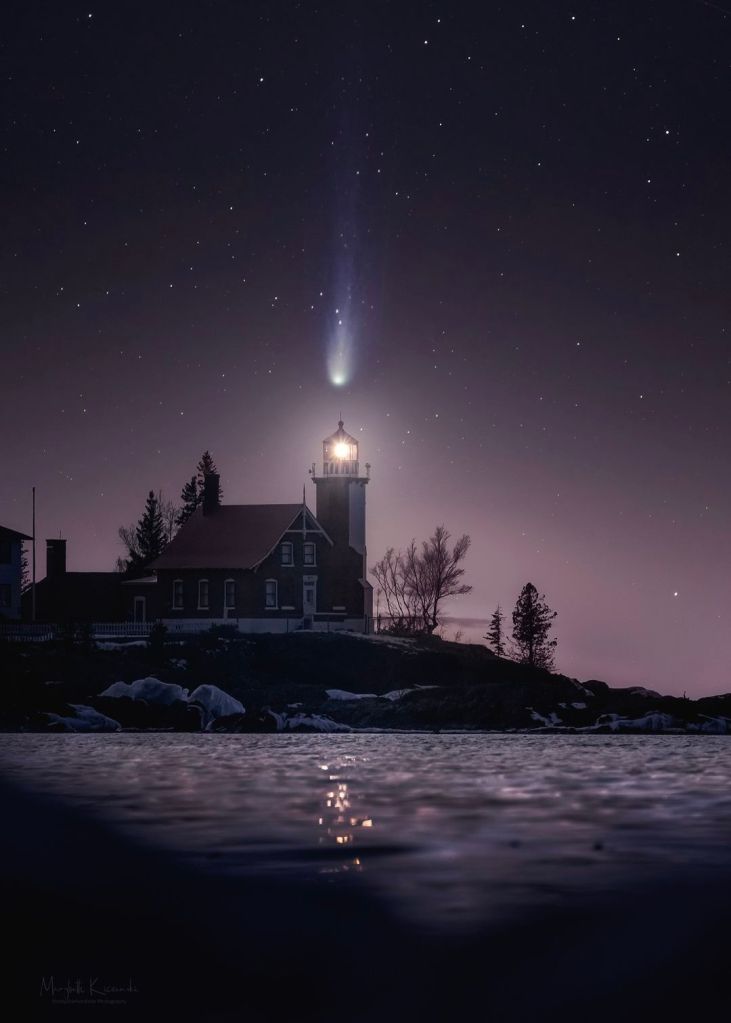
Comet P12 Pons-Brooks Visits Eagle Harbor by Shelby Diamondstar Photography

Comet P12 Pons-Brooks Visits Eagle Harbor by Shelby Diamondstar Photography

Let’s head WAY north for another exciting celestial phenomenon, Comet P12 Pons-Brooks aka the Devil’s Comet. Space.com explains that the comet is named after French astronomer Jean-Louis Pons (1761-1831) who went on to become the greatest visual comet discoverer of all time:

In today’s world, comets are routinely found when they are far out in space, beyond the ability of being picked up by human eyes, but are caught using robotic cameras attached to large telescopes either here on Earth or from satellites out in space.

In contrast, Pons made most of his discoveries using telescopes and lenses of his own design; his “Grand Chercheur” (“Great Seeker”) was an instrument with a large aperture and short focal length, similar to telescopes that our modern-day amateurs would refer to as a “comet seeker.” Pons is noted today for visually discovering 37 comets (still a record) from 1801 to 1827.

…On Sept. 2, 1883, British-born American comet observer William R. Brooks (1844-1921) accidently found it. Like Pons, Brooks was a prolific discoverer of comets. In fact, his total of 27 visual discoveries is second only to Pons. Not until the first orbital calculations of Brooks’ discovery was made, was it realized that this comet and the comet found by Pons of 1812 were one of the same. So, this comet now bears the surnames of both observers.

With an orbital period of roughly 71 years, comet Pons-Brooks is considered to be a “Halley-type” comet, that is, a comet with an orbital period between 20 and 200 years, often appearing only once or twice within one’s lifetime. Other comets with a similar orbital period include 13P/Olbers, 23P/Brosen-Metcalf and the most famous of all, 1P/Halley. Because it was the twelfth comet to have a definitive orbital period calculated, it is cataloged today as 12P/Pons-Brooks.

You can look for the comet just after sunset, but you will probably need binoculars given the afterglow of the sunset.

MaryBeth took this way up on the Keweenaw Peninsula at Eagle Harbor Lighthouse. Click the photo above to share a comment with her on Facebook and for sure view & purchase her work at shelbydiamondstar.com!

PS: In my best Arnold voice, “I’ll be back” (because she has an amazeballs photo for us!)

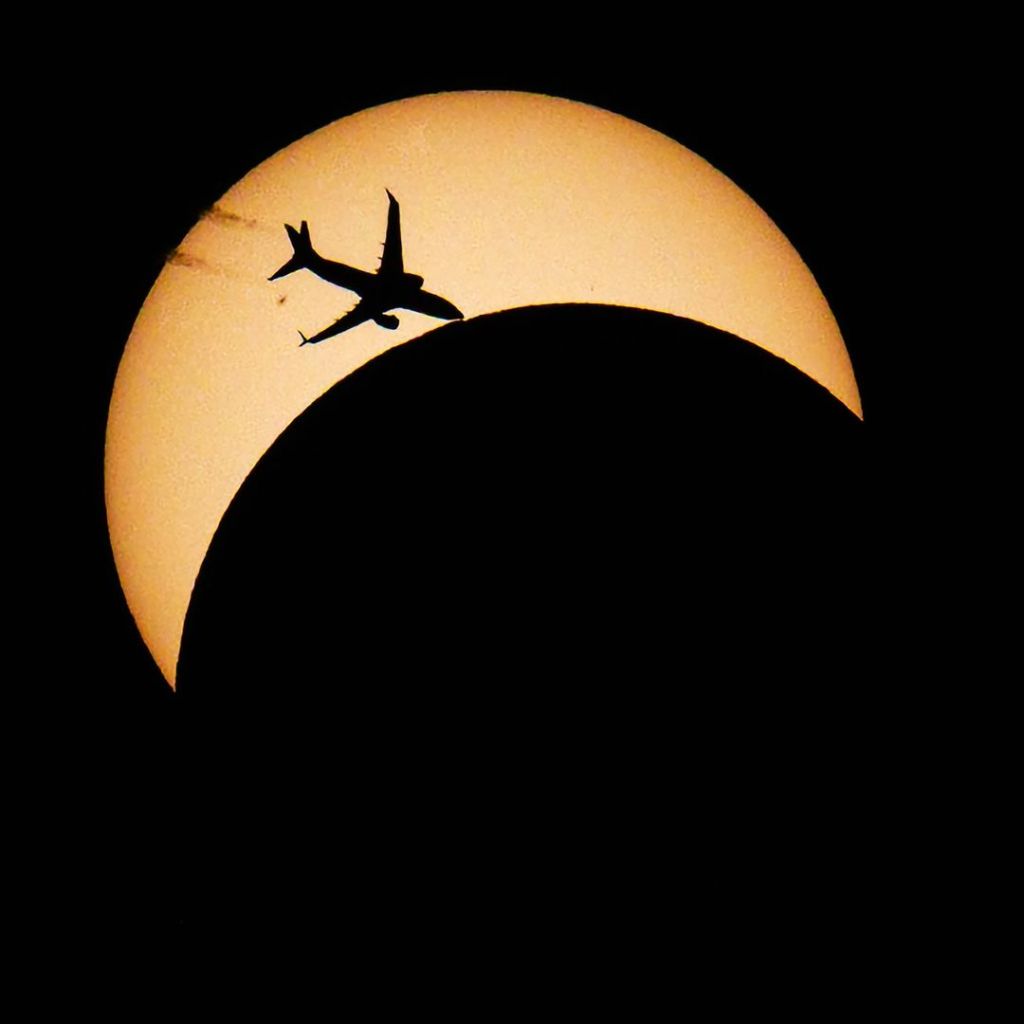
Fly Me to the Moon

This photo was the third most popular photo of 2024 on Michigan in Pictures!!

Fly Me to the Moon by Morgan Andrew Somers

I have seen a lot of amazing photos of the April 8, 2024 eclipse, but this shot from Flint by Morgan Andrew Somers of a plane flying into the eclipse is one of the coolest!!

Head over to the MASphoto Facebook for more including the answer to “is this photo fake” (no, it is not). View & purchase prints including this one at morganandrewsomers.com!

More eclipse photos on Michigan in Pictures & please share yours in the comments, to the post on Facebook or our Michigan in Pictures group!

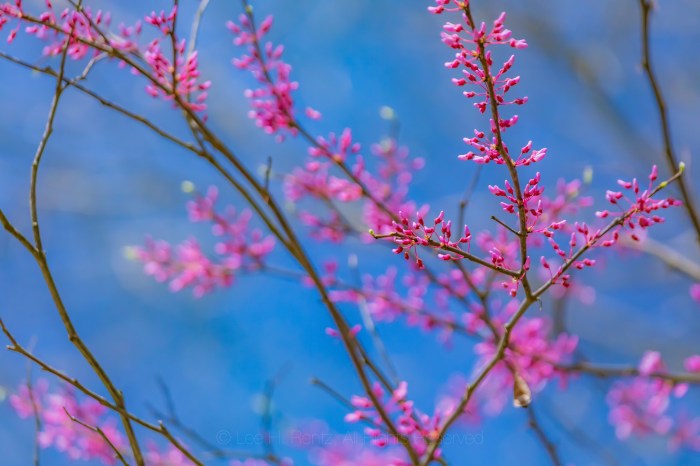
Redbud in a Blue Sky

Eastern Redbud Blooming in Michigan by Lee Rentz

Eastern Redbud Blooming in Michigan by Lee Rentz

A Michpics reader shared that the blooming of redbuds was one of her favorite signs of Spring & I heartily agree!

Lee got this shot of Eastern Redbud (Cercis canadensis) in bloom last week. For sure check out his blog for some great travel stories including a Michigan bear encounter & view and purchase his work on his website.

Support Michigan in Pictures with Patreon

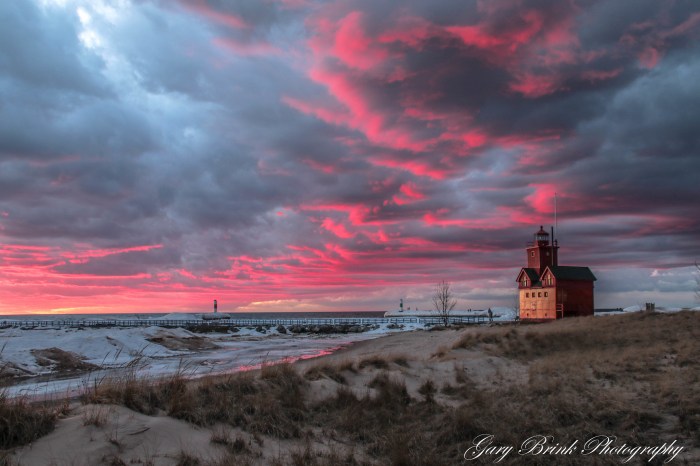
Valentine Skies

Valentines Skies #2 by Gary Brink Photography

Valentines Skies #2 by Gary Brink Photography

Gary took this stunning shot at Holland’s “Big Red” lighthouse on Valentine’s Day back in 2017. Head over to his Flickr for the latest & I hope that you all have a lovely week!

Support Michigan in Pictures with Patreon

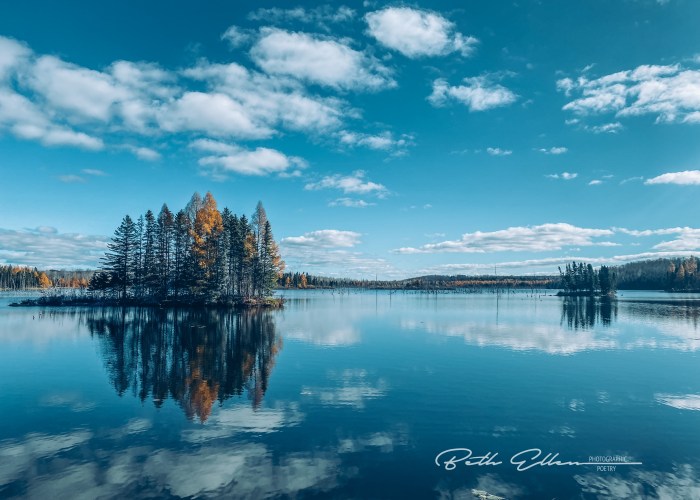
Life is like a mirror

Life is like a mirror, we get the best results when we smile at it by Fire Fighters Wife

Life is like a mirror by Fire Fighters Wife

“Life is like a mirror, we get the best results when we smile at it.”

As usual, Beth shares a beautiful thought to go with her equally beautiful photo. See more in her Hello Fall! gallery on Flickr.

Support Michigan in Pictures with Patreon