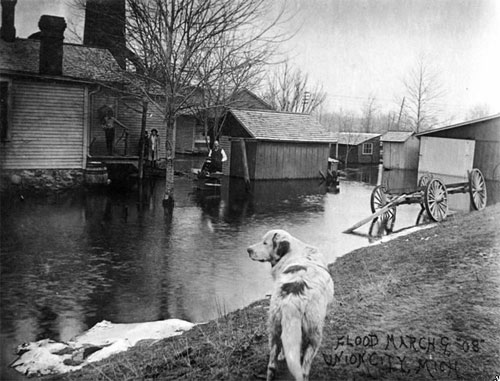
Union City history and the Flood of 1908

Union City Flood, 1908

Union City 1908 Flood, photo from UC1960

This photo is one of hundreds of historical postcards from Union City, Michigan posted to a site called Footnote to which I was recently referred. The site has an interesting interface and is one of a growing number of sites that try to leverage the power of social networks (and of course clicky-draggy stuff) to provide a richer experience. In Footnote’s case, they’re focusing on history and the result is pretty cool.

Union City is located south of Battle Creek, where the Coldwater River joins the St. Joseph River (I swear I didn’t plan that tie-in!). In an effort to prove that they have everything about everything, Wikipedia has an entry titled Floods in the United States: 1901-2000 which has this to say about the Michigan Flood of March 1908:

In February, snowstorms had deposited a significant snowpack across the region. Then, in early March, heavy rains and warmer conditions set in, setting the stage for a flood. The Kalamazoo River flooded Albion when the Homer Dam broke around 3 p.m. on March 7. By midnight, the bridges surrounding town were underwater. Six buildings in Albion collapsed, which caused over US$125,000 in damage (1908 dollars).

Union City lost its bridge in the flooding – here’s a photo. You have to see this great photo from the same flood in Battle Creek.

River of Mystery – exploring the St. Joseph River

St. Joseph River Valley

St. Joseph River Valley, photo by mojophiltre.

Mojophiltre took this photo of the St. Joseph River, just above the Buchanan Hydro-Electric Dam. He has a view of the water going over the Buchanan Dam that you’ll want to check out too.

As usual, Wikipedia has an entry on the St. Joseph River – I like to include these so that people who are passionate and knowledgeable can add to the phenomenal resource that Wikipedia offers. The St. Joseph River Watershed site (which has some cool maps of the watershed but some rather annoying Java) says:

The St. Joseph River Watershed is located in the southwest portion of the Lower Peninsula of Michigan and northwestern portion of Indiana. It spans the Michigan-Indiana border and empties into Lake Michigan at St. Joseph, Michigan. The watershed drains 4,685 square miles from 15 counties (Berrien, Branch, Calhoun, Cass, Hillsdale, Kalamazoo, St. Joseph and Van Buren in Michigan and De Kalb, Elkhart, Kosciusko, Lagrange, Noble, St. Joseph and Steuben in Indiana). The watershed includes 3,742 river miles…

The Friends of the St. Joseph River has a nifty historical photo of the Buchanan Dam and a great article about the history of the names of the St. Joseph River by Bob Owens & Scott Null. The river was important to native peoples – all the way from the enigmatic Hopewell Mound Builders who made their home all along the Saint Joseph River valley to the Fox & Sauk who moved in as mercenaries for the English. This very interesting page lists various names for the river and I think it’s fascinating how one river can provide such a wealth of insight into Michigan’s history:

  • The Miami called it Sauk-Wauk-Sil-Buck (which The Google thinks means “River of Mystery”).
  • The Iroquois, who apparently conducted a nasty genocidal campaign on the Algonquian in the region, called the river The Illinois – maybe because the first Algonquian tribe they met were the Illinois.
  • In spring of 1672, Explorer Rene-Robert Cavalier De La Salle (searching for the best route between Quebec and the mouth of the Mississippi) ran into the Miami (who by this time were in the pay of the Iroquois against their Algonquin brethren), so naturally he christened it The River of the Miamis.
  • Jesuit Missionary Claude Allouez (who earlier had named Lake Michigan “Lake Saint Joseph” after first sighting it on Catholic Feast Day of Saint Joseph) founded a mission at the rail junction at Bertrand. It’s noteworthy that when LaSalle returned later, he still called it the River of the Miami.
  • North and east, the French built Fort St. Joseph near Niles in 1691. At that time the Potowatomi (who called the river Sohg-Wah-Se-Pe – also Mystery River) were friendly with the French.
  • Around 1700, the Fox & Sauk tribes, who were allied with the English and named the river O-Sang-E-Wong-Se-Pe (Mystery River again), began to tangle with the Potowatomi and French.

The authors advocate for naming the river the Sagwa. I don’t know about that, but I do know that time seems to mysteriously disappear when I run into cool Michigan history like this!

More from the Michigan Fall Wallpaper series

A Letter from Downstream

In the Michigan Immense Public Park, photo by Andy McFarlane

In the Michigan Immense Public Park, photo by Andy McFarlane

Welcome to a “Soapbox Saturday” on Michigan in Pictures, where your host takes you a little ways past “ain’t it cool” towards “ain’t it a shame.” Don’t worry though – it’s still cool. If it doesn’t seem cool – please click the photo above. I figured that since I was going to be sharing some personal feelings, I probably should use one of my own photos. This photo of my daughter exploring something on the Lake Michigan beach was taken a few years ago at the base of Pyramid Point in the Sleeping Bear Dunes National Lakeshore. I had posted it in gratitude to the Michigan Supreme Court for upholding our right to walk the Great Lakes shore.

Flash forward to the present day when Michigan’s regulators appear poised to permit the first metallic sulfide mine in Michigan. Several years ago, my friend Dick Huey and a few others started a group called Save the Wild UP when Kennecott Minerals, a subsidiary of mining giant Rio Tinto (one of the world’s largest polluters), began the process of securing a permit for a sulfide mine north of Marquette. The proposed mine is located directly under the Salmon-Trout River on the wild and beautiful Yellow Dog Plains. This is state land, our land, and the Salmon-Trout flows just a few miles through it and then empties into Lake Superior. Over that time I’ve been working for them to maintain their web site and have learned a thing or two about “acid mining”.

Iron and copper mining are things that helped forge the character of the Upper Peninsula. You can think of traditional mining as picking the chocolate chips out of a cookie. Sulfide mining is like getting the sugar out of a cookie – a chemical rather than mechanical process that yields a dust as a by-product. If this dust mixes with water and air, it forms sulfuric acid aka battery acid. There has never been a sulfide mine with the potential to pollute ground or surface water that failed to do so. Sulfide mining has polluted 40% of the watersheds in the West, and you can read more of the facts about metallic sulfide mining at Save the Wild UP (has a nice video if you prefer).

Sulfide Mining waste in PennsylvaniaA process with 100% failure rate of protecting water located directly under a pristine river that flows into the largest body of freshwater in the world seems like a bad idea. When you realize that they also plan to blow the sulfide dust into the air and that there are hundreds of other prospected sites waiting in the wings, it becomes terrifying. Michigan and the UP have a lot of challenges right now, but something we do have going for us is our water and wild places and the tourism dollars and jobs they generate. The picture to the right is a result of sulfide mining from Sudbury, Ontario. Multiply that across Michigan’s Upper Peninsula and consider how many thousands of tourism jobs and millions of tourism and tax dollars might be lost.

One of the people who has considered this is a wonderful musician named Daisy May. She has donated a song called A Letter from Downstream to Save the Wild UP and I hope you take the time to listen to it and see the photos that folks have shared about what Michigan’s water means to them.

If you’re a Flickr member, consider adding a photo to the Downstream group.

Tahquamenon Falls double exposure(detroit)

Upper Falls

Upper Falls, photo by rckrawczykjr.

Ralph recently returned from an autumn trip to the UP (slideshow). When I saw his double exposure of Tahquamenon’s Upper Falls, I knew I wasn’t going to be waiting any longer to give a shout out to the next Exposure.Detroit show.

Exposure Detroit show posterExposure.Detroit Presents!

When: November 9th 7pm-10pm
Who: Cris Rea, Joe Alisa, Ralph Krawczyk Jr., Rhonda McElroy, Sue Fraser
Where: The Bean & Leaf Cafe, Royal Oak

If you can, be sure to show up to see work from Ralph and the other very fine photographers in the show!

See more Tahquamenon Falls photos on Michigan in Pictures and don’t miss other photos in the Michigan Fall Wallpaper series.

Fall Color Tours: Lansing – Grand Ledge – Hastings – Battle Creek – Eaton Rapids

maplepath by Aunt Owwee

maplepath, photo by Aunt Owwee

Our next fall color tour from Travel Michigan, Lansing – Grand Ledge – Hastings – Battle Creek – Eaton Rapids, starts where the above photo was taken: at the Fenner Nature Center in Lansing (once known as the Fenner Arboretum). The park is named after biologist Carl G. Fenner and has 130 acres with 4 miles of trails winding through maple groves, pine forests, swamp forests, old fields and 3 different ponds. This weekend (Oct 20 & 21) they’re having an Apple Butter Festival. Aunt Owwee (Shirl) has a cool four seasons view from here and lot more great shots of autumn in Michigan.

If you’ve got the nature center bug, you can stop at the Woldumar Nature Center, located along the Grand River not far southwest of Lansing. From there, head out M-43 to Grand Ledge. Fitzgerald Park aka “The Ledges” are absolutely gorgeous in the fall, as evidenced by this photo from Rein Nomm of Fall at the Ledges that appeared last year on Michigan in Pictures. Not convinced? Search fall at Grand Ledge on Flickr. Last weekend, the city of Grand Ledge held their annual Color Cruise, but there’s still plenty of color to be found.

Thornapple River by hansendmThen it’s on to Hastings and Historic Charlton Park, a re-creation of a 19th century town. The structures are open only Memorial Day to Labor Day but you can certainly enjoy strolling along the river. For a little more exercise, jump on the non-motorized vehicle only Paul Henry – Thornapple Trail (see photos of the trail on Flickr). When complete, the trail will be a 42-mile route from Grand Rapids to Vermontville. The photo to the right of the Thornapple River was taken by hansendm.

The it’s on to Gull Lake and the W.K. Kellogg Bird Sanctuary. The sanctuary is one of the North America’s pioneer wildlife conservation centers and offers a chance to see birds in the wild, bird displays and birds of prey enclosures featuring rare and common raptors including a bald eagle, red-tailed hawks and eastern screech owl.

Travel Michigan suggests a possible detour to the Fort Custer Recreation Area, located between Battle Creek and Kalamazoo. It features three lakes, the Kalamazoo River and an excellent trail system that includes 16 miles of mountain bike trails. The 3000+ acre area was farmland that was acquired by the federal government to establish Camp Custer, an induction and military training center for the US Army during WWII.

If it’s raining or all this outdoor stuff doesn’t sound fun, consider stopping at the Gilmore Car Museum in Hickory Corners which features almost 200 vehicles spanning over 100 years of automotive heritage from a 1899 Locomobile to the muscle cars of the 60s and 70s.

Kalamazoo river from the Nature Center bridge by cathieContinuing south, we come to the city of Battle Creek where recommended stops include the Sojourner Truth Monument (check out this set of photos of the Monument), Binder Park Zoo, the Leila Arboretum and Children’s Garden and the Battle Creek Linear Park. The park is a walkable, bikeable and billed as “the world’s largest classroom,” featuring signs that tell about plant, animal, cultural and historical points-of-interest along the park.

If you’re hungry as you head out on Old 27, consider Cornwell’s Turkey House aka Turkeyville USA. A bit further south is the town of Marshall. In addition to being a shopping mecca, Marshall’s downtown is designated as a National Historic Landmark District and features a wealth of historic attractions including the American Museum of Magic.

The photo to the right is of the Kalamazoo river from the Nature Center bridge by cathie and it’s just one of the places you can stop as you ease on down the road back to Lansing through the towns of Albion, Springport & Eaton Rapids. They recommend a stop at The English Inn of Eaton Rapids for dinner. Having eaten there before, I can only say “got room for another?”

Just so it’s clear, these fall color tour entries are produced by Absolute Michigan & Michigan in Pictures using the great information compiled in Travel Michigan’s Fall Color Tours as a starting point. We’re trying to add to what they’ve put together – not rip them off! As always, if you have links to information or photos that we missed, comments or reports, post them in the comments below!

Don’t miss our Michigan Fall Wallpaper series and see more of Travel Michigan’s Fall Color Tours.

Fall Color Tours: The Western Upper Peninsula

Mom's Vista from Tiffibunny

Mom’s Vista, photo from Tiffibunny

This is one of a large number of great photos from all over the US posted by Tiffany Follett that were taken by her mom (see her set From My Mom for more!). It’s a view of Porcupine Mountains Wilderness State Park from M-107 that was taken in September 2003.

I thought this was a perfect photo to use to highlight Ironwood – Silver City – Wakefield, the first Michigan fall color driving tour from Michigan.org that I’m going to try and flesh out with photos from the Absolute Michigan group on Flickr and links to even more photos and information. View from Copper PeakI hope this isn’t seen as a rip-off – the tours they have developed are pretty cool and my hope is that this can be a complement to what Travel Michigan has put together. If you take the tour and/or have observations, photos or links to add, please do in the comments below!

This tour starts at the western end of Michigan’s stretch of US-2, in the town of Ironwood. Absolute Michigan’s page for Ironwood lists Copper Peak Ski Flying (MoodyGoat offers View from the Top – that’s over 1800′ up!) and the Western UP CVB as some notable sites. To those I’ll add the North Country National Scenic Trail, which enters Michigan at Ironwood and goes all the way to the Mackinac Bridge (explore the UP portion of the trail) and North Guide’s WesternUP.com (they are regularly posting fall color photos too).

They send you down U.S. 2 to Wakefield, one of many ore towns settled in the late 1800s, and then up County Road 519 to the Porcupine Mountains Wilderness State Park where you can catch staggering views like the one above (lots more from the Porkies on Michigan in Pictures). The photo below is Lake of the Clouds, Porcupine Mountains by J. Michael Ducey.

Lake of the Clouds, Porcupine Mountains by J. Michael DuceyNext it’s east to Silver City, about which Hunt’s Guide to the UP says:

Today Silver City is mostly a collection of tourist-oriented resorts and other businesses along M-107 near the entrance to Porcupine Mountains State Park. But for three years in the 1870s it was a silver mining boom town. At the fur-trading post that was the first settlement here, stories circulated about silver found by Indians back in the woods away from Lake Superior. Homesteader Austin Corser actually found the silver on the Little Iron River in the 1850s. He kept quiet about it until he proved his claim. In the 1870s he revealed the silver, sold his land, and left. Only one brick of silver, worth $723, was ever shipped from Silver City.

Then it’s south on M-64 to Bergland, located at the northern tip of the Upper Peninsula’s largest lake, Lake Gogebic. They suggest stretching your legs on the Gogebic Ridge Hiking Trail or Lake Gogebic State Park before heading back west to Ironwood.

You can check out more photos from this area on the Absolute Michigan group’s map on Flickr (and add your own!) and get your desktop in theme with the season with out Michigan Fall Wallpaper series!

More of Travel Michigan’s Fall Color Tours.

Exposure.Detroit: September Show

The Bridge Again

The Bridge Again, photo by mi_kirk.

Kirk says that the trees have grown some since the first time he shot this. You can check out other photos from the Exposure .Detroit Safari to Cranbrook on 08/26/07 (slideshow).

Kirk is one of 5 photographers (tEdGuY49, mi_kirk, radiospike, paulhitz & Bobby Alcott) who will be displaying their work at The Bean & Leaf Cafe in Royal Oak next Friday (Sept 21) from 7-10 PM. Theatre of the Absurd and Liz Larin will provide musical entertainment.

If you’re a person in the metro area who enjoys photography, definitely check out Exposure.Detroit.

The Detroit Belle Isle Grand Prix

Raw00340

Raw00340, photo by ktpupp.

Sometimes I make a note to post about something at a later date, lose the note and then when the later date rolls around, realize that I’ve become a party to one of my pet peeves: telling folks about something when it’s too late to make any plans for it. That’s what happened with my plan to post something about the 2007 Detroit Grand Prix. Ah well, such is life…

The Detroit Belle Isle Grand Prix official site says that the Detroit Belle Isle Grand Prix returns after a 6 year absence and features the cars of the American Le Mans Series (Detroit Sports Car Challenge on Saturday at 3:15) and the IndyCar Series (Detroit Indy Grand Prix on Sunday at 3:30 on ABC). Net proceeds raised by the Grand Prix will fund measures to preserve and improve Belle Isle, and the Detroit Belle Isle Grand Prix has earmarked $100,000 in cash for the improvement and preservation of Belle Isle (Belle Isle park page).

Here’s a map of the course, which is also available in the Detroit News interactive tour of the course. Over at Jalopnik they’ll be covering the race all weekend (check the Detroit Grand Prix tag) and they have a video of the pace car navigating the course (there’s also some historical footage from past Detroit Grand Prix in the menu at the end of the video).

Wikipedia’s Detroit Indy Grand Prix entry has a bit about the history of the race and there’s some more in the US Grand Prix history pages.

The photo above is part of Kate’s Detroit Belle Isle Grand Prix 2007 set (slideshow). She has a photo from the qualifying of pole-sitter Ryan Briscoe of hometown Penske Motorsports.

There’s some more pics available from yesterday including this massive set of
Detroit Grand Prix 2007 photos
and I’m guessing that the detroitgrandprix tag might be the best place to find pics as the event unfolds.

There’s also this cool set of Formula One pics that includes a lot from the old Detroit Grand Prix.

Downtown Grand Rapids

Downtown Grand Rapids

Downtown Grand Rapids, photo by DarrinW.

Darrin says that this is one of his favorite vantage points to view downtown GR, and he’s put it up big enough that you can make your desktop another excellent place to view Michigan’s second largest city!

Michigan History magazine needs your photos!

Untitled, photo by jacalynsnana.

Christine Schwerin is a photo editor looking for a good venue to find specific images from Michigan photographers on a regular basis to be used in Michigan History magazine. She’s hoping to find photographers interested in joining an email list to receive a monthly list of images they’re looking for. If you are, send her an email!

Christine says that the first photo they’re looking for is a nice scenic picture – river, meadow, whatever, so long as it is in the Huron National Forest. Do you have one? Let her know!

A quick review of the Huron National Forest (part of the Huron-Manistee National Forests) tells me that we’ll have to return for an extended visit another day.

The above photo is of one of the world’s premier trout streams, the Au Sable River – a large portion of which winds through the Huron National Forest.