Knockout storm packs 100 MPH winds & huge hail

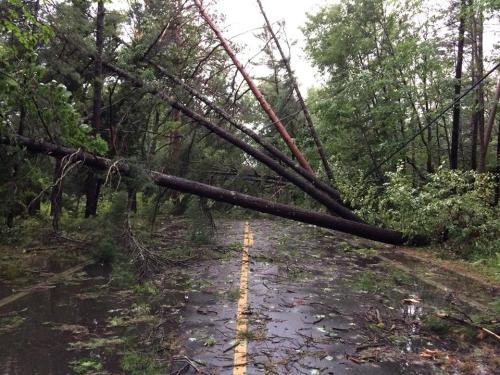
Road Closed in Glen Arbor

Road Closed in Glen Arbor, photo via the Glen Arbor Sun

One more day of storm reporting from my neck of the woods…

In Glen Arbor Hit By Knockout Storm, Jacob Wheeler of the Glen Arbor Sun lays out a diary of the destruction of the storm and wrote:

In the storm’s wake yesterday, Glen Arbor residents immediately recognized that the destruction they witnessed was unprecedented for our town. This was worse than the 1987 storm, people said. In fact, it was far worse. The storm was more powerful and more destructive than any other Glen Arbor storm ever recorded. And now we have stats to prove it.

I spoke late this afternoon to Jeff Lutz, meteorologist with the National Weather Service (NWS) in Gaylord. While Lutz clarified that yesterday’s storm was not a tornado (you can blame some of the hyperbole on this newspaper) he did confirm that the straight-line winds which accompanied the sudden thunderstorm reached speeds of 100 miles per hour. That’s strong enough to be called a tornado. More significantly, it blows away the previous wind velocity record for Leelanau County. According to the NWS, on Sept. 13, 2005, a barrage of wind traveling at 63 miles per hour hit Leland and Empire, but not Glen Arbor. But 63 is not 100. Not even close. Nope, yesterday’s storm was the strongest to ever hit Leelanau County, since records were kept starting in 1950.

You can click through to the Sun for more pics and storm coverage and get even more on their Facebook. Jacob also shared the National Weather Service’s Aug. 2 severe weather recap:

  • Multiple rounds of severe weather impacted northern Michigan on August 2nd, 2015. The first severe thunderstorm warning was issued 10:34 am with an additional 27 warnings being issued before the last warning of the day expired at 8:00 pm.
  • The largest hail reported was 4.25″, or the size of a softball, seven miles north of West Branch at 4:55 pm. The large hail was reported by trained spotters and members of the public. There were several reports of damage to vehicles and other property. At the time of the event, a Severe Thunderstorm Warning was in effect for all of Ogemaw County, issued at 4:33 pm. Additional reports of 1.00″ to 2.00″ hail were received from law enforcement, emergency managers, trained spotters and the public across multiple locations in northern Michigan.
  • The 4.25″ hail observed seven miles north of West Branch was the largest documented hail stone ever to impact northern Michigan since records began in 1950 and the largest since 1998 when a 3.50″ hail stone was recorded in Arenac County.
  • Hundreds of downed trees and power lines were reported on Sunday as 60-80 mph (locally 90-100 mph) straight-line winds accompanied the severe thunderstorms.

Lots more at that link including some pics of that hail.

Badger in the Mist

Badger Heading Out

Ludingtons SP_0103, photo by Ron DeHaan

Here’s the S.S. Badger heading out for Wisconsin. I rode the Badger many times in my Junior & Senior year of high school (Go Wausau East Lumberjacks!) to get from Michigan to Wisconsin. It was such a pleasant way to cross Lake Michigan, and at the prices they charged there were a number of people who would do a round trip crossing, playing cribbage, drinking beer from a cooler and laughing as they enjoyed the ride.

View Ron’s photo bigger and see more cool shots from the Ludington area in his slideshow.

More ships & boats, more Ludington and more of the Badger (and badgers) on Michigan in Pictures.

Summertime Rolls

Lake Michigan Rolls

Untitled, photo by Noah Sorenson

There’s nowhere in Michigan that’s more than 85 miles from one of the Great Lakes, and you can probably find a swimmable lake or river closer than that.

That’s something that I hope you’ll manage to do on this sweltering weekend – stay cool folks!

Noah took this on Monday at Elberta beach on Lake Michigan. Definitely check it out background bigalicious and see more northern Michigan goodness in his slideshow.

Lots more Michigan beaches and summer wallpaper on Michigan in Pictures!


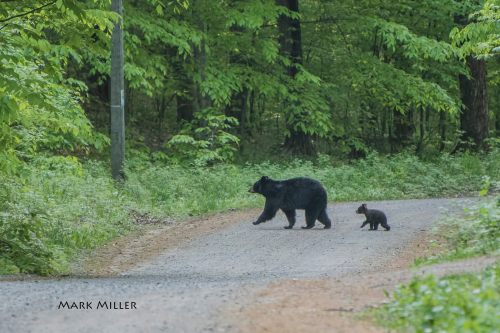
Saturday Morning Stroll: Black Bear in Michigan

Saturday Morning Stroll Michigan Black Bears

Saturday Morning Stroll, photo by Mark Miller

Recently there have been several reports of black bear sightings in Michigan, in traditional ranges like Leelanau County where these bear were photographed and even as far south as the state line in southwest Michigan and Washtenaw County, where  The Hastings Banner shared that while some are escapees from private facilities, others are ranging south:

“We’re interested in learning more about how they use the landscape in southern Michigan,” explained DNR wildlife research biologist Dwayne Etter. “The landscape in southern Michigan is very different from traditional bear habitat further north.”

…The Saginaw County bear is the southernmost collared bear in Michigan. Other collared bears south of traditional Michigan bear country include a male that was trapped and collared outside of Whitehall in orchard country, as well as a sow with cubs in Newaygo County, and a male in Oceana County. “We got a good break getting this bear collared this far south,” said Etter, who is studying how bears disperse in southern Michigan.

In recent years, bears have been documented in Washtenaw, Ionia and Ingham counties. “There was a bear sighted just north of Lansing several years ago,” Etter said. “We have photos of tracks from Sleepy Hollow State Park in April.

Read on for more including how they tranquilized and collared the Saginaw in an effort to learn more about bear movements. The DNR’s Living with Bears page shares some good tips for staying safe:

With the exception of baiting for hunting purposes in remote areas, placing food to attract bear near homes, cottages, parks, campgrounds and picnic areas may teach them to associate people with food. This may place them and people at risk of injury.

Black bear have enormous appetites and an excellent sense of smell, and are capable of remembering the locations of reliable food sources from year to year. They will travel great distances to find food. When natural foods such as tender vegetation, nuts, berries and insects are scarce, bear are likely to come into contact with people. Problems occur when bear attempt to feed or actually feed on human foods, garbage, pet foods or birdseeds.

Although most bear are secretive and shy by nature, they will tolerate contact with people when their natural food is scarce. Because they are large and powerful animals, they must be respected.

Black bear are generally fearful of humans and will leave if they are aware of your presence. In the rare circumstance that you encounter a bear that does not turn and leave, first try to scare it off by yelling while leaving a clear, unobstructed escape route for the bear. If the bear stands its ground, makes threatening sounds or bluff charges, you are too close. Take slow steps backward while continuing to talk to the bear in a stern tone. In the rare event of an attack, fight back with a backpack, stick or your bare hands. Black bears have retreated in similar situations.

Mark took this photo on the Leelanau Peninsula and wrote: When my neighbor called me early on a Saturday morning to tell me a bear was heading my way, I had to go looking for him. View his photo bigger and see more in his In My Backyard slideshow.

Want to know more about bear cubs with triple the bear cuteness? Check out Bear Triplets on Michigan in Pictures!


Storming the Harbors of Darkness: DH Day Barn Edition

Night and DH Day Barn

Night and DH Day Barn, photo by Heather Higham

This shot of the iconic D.H. Day barn in the Sleeping Bear Dunes National Lakeshore from a couple of days ago is beautiful, dramatic and … wrong. While the orange looks cool against the deep blue, it’s a very visible reminder that our night skies suffer from serious light pollution, even in our most preserved spaces. I encourage everyone to learn about night-sky friendly outdoor lighting options and to advocate in your community for better lighting decisions.

On a less preachy note, if you’re in the Traverse City/Sleeping Bear area tonight, the National Lakeshore is hosting the latest in their “Find Your Park After Dark” night sky events from 9-11 PM at the Pierce Stocking Scenic Drive #3 Overlook. They write:

All sky programs offered by the National Lakeshore are free. Participants need only purchase the Park Entrance Pass or have an Annual Pass displayed in their vehicle to join in the fun. Programs will be cancelled if the sky is not visible due to weather conditions. The decision to cancel is usually made three hours in advance. Please call 231-326-4700, ext. 5005, for a voicemail message with the decision. For all evening astronomy events, bring a flashlight for the walk back to your car and bug spray, if needed. Park rangers and Grand Traverse Astronomical Society (GTAS) staff will wear red glow bracelets at the events.

Each special event takes place at a different location throughout the National Lakeshore to take advantage of strategic viewing opportunities. You can come for star-gazing, eclipses, meteor showers, solar viewing, and storytelling. These events are the perfect opportunity to Find Your Park in the stars. Starry night skies and natural darkness are important components of the special places the National Park Service protects. National parks hold some of the last remaining harbors of darkness and provide an excellent opportunity to experience this endangered resource.

“Harbors of darkness” – what a cool turn of phrase! Head over to the National Lakeshore’s website for more about this and upcoming events.

Over at her blog, the Rapid City Recess, Heather writes about her experience shooting at night with two other photographers – I encourage you to read it.

View Heather’s photo bigger, see more in her Night Sky slideshow and definitely follow her at Snap Happy Gal on Facebook!

More night photography and more Michigan barns on Michigan in Pictures.

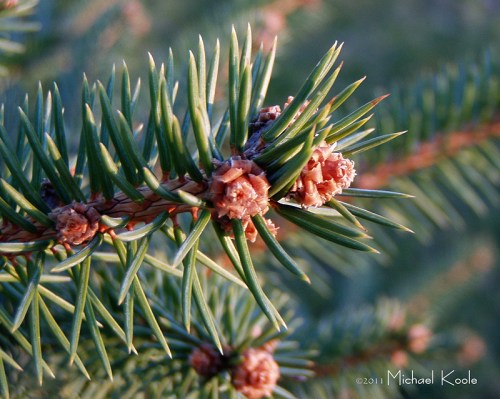
Requiem for a Spruce: Spruce Budworm in Michigan

April 11, photo by Michael Koole

April 11, photo by Michael Koole

Garret Ellison of the Grand Rapids Press & mLive writes that the Michigan Department of Natural Resources expects spruce budworm to inflict heavy damage on white spruce and balsam fir trees across the Upper and northern Lower Peninsulas this year:

The budworm is “one of the most destructive native insects” in the northern spruce and fir forests of the eastern U.S. and Canada. The worms drop as caterpillars from treetops on webs and feed on tree growth in the spring.

Repeated budworm defoliation can cause top-kill and death in older and stressed trees. Balsam fir older than 60 and spruce over 70 years are prime targets. Younger trees infested with budworms lose much new growth but generally survive.

Read on for more, including how to protect your trees. The U.S. Forest Service has more about the spruce budworm:

The spruce budworm Choristoneura fumiferana (Clemens) is one of the most destructive native insects in the northern spruce and fir forests of the Eastern United States and Canada. Periodic outbreaks of the spruce budworm are a part of the natural cycle of events associated with the maturing of balsam fir.

The first recorded outbreak of the spruce budworm in the United States occurred in Maine about 1807. Another outbreak followed in 1878. Since 1909 there have been waves of budworm out breaks throughout the Eastern United States and Canada. The States most often affected are Maine, New Hampshire, New York, Michigan, Minnesota, and Wisconsin. These outbreaks have resulted in the loss of millions of cords of spruce and fir.

Balsam fir is the species most severely damaged by the bud-worm in the Eastern United States. White, red, and black spruce are suitable host trees and some feeding may occur on tamarack, pine, and hemlock. Spruce mixed with balsam fir is more likely to suffer budworm damage than spruce in pure stands.

If you’re intrigued by the “natural cycle” as I was, head over to Wikipedia’s entry on Choristoneura fumiferana, the Eastern Spruce Budworm for an explanation and some pics of these (for a change) native pests.

View Michael’s photo bigger and see more (including lots of tasty macro) in his Around the Yard slideshow.

PS: Sorry about the Monday morning novel … sometimes I over share. ;)

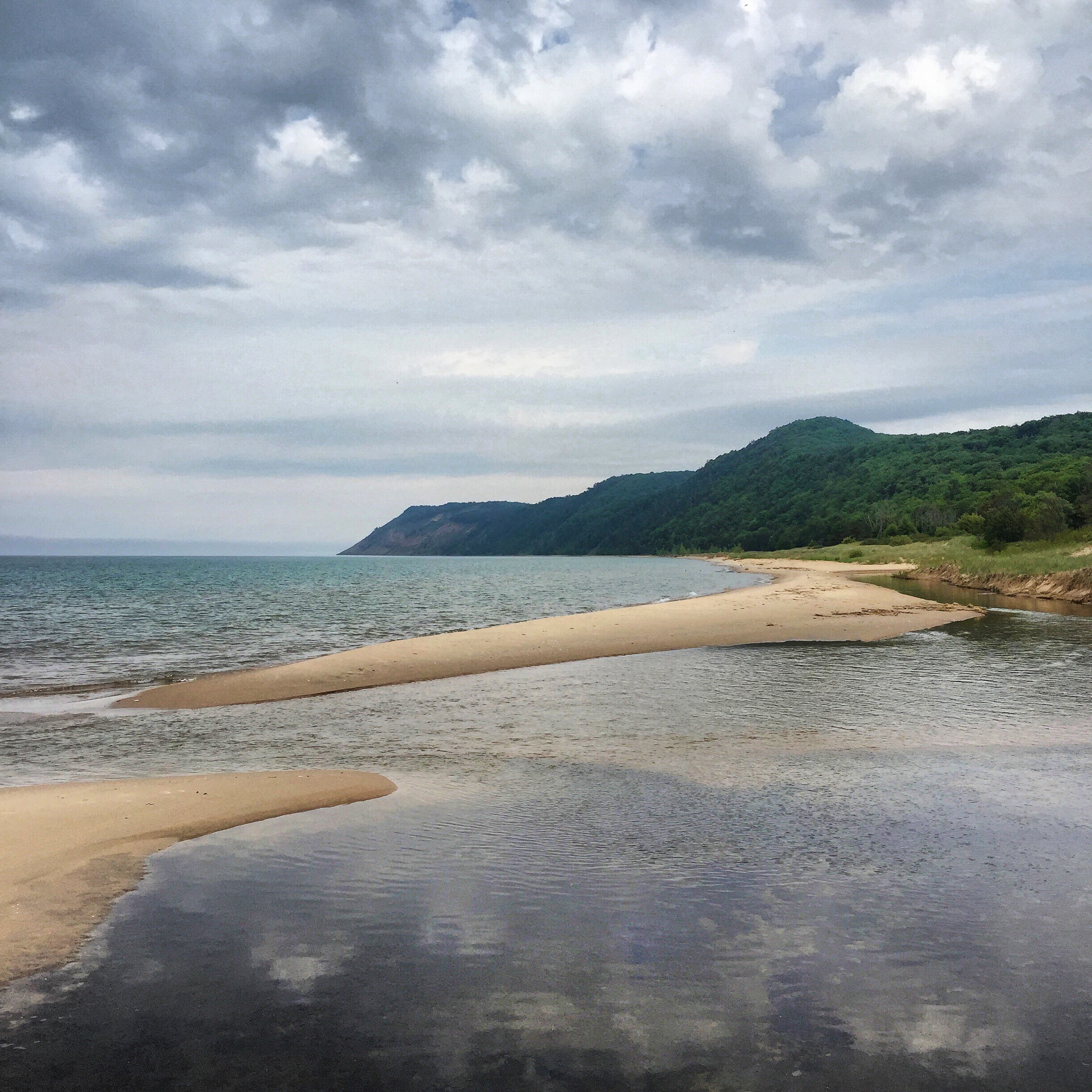
Michigan Ghost Towns: Aral at Otter Creek

Esch Beach

Esch Beach, Otter Creek, photo by Sara Hunt/oni_one_

The Sleeping Bear Dunes National Lakeshore tells the rich tale of the ghost town Aral:

Aral was located on Lake Michigan where Otter Creek empties into the Lake just south of Esch Road, a few miles south of Empire, MI. Today this is one of the most popular swimming beaches in the Lakeshore, but in the 1880s, Aral was a booming lumber town!

When the United States acquired land, it first had to be surveyed before it was made available to individuals. In the summer of 1849, Orange Risdon was one of the surveyors assigned to the area around Grand Traverse Bay. In 1853 soon after he finished the survey, Risdon and his wife, Sally, bought 122 acres where Otter Creek emptied into Lake Michigan.

The US Civil War began in 1861, and to induce able-bodied men to join the Union forces, the US government offered $100 bounty to men who enlisted. By 1863 the bounty was increased to $300, and finally a draft was instituted. An interesting provision of the draft act allowed drafted men to avoid service by hiring a substitute or by paying $300. One of the men receiving draft notice was Robert F. Bancroft, who was married and 30 years old. He chose to take advantage of this provision by hiring a German immigrant to take his place as a soldier, but interestingly he followed his replacement to the battlefield. Instead of carrying a gun, he brought his camera and became one of the first battlefield photographers.

Following the war, the veterans returned home, and Robert Bancroft settled with his wife Julia and daughter Anna in Traverse City. He began buying land in Platte and Lake townships as investments and in late 1864, he bought the 122 acres from Orange and Sally Risdon of Saline, MI.

Bancroft cleared 20 acres and built a log cabin for his family to live in. Then he planted some black locust trees and an apple orchard around the cabin. Lumber speculators soon arrived looking for stands of white pine. Most of the forest in this area was hardwood, but there were some stands of white pine inland from Otter Lake. By the late 1870s Daniel Thomas bought a 5-acre parcel on Lake Michigan south of Otter Creek, but he decided to build a house across the road from the Bancroft’s. Lumber speculators were on their way north as the forests near Grand Haven and Muskegon were harvested.

…By 1883, the lumber business was booming and the town was growing. A post office was required. The community was known as Otter Creek – the “Krik” by locals. When they applied for a post office, their name was rejected because there was already an “Otter Creek” in Michigan. “Bancroft” was the next suggestion, but again the name had already been used. One of the workers suggested the name “Aral” because of the beautiful Aral Sea in Europe. Locals continued to call it Otter Creek though. Dr. Frank Thurber was named the first postmaster. Keep his name in mind, for he too would play a central role in the murder.

Murder you say? Indeed – read on for lots more…

View Sarah’s photo background bigilicious on Facebook and follow her for lots more at oni_one_ on Instagram.

Chaos & Order: Elberta Breakwall Edition

IMG_20150529_122634

Untitled, photo by Noah Sorensen

You really should check out this photo background bigtacular. Lots more in his slideshow and if you do the Instagram thing, Noah is a great follow @mcsorensens.

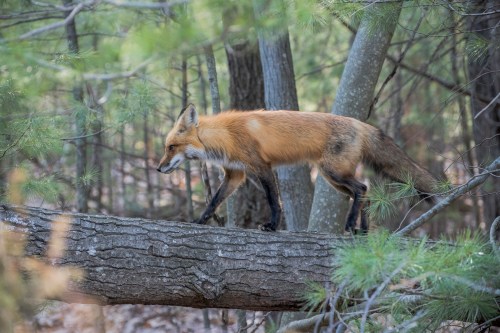
Foxy Friday

Fox Crossing

Fox Crossing, photo by Mark Miller

What an incredible catch by Mark!

View his photo bigger and see more of this little lady in his slideshow.

PS: More about red fox in Michigan from Michigan in Pictures.

Old Mission Orchard in Bloom

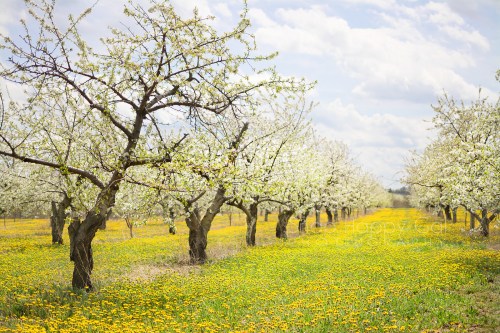
Old Mission Orchard

Old Mission Orchard, photo by Heather Higham

The cherry blossoms are out on northwest Michigan’s Old Mission Peninsula. A little over 100 years ago, this annual occurrence gave birth to Traverse City’s National Cherry Festival. The Cherry Festival’s history page shares that sometime around 1910, cherry growers in the Grand Traverse area began to hold informal “blessing of the blossoms” ceremonies each year at blossom time in May. The TC Record-Eagle picks up the story:

Something had to be done to attract tourists to the Grand Traverse area, local resident and community leader Jay P. Smith declared in 1925.

Henry Ford had introduced a new automobile that allowed people to travel long distances with ease, and Hannah, Lay & Co. spurred a growing business atmosphere here, but tourism still lagged. So Smith created the Blessing of the Blossoms festival.

For one day in May area residents and visitors traveled out to the Old Mission Peninsula to view fields of cherry blossoms from the vantage point of two towers, then flocked to a downtown parade that moved east on Front Street from Elmwood Avenue to Railroad Avenue.

“This was kind of a big deal,” said Gary Kaberle, a former National Cherry Festival president. “People really liked this.”

But Smith and his committee quickly realized that a May festival meant children weren’t out of school and tourists were less likely to have time off work, so they moved the festival to July to coincide with the cherry harvest.

You can read on for more about the evolution of the Cherry Festival and if you want to attend, the dates are July 4-11, 2015 and you can get all the details at cherryfestival.org.

Heather writes that she was looking into an orchard from the edges, surrounded by flowers and bees when she took this picture. View her photo bigger on Flickr, see more in her Old Mission Peninsula slideshow and definitely follow her at Snap Happy Gal Photography on Facebook.

PS: If you want to learn about the early days of the Old Mission Peninsula, check out Rev. Peter Dougherty House on Old Mission having one heck of a yard sale from May 2007 on Michigan in Pictures.