Fall Color Tours: Pictured Rocks & Munising – Newberry – Grand Marais

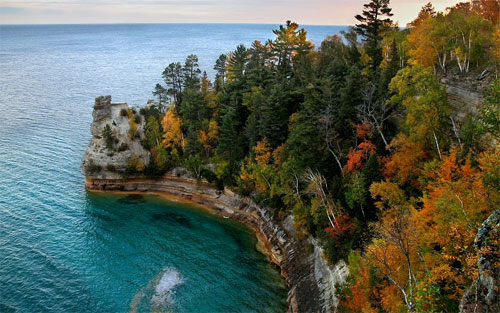
Miners Castle - October 2006, Lars Jensen

Miners Castle – October 2006, photo by Lars Jensen

Let’s jump over to the eastern side of the UP for the next color tour of Munising – Newberry – Grand Marais … and the Pictured Rocks.

The highlight of this tour is of course the stunning Pictured Rocks National Lakeshore., (be sure to check out Lars Jensen’s other Pictured Rocks galleries). Travel Michigan starts you heading east from the town of Munising (Munising.com has the best links, but you can also see the Munising Visitors Bureau). Horseshoe falls at night by Amy KilroyBe sure to check out Munising area waterfalls including Horseshoe Falls (photographed so well by Amy Kilroy – see her Pictured Rocks set for more!). Regarding Munising, Michigan.org says:

This harbor town of about 2,500 is the departure point for regularly scheduled, 2-1/2 hour, narrated Pictured Rocks Boat Cruises as well as chartered Skylane Air Tours that offer a birds-eye view of the scenery. Hikers can tackle all or a portion of the 43 mile Pictured Rocks segment of The North Country Trail (NCT), a national scenic hiking route from North Dakota to New York.

I’ve never done the Air Tour (check that link above and scroll down for the video!), but the boat cruise offers an amazing look at the Pictured Rocks that’s well worth the time and cost! The Pictured Rocks is my favorite place in Michigan, and I’ve covered it pretty well on Michigan in Pictures and on Absolute Michigan. The same is true of Tahquamenon Falls, so let’s say that Grand Marais is a cool little harbor town with its own brewery and a great little diner car diner and skip over to the Tahquamenon Logging Museum which features all kinds of logging era memorabilia and special events including Lumberjack Breakfasts and a Harvest Fest the 3rd weekend of October.

They don’t stop at the Great Lakes Shipwreck Museum at Whitefish Point (’cause that’s another tour), but you can definitely make the short detour to check this very cool museum out. Then it’s back south to Newberry (recent photos at visitnewberry.com) and then west to the Seney National Wildlife Refuge (Wikipedia entry) and the gorgeous Seney Stretch of M-28. Although this highway has been called “mind-numbingly monotonous” and “the state’s most boring route“, it’s actually pretty beautiful in the fall! (photo to the right is H-58 in Fall Color by James Phelps – part of his great Pictured Rocks set).

Here’s a link to a map of photos from the Munising / Pictured Rocks area in the Absolute Michigan pool!

Just so it’s clear, these fall color tour entries are produced by Absolute Michigan & Michigan in Pictures using the great information compiled in Travel Michigan’s Fall Color Tours as a starting point. We’re trying to add to what they’ve put together – not rip them off! As always, if you have links to information or photos that we missed, comments or reports, post them in the comments below!

Don’t miss our Michigan Fall Wallpaper series and see more of Travel Michigan’s Fall Color Tours.

Hunter’s Point

up_hunter_point_026_m1_screen

up_hunter_point_026_m1_screen, photo by pntphoto.

This photo is part of a set of photos from Hunter’s Point Park near Copper Harbor, Michigan that I think is best viewed as a slideshow (you can also see where it is on a map).

The web site for Hunter’s Point has a neat aerial photo in which you can see the Isle Royale Queen ferry which was captured along with fireworks & northern lights in this photo.

In the Pigeon River State Forest…

2007_0703July40155

2007_0703July40155, photo by JJ Murletti.

I don’t know the name of this lake but was struck by just how peaceful it looks.

There’s a campground in the Pigeon River State Forest and lots and lots of trails. The DNR says that the Pigeon River Pine area has over 100 acres of white pine (most about 100 years old) and that the Dog Lake area is considered to be one of the most remote and wild areas in the region. Nesting loons, bald eagles, and osprey are a few of the many animals using the lakes.

The International Mountain Biking Association is quite taken with:

An awesome ribbon of trail looping through the heart of elk country, the High Country Pathway (HCP) embodies the classic definition of an IMBA Epic Ride. The first IMBA Epic Ride in Michigan will take you far into the backcountry with beautiful lowlands and panoramas in the highlands.

Be sure to outfit for self-support, as you may not see another human on this 80-mile soul searcher. The trail passes through a variety of woodlands and wetlands containing massive groves of silver beech, tamarack swamp and leather leaf bogs. The area is home to beaver, black bear, bobcat, pine martin, snowshoe hare, wood ducks, bald eagles, deer, wild turkey and the largest elk herd east of the Mississippi River.

Grandfather Beech and the celebration of trees

Grandfather Winter Grandfather Spring
Grandfather Summer Grandfather Fall

Grandfather Beech (4 photos), by Eye See 360

I am pretty sure that the above photos are by Betsy Lewis , whose work is featured at the Tahquamenon Area Library in Newberry. The Mining Journal has an article on the exhibit. They had planned around an arts grant from the state (which was cut), but they are still holding an amateur photo contest. It’s the 4th annual and the theme is Trees. You can get more information about the contest right here, but even if you don’t enter, consider what Betsy has to say about trees:

Our economy, our recreation, our lives are dependent on trees. They build our homes, provide fuel, jobs, clean the air, provide respite for us and are home to many creatures besides us. They provide roots, they are flexible, they bend, they break, they change. They surround us and uplift us and inspire us to reach for the sky.

Little Foxes

Little Foxes

Little Foxes, photo by curlyson.

Red fox cubs exploring the world near their den.

The Michigan DNR’s red fox (Vulpes vulpes fulva) page says that a large fox (14 inches high) will weigh only 12-15 pounds and be able to easily pass through a four inch hole.

The Red fox pages at the UM Animal Diversity web are sleeping late this morning but doubtless have great info, photos and fox barks. Wikipedia’s red fox entry has a lot more about foxes and shows their range as covering most of the northern hemisphere.

Brood XIII Cicadas in SW Michigan?

After 17 years?

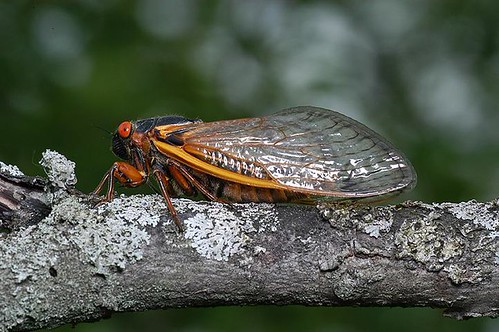
After 17 years?, photo by mfophotos.

The Magicicada are the genus of the 13- and 17- year periodical cicadas of eastern North America who display a unique combination of long life cycles, periodicity, and mass emergences. They are classified according to “Brood” and 2007 is the year of Brood XIII, on a 17-year cycle and also known as the Northern Illinois Brood. Wikipedia’s Brood XIII page has a nice picture of the cicadas of this brood.

While Wikipedia and the U-M’s Museum of Zoology cicada page say that Brood XIII has a presence in southwest Michigan, retired University of Michigan entomologist and cicada expert Thomas Moore says (Freep article) that overeager graduate students and sloppy work by a 19th-Century government scientist and irresponsible replication are responsible for the erroneous perception that Brood XIII may make an appearance in Michigan.

Mark O’Brien comments that it’s unfortunate that Tom Moore was quoted as dismissing the work by former UMMZ graduate students John Cooley and David Marshall (who created the useful pages and did state that the maps are “approximate”). On his blog, Six-legged Wonders, Mark has a post about Brood XIII in Michigan where he says:

What needs to be done is to get modern records. Researchers tend to go to where previous records show emergences. So, if you know that Lake County, Illinois has 17-yr cicadas, that’s where you go if you have limited time to do experiments, etc. I don’t doubt that there may have been 17-yr cicadas at some point in SW Michigan — especially inland away from the sand dunes. However, the area has been heavily agriculturized over the past 100 years, and some areas have also gone back to woods. Have small pockets of Magicicada survived? The only way to know is to go and traverse the area and listen. Lacking that… if you live in that area of the state, tell me that you have them and show me the specimens. It would be nice to know, either way. The next emergence would be in 2024. I’m going to be an old man by then.

You can get a ton more information about the cicadas of Brood XIII (and others) including lots of photos and video and all your Brood XIII gear at Cicada Mania.

Summer 2007 … LAUNCHED!

The Launch! by starryeyez024

The Launch! by starryeyez024

Memorial Weekend is a time to honor the sacrifice of those who have fought for our country, but it’s also the beginning of summer. When I saw the photos of Kendall and her family having fun this weekend on a Michigan lake (Joslin Lake in Unadilla), I knew that this important facet of Memorial Weekend couldn’t pass unremarked.

It seems as if quite a number of people braved the dire forecast, took their lives in their hands and ventured out into the potentially chilly Michigan air. 360Michigan’s Mark Houston went to the Memorial Day Parade in Ferndale while Dave Hogg snapped some shots at Royal Oak’s Parade. David McGowan spent the weekend in the Manistee National Forest with some campfire cooked venison stew. Shqipo went to the St. Mary’s Polish Fair in Keego Harbor while Craig took in the Holland Farmer’s Market (and some tasty asparagus!). Joy took a pair of horses to the Empire Beach while Mario Q lamented that the Tigers just didn’t have the horses to pull off a victory vs. the Indians at Comerica.

I could go on and on, but since I’m starting to reach for transitions, I’ll ask you all to continue by posting links in the comments to any of your Michigan Memorial Day Weekend photos!

An Afternoon at Flat River

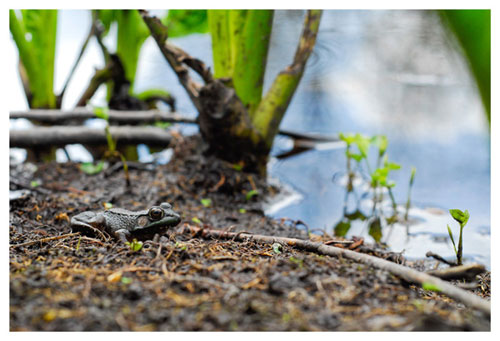
Frog at Flat River State Game Area

David McGowan is a travel photographer working out of West Michigan. Of the day he took this photo, he writes:

Today (May 2, 2007) seemed the perfect day to tour our public wetlands. It’s that sweet part of Spring with lots of budding and blooming, yet not so overgrown that you can’t freely move along a creek or river. This series is from the Flat River and a couple of its tributaries, which I’m sure I wouldn’t have mentioned had I found any morel mushrooms.

Click over to David’s site, humanfiles, to view more photos from his afternoon at Flat River and galleries with many more shots from Michigan (and elsewhere, but I’m not sure I can talk about photos from elsewhere).

You can get more info about the Flat River State Game Area from the DNR and also get the scoop on paddling Flat River from Michigan Water Trails.

Trillium in Michigan

Editor’s Note: The photo that originally appeared here was deleted by the photographer so I am using one of my own!

Trillium lit by Spring Beauties
Trillium lit by Spring Beauties, photo by farlane

The Wikipedia page on trillium lists the 40-50 species of genus trillium. This photo is Trillium grandiflorum, also known as white trillium, grand trillium and snow trillium. The flower is protected in Michigan and is most often on steep slopes where it is protected from grazing white-tailed deer who dislike grazing on inclines.

The USDA’s Trillium grandiflorum (white trillium) page has excellent information regarding classification and lots of photos and links.

Michigan Breeding Bird Atlas II

some cute chicks

some cute chicks, photo by paulhitz.

As is usually the case, I came upon today’s picture in a roundabout way. Stylurus (who seems to know a thing or two about birds) noted that Paul could submit this to the Michigan Breeding Bird Atlas II. The Michigan DNR’s page on MBB II explains:

In the 1980s, volunteers surveyed the entire state in a massive effort to record and map in an atlas the birds which breed in Michigan. This information has proved invaluable to scientists and natural resource managers, but there are indications that bird distribution and abundance has changed since this atlas was created.

Starting in 2002, the Kalamazoo Nature Center was contracted to coordinate the creation of a second Michigan Breeding Bird Atlas. The data collection portion of this process is scheduled to be completed in 2008, and its success depends again on the dedication of a corps of volunteers: backyard birdfeeders, hunters, amateur birdwatchers, and professionals.

You can get all the details on this project at the links above and go to the main MichiganBirds.org page for a flock of links to Michigan birding sites.