Michigan Big Tree Hunt and the White Ash

White ash canopy

White ash canopy, photo by vaprwere.

A couple of weeks ago mLive featured an article on the 2008-09 Michigan Big Tree Hunt.

The contest, run by Global ReLeaf of Michigan, tries to find the biggest tree in each county every two years, as well as the largest white pine (the state tree), and the largest overall tree in the state — which this year is a 306-inch weeping willow in Van Buren County.

A forester who verified Nelson’s tree said that going by only circumference (206″), it is the largest white ash in a five-county (Grand Rapids) area. But it’s not the largest in the state. The Michigan Botanical Club, a partner in the contest, lists a 247-inch white ash in Leelanau County.

Learn more about the contest (and neighborhood tree planting) from Global ReLeaf of Michigan and more about the White ash at Wikipedia.

Check this photo out bigger and in Joseph’s Tree Images set (slideshow).

Interestingly enough, Joseph is a plant pathologist and writes that this large white ash was photographed in northern lower Michigan, and that like its brethren, it’s threatened by the emerald ash borer, a pretty but destructive insect. The article says that this tree was judged free of the pest.

There’s more about the Emerald Ash Borer and also more tree photos on Michigan in Pictures.

(back) Into the Woods

Into the Woods

Into the Woods, photo by jimflix (busy).

With deer hunting season over, that’s where I’ll be going this afternoon.

Jim took this photo on the trail at the Grand Traverse Regional Land Conservancy’s Ransom Lake Natural Area.

Be sure to check this out background bigtastic and in Jim’s Fall Colors set (slideshow).

More fall wallpaper on Michigan in Pictures

The Fantastic Mr. Fox … Michigan Red Fox that is

The Sly look

The Sly look, photo by taterfalls.

A little nonsense now and then is relished by the wisest men.
~Roald Dahl

Wes Anderson’s film Fantastic Mr. Fox (based on the book by Roald Dahl / view trailer) opens tomorrow, so I thought it a good time to take a look at the red fox. The Michigan DNR’s Red Fox (Vulpes vulpes fulva) page says:

Red foxes can be found in every county in Michigan but are especially common in areas with fallow and cultivated fields, meadows, bushy fence lines, woody stream borders, and low shrub cover along woods and beaches. They can also be found in suburban and, less commonly, urban areas where food is readily available. Foxes are highly mobile, which means they can use a large area to find food and shelter.

Red foxes resemble slender, small dogs, with the head and body typically around two feet long. Red fox tail is long and bushy, usually around 15 inches. The size and weight of foxes are commonly overestimated, because their long fur masks a bone structure that is slighter than that of most domestic dogs. Red foxes have a characteristic red coloration (hence their name), with the face, top of head, and neck having yellow or orange coloration. The tail is reddish mixed with black, and always has a white tip. The outer sides of the ears, lower parts of the legs, and feet are dark or black, while the insides of the ears, and the lips, chest, and belly are creamy white.

Much more about red foxes at Wikipedia and at Vulpes vulpes (red fox) on the UM Animal Diversity Web.

Be sure and check this out bigger also have a look at Tate’s slideshow of this brave fox in action.

Great Egret (Ardea alba)

Great Egret ( No. 2 ) Sepia

Great Egret ( No. 2 ) Sepia, photo by Paul Degi Photography.

The All About Birds entry for the Great Egret says:

A large white heron, the Great Egret is found across much of the world, from southern Canada southward to Argentina, and in Europe, Africa, Asia, and Australia. It’s the largest egret in the Old World, and thus has garnered the name Great White Egret. In the New World, however, the white form of the Great Blue Heron is larger. In the United States, the Great Egret used to be called the American Egret but that was hardly appropriate, since its range extends beyond the Americas and indeed farther than other herons.

The Great Egret (Ardea alba) entry on the UM Zoology Animal Diversity Web adds that the ideal location for great egrets is near any form of water. Streams, lakes, ponds, marshes and wooded swamps and wetlands are the preferred location for great egrets and other heron species. There is (of course) more on Wikipedia and here’s a sweet video of a great egret nesting site along Lake Huron.

Be sure and check this out bigger or in Paul’s B&W set (slideshow).

Check out many more Michigan Birds on Michigan in Pictures!

Know Your Michigan Birds: Great Blue Heron


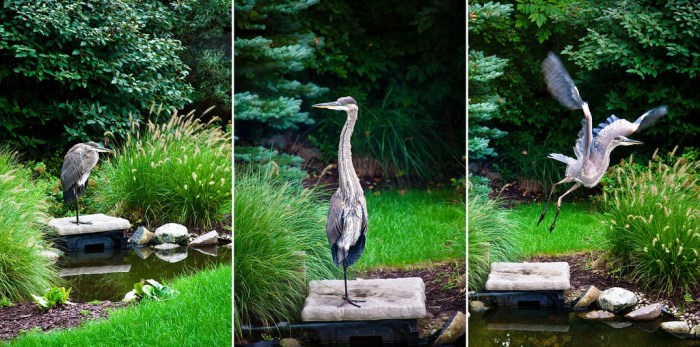
Great Blue Heron Tryptich

backyard-heron-triptych, photo by numstead.

Great Blue Heron (Ardea herodias) on Animal Diversity Web at UM – where you can get complete information, pictures & sounds – says that these birds are the largest and most common herons in North America. The Michigan DNR’s Blue Heron page explains that:

This is the familiar, large grayish-blue heron seen wading in shallow water in marshes, ponds and along lakeshores and stream edges. They are sometimes confused with the sandhill crane; the heron is smaller and flies with its neck folded back, while cranes fly with their neck extended. Great blue herons are commonly seen in small suburban wetlands (cranes are generally less tolerant of close presence). Herons feed on fish, frogs, and other small animals, captured by a quick jab of the beak. They nest in colonies, usually building their stick platform nests in trees in lowland hardwood swamps. In recent years many rookeries have been displaced by shoreline development or timber cutting. Every attempt must be made to preserve known nesting sites if these beautiful birds are to remain common in Michigan’s wetlands.

Wikipedia has more about the Great Blue Heron and you can get more info (and typical calls) from All About Birds. There’s even a short video of a Michigan blue heron on the Kalamazoo River on YouTube.

Nathan says he looked out the window, saw this guy chillin’ by the frog pond and couldn’t believe his eyes when he stretched his neck. Be sure to check this out bigger or in his Great Outdoors set (slideshow).

Here comes fall color!

Camp 5 Lake 01.jpg

Camp 5 Lake 01.jpg, photo by smartee_martee

My stats page says that people are starting to think about autumn and fall color. If you’re one of those folks, have a look at the Michigan Autumn slideshow from the Absolute Michigan pool and also the Michigan Fall wallpaper page!

Be sure to see this photo by Marty bigger and in his Michigan Fall Colors set (slideshow).

Calico Pennant Dragonfly

Calico Pennant Dragonfly

Calico Pennant Dragonfly, photo by jbnuthatch.

Wikipedia doesn’t have much to say about the Calico (or Elisa) Pennant, Celithemis elisa. The Calico Pennant Dragonfly – Celithemis elisa page at North American Insects and Spiders says that Calico Pennants are of the order Odonates and that:

Dragonflies have excellent eyesight. Their compound eyes have up to 30,000 facets, each of which is a separate light-sensing organ or ommatidium, arranged to give nearly a 360° field of vision, important for taking prey on the wing, as has done the female shown above. Odonates are completely harmless – they do not sting or bite. Indeed, they are beneficial in the same respect spiders and other predators are beneficial – they keep the burgeoning insect population in check..

Dragonflies are among the most ancient of living creatures. Fossil records, clearly recognizable as the ancestors of our present day odonates, go back to Carboniferous times which means that the insects were flying more than 300 million years ago, predating dinosaurs by over 100 million years and birds by some 150 million…

Dragonflies are the world’s fastest insects and, although estimates of their speed vary wildly, most credible authorities say they are capable of reaching speeds of between 30 and 60 km/h (19 to 38 mph). A study showed that dragonflies can travel as much as 85 miles in one day.

Here’s some more general information about dragonflies.

Check this photo out bigger or in John’s Critterz set (slideshow).

A boat full of Michigan bluegills

One of Many

One of Many, photo by mickey-finn.

Mickey Finn says that this picture is from an awesome night of fly fishing for bass and bluegills in Michigan in which he landed over 30 of these hand-sized beauties. The Michigan DNR’s Bluegill (Lepomis macrochirus) page says:

The bluegill is a native to eastern and central North America, including the lower Great Lakes. This fish enjoys a well-deserved popularity with anglers. Many a young angler boasts the delicious bluegill as a first catch, while seasoned anglers using light tackle find it a valiant fighter. Bluegills favor warm waters (64 to 70 degrees F) with plenty of cover such as weed beds, submerged logs, or drop-offs. They usually stay in relatively shallow water, but as temperatures rise in the summer, large bluegills will head for deeper water. This fish also provides good winter sport since it remains active all winter long.

The bluegill spawns in the shallows in the late spring or early summer when the water temperature reaches 65 degrees F. Males build nesting colonies in gravel, sand or mud and will guard the eggs and newly hatched fry until they reach the swimming stage.

Wikipedia’s bluegill entry has lots more about this common sunfish.

Yellow-footed Chanterelle mushroom

6739 Yellow-footed Chanterelle

6739 Yellow-footed Chanterelle, photo by darylann

MichiganMorels.com says that the Yellow-Footed Chanterelle is a bright yellow mushroom, this is sometimes funnel shaped and:

Time Of Year: Late Spring through early Summer. Once you find an area that produces chanterelles, go back 2 or 3 times within that month. you just might find they fruit in the same area 2, 3 or 4 times!!

Edibility: Delicious and well respected as one of the best edible mushrooms by nice restaurants as well as harvesters. The chanterelle is one of my favourites and I look forward to it as much as morels. One must use caution so as not to confuse it with the poisonous Jack O Lantern. The Jack will have “normal” gills and fruit off of wood.

Habitat: I find them in mixed deciduous woods where sunlight is allowed to reach the ground. They seem to relate to Oak in my area, but I read that they also relate to Maple, Aspen and Pine.

You can read more at Wikipedia’s Chanterelle entry and even order chanterelle mushrooms from Michigan’s own Wild Harvest.

You can see this bigger in Daryl Ann’s slideshow.

The Painted Turtle in Michigan

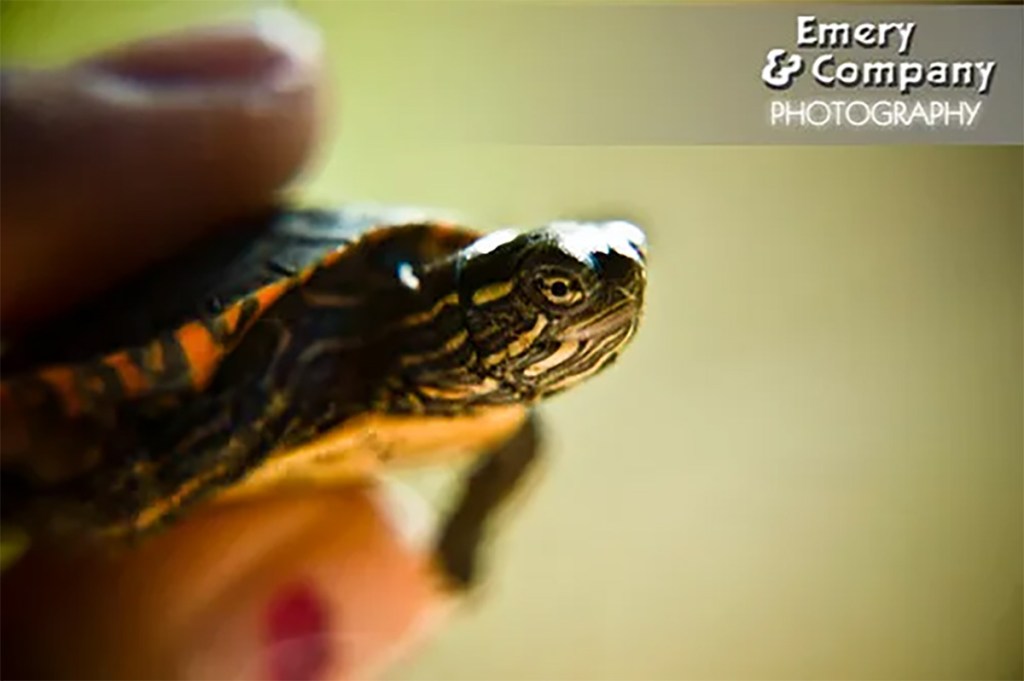
-3, photo by Emery Co Photo.

NOTE: there are two subspecies in Michigan: the Western Painted Turtle and Midland Painted Turtle

When I saw this photo in the Absolute Michigan group, I wondered it it was the right day to talk about painted turtles (I have to be careful after last summer’s TurtleGate incident as you may recall). When I saw the siskokid’s shot of a painted turtle basking in the sun just a few photos later, I figured it was a sign of some sort.

The painted turtle is one of the most common turtles in the US. It’s Michigan’s state reptile and the Michigan DNR’s Painted Turtle page has a map that shows where you can find them in the state. Wikipedia’s Painted Turtle entry notes that turtle nests are the snack bar of the animal world, vulnerable to predation by raccoons, squirrels, chipmunk, woodchucks, skunk, badger, foxes, fish crows, garter snakes, deer, ants, beavers and humans. The UM Animal Diversity web has pictures and information about Chrysemys picta (the painted turtle) and says that:

Painted turtles prefer living in freshwater that is quiet, shallow, and has a thick layer of mud.

Painted turtles are brightly marked. They have a smooth shell about 90 to 250 mm long. Their shell acts as protection, but since the ribs are fused to the shell, the turtle cannot expand its chest to breathe but must force air in and out of the lungs by alternately contracting the flank and shoulder muscles. The painted turtle has a relatively flat upper shell with red and yellow markings on a black or greenish brown background.

See some more photos of this little guy in Emery Co’s slideshow and check out even more in the turtle slideshow from the Absolute Michigan pool!