

Bleeding Heart, photo by The Toad.
Be sure to check it out bigger and also all the Michigan flowers that are popping up in the Absolute Michigan pool.
Bleeding Heart, photo by The Toad.
Be sure to check it out bigger and also all the Michigan flowers that are popping up in the Absolute Michigan pool.
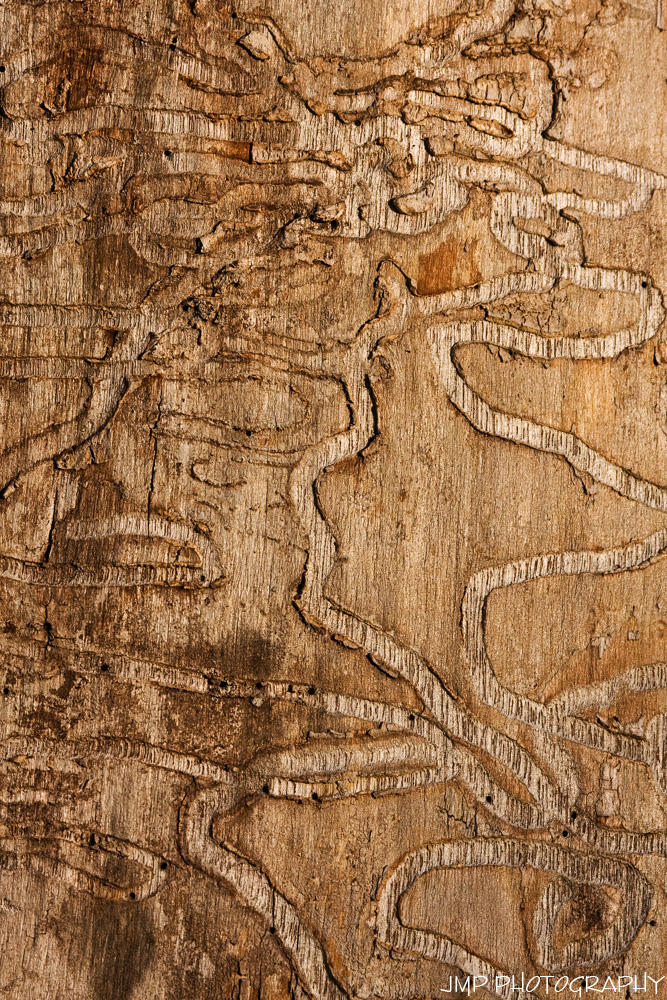
Emerald Ash Borer Handiwork, photo by mandj98.
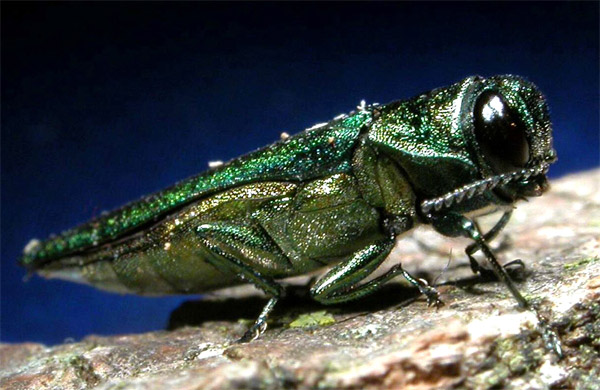 The Emerald Ash Borer information site says:
Emerald ash borer (EAB), Agrilus planipennis Fairmaire, is an exotic beetle that was discovered in southeastern Michigan near Detroit in the summer of 2002. The adult beetles nibble on ash foliage but cause little damage. The larvae (the immature stage) feed on the inner bark of ash trees, disrupting the tree’s ability to transport water and nutrients.
Since its discovery, EAB has killed tens of millions of ash trees in southeastern Michigan alone, with tens of millions more lost in Ohio, Illinois, Indiana, Pennsylvania, West Virginia, Missouri, Wisconsin, Virginia, Ontario, and Quebec. The Michigan Department of Agriculture page on the Emerald Ash Borer explains that the best way to stop the spread of EAB (and to avoid fines ranging from $1,000 to $250,000 and jail time of up to five years) is to not transport firewood. All types of firewood can transport invasive pests other than EAB including Beech Bark Disease, Asian Longhorned Beetle, Sirex Woodwasp, and Gypsy Moth.
This photo is part of James’ massive Michigan photo set (slideshow).

Morel Hunting, photo by Apocaplops.
Erich says that morels are his favorite part of spring and writes:
I recently spent a long weekend up in northern Michigan looking for the elusive Morel mushroom, guided by some friends. Maeby tagged along too, as you can see.
Turns out spotting the black Morels was much more difficult than I remembered, like a Where’s Waldo hunt that spans many square miles. Still, we found enough to be happy, and I enjoyed the trip up north immensely.
Check it out larger in his Up North slideshow.
If you’re looking for tons of morel fun and are near enough to Boyne City, check out the National Morel Mushroom Festival today & tomorrow or enjoy it through this Absolute Michigan report from the 2009 Morel Fest!

Cerulean-Warbler-at-Embury-, photo by richard.sleeman.
I’ve recently posted about the de-listing of the gray wolf and bald eagle in Michigan. The osprey was recently removed as well, but the Michigan Department of Natural Resources recently revised its list of threatened and endangered species and added 69 to the list. They say that the most notable addition is the cerulean warbler.
The All About Birds page on the Cerulean Warbler has some excellent photos and even the warbler’s song. The Audubon Watchlist for the Cerulean Warbler (Dendroica cerulea) estimates that there are about 1/2 a million of these birds in the world and says:
This wood-warbler is not easily confused with other warblers. The adult male is a deep cerulean blue above with a streaked back, and is white below with a narrow blue-black band across the throat. The adult female is bluish-green above with no streaks, and white washed with yellow below with a distinct white or yellowish line over eye. All plumages and both sexes have white wing bars and white tail-spots.
The species suffers from habitat loss and degradation in both its summer and winter range. The remaining population breeds in the northeastern and central parts of the United States as far north as s. Ontario, as far south as Arkansas, as far east as the Atlantic Coast, and as far west as Iowa. Ceruleans are not evenly distributed throughout this range.
Typically found in mature forested areas with large and tall trees of broad-leaved, deciduous species and an open understory, but may also inhabit wet bottomlands, some second-growth forests, and mesic upland slopes. Eats insects in the foliage and a small amount of plant material in the winter. Nests high in the canopy on a lateral limb of a deciduous tree above an open area. The nest is concealed from above by leaves or vines. The 3-4 eggs are incubated by the female, but both parents feed the young. As a medium- to long-distance migrant, these warblers may arrive on their breeding range from late March to mid-May and be back on their wintering grounds as early as August.
Richard took this photo at the Waterloo State Game Area. See it bigger in his Warblers slideshow.

woods_049, photo by Hart Ryan Noecker.
Circa 2000. It’s part of Hart Ryan Noecker’s un luogo solitario set (slideshow).

black morels, photo by PLskell
Peter says that he found this delicious pair black morels in Delta County in the UP last May.
Over on Absolute Michigan we have a nice feature on morel hunting in Michigan that offers some tips for tracking down these elusive and tasty mushrooms.
Our best advice for how to find morels is to attend one of Michigan’s morel celebrations. The 50th annual Mesick Mushroom Festival happens this weekend (May 8-10, 2009) and the Boyne City National Morel Mushroom Festival takes place May 14-17, 2009.
More morel madness from Michigan in Pictures!
For more photos, check out the Michigan Morel slideshow on Flickr.

Trout Lilies on a Sunday Morning, photo by farlane>
FYI, the photo that was featured here was removed, so here’s one of mine…
A good friend was telling me about trout lilies the other day as we walked through the woods. She said that they only bloom every 17 years, something I have been unable to find anything about online. If anyone has more info on this, please post a comment. I’ve been told it’s 7 years, and there seems to be support for that.
This great Wild About Gardening feature on the trout lily (Erythronium americanum) says that the name is is derived from the resemblance of its mottled leaves to the coloring on brook trout. This 4-10″ tall wildflower is one of the earliest to bloom in Michigan and is also known as Adder’s Tongue and Dogtooth Violet:
This is a plant that relies more on the spreading abilities of its underground root system (corms) than on seed production from its flowers. In fact, it takes a few years for a plant to be mature enough to produce a flower and seeds. Trout lilies have recruited the help of ants, who eat a nutritious appendage attached to each seed and leave the rest to germinate. If you wish to propagate your trout lilies from seed, you will want to follow nature’s lead, at least as far as temperature is concerned. Keep your seeds moist and give them a few months of warm followed by a few months of cold, similar to the seeds falling on the ground at the beginning of summer and receiving the summer warmth and winter cold before sprouting the following spring. Wildflowers sometimes stagger their germination over several years, so you might want to sow a few extra seeds to avoid disappointment.
These plants will naturally spread by forming vast colonies. Some wild colonies are reputed to be as old as the trees around them — two or three hundred years! Despite its ability to spread, the trout lily is not considered an aggressive spreader but rather a delight to have in one’s garden.
You can see this larger right here or in Robert’s slideshow. Even more in Flickr’s Michigan Trout Lily slideshow.

As yesterday’s Traverse City Record-Eagle reported:
The bald eagle is now off both state and federal endangered species lists for Michigan. But the federal Bald Eagle Protection Act of 1940 makes it a crime to hunt, kill or otherwise harm them.
Fewer than 100 nests existed in the state in 1969, DNR officials said. In 2006, there were nearly 500 occupied nests, and the number is growing.
The Michigan DNR page on the Bald Eagle in Michigan has lots of information about their seasonal behavior (they are beginning to hatch their eggs right now) and documents the history of the bald eagle in Michigan:
Before European settlement, bald eagles probably nested in all regions of Michigan where food was available. In the early 1900s they were described as being “generally distributed,” but “nowhere abundant.” A decline through the early and mid-1900s was probably related to slow but consistent loss of suitable habitat and available food, and predator control by humans. These eagles are so disturbed by the presence of humans near their nest that they may be induced to abandon the nest, or even chicks that have already hatched. By 1959, the species was considered, “largely restricted to the northern half of the state.”
Through the 1950s, the slow decline accelerated dramatically, until suddenly, bald eagles were on the brink of extinction in the lower 48 states. The population crash was due to several factors that had reduced reproductive success of nesting pairs, but was mostly the result of increased use of pesticides with chemicals such as PCB and DDT. These chemicals affected the eagles in many ways, including causing them to delay their breeding until it was too late in the season, or even to not breed at all. Eggs that were laid often had thin shells, causing them to break in the nest. At its worst in 1967, only 38 percent of the Michigan population of bald eagles were able to raise at least a single chick. Productivity must be at least 70 percent for a bald eagle population to remain stable.
Recognition of the plight of bald eagles in the US and its cause finally occurred in the 1960s. By the 1970s DDT had been banned in the US. Intensive monitoring of eagles in Michigan began in 1961. Although bald eagles had been protected at federal and state levels since 1940 and 1954, respectively, they received much greater protection after the ratification of the Endangered Species Act in 1973, and the Michigan endangered species act in 1974.
Reproductive success began to improve and in 1975, the 70 percent productivity mark was reached, although it dropped off again soon after. The population remained at around 86 nesting pairs through the 1970s. In 1981, the population at last began to increase. The 1999 survey found 343 nests that produced 321 young. The productivity was calculated as 96% (young per nests with known outcomes). But some problems still exist. Eagles nesting along the Great Lakes coasts have higher contaminant levels in their blood than inland nesting pairs.
The American Bald Eagle information site has all kinds of sighting information from Michigan and will help you find places to see bald eagles.
If you’d like to check them out from your computer, you can see the above photo background big or in Bob’s Eagles set (slideshow, check out the Bald Eagle slideshow in the Absolute Michigan pool and/or Michigan Bald Eagles on Flickr.

A Blue Like No Other, photo by sl33stak.
Wikipedia’s American Robin entry (that’s Turdus migratorius for all the 3rd graders out there) says:
The American Robin begins to breed shortly after returning to its summer range. It is one of the first North American bird species to lay eggs, and normally has two to three broods per breeding season, which lasts from April to July.
The nest is most commonly located 1.5–4.5 meters (5–15 ft) above the ground in a dense bush or in a fork between two tree branches, and is built by the female alone. The outer foundation consists of long coarse grass, twigs, paper, and feathers. This is lined with smeared mud and cushioned with fine grass or other soft materials. A new nest is built for each brood, and in northern areas the first clutch is usually placed in an evergreen tree or shrub while later broods are placed in deciduous trees. The American Robin does not shy away from nesting close to human habitation.
A clutch consists of three to five light blue eggs, and is incubated by the female alone. The eggs hatch after 14 days, and chicks leave the nest a further two weeks later. All chicks in the brood leave the nest within two days of each other.
The cool blog ColorBuzz has a cool post about Robin’s Egg Blue that has a number of cool tidbits about this unique shade of blue such as the reason that a robin’s egg is blue is to hide it from color blind mammals and that Tiffany has trademarked the hue.
In case you’re itching for a fight with Tiffany and wondering how to make it, in hex code it’s #00CCCC or 0, 204, 204 in RGB. You might just want to buy the crayon.
You can view this larger in Jamie’s Nature slideshow (or check out the set).
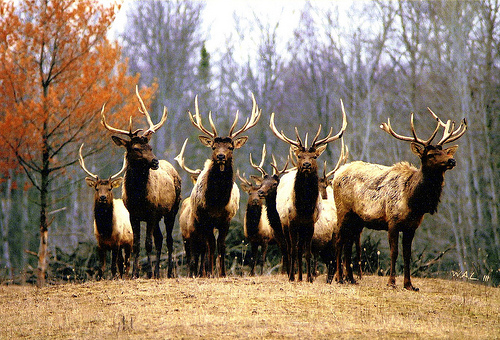
Got Rut?, photo by lonewolv / William A. LaCrosse III.
When I saw this picture (shot in Hillman, MI in 2004) I figured “elk farm.” However, as I looked into the subject I discovered that Michigan has a significant wild elk population. Michigan Elk: Past and Present from the Michigan DNR says:
Michigan’s native elk disappeared around 1875. Today’s elk herd dates back to 1918, when seven western animals were released near Wolverine. From that reintroduction, the number of animals grew steadily to about 1,500 elk in the early 1960s. They reached the point where limited hunting was possible in 1964 and 1965.
… Reduced poaching losses, habitat improvement and successful management of hydrocarbon development resulted in an increase in elk numbers to 850 by 1984.
As the herd grew, problems also increased with forest and agricultural damage. To bring the herd in better balance with its natural food supplies and with the needs of landowners, elk hunting resumed in 1984. Biologists estimated the January 2006 population to be between 800-900 animals. This goal is a winter herd of 800 to 900 elk.
The village of Atlanta claims the title of Elk Capital of Michigan and holds an Elk Festival every September (September 25-27, 2009). You can read more about the second largest species of deer (following only the moose) in Wikipedia’s Elk entry which has this to say about rut:
Adult elk usually stay in single-sex groups for most of the year. During the mating period known as the rut, mature bulls compete for the attentions of the cows and will try to defend females in their harem. Rival bulls challenge opponents by bellowing and by paralleling each other, walking back and forth. This allows potential combatants to assess the others antlers, body size and fighting prowess. If neither bull backs down, they engage in antler wrestling, and bulls sometimes sustain serious injuries.
Find even more elk info and photos under Cervus elaphus, elk (also: red deer; wapiti) from the University of Michigan Museum of Zoology’s Animal Diversity Web.
See this larger in William’s slideshow.
 Michigan in Pictures