The Ruffed Grouse and how to manage land for it in Michigan

n21_107-9216

n21_107-9216, photo by sgowtham.

Managing Michigan Wildlife: A Landowners Guide is produced by the Michigan DNR and is designed to tell landowners how they can improve wildlife habitat on their property and ease the consequences of our changed ecosystems. They have this to say about the Ruffed Grouse:

Ruffed grouse live in 34 of the 49 continental states and in all Canadian provinces. Michigan is an important portion of the grouse range. Often thought of as a bird of the deep forest, grouse actually thrive best in young, aspen forests and brushlands. When aspen is not available, oak, lowland brush, and dense stands of trees are optional habitats. Grouse are a welcome sight at bird feeders in neighborhoods where natural habitat is available. Despite human encroachment, grouse are able to survive.

You can manage for grouse in Michigan if you own 20-40 acres of woodlands, and birds have access to other nearby woodlots. When habitat needs are met, ruffed grouse usually spend their entire lives in an area of 40 acres or less. If critical habitat is not available, grouse will disperse up to several miles in search of a new home. Birds are basically solitary and do not collect in coveys like bobwhite quail, although several grouse may feed or roost together. Be aware that populations fluctuate even when habitat needs are met.

Learn much more about this popular game bird from Wikipedia and Ruffed Grouse (Bonasa umbellus) from All About Birds where you can hear the grouse’s unique thrumming call.

Gowtham took this photo in Pelkie. Check it out bigger and in his Nature slideshow.

Cathedral

Cathedral

Cathedral, photo by Mike Lanzetta.

For in the true nature of things, if we rightly consider, every green tree is far more glorious than if it were made of gold and silver.
~Martin Luther

See it bigger in Mike’s slideshow.

Happy weekend to everyone, and I hope all you folks without power get some soon!

Take a walk through the trees on Michigan in Pictures.

Fish Dinner: Blue Heron Style

Fish Dinner

Fish Dinner, photo by Mario.Q.

Mario took this great shot of a blue heron fishing on the Red Cedar River.

Check it out bigger in his Great Outdoors slideshow.

Much more about blue herons on Michigan in Pictures.

Great Horned Owl

gh4282010-3

gh4282010-3, photo by Sherri & Dan.

Wikipedia says that the Great Horned Owl Bubo virginianus is also known as the tiger owl, or cat owl because of its catlike ears, eyes, shape of head, and appearance when huddled up on its nest. The UM Animal Diversity Web Bubo virginianus page notes that while the owl can see during the day, it has even better vision at night and does its most effective hunting then. They also warn that when the great horned owl has young in its nest, it can be very hostile.

Here’s some fun facts on Great Horned Owls from All About Birds:

  • The Great Horned Owl is the only animal that regularly eats skunks.
  • The Great Horned Owl will take large prey, even other raptorial birds. It regularly kills and eats other owls, and is an important predator on nestling Ospreys. The reintroduction of Peregrine Falcons has been hampered in some areas by owls killing both adult and nestling falcons.
  • The Great Horned Owl is a regular victim of harassment from flocks of American Crows. Crows congregate from long distances to mob owls, and may continue yelling at them for hours. The enmity of the crows is well earned, however, as the owl is probably the most important predator on adult crows and nestlings.
  • Even though the female Great Horned Owl is larger than her mate, the male has a deeper voice. Pairs often call together, with audible differences in pitch.

All three of the sites above have cool photos and owl calls and you might also enjoy this video of a great horned owl being harassed by crows in Mt. Clemens.

Check this out bigger in Sherri & Dan’s slideshow!

Lots more Michigan birds from Michigan in Pictures!

gulo gulo: The Wolverine and Why Michigan is the Wolverine State

Gulo gulo

Gulo gulo, photo by anikarenina.

Wikipedia’s wolverine entry says that the wolverine (Gulo gulo), also referred to as glutton, carcajou, skunk bear, quickhatch, or gulon, is the largest land-dwelling species of the Mustelidae (weasel) family in the genus Gulo (Latin: “glutton”). It is a stocky and muscular carnivore, more closely resembling a small bear than other mustelids. The wolverine has a reputation for ferocity and strength out of proportion to its size, with the documented ability to kill prey many times its size.

For more detailed information and photos, check out gulo gulo (wolverine) from the UM Animal Diversity Web. You can also see videos of the wolverine at ARKive.

Speaking of videos, recently Michigan lost its only known wild wolverine. Just days before, the Bay City Times put together this cool feature on Deckerville High School science teacher Jeff Ford’s longtime fascination with the wolverine that includes photos and video.

As to the question of why Michigan is called the Wolverine State, I couldn’t find anything definitive, but 50 States offers two theories:

Some people believe that Ohioans gave Michigan the nickname “The Wolverine State” around 1835 during a dispute over the Toledo strip, a piece of land along the border between Ohio and Michigan. Rumors in Ohio at the time described Michiganians as being as vicious and bloodthirsty as wolverines. This dispute became known as the Toledo War.

Another reason given for the nickname is a story that has Native Americans, during the 1830s, comparing Michigan settlers to wolverines. Some native people, according to this story, disliked the way settlers were taking the land because it made them think of how the gluttonous wolverine went after its food.

About this photo, Andrea writes:

Everett adopted a Detroit Zoo wolverine for me for Valentine’s Day last year. The zoo’s “Wildlife Preservers” adoption package came with a cute stuffed wolverine that we named Winchell.

Detroit’s wolverines produced 2 kits in 2005, who were fondly nicknamed Bucky and Sparty by the zookeepers. At the time, there were only 77 wolverines in captivity in North America, and Aggie’s litter was the only pair of surviving kits that year–and Detroit’s first surviving wolverine kits ever. Their official names are now Tamarack and Tilia.

See this photo bigger or in her Detroit Zoo set (slideshow).

More animals from Michigan in Pictures.

Deer at Ludington State Park

Deer at Ludington State Park

Deer at Ludington State Park, photo by R.J.E..

Taken at Ludington State Park.

See this bigger or in the slideshow from the Lovely Ludington group.

Many more park photos from Michigan in Pictures.

Hooded Merganser Party

Hooded Merganser Party

Hooded Merganser Party, photo by Adore707.

While these birds are partying*, you probably won’t have to shout at them to keep it down. The All About Birds entry for Hooded Merganser (Lophodytes cucullatus) says that they are silent except in courtship when male gives a deep rolling frog-like sound. Their wings do produce a loud whistling in flight which you can hear under “Sounds” at the link above.

This small fish-eating duck frequents wooded ponds and nests in holes in trees. More fun facts:

The Hooded Merganser is the second-smallest of the six living species of mergansers (only the Smew of Eurasia is smaller) and is the only one restricted to North America.

Although up to 44 Hooded Merganser eggs have been found in one nest, one female probably does not lay more than about 13. Larger clutches result when more than one female lays eggs in a nest.

The Hooded Merganser finds its prey underwater by sight. The merganser can actually change the refractive properties of its eyes to enhance its underwater vision. In addition, the nictitating membrane (third eyelid) is very transparent and probably acts to protect the eye during swimming, just like a pair of goggles.

For more, including photos, see the UM Animal Diversity Web entry for Lophodytes cucullatus (hooded merganser) and Wikipedia’s Hooded Merganser page. If you haven’t had your fill of ducks, there’s always the ever-growing Michigan in Pictures Duckie Gallery.

See this bigger in Eli’s Birds slideshow (view the set).

* Three boys and one girl? I’ve been to parties like that…

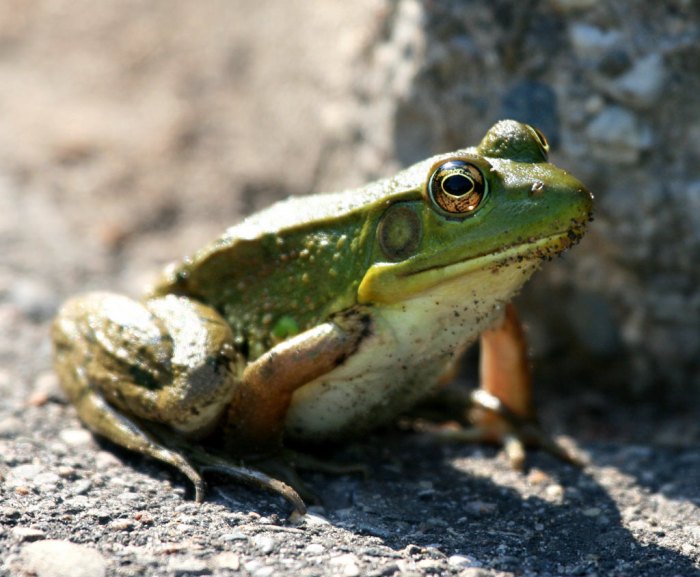
Northern Green Frog

Northern Green Frog

Frog!, photo by StormchaserMike Photography.

I nearly misidentified this guy as an American Bullfrog, likely confusing a whole new generation of readers just as they were recovering from Turtlegate.

The Michigan Herps page on Michigan’s Frogs & Toads says that misidentification is common – the trick is the fold of skin running from their eardrum to their back. The UM Animal Diversity Web entry for Lithobates clamitans (green frog) says you can find them all over the eastern US and that:

Green frogs are found in a wide variety of habitats that surround most inland waters, such as: swamps, wooded swamps, ponds, lakes, marshes, bogs, banks of slow moving rivers and streams, oxbow lakes, sloughs, and impoundments. Juveniles may disperse into wooded areas or meadows during times of rain. Green frogs overwinter in the water usually buried in the substrate.

Green frogs produce as many as six different calls. Males attracting a mate give an advertisement call and a high-intensity advertisement call. Their advertisement call has been compared to the pluck of a loose banjo string. Male frogs defending a territory from an intruding male usually give aggressive calls and growls. The release call is given by non-receptive females and by males accidentally grabbed by another male. Finally, the alert call is given by males and females when startled or attacked by a predator.

Green frogs have an excellent sense of vision and use this to detect and capture prey.

You can hear one of their calls at the link above and also read about them at Wikipedia and the MIchigan DNR’s page on the Green Frog.

Check this out bigger and see it in context in Mike’s Cass Lake set (slideshow).

More about Michigan’s animals from Michigan in Pictures.

Rough-legged Hawk (Dark Morph)

Rough-legged Hawk (Dark Morph)

Rough-legged Hawk (Dark Morph), photo by Michigan James.

Wikipedia says that the Rough-legged Buzzard (Buteo lagopus) is called the Rough-legged Hawk in North America:

It is between 50 and 60 centimetres long with a 130 cm wingspan. Its breeding range is northernmost Europe, Asia, and North America, but it migrates further south in winter..

It breeds on cliffs, slopes or in trees, laying about four eggs, but more in good lemming years. It hunts over open land, eating small mammals and carrion. This species, along with the Osprey, is one of the few large birds of prey to hover regularly.

There’s more information and pictures on All About Birds.

James took this photo in Carsonville in Sanilac County. Check it out bigger and in his hawk slideshow.

Seeing Red: Rose Hips

Seeing Red

Seeing Red, photo by Kiley_Evanne.

One of my favorite books as a kid was My Side of the Mountain. In it, the teenaged hero Sam Gribley learns how to feed himself and survive in the woods. Inspired by Sam’s example, I got as far as being able to identify rose hips, the red-orange fruit of the rose plant.

When snowshoeing or skiing in the winter, I like to snack on these when I find them. This article about gathering rose hips begins:

Known mostly for beauty in the garden and as a floral declaration of love, roses don’t usually come to mind when we think of either food or nutrition. Yet, all parts of the rose, and especially the hips, are storehouses of Vitamin C and other important nutrients.

Compare the nutritional content of oranges to rose hips and you will find that rose hips contain 25 percent more iron, 20 to 40 percent more Vitamin C (depending upon variety), 25 times the Vitamin A, and 28 percent more calcium.

They’re also a great source of bioflavanoids, pectin, Vitamin E, selenium, manganese, and the B-complex vitamins. Read on for suggestions about gathering and drying them. The BBC has an article about Rose-hips as a possible remedy for arthritis that you might enjoy as well. One tip: you have to leave the blossoms on the rose bush for hips to fully develop.

Check it out bigger or in Kiley’s slideshow.