Know Your Michigan Birds: Great Blue Heron


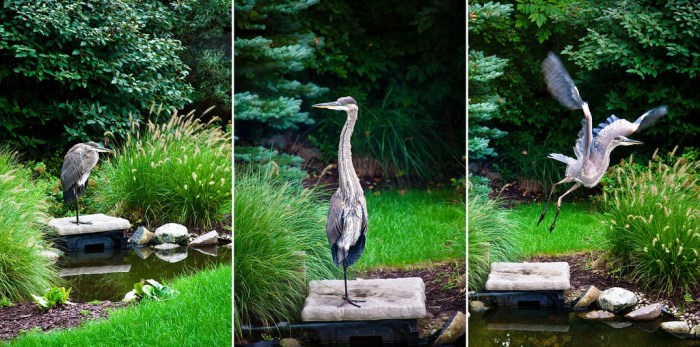
Great Blue Heron Tryptich

backyard-heron-triptych, photo by numstead.

Great Blue Heron (Ardea herodias) on Animal Diversity Web at UM – where you can get complete information, pictures & sounds – says that these birds are the largest and most common herons in North America. The Michigan DNR’s Blue Heron page explains that:

This is the familiar, large grayish-blue heron seen wading in shallow water in marshes, ponds and along lakeshores and stream edges. They are sometimes confused with the sandhill crane; the heron is smaller and flies with its neck folded back, while cranes fly with their neck extended. Great blue herons are commonly seen in small suburban wetlands (cranes are generally less tolerant of close presence). Herons feed on fish, frogs, and other small animals, captured by a quick jab of the beak. They nest in colonies, usually building their stick platform nests in trees in lowland hardwood swamps. In recent years many rookeries have been displaced by shoreline development or timber cutting. Every attempt must be made to preserve known nesting sites if these beautiful birds are to remain common in Michigan’s wetlands.

Wikipedia has more about the Great Blue Heron and you can get more info (and typical calls) from All About Birds. There’s even a short video of a Michigan blue heron on the Kalamazoo River on YouTube.

Nathan says he looked out the window, saw this guy chillin’ by the frog pond and couldn’t believe his eyes when he stretched his neck. Be sure to check this out bigger or in his Great Outdoors set (slideshow).

Here comes fall color!

Camp 5 Lake 01.jpg

Camp 5 Lake 01.jpg, photo by smartee_martee

My stats page says that people are starting to think about autumn and fall color. If you’re one of those folks, have a look at the Michigan Autumn slideshow from the Absolute Michigan pool and also the Michigan Fall wallpaper page!

Be sure to see this photo by Marty bigger and in his Michigan Fall Colors set (slideshow).

Calico Pennant Dragonfly

Calico Pennant Dragonfly

Calico Pennant Dragonfly, photo by jbnuthatch.

Wikipedia doesn’t have much to say about the Calico (or Elisa) Pennant, Celithemis elisa. The Calico Pennant Dragonfly – Celithemis elisa page at North American Insects and Spiders says that Calico Pennants are of the order Odonates and that:

Dragonflies have excellent eyesight. Their compound eyes have up to 30,000 facets, each of which is a separate light-sensing organ or ommatidium, arranged to give nearly a 360° field of vision, important for taking prey on the wing, as has done the female shown above. Odonates are completely harmless – they do not sting or bite. Indeed, they are beneficial in the same respect spiders and other predators are beneficial – they keep the burgeoning insect population in check..

Dragonflies are among the most ancient of living creatures. Fossil records, clearly recognizable as the ancestors of our present day odonates, go back to Carboniferous times which means that the insects were flying more than 300 million years ago, predating dinosaurs by over 100 million years and birds by some 150 million…

Dragonflies are the world’s fastest insects and, although estimates of their speed vary wildly, most credible authorities say they are capable of reaching speeds of between 30 and 60 km/h (19 to 38 mph). A study showed that dragonflies can travel as much as 85 miles in one day.

Here’s some more general information about dragonflies.

Check this photo out bigger or in John’s Critterz set (slideshow).

A boat full of Michigan bluegills

One of Many

One of Many, photo by mickey-finn.

Mickey Finn says that this picture is from an awesome night of fly fishing for bass and bluegills in Michigan in which he landed over 30 of these hand-sized beauties. The Michigan DNR’s Bluegill (Lepomis macrochirus) page says:

The bluegill is a native to eastern and central North America, including the lower Great Lakes. This fish enjoys a well-deserved popularity with anglers. Many a young angler boasts the delicious bluegill as a first catch, while seasoned anglers using light tackle find it a valiant fighter. Bluegills favor warm waters (64 to 70 degrees F) with plenty of cover such as weed beds, submerged logs, or drop-offs. They usually stay in relatively shallow water, but as temperatures rise in the summer, large bluegills will head for deeper water. This fish also provides good winter sport since it remains active all winter long.

The bluegill spawns in the shallows in the late spring or early summer when the water temperature reaches 65 degrees F. Males build nesting colonies in gravel, sand or mud and will guard the eggs and newly hatched fry until they reach the swimming stage.

Wikipedia’s bluegill entry has lots more about this common sunfish.

Yellow-footed Chanterelle mushroom

6739 Yellow-footed Chanterelle

6739 Yellow-footed Chanterelle, photo by darylann

MichiganMorels.com says that the Yellow-Footed Chanterelle is a bright yellow mushroom, this is sometimes funnel shaped and:

Time Of Year: Late Spring through early Summer. Once you find an area that produces chanterelles, go back 2 or 3 times within that month. you just might find they fruit in the same area 2, 3 or 4 times!!

Edibility: Delicious and well respected as one of the best edible mushrooms by nice restaurants as well as harvesters. The chanterelle is one of my favourites and I look forward to it as much as morels. One must use caution so as not to confuse it with the poisonous Jack O Lantern. The Jack will have “normal” gills and fruit off of wood.

Habitat: I find them in mixed deciduous woods where sunlight is allowed to reach the ground. They seem to relate to Oak in my area, but I read that they also relate to Maple, Aspen and Pine.

You can read more at Wikipedia’s Chanterelle entry and even order chanterelle mushrooms from Michigan’s own Wild Harvest.

You can see this bigger in Daryl Ann’s slideshow.

The Painted Turtle in Michigan

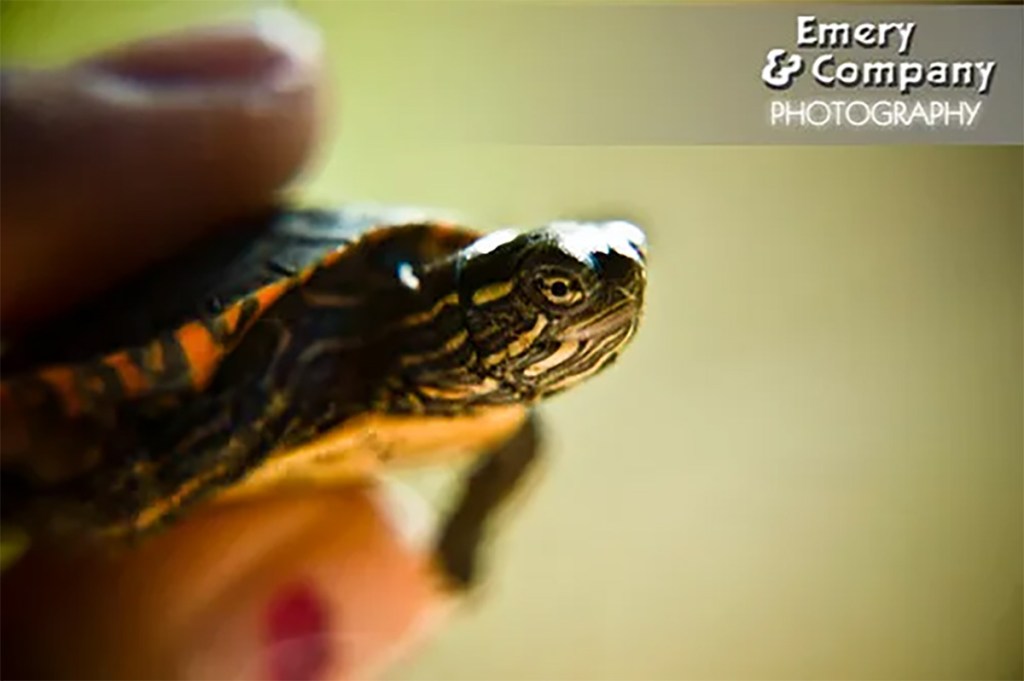
-3, photo by Emery Co Photo.

NOTE: there are two subspecies in Michigan: the Western Painted Turtle and Midland Painted Turtle

When I saw this photo in the Absolute Michigan group, I wondered it it was the right day to talk about painted turtles (I have to be careful after last summer’s TurtleGate incident as you may recall). When I saw the siskokid’s shot of a painted turtle basking in the sun just a few photos later, I figured it was a sign of some sort.

The painted turtle is one of the most common turtles in the US. It’s Michigan’s state reptile and the Michigan DNR’s Painted Turtle page has a map that shows where you can find them in the state. Wikipedia’s Painted Turtle entry notes that turtle nests are the snack bar of the animal world, vulnerable to predation by raccoons, squirrels, chipmunk, woodchucks, skunk, badger, foxes, fish crows, garter snakes, deer, ants, beavers and humans. The UM Animal Diversity web has pictures and information about Chrysemys picta (the painted turtle) and says that:

Painted turtles prefer living in freshwater that is quiet, shallow, and has a thick layer of mud.

Painted turtles are brightly marked. They have a smooth shell about 90 to 250 mm long. Their shell acts as protection, but since the ribs are fused to the shell, the turtle cannot expand its chest to breathe but must force air in and out of the lungs by alternately contracting the flank and shoulder muscles. The painted turtle has a relatively flat upper shell with red and yellow markings on a black or greenish brown background.

See some more photos of this little guy in Emery Co’s slideshow and check out even more in the turtle slideshow from the Absolute Michigan pool!

Bleeding Heart

Bleeding Heart

Bleeding Heart, photo by The Toad.

Be sure to check it out bigger and also all the Michigan flowers that are popping up in the Absolute Michigan pool.

Emerald Ash Borer Handiwork

Emerald Ash Borer Handiwork
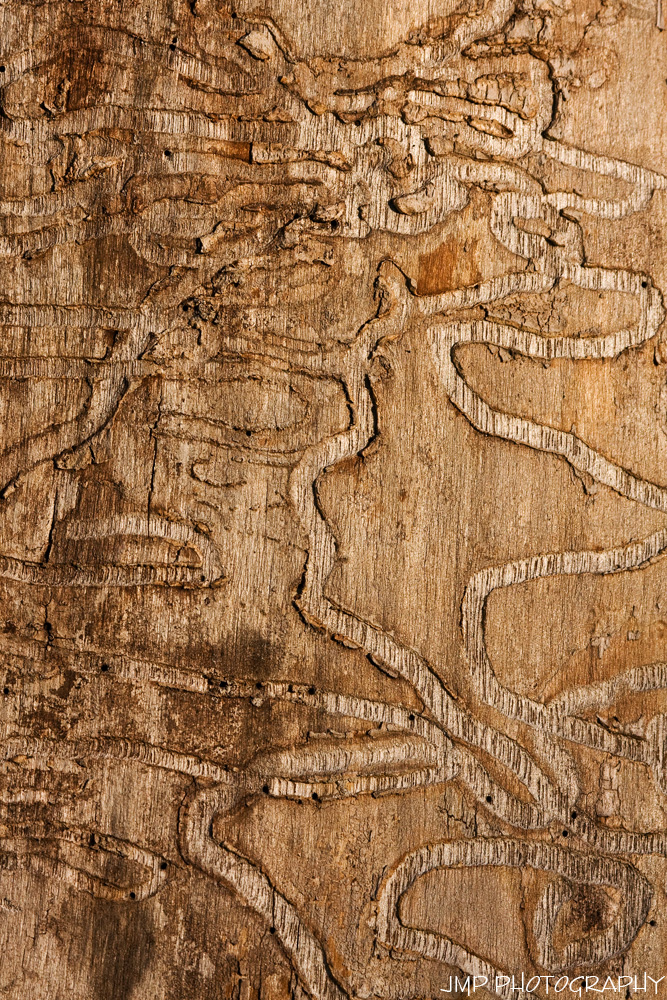
Emerald Ash Borer Handiwork Elizabeth Park Trenton, Michigan

Emerald Ash Borer Handiwork, photo by mandj98.

emerald-ash-borerThe Emerald Ash Borer information site says:

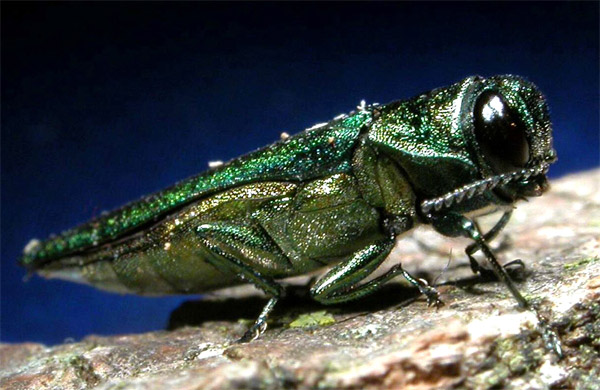
Emerald ash borer (EAB), Agrilus planipennis Fairmaire, is an exotic beetle that was discovered in southeastern Michigan near Detroit in the summer of 2002. The adult beetles nibble on ash foliage but cause little damage. The larvae (the immature stage) feed on the inner bark of ash trees, disrupting the tree’s ability to transport water and nutrients.

Since its discovery, EAB has killed tens of millions of ash trees in southeastern Michigan alone, with tens of millions more lost in Ohio, Illinois, Indiana, Pennsylvania, West Virginia, Missouri, Wisconsin, Virginia, Ontario, and Quebec. The Michigan Department of Agriculture page on the Emerald Ash Borer explains that the best way to stop the spread of EAB (and to avoid fines ranging from $1,000 to $250,000 and jail time of up to five years) is to not transport firewood. All types of firewood can transport invasive pests other than EAB including Beech Bark Disease, Asian Longhorned Beetle, Sirex Woodwasp, and Gypsy Moth.

This photo is part of James’ massive Michigan photo set (slideshow).

Morel Hunting Up North

Morel Hunting

Morel Hunting, photo by Apocaplops.

Erich says that morels are his favorite part of spring and writes:

I recently spent a long weekend up in northern Michigan looking for the elusive Morel mushroom, guided by some friends. Maeby tagged along too, as you can see.

Turns out spotting the black Morels was much more difficult than I remembered, like a Where’s Waldo hunt that spans many square miles. Still, we found enough to be happy, and I enjoyed the trip up north immensely.

Check it out larger in his Up North slideshow.

If you’re looking for tons of morel fun and are near enough to Boyne City, check out the National Morel Mushroom Festival today & tomorrow or enjoy it through this Absolute Michigan report from the 2009 Morel Fest!

Cerulean Warbler and 68 endangered friends

Cerulean-Warbler-at-Embury-

Cerulean-Warbler-at-Embury-, photo by richard.sleeman.

I’ve recently posted about the de-listing of the gray wolf and bald eagle in Michigan. The osprey was recently removed as well, but the Michigan Department of Natural Resources recently revised its list of threatened and endangered species and added 69 to the list. They say that the most notable addition is the cerulean warbler.

The All About Birds page on the Cerulean Warbler has some excellent photos and even the warbler’s song. The Audubon Watchlist for the Cerulean Warbler (Dendroica cerulea) estimates that there are about 1/2 a million of these birds in the world and says:

This wood-warbler is not easily confused with other warblers. The adult male is a deep cerulean blue above with a streaked back, and is white below with a narrow blue-black band across the throat. The adult female is bluish-green above with no streaks, and white washed with yellow below with a distinct white or yellowish line over eye. All plumages and both sexes have white wing bars and white tail-spots.

The species suffers from habitat loss and degradation in both its summer and winter range. The remaining population breeds in the northeastern and central parts of the United States as far north as s. Ontario, as far south as Arkansas, as far east as the Atlantic Coast, and as far west as Iowa. Ceruleans are not evenly distributed throughout this range.

Typically found in mature forested areas with large and tall trees of broad-leaved, deciduous species and an open understory, but may also inhabit wet bottomlands, some second-growth forests, and mesic upland slopes. Eats insects in the foliage and a small amount of plant material in the winter. Nests high in the canopy on a lateral limb of a deciduous tree above an open area. The nest is concealed from above by leaves or vines. The 3-4 eggs are incubated by the female, but both parents feed the young. As a medium- to long-distance migrant, these warblers may arrive on their breeding range from late March to mid-May and be back on their wintering grounds as early as August.

Richard took this photo at the Waterloo State Game Area. See it bigger in his Warblers slideshow.